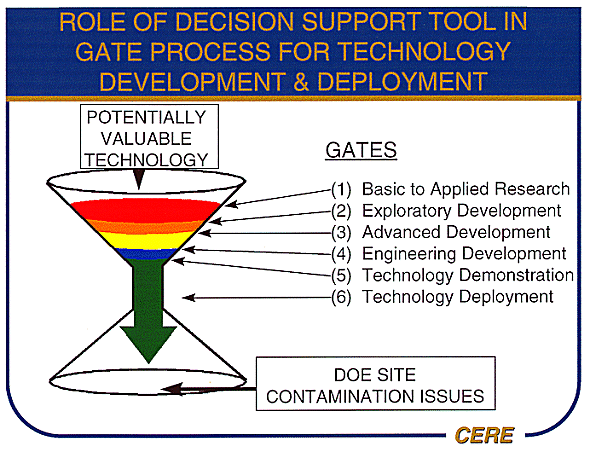
Fig. 1. Role of decision support tool
in gate process for technology development and deployment.
J.L. Regens and D.G. Hodges
Tulane University Medical
Center
P. Wilkey and E. Zimmerman
Argonne National Laboratory
E. A. Hughes and A. Unione
Erin Engineering
ABSTRACT
An integrated framework was developed by the Consortium for Environmental Risk Evaluation for planning, making, and communicating decisions regarding the selection of technologies to remediate subsurface contamination. The framework is designed to be used by U.S. Department of Energy managers to help them determine what innovative environmental technologies to deploy as part of remediation actions for cleanup following full field demonstrations.
INTRODUCTION
The federal government's nuclear weapons research, development, testing, and production activities during the past 50 years have resulted in radioactive and hazardous waste contamination of groundwater, soils, sediments, and surface water. Over 100 U.S. Department of Energy (DOE) or its predecessor agency installations and facilities are affected (U.S. Office of Technology Assessment 1991; National Research Council 1989). Those sites encompass portions of more than 3,300 square miles in 34 states and territories. Most of the contamination occurred as a byproduct of the nuclear fuel cycle that supported weapons production. The array of factors contributing to the contamination at the weapons complex include manufacturing processes that are inherently waste producing, the historically higher priority given weapons production than to environmental considerations, and a shroud of secrecy and self-regulation that exempted the weapons complex from effective, independent oversight.
Starting in 1989, DOE adopted a new mission: cleaning up and restoring its contaminated facilities and sites in compliance with federal and state environmental laws and regulations.a In striving fulfill its mission to cleanup the weapons complex, DOE's environmental management activities are being conducted according to a tri-party procedural framework established through enforceable compliance agreements between DOE, the U.S. Environmental Protection Agency (EPA), and the individual states in which DOE sites are located. Additionally, Native American tribes have specific authority, responsibilities, and rights that must be addressed by DOE in its cleanup decisions. As result, to be successful in establishing and meeting realistic cleanup goals, DOE will need to develop a mutually collaborative relationship with its regulators and myriad stakeholders (National Research Council 1994).
Few organizations have ever attempted to carry out a program as immense and complex in terms of scale as the post-Cold War cleanup of the weapons complex. Little in the way of historical precedent or ongoing equivalent programs from which to gain guidance or measure the effectiveness and efficiency of such an undertaking exists. The U.S. Department of Defense(DOD) currently is implementing a cleanup of military facilities, but the chemical contamination at military bases generally represents a lesser technical challenge than does the isolation and removal of radionuclides due to the existence of a large, well-developed commercial market for remediating hazardous waste sites under CERCLA and RCRA. Although the newly independent states of the former Soviet Union (Russia, Ukraine, Belarus, Kazakhstan) face a nuclear weapons complex cleanup rivaling if not exceeding that being pursued in the United States, they possess little in the way of financial resources to do more than a holding action against the most imminent health and safety risks. As a result, in making the transition from weapons production to environmental management, DOE's Office of Environmental Management (EM) initially may have promised too much early in the cleanup program before realizing the extent and complexity of contamination problems at its sites.b Also, the EM program may have been overly optimistic about the time frame for technological breakthroughs or overly ambitious in agreeing to certain compliance goals and schedules. Intended to ensure that sources of contamination are investigated thoroughly and that timely remedial action is taken, these compliance agreements are structured to identify relevant criteria, laws, and standards; establish cleanup procedures, schedules, and milestones; and facilitate meaningful stakeholder involvement. This challenge is underscored in a recent DOE report:
We have large amounts of radioactive materials that will be hazardous for thousands of years; we lack effective technologies and solutions for resolving many of the environmental and safety problems; we do not fully understand the potential health effects of prolonged exposure to materials that are both radioactive and chemically toxic; and we must clear major institutional hurdles in the transition from nuclear weapons production to environmental cleanup (U.S. Department of Energy 1995: 9).
At the same time, congressional concerns have increased over the ultimate and potentially large amount of funding as well as time frame required by DOE to clean up the weapons complex U.S. Congressional Budget Office 1994). For example, DOE initially estimated that the cost of cleanup would be between $66 billion to $110 billion for a program which was assumed to require 30 years to complete. Since 1989, the EM program has spent $34 billion, but progress in meeting the milestones originally projected has slipped. Five years later, in 1995, EM's Baseline Environmental Management Report (BEMR) was projecting that the cleanup might take an additional 75 years with cost estimates ranging from $206 billion to $360 billion, excluding the cost of cleaning up most contaminated groundwater or installation currently managed by Defense Programs (DP).c DOE's 1996 BEMR estimates costs to be between $189 billion to $265 billion primarily due to increased productivity. The lower cost projections also result from assumptions reducing the scope of cleanup activities, a change in modeling costs, and a change in technical assumptions for addressing problems. The volatility in terms of cost projections, however, underscores the importance of reducing the mortgage associated with the Manhattan Project's legacy.
Recognizing the necessity to constrain cost and minimize risk, EM launched an initiative in June 1996 to design a "Ten Year Plan" to accelerate cleanup in order to achieve substantial mortgage and risk reductions by 2006. With its emphasis on accomplishing the majority of its cleanup work within a decade, the "Ten Year Plan" represents a major change in emphasis from prior plans that would have stretched DOE's environmental management program well into the 21st century. The "Ten Year Plan" is intended to address a complex interplay of risks, costs, and public concerns, while meeting the requirements of various federal, state, and local health and environmental laws, regulations, and compliance agreements. The seven principles underlying the plan are:
The "Ten Year Plan" is an ambitious undertaking that will require a substantial improvement in as well as integration of existing information availability and decision-making support to achieve its stated objective of simultaneously compressing the timeline and level of funding for cleanup. As a result, DOE confronts the challenge of developing and utilizing reliable tools for making risk-based, environmental management decisions so remediation priorities and alternatives can be appropriately identified. Such aids are necessary to ensure that EM is using its resources as cost effectively as possible to make sites safe, secure, and ready for public use within a shorter time frame and for less money.
The Consortium for Environmental Risk Evaluation (CERE), an integrated team of experts from universities, national laboratories, and consulting firms, is helping DOE meet that challenge by designing and evaluating decision support tools for environmental management that can help transform DOE's tremendous information and knowledge base into the practical wisdom needed to perform successfully the cleanup mission. The decision support tools being developed and/or evaluated by CERE can augment other tools (i.e., Risk Data Sheets; Activity Data Sheets; "Green Books") already in use by providing useful mechanisms to compare and select environmental technologies.
OVERVIEW OF THE CERE PROGRAM
CERE is a Tulane University/Xavier University partnership established in 1993 under a DOE cooperative agreement. CERE develops and applies credible scientific approaches, with meaningful stakeholder involvement, to assess technology performance, evaluate risks, estimate life cycle costs, and analyze public concerns linked to the cleanup of the weapons complex. Managed by Tulane University, the CERE program is funded by EM.
A guiding principle for CERE's efforts is to concentrate on significant EM problem areas. As a result, CERE is committed to maintaining a high-quality research effort in support of the Nation's need for credible scientific approaches addressing problems characterized by:
CERE's technology evaluation efforts focusing on subsurface contaminants are responsive to that need. The technology evaluation framework illustrates how decision support tools can aid internal DOE decision makers, both at headquarters and the field, in appraising strategies for environmental management at the weapons complex. In addition to this primary audience, there are several secondary audiences which are likely to be interested in our results: 1) a parallel non-DOE expert audience of individuals with an interest in the technology evaluation framework; and 2) a potential non-expert/expert audience of stakeholders (i.e., regulators, local publics) with a general interest in how DOE makes and communicates cleanup decisions.
EXTENT OF THE SUBSURFACE CONTAMINATION PROBLEM AT DOE SITES
The technology evaluation activities being conducted by CERE focus on aspects of the subsurface contamination problem confronting DOE as pursues cleanup of the weapons complex. Contamination of groundwater and soils is a pervasive problem across the weapons complex (Regens et al 1995). The contaminants of concern include radionuclides such as plutonium, tritium, and strontium-90; heavy metals; and dense, nonaqueous phase liquids (DNAPLs) formed by chlorinated solvents such as trichloroethylene and carbon tetrachlorides. For example, DOE estimates reveal that more "than 5,700 known groundwater plumes have contaminated over 600 billion gallons of water and 50 million cubic meters of soil" (U.S. Department of Energy 1996: 6). Migration of these plumes off-site as well as considerations about future land use on-site are significant considerations for EM managers.
In addition to groundwater plumes, landfills at DOE sites also "are estimated to contain over 3 million cubic meters of buried waste" (U.S. Department of Energy 1996: 10). As the containers in which that waste is stored has degraded over time, the surrounding soils and groundwater have been contaminated by transuranic (TRU), low-level, and hazardous waste.
OVERVIEW OF THE TECHNOLOGY EVALUATION EFFORT
CERE is designing an integrated framework for planning, making, and communicating decisions for selecting technologies to remediate contamination. At the present time, as Fig. 1 illustrates, the DOE decision process for developing and deploying environmental management technologies is structured according to a sequential "gate" process with each gate representing a major decision point vis a vis proceeding with a given technology to the next stage in its maturation (National Research Council 1995). DOE's "gated" decision-making process divides the innovative technology development cycle into six stages. The first four "gates" involve technology development decisions, while the later two involve deployment decisions:
Within the context of the "gates" process, EM has adopted a complex-wide, common need approach to technology development that is reflected in its technology focus areas organization. The technology deployment phase, however, is more site-specific in nature due to differences in environmental settings and stakeholder concerns.
Fig. 1. Role of decision support tool
in gate process for technology development and deployment.
The CERE technology evaluation effort focuses on the final "gate" in the process of moving from initial conceptualization of environmental technologies to their deployment as part of a treatment train to remediate contamination. CERE's activities in this area are is designed to develop and apply a framework that internal DOE managers, both at headquarters and in the field, can use for selecting environmental management technologies that already have received a full-field demonstration for deployment. Each of the evaluative criteria or elements incorporates key features that affect the selection of technologies for environmental remediation, encompassing an array of factors ranging from engineering performance, cost, and risk to stakeholder concerns. In essence, CERE is developing a framework that integrates criteria which may be relevant to the technology selection decision across multiple dimensions (see Table I):
Table I Technology Evaluation Framework Basic Measures

CERE's framework identifies and defines consistent measurable indicators for each of the criteria, relying on existing information, in order to bring together diverse considerations in selecting technologies.
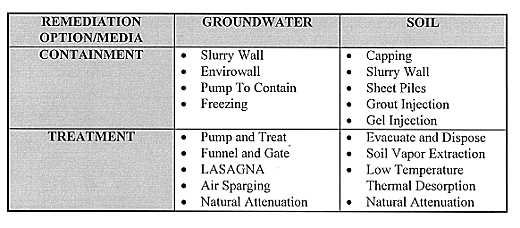
The CERE technology evaluation framework is being applied initially to trichloroethylene (TCE) contamination of soil and groundwater to demonstrate its utility as a decision support tool. A four-celled approach to containment and treatment by media of the contaminant is used, with illustrative technologies selected for each cell (see Table II). The technologies include a mix of innovation and existing, conventional technologies appropriate for the remediation options being considered.
Table II Technologies Evaluated by Evaluation Framework
CONCLUSIONS
DOE faces the challenge of demonstrating that it can complete major aspects of the cleanup project at the weapons complex responsibly and efficiently. To reach its "Ten Year Plan" targets, EM will need to establish coherent objectives with measurable criteria for evaluating accomplishments. CERE's technology evaluation framework contributes to this designing and evaluating tools that assist in planning, making, and communicating the underlying basis for EM's choices are a key element in achieving this goal by better informing decisions. Moreover, because the tools for environmental management being developed or evaluated by CERE includes an appraisal of uncertainties, they also capture the inherent conditional nature of the decision-making process. Although no "silver bullet" exists to solve DOE's cleanup problems, decision support tools such as CERE's technology evaluation framework offer an effective way to integrate and communicate any array of complex information in order to clarify remediation options at DOE sites.
REFERENCES
a For purposes of this study, cleanup is defined to include not only environmental remediation but all activities necessary to contain, treat, store, and ultimately dispose of the radioactive, chemical and mixed waste at the DOE weapons complex.
b This office, originally named the Office of Environmental Restoration and Wast Management, was renamed the Office of Environmental Management in 1994.
c DP currently is the landlord for and funding approximately 500 excess facilities that are supposed to be transferred to EM within approximately 2 years according to the terms of DOE Order 4330.5. The draft EM 10 year plan assumes these additional facilities, including "high risk" facilities, are not transferred from DP to EM.