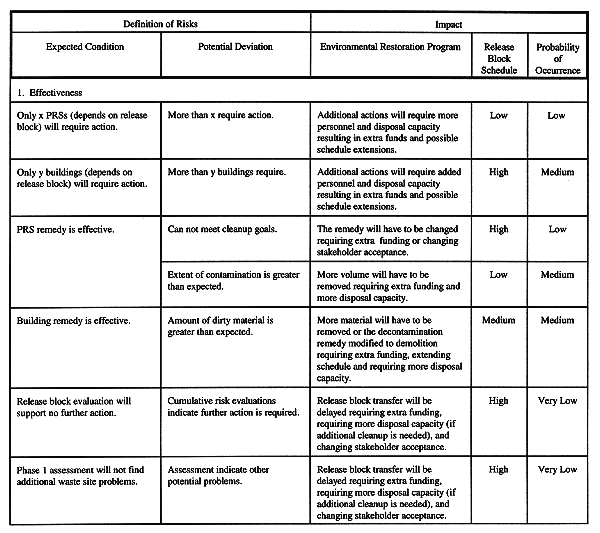
Table I Risk Definition
Todd Walsh and Roberta Day
Project Performance Corp.
ABSTRACT
This paper will present the approach that the Department of Energy (DOE) at Mound adopted to manage the programmatic risks that will impact their ability to complete their environmental restoration projects as planned. DOE Mound's goal is to complete all of their environmental restoration projects and reach final site disposition by the year 2005. Several changes will occur over this time period that will influence DOE Mounds ability to accomplish the 2005 goal. To manage these changes, DOE Mound conducted an uncertainty analysis to:
- Provide a format for communicating the impacts of risks to DOE, regulators, and the public
- Identify schedule impacts across several projects from multiple risks
- Decide where to focus risk management efforts on minimizing impacts of risks
A method that could analyze risks with impacts across several projects and could meet all of DOE Mound's objectives was not readily available. Therefore, DOE Mound developed a qualitative analysis process as the basis for determining relationships between risks and quantifying potential cost impacts. This process captured impacts of the risks across the multiple projects and assessed their impact on the final site disposition schedule. DOE Mound used information from this analysis to create a schedule uncertainty model using a software program called Decision Programming Language. The model provided a method for measuring the impacts of the risks on the entire environmental restoration program rather than individual consequences within a specific project. DOE Mound used this information to focus their efforts on developing alternative plans and contingencies ensuring their environmental restoration schedule could be realistically met.
INTRODUCTION
A comprehensive project risk management approach "...includes the processes concerned with identifying, analyzing, and responding to project risk. It includes maximizing the results of positive events, and minimizing the consequences of adverse events." (1) Different methods exist that can determine the riskiest parts of the schedule and the probabilities of possible finish dates. Critical path method scheduling computes the shortest project completion date based on the longest set of activities. Monte Carlo simulation will calculate a probability distribution of potential finish dates based on ranges of activity durations. While these types of risk management methods help manage day to day activities, they do not define what is causing the risk and can not measure impacts of individual risks among a multiple set of risks. This incomplete identification and analysis of risks will not expose the full range of risk management options available for a project.
The Department of Energy (DOE) at Mound environmental restoration program is responsible fordecontamination and decommissioning of all buildings and remediation of all waste sites at the Mound Plant. DOE Mound will achieve this mission by completing multiple projects over the next 9 years. This schedule represents the shortest possible time that the environmental restoration program can be completed given current conditions. Therefore, risks impacting individual projects and operations of the site must be properly managed along with site wide risks. DOE Mound is managing risks of individual projects and operations using a combination of traditional methods and approaches similar to the one explained in this paper. However, in addition to the limitations already discussed, a method that could analyze site wide risks with impacts across several projects on the final site disposition schedule was not readily available. In order to select method that was useful, DOE Mound represented what they needed to accomplish by setting three objectives:
- Provide a format for communicating the impacts of risks to DOE, regulators, and the public
- Identify schedule impacts across several projects from multiple risks
- Decide where to focus management efforts on minimizing impacts of risks
These objectives guided the development of DOE Mound's methodology described in the next section.
METHODOLOGY
DOE Mound adapted a methodology developed by the University of Colorado's civil engineering department to identify, analyze, and respond to risks. (2) The methodology uses an influence diagram to establish direct relationships between risks. Using the influence diagram, a probability tree is created to calculate a distribution of potential finish dates and determine the magnitude of each risk's impact. Since this analysis is not tied directly to project activities, it can be used to analyze risks across multiple projects.
DOE Mound's approach introduced some qualitative methods to better define each risk and the potential problems they could cause. The qualitative methods were based on the DOE's Streamlined Approach for Environmental Restoration which combines the observational approach with data quality objectives to identify required monitoring and contingency plans for managing technical risks. This provided the needed information to help improve risk communication and respond to project risk. (3)
DOE Mound implemented the approach through 4 steps:
RESULTS
Risk Identification
DOE Mound identified and defined 13 risks having site wide impacts. Table I shows a sample of how the risks were defined. The first three columns define each risk and provide information about their specific impacts. This information was used to define the relationships among the risks and the release block schedule. The last three columns provide qualitative information about the magnitude of the schedule impacts and the probability of the risk occurring. This information was used to help quantify all the possible variations in the schedule risk model so DOE Mound could analyze how the risks affect the overall release block schedule.
For the release block schedule impact, low means less than 3 months, medium means between 3 months and 9 months, high means between 9 and 15 months, and very high means greater than 15 months. For the probability of occurrence, very low means less than 10%, low means between 10% and 40%, medium means between 40% and 70%, and high means greater than 70%.
Table I Risk Definition
This definition format helped meet the first objective and provided the information required to meet the other two objectives. The format provided an easy method for explaining the risks and gathering comments about the impacts. It also provided the detail required to quantify impacts and identify the areas that risk management options must address. The other 12 risks were defined the same way as effectiveness. These risk, starting with the second one after effectiveness, are:
Risk Analysis
The first part of the analysis, determining influences, provided a representation of how all the risks impact each other. The influence diagraming technique was able to capture multiple relationships so a probability tree could be built that calculated cumulative impacts. Figure 1 shows all the relationships between the risks and between the risks and the release block schedule (e.g., block M releasable). The relationships with completion of other programs and land transfer process show that the environmental restoration programs of each release block can be completed independently of other programs and that the land transfer process is the last step required to release the site. This means that these two risk do not impact schedule of the environmental restoration program. The influence diagram provided a simple one page tool for showing what all the uncertainties are and how they impact the environmental restoration program.
Based on the probabilities and schedule ranges, the model calculated all the possible finish dates within the assigned schedule range and the chances of meeting each possible finish date. This information was used to generate results showing the likelihood of meeting the baseline finish date and how much each uncertainty contributes to the overall schedule variation. Figure 2 is a cumulative distribution of possible total schedule durations and shows the cumulative probability of releasing a release block withing a particular duration. Figure 3 is a frequency distribution of possible total schedule durations and shows the potential ranges of time it will take to release a block and the probability of falling withing a portion of the total range. Figure 4 is a sensitivity graph that shows which risks have the largest impact on the release block schedule. The uncertainty at the top of the graph has the largest impact with each uncertainty after that having the next largest impact. These results clearly demonstrated schedule impacts of all these risks on the amount of time it will take to complete all projects within a release block. In addition, the three simple graphs provided a straight forward format for communicating the impacts of risks to DOE, regulators, and the public.
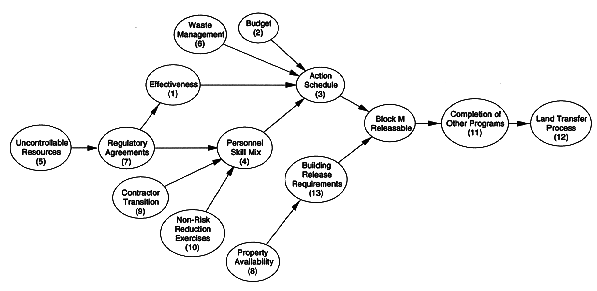
Fig. 1. Influence diagram.
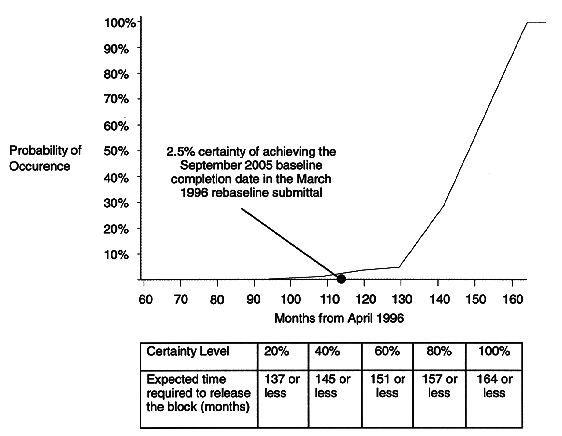
Fig. 2. Cumulative distribution.
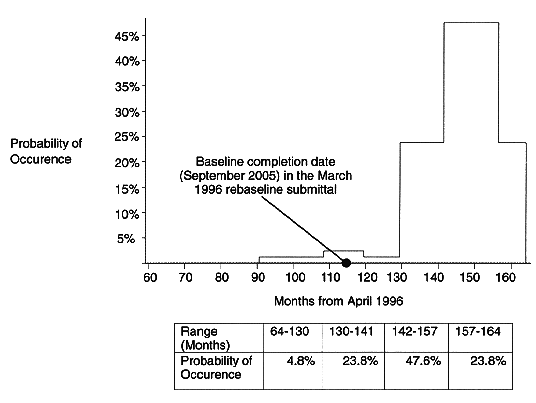
Fig. 3. Frequency distribution.
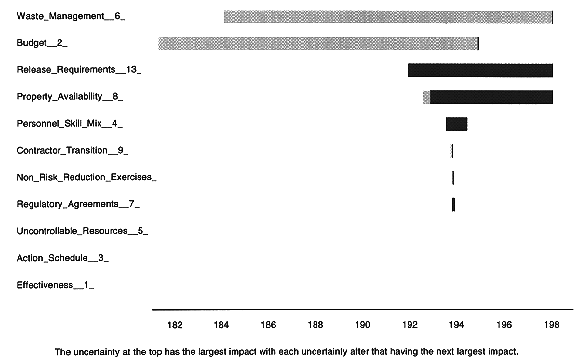
Fig. 4. Sensitivity graph.
Risk Management
Across all DOE Mound's release blocks, waste management, actions schedule, budget, release requirements, and property availability were determined from the analysis to have the largest schedule impacts. DOE Mound can reduce the majority of the schedule risks by focusing all their efforts on eliminating the uncertainties associated with these 5 risks. When DOE Mound fully implements the risk management actions described in Table II, they will update their baseline to reflect the more certain and streamlined schedule. Through implementing these actions, DOE Mound will meet the third objective of their risk management strategy. Although this successfully completes the initial effort to identify, analyze, and respond to risk, the job is not complete. Conditions will always change and new risks emerge on any lengthy project. Therefore, DOE Mound will periodically assess new risk conditions to determine the necessary steps to keep the environmental restoration program on track.
Table II Risk Management Actions

REFERENCES