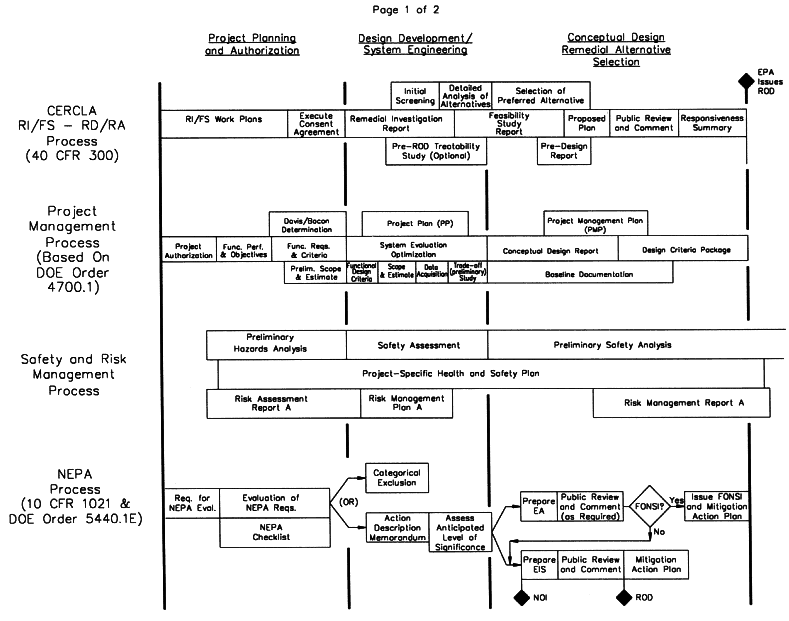
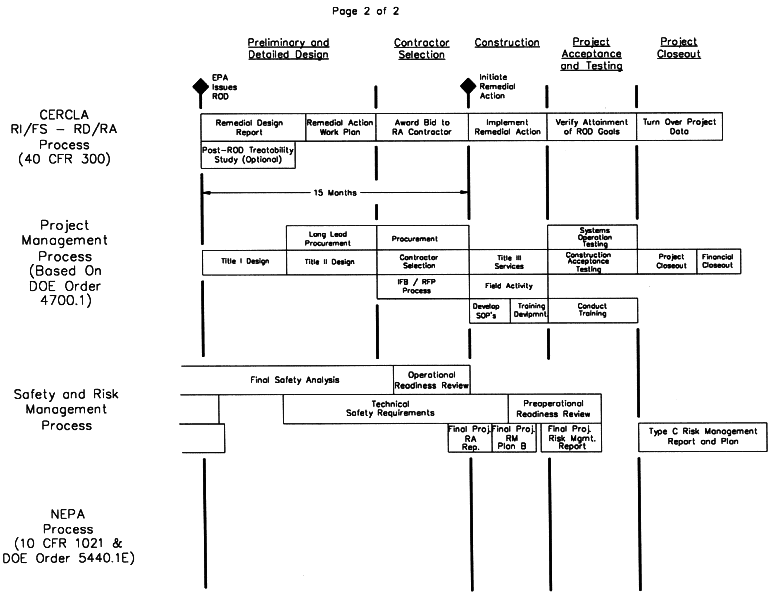
Fig.
1. -Overview of project management.
Gregory B. Cotten, P.E.
Parsons Infastructure &
Technology Group, Inc.
Jake D. Dustin, Ph.D., P.E.
COL, USAF
(RET)
ABSTRACT
Every Department of Energy (DOE) site has some form of Environmental Restoration (ER) in progress - be it remedial investigations or remedial action. A great challenge to successful-and timely-execution of projects within a federal ER program is preparing for and coping with the financing of those projects. There are two aspects of the budget "process" that make execution challenging, 1) living with the annual allocation-which is sometimes delayed until after the fiscal year has begun, and has a high likelihood of being less than optimally required, and 2) the inevitable release of additional "year end" money late in the fiscal year which requires the site to be able to solicit, award, mobilize, perform the cleanup, and demobilize in a few short months while coordinating these actions and obtaining the necessary approvals as required in the multi-party agreements that the various agencies are signatory to.
To cope with these uncertainties effectively and efficiently, one must stay ahead of the curve by completing conceptual designs for a cross section of project types and complexity. These would be taken to an early stage, such as 30 percent design, which will give a technical scope and a budget and schedule estimate to a degree much better than a rough order of magnitude. These conceptual designs could then be "put on the shelf" and brought forward in short order when funds become available.
While there is yet a long way to go, the Idaho National Engineering Laboratory (INEL) has made some progress toward implementing such a program with fairly impressive results in FY 96. Refinements are being made and there is fairly good promise that FY 97 will be a watershed year.
INTRODUCTION
One of the great difficulties experienced in the Environmental Remediation/Restoration business is being able to consistently determine the "right" point at which to invest in up front design. If started too early i.e., before "enough" (a very difficult point to define) characterization has been done the risk is high that significant time and money may be spent going down the wrong path. But if delayed too long i.e., site is fully characterized and the Record of Decision (ROD) is signed-considerable resources must be mobilized and invested to meet compressed time lines. Either way is inefficient, frustrating, and costly.
Because of the complexity of the business, it is highly unlikely that we, as a community of Remedial Design/Remedial Action (RD/RA) professionals will ever be able to develop a complete solution to that problem especially one that can be universally applied. However, there are things which can be done to more effectively and efficiently integrate the front-end work at the Remedial Investigation/Feasibility Study (RI/FS)/System Evaluation/Conceptual Design interface.
The concepts presented in the following discussion are certainly not new. They have been detailed and advocated in a variety of forums and documents and the logic is solid. But the implementation has often proven difficult particularly in the federal system due to a variety of reasons ranging from competing/changing priorities to planning, programming, and budget cycles. The Implementation of the concepts forms the basis for this paper.
Some of those complications are, and will remain, inherent to the system and may have no realistic fix. However, over the past two years, the ER Team at the INEL have been able to make considerable progress in moving closer to the "ideal" phasing of the RD/RA effort and achieved significant savings in the process.
DISCUSSION
As described by John E. Moylan in a paper prepared by the U.S. Army Corps of Engineers, Kansas City District, Geotechnical Branch in cooperation with the EPA Engineering Forum:
Technical work during the RI/FS phase has typically been considered the province of scientists whereas engineers are given the functional lead during RD/RA. The engineers have not always been requested to provide significant input during RI/FS. Similarly, the scientists have not often been made available during RD/RA. Consequently, some RODs or settlement agreements have dictated remedies that are only marginally appropriate or not effective at all, much more costly than anticipated, or virtually impossible to implement. (1)
In looking at the "idealized" time-line/flow chart in Fig. 1, Overview of Project Management (2), which includes establishing functional design criteria and developing scope and estimates, RD/RA input should occur as a parallel activity with the compilation of the RI report and the Conceptual Design should begin before the FS report is complete. The objective is to have the Design Criteria Package complete by the time EPA/State/Local Authorities issue the ROD.
Fig.
1. -Overview of project management.
The advantages of maintaining this discipline are:
While far from achieving perfection, we at the INEL experienced our first real success in attempting to follow this model over the FY 96 design/construct year.
The Operable Unit (OU) 4-12 Central Facilities Area Landfills I, II and II Native Soil Cover Project and OU 5-05/6-01 BORAX-I/SL-1 Buried Reactor Engineered Barrier Project were taken from pre-ROD signature through design and construction in a little over a year and more than a year ahead of schedule and millions of dollars under the baseline cost estimate. Although the RD/RA contractor was not involved as early as the paper would suggest, the RD/RA contractor was brought into the process approximately 1 month prior to ROD signature to provide design and constructability input. This was, however, earlier than most projects completed on the INEL to date.
The early part of the design stage was actually project scoping to determine the design criteria and functional and operational requirements (F&ORs) that were not specifically addressed in any other format and were somewhat vague in the respective draft RODs from a design and construction perspective. It was learned during this scoping phase that the ROD authors and signatories had indeed discussed the design criteria and F&ORs amongst themselves, but had not formerly documented these items nor reached consensus on all of them.
The two projects were similar from a civil engineering standpoint, but offered some significant differences that had to be addressed. Mainly, infiltration on the landfills project and bio-intrusion on the buried reactor projects. In addition, there was radionuclide contamination on the buried reactor projects and no radiological or hazardous constituents expected to be encountered on the landfills project. The RD/RA contractor was able to achieve significant design cost savings through the development of a synergistic project design team.
The potential combining of the projects for construction allowed for the increased competition between small local firms and large international firms who chose to bid on the projects. The contracts were awarded to a single international firm who individually won both projects from a separate technical and cost selection process. The award to a single firm in turn yielded significant cost savings for the project and subcontract management team.
Lessons learned in this highly successful venture have led to greater appreciation for the benefits gained from blending the engineers into the project during the RI/FS stage and we are carrying it to the next level during the FY 97 season with Waste Area Groups (WAG) - 3 and 7.
The OU 3-13 Idaho Chemical Processing Plant (ICPP) Comprehensive RI/FS encompasses a significant number of sites ranging from soil contamination, liquid radioactive waste in underground storage tanks to radionuclide contamination in the aquifer nearly 500 feet below the facility, to name a few. The RD/RA contractor was asked to provide engineering support during the RI/RF process to evaluate FS alternatives for design implementability and construction feasibility. This project is envisioned to be one of the first major FSs where the RD/RA contractor has significant input for constructability review in the pre-ROD stage.
The OU 4-13 Central Facilities Area (CFA) Comprehensive RI/FS is currently evaluating 52 sites located within the CFA boundaries. These sites are predominately contaminated soil sites contaminated with petroleum, lead, and/or, poly aromatic hydrocarbons (PAH). The RD/RA contractor has been brought onboard during this process to help in identifying sites that can be cleaned up under a Time Critical (TCRA) and/or a Non Time Critical Removal Action (NTCRA) prior to ROD signature. This is showing an aggressive approach to cleaning up the INEL rather than delaying the cleanup to allow for more extensive and costly study and evaluation of the sites.
The OU 7-13/14 TRU Pits &Trenches Comprehensive RI/FS encompasses nearly 100 acres of pits and trenches used for radionuclide and hazardous waste disposal for the past 40 years. The RD/RA contractor has been brought onboard the process in the RI/FS stage to develop a conceptual design for a containment barrier and provide constructability and design review for the various remediation alternatives to be evaluated.
The containment barrier for the OU 7-13/14 remedial action will most likely require large amounts of raw cover materials such as rip rap, low permeability soil, gravel, cobble, asphalt, etc. Some of these materials are indigenous to site and some of them are not. Some of the materials could be stockpiled years ahead of cover construction to reduce construction traffic interference and minimize any series productivity conflicts. The RD/RA contractor may be able to accomplish these activities ahead of the final remediation schedule. WAG-7 presents the INEL with one of the most technically challenging and potentially dangerous to the worker projects that the CERCLA process will encounter. The PIT 9 project has demonstrated that the complexity of the work and the available remediation technologies demand the utmost attention. Since Pit 9 represents only a few acres of the OU 7-13/14 area, it is obvious that there is a substantial need for RD/RA input to the RI/FS process.
CONCLUSIONS
Although remediation, by its very nature, tends to deal with a lot of unknowns that complicate the design process, bringing engineers into the picture during the RI/FS phase can enhance the probability that a selected alternative will be implementable both from a budgetary and schedule aspect. It also allows for more "design" input up front-before the ROD is signed-so that final design and procurement can proceed more rapidly and efficiently.
Following this process can also lead to "queuing up" several preliminary designs that, with little additional effort, could be pulled off the shelf when additional funds become available.
ACKNOWLEDGMENTS
Special thanks are given to Craig L. Reese of Parsons Infrastructure & Technology Group, Inc. for their input and review of this paper.
REFERENCES