Fig. 1 Schematic diagram of the
ENTROCLEANTM .
C. S. Yam and R. Kaiser
Entropic Systems Inc.
P.O.
Box 397
Winchester, MA 01890-0597
P.A. Drooff and P.H. Jones, Jr.
Pilgrim Nuclear Power
Station
Boston Edison Company
Rocky Hill Road, Plymouth MA 02360
ABSTRACT
The application of Entropic Systems, Inc.'s (ESI) enhanced particle removal process to the nondestructive decontamination of nuclear equipment is discussed. The cleaning media used in this process is a solution of a high molecular weight fluorocarbon surfactant in an inert perfluorinated carrier liquid which results in enhanced particle removal. The perfluorinated liquids of interest, which are recycled in the process, are non-toxic, nonflammable, generally safe to use, and do not present a hazard to the atmospheric ozone layer. This novel process has been demonstrated on a laboratory scale at the MIT Nuclear Reactor Laboratory(MITNRL). A high degree of decontamination of radioactive particles from small scale parts, including model circuit boards was obtained in these tests. Typically, a three log reduction in contamination was obtained in 1 hour. The radioactive particles removed from the circuit boards were captured by 0.2 µm filters with a filtration efficiency of 99.5% per stage. Compatibility tests, performed with the model electronic circuit boards, indicated that neither the process fluids used nor the maximum level of the ultrasonic agitation applied affected the operation of the circuit boards or of the circuit components. A commercial scale system, so called Prototype Nuclear Decontamination System (PNDS), based on this ESI process is now under construction and is scheduled to be installed at Boston Edison's Pilgrim Nuclear Power Station in January of 1997.
ENTROCLEANTM PARTICLE REMOVAL PROCESS
Entropic Systems, Inc. (ESI) has developed a novel environmentally compatible process to remove small particles from solid surfaces which is more effective than spraying or sonicating with CFC-113. This process uses inert perfluorocarbons (PFC's) as the working media. PFC's are non-toxic, non-flammable and are generally recognized as non-hazardous materials. In addition, PFC's have zero ozone depletion potential, they are not OLDS(ozone layer depleting substance).
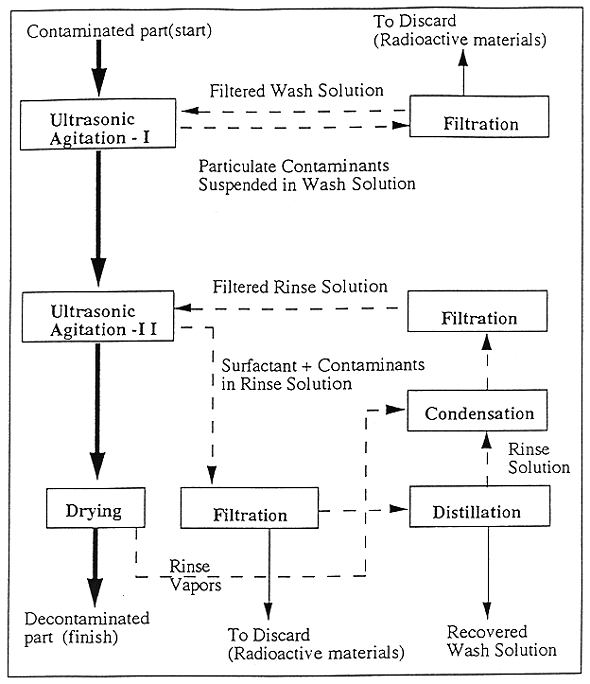
In the ESI's ENTROCLEANTM process, as outlined in Fig. 1, the parts to be cleaned are first sprayed or sonicated with a dilute solution of a high molecular weight fluorocarbon surfactant in an inert perfluorocarbon liquid to effect particle removal. The parts are then rinsed with the perfluorocarbon carrier liquid to remove the fluorocarbon surfactant applied in the first step. The residual fluorinated liquid is then evaporated, the vapor is recovered, and the part is removed from the system.
Fig. 1 Schematic diagram of the
ENTROCLEANTM .
APPLICATION OF THE ENTROCLEANTM PROCESS IN NUCLEAR DECONTAMINATION
None of the decontamination methods now available can be used to decontaminate electronic/electrical equipment without irreversible damage. For this reason ESI received support from the Nuclear Regulatory Commission to further develop the application of the ENTROCLEANTM process to nuclear decontamination. A laboratory scale ultrasonic decontamination system has been developed to demonstrate the application of ESI's enhanced particle removal process (1) to the decontamination of radioactive electronic circuit boards (2). The parts to be cleaned are first sonicated with a dilute solution of a high molecular weight fluorocarbon surfactant in an inert perfluorinated liquid. The combination of ultrasonic agitation and liquid flow promotes the detachment of the particles from the surface of the part being cleaned, their transfer from the boundary layer into the bulk liquid, and their removal from the cleaning environment, thereby reducing the probability of particle redeposition (3). After the cleaning step, the parts are rinsed with the pure perfluorinated liquid to remove residual surfactant, and dried. Detached particles are removed from the process by filtration, allowing the process to be operated in a closed flow loop, thereby minimizing the consumption of the process liquids. To distinguish nuclear decontamination applications from non-nuclear cleaning applications, the decontamination process has been given the SONATOLTM tradename.
LABORATORY DECONTAMINATION STUDIES
Equipment
A laboratory scale decontamination system has been designed and constructed with a process layout as outlined in Fig. 2. There are two separate cleaning loops in this system; loop #1 is a washing loop which contains a surfactant solution in perfluorinated liquid as the working medium; and loop #2 is a rinsing loop which contains pure perfluorinated rinse liquid. As shown in Fig. 2, the cleaning liquid is drawn from storage tank (T-1) by pump (P-1) through a closed flow loop #1 consisting of a flow meter (FM-1), a 0.2 mm membrane filter assembly (F-1), a test cell (S), a 0.2 mm membrane particle capture filter (F-3), a redundant 0.2 mm membrane filter assembly (F-4), and finally returns to the storage tank (T-1). The test cell, containing the test part to be cleaned, is placed in a temperature controlled ultrasonic bath, filled with 2 gallons of water as a coupling liquid for ultrasonic propagation. Ultrasonic agitation in the bath is generated by a square wave generator with a power range of from 15 watts to 285 watts. The "detached" radioactive particles are removed from the cell by the fluorocarbon perfluorinated liquid, and then captured on a disposable 0.2 mm membrane filter cartridge(F-3). In this laboratory scale cleaning system, the radioactive parts are placed in a small test cell as shown in Fig. 2. This test cell is a thin walled, electropolished, stainless steel cylindrical chamber, 6 cm in diameter and 10 cm deep. The cylinder has an internal volume of 250 ml.
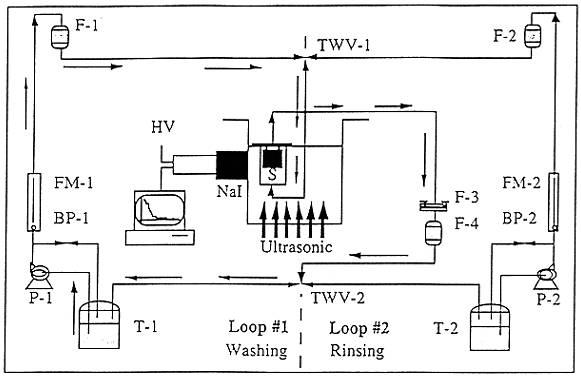
Fig. 2 Flow schematic diagram of the
MIT laboratory scale decontamination system
Decontamination Results
This laboratory decontamination system was installed at the MIT Nuclear Reactor Laboratory where it was used to demonstrate the effect of process parameters on the decontamination of model electronic circuit boards and other small parts. The circuit boards were contaminated mainly with radioactive iron oxide (Fe59). The initial radioactivity of the circuit boards ranged from 1,000 to 20,000 dpm. An on-line radiation monitoring system (NaI scintillation detector) was used to measure the level of decontamination during the cleaning process.
More than 100 cleaning experiments (4,5) were performed under different operating conditions - liquid type, flow rate, temperature, particle size, sonication power, etc. Typical results are presented in Fig. 3. As can be seen in this figure, a combination of ultrasonic agitation and flow is required to achieve particle removal. As is evident from Fig. 2, no significant change in activity is noted during the first five minutes of the experiment when no ultrasonic power was applied. Once the ultrasonic power was applied (60 W), a very rapid change in activity was then noted, with the rate of removal decreasing exponentially.
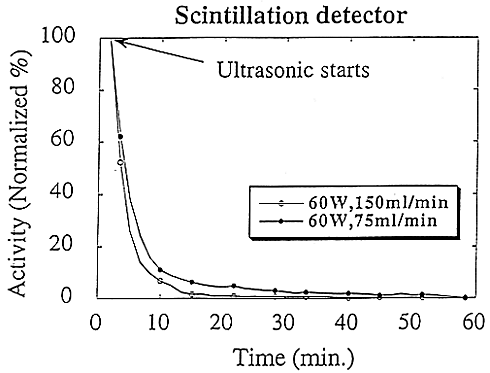
Fig. 3 Typical results from
decontamination of small contaminated circuit board
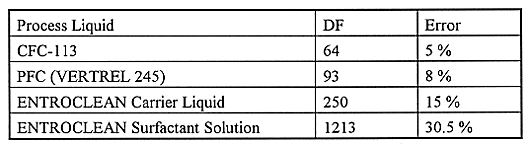
Particle removal is also a function of liquid properties. Different process liquids were used in the cleaning experiments. The results show that perfluorinated liquids have better particle removal capability than CFC-113 (Freon-113). Addition of 0.3 w/o of a fluorinated surfactant further enhances the cleaning capability of the perfluorinated liquids. A summary of the DF(Decon. Factor) results obtained with different process liquids in 1 hr is presented in Table I. This table presents the best results obtained under the following process conditions: sonication power 60 W, flow rate 75 ml/min. and temperature 110°F .
Table I Comparison of DF for different process liquids. Best results
obtained at 60 watts sonication power, 75 ml/min., 110 oF and cleaning period 1
hour.
The removal rate is also a function of flow rate. Initially, the rate of particle removal is higher at a higher flow rate of 150 ml/min. than at 75 ml/min. However, after approximately 60 min., flow rate has little further effect on the continuing rate of decontamination. Initially, particle removal appears to be a function of the rate of mass transfer of the particles into the flowing liquid stream. The larger the flow rate, the higher the rate of removal. At the end, when most of the particles are removed, removal is no longer a function of mass transfer, but is a probabilistic surface event independent of fluid flow. At 60 min., at both flow rates, values of DF > 1200 were obtained with the surfactant solutions used. The particle removal rate at the end of the 1 hour experiment is not zero with the DF increasing from 1200 after 1 hr to 1800 after 2 hours.
The model electronic circuit boards used were functionally checked before and after each decontamination experiments. In all cases, no physical or functional damage was found.
PROTOTYPE NUCLEAR DECONTAMINATION SYSTEM (PNDS)
Based on the successful laboratory results obtained at MITNRL, it was decided to build a full scale commercial decontamination, which has been named the "Prototype Nuclear Decontamination System" or PNDS. The decontamination process developed on a laboratory scale at MITNRL will be used in the PNDS which has been designed to operate with volatile, non-flammable organic liquids, such as perfluorocarbons, which have atmospheric boiling points from about 100°F (38°C) to more than 220°F(105°C). However, the capabilities and operating characteristics of the two systems will be vastly different. While the laboratory system could only handle piece parts that were less than 10 cm (4.0 in) in one dimension and 5.0 cm (2.0 in) in the other dimensions, the operating chamber or sump of the PNDS will be large enough to decontaminate most of the portable equipment that is likely to become contaminated in a nuclear power plant, such as meters, tools, personal computers, etc. While the laboratory unit was operated manually, the PNDS will be fully automated.
A system schematic of the PNDS is presented as Fig. 4. Equipment design features include:
The heart of the system is an electropolished, cove cornered, ultrasonic immersion sump where the contaminated parts are cleaned. This sump is 20 in (35 cm) long, 14 in (25 cm) wide and 12 in (23 cm) high, and has a fluid capacity of 15 gallons (56 liters). Ultrasonic power to the sump, at a frequency of 40 kHz with a ± 2 kHz sweep, can be varied from 25 to 1000 watts. Uniform vertical liquid flow is achieved by introducing the liquid at the bottom of the sump through a distributed sparge, and withdrawing it at the top over a four-sided overflow. The immersion sump is connected to two liquid circuits that allow different chemistries to be introduced as outlined in Fig. 4. The automated lift in the PNDS is capable of handling 50 lb load.
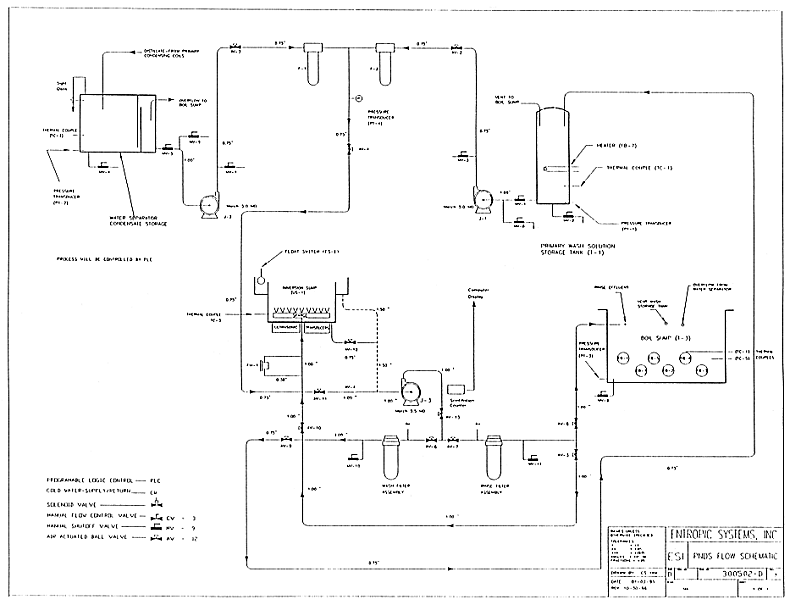
Fig. 4 Flow schematic diagram of
PNDS.
System operations are controlled by an Allen-Bradley SLC 500 processor. This processor is also connected to an Allen-Bradley PanelView 900 gas plasma display panel which acts as the operator terminal. Operating commands are displayed as self-explanatory screen messages which instruct the operator to push the appropriate buttons on the associated key pad. The PNDS is designed to meet NESHAP requirements. The vapor containment features include:
The PNDS can be equipped with on-line radiation detector to measure the radioactivity of the parts. This features allows the user to set the cycle times so that these closely match the time actually necessary to clean the parts. In many operations, the length of time actually needed to obtain clean parts is not known, and the process times can be monitored and adjusted to achieve optimum conditions.
FULL SCALE CLEANING OF NUCLEAR EQUIPMENT
Demonstration tests of the decontamination of nuclear instruments in the PNDS with the SONATOLTM process are scheduled to begin in January 1997. The system will be installed at the Pilgrim Nuclear Power Station, Boston Edison Company, Plymouth MA. It is planned to present the preliminary results of these demonstration tests at the conference.
ACKNOWLEDGMENT
The authors acknowledge the support of this work by the Nuclear Regulatory Commission under Contract No. NRC-04093-106.
REFERENCE