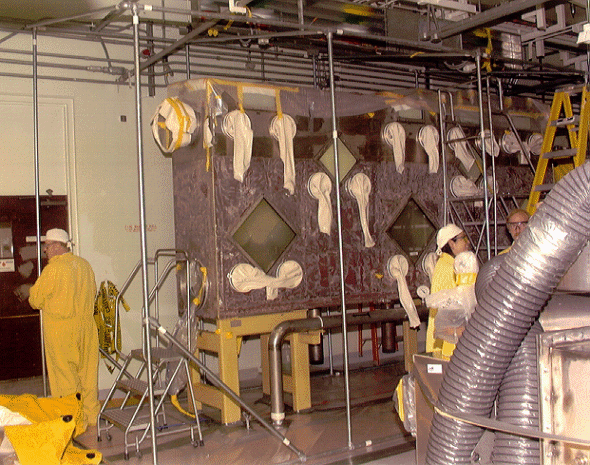
Fig. 1. Glovebox 46
R. J. Sexton
Scientific Ecology Group
Rocky Flats
Environmental
Technology Site
Golden, CO 80402
M. E. Hickman and B. J. Henderson
Rocky Mountain,
Remediation Services
Rocky Flats Environmental
Technology Site
Golden, CO 80402
ABSTRACT
With the redirection and discontinuation of plutonium processing at Rocky Flats, development and installation of plutonium residue processing systems has begun. To accommodate these new systems, many of the existing process equipment must be decontaminated, dismantled, and removed.
This paper discusses the removal of gloveboxes in Building 371 to accommodate the installation of new plutonium waste processing equipment. The scope of this project consists of removal of process equipment from the glovebox, decontamination of the internal surfaces of the glovebox, removal of all processes piping, ventilation, and drain systems from the glovebox, and in-place size reduction of the glovebox.
BACKGROUND
The scope of the glovebox removal project was to remove three gloveboxes from the abandoned systems to which they were attached. These gloveboxes were numbered 46, 43, and 44B.
Glovebox 46 was built to contain an acid leach process that stripped uranium from plutonium. The box was constructed from stainless steel, with dimensions of approximately 6' 4" high by 2' 6" wide by 14' 6" long. The sides and roof of the box were 1/8" thick. The bottom was 1/4" thick. The sides of the box were lined with 1/4" thick lead. The process lines into the box were acid, process liquid, glovebox vent and vacuum. The box drew air in from the room box and then exhausted through a filter duct system. Glovebox 46 is shown in Fig. 1.
Fig. 1. Glovebox 46
Glovebox 43 was built to contain an acid leach process that stripped beryllium from plutonium. The box was attached to a conveyor system, constructed from stainless steel, with dimensions of approximately 6' 0" high by 3' 0" high by 12' 6" long. The sides and roof of the box were 1/8" thick. The bottom was 1/4" thick. When in service, the box had an inert nitrogen environment. Process lines into the box include nitric acid, hydrofluoric acid, process liquid, process vent and process vacuum. A criticality drain exited the bottom of the box.
Gloveboxes 44A and 44B were used for parts disassembly. The box was an inert environment. The boxes were constructed from stainless steel. Glovebox 44A was 5' 1" high by 3' 4" wide by 10' 0" long. Glovebox 44B was 5' 1" high by 3' 0" wide by 8' 4" long. The sides and roof of the box were 1/8" thick. The bottom was 1/4" thick. The sides of the box were lined with 1/4" thick shielding. A four inch diameter nitrogen supply line was the only supply line to Glovebox 44B. A criticality drain exited both boxes.
PROJECT DESCRIPTION
Characterization
Characterization of the gloveboxes was initiated by reviewing existing information on the use and materials processed in the gloveboxes. Drawing review and walkdowns of the room indicated the presence of lead shielding on the exterior of all of the boxes, except box 43. Non-destructive gamma spectroscopy assay techniques were used to assess the quantity and approximate location of any plutonium remaining in the boxes. Review of the glovebox history with operational personnel provided clues for the likely contaminants and the location for a biased sampling strategy.
Project Planning and Engineering
An Integrated Work Control Package (IWCP) was written to control the work activities. The IWCP contained detailed work instructions of all activities required to complete the glovebox removal. These work instructions included the isolation and removal of all services and utilities, decontamination procedures, secondary containment installation procedures, and size reduction procedures.
During the planning of the work instructions, an Activity Hazard Analysis (AHA) was prepared for each activity. The AHA was prepared by Industrial Hygiene & Safety personnel and used in the field to ensure the safe implementation and completion of each activity.
In addition, the planned work activities were reviewed by Nuclear Safety for any criticality concerns. Specific criticality safe operations limits (CSOL) were developed for the application and removal of strippable paint that was used to decontaminate the interior surfaces of the gloveboxes.
The work task instructions were developed using Engineering, Hygiene and Safety, Radiological Engineering, and technical craft input. The most efficient and least waste techniques were incorporated to the greatest extent possible.
A number of potentially contaminated small diameter pipes entering the glovebox had to be removed prior to the installation of a pre-fabricated containment tent. This was accomplished using a "score and snap" technique for potentially contaminated pipe system removal and size reduction. This technique was used for small diameter (2" or less) piping systems. The pipe was scored between 50% and 75% of the distance through the pipe wall. A sleeve was then constructed around the scored location. The pipe was then snapped, using a rubber mallet, and a bag cut performed at the sleeve, leaving both ends unbreached. This technique is very efficient, minimizes the use of glovebags, and effectively controls the spread of contamination.
A prefabricated tent was used to provide secondary containment during the size reduction of the gloveboxes. The tent was ordered from a vendor to custom specifications established by radiological engineering. The tent included a Velcro airlock attachment and a removable end to allow multiple gloveboxes to be reduced in the same tent. The tent was equipped with a through pass in the side so that the waste crate could be staged outside the tent. The size reduced pieces of the glovebox were packaged and passed through the flap into the crate. The size reduction tent for glovebox 46 is shown in Fig. 2.
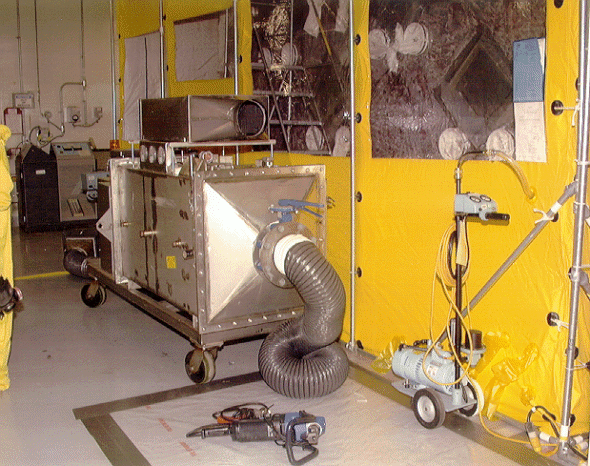
Fig. 2. Size reduction tent
Decontamination
The gloveboxes were initially swept for removal of all loose material. A strippable paint was applied and removed from the internal surface of the glovebox to remove any residual surface contamination. The stripcoat was then reapplied to provide contamination control during the size reduction of the glovebox. This technique was very effective at reducing loose contamination levels and controlling contamination during the size reduction operation.
Size Reduction Techniques
The size reduction of the glovebox was accomplished using hand held electric metal nibbling tools. The nibblers cut by punching out small pieces of metal. This technique was selected due to its relative high cutting speed (1 - 3 ft/min), significant reduction in risk of potential airborne contamination, and a reduction in risk of injury to the worker during operation, when compared to saw or plasma-arc cutting.
Waste Management
Prior to the project implementation, a Waste Management Plan was prepared to identify the projected types and amounts of waste to be generated by the removal of the gloveboxes. The plan also identified applicable waste management activities to minimize waste volumes and addressed the disposition of materials to the Plant Utilization and Disposal (PU&D) organization for unconditional release.
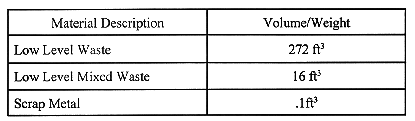
Table I presents the actual decommissioning waste streams and the total volume removed.
Table I Building 371 Decommissioning Waste Streams (Glovebox 46
Removal Only)
Radiological and Industrial Safety Performance
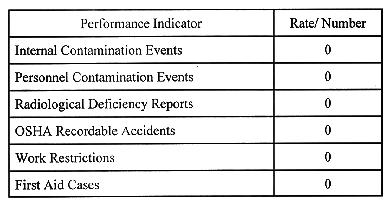
The decommissioning project had an excellent radiological and safety record as summarized in Table II. This performance was a result of an integrated project planning team that included radiological engineering, industrial hygiene & safety, discipline engineering and technical craft. This approach builds a team that focuses on safety continuously from the inception phase through the close out phase.
Table II Radiological and Safety Performance Indicators
Project Status
To date, only glovebox 46 has been removed. At this time the project is on budget and ahead of schedule.
CONCLUSIONS/LESSONS LEARNED
The decontamination and dismantlement of the glovebox 46 in Building 371 was completed with no lost workdays. In addition the size reduction techniques employed have minimized the amount of radioactive and hazardous waste produced. At present, the decommissioning and dismantlement of gloveboxes 43 and 44 has been suspended.
The decontamination and dismantlement of the glovebox 46 in Building 371 provided a unique opportunity to gain practical experience on project planning, characterization, decontamination, and the size reduction of a radiologically contaminated component. Some important lessons have been learned in project organization, planning and decontamination techniques. Some that are of particular note are:
REFERENCES