Sinisa M. Djordjevic and L. Richard Spangler
Benchmark
Environmental Corporation
Michael J. Connolly
Lockheed Martin Idaho Technologies
Company
ABSTRACT
Each CH-TRU waste container destined for the Waste Isolation Pilot Plant (WIPP) is designated by a Transuranic Package Transporter-II (TRUPACT-II) shipping package shipping category based on the type of container (i.e., drum, standard waste box, or ten-drum over pack), the type of waste material, and the packaging configuration (i.e., number and type of plastic confinement layers). Each waste container is assigned a unique wattage (decay heat) limit based on the shipping category. Currently, all containers forming a payload in a single TRUPACT-II are required to belong to the same shipping category. As a consequence, many shipments may be made with dunnage (empty) drums as part of the payload because of the difficulty in assembling enough containers of the same shipping category.
A methodology was developed to allow any combination of shipping categories with either drum or SWB payload containers to be mixed within the TRUPACT-II. The methodology takes credit for shipping less than the maximum allowable number of containers and the additional void volume of dunnage containers. A computer program was developed in the Java programming language to implement this methodology. The computer program incorporates a graphical user interface (GUI) that facilitates data input, performs a series of checks to eliminate invalid input, provides for software revision control, and facilitates the certification process. Upon acceptance of the methodology and computer program by the U.S. Nuclear Regulatory Commission (NRC), a trained operator can use the computer program to configure individual TRUPACT-II shipments from the available inventory at a site, minimizing the need to utilize dunnage containers or repackage higher wattage containers for shipment.
INTRODUCTION
The Transuranic Package Transporter-II (TRUPACT-II) shipping package is a reusable Type B shipping package designed for the transportation of contact-handled transuranic (CH-TRU) waste containers between U.S. Department of Energy (DOE) sites and the Waste Isolation Pilot Plant (WIPP). Waste containers are 55-gal. drums, standard waste boxes (SWBs), and ten-drum overpacks (TDOPs). Each CH-TRU waste container is designated by a TRUPACT-II shipping category based on the type of container (i.e., drum, SWB, or TDOP), the type of waste material, and the packaging configuration (i.e., number and type of plastic confinement layers). Each waste container is assigned a unique wattage (decay heat) limit based on the shipping category. Currently, all containers forming a payload in a single TRUPACT-II are required to belong to the same shipping category. It is expected that a large number of TRUPACT-II payloads will have less than the maximum allowable number of containers because of difficulties in assembling a sufficient number of containers with the same shipping category. As a consequence, many shipments may be made with dunnage (empty) drums as part of the payload.
Furthermore, shipments of waste containers in the TRUPACT-II are limited by total wattage. The current TRUPACT-II wattage calculations neither take credit for shipping fewer containers nor the additional void volume of the dunnage drums. Taking credit for these factors would allow higher individual container wattage limits, reducing the number of drums requiring repackaging. Because the current requirement precludes mixing of shipping categories, more shipments will be required, resulting in higher costs and risks than if shipping categories could be mixed.
A methodology was developed to allow any combination of shipping categories. The MixCat software, a Java programming language application, implements a methodology that allows any combination of shipping categories with either drum or SWB payload containers to be mixed within the TRUPACT-II. The software takes credit for shipping less than the maximum allowable number of containers and the additional void volume of dunnage containers. The software provides a graphical user interface (GUI) that facilitates data input, performs a series of checks to eliminate invalid input, provides for software revision control, and facilitates the certification process.
SOFTWARE DEVELOPMENT HISTORY
The software was developed using a graded and iterative approach to control the software for the Mixing of TRUPACT-II Shipping Categories Project (Project). The software was developed, verified, validated, documented, and tested prior to use in accordance with the requirements specified in the Quality Assurance Project Plan and Software Procedure (QAPjPSP) (INEL 1996a), which addresses all applicable quality elements specified in the DOE-Carlsbad Area Office (CAO) Quality Assurance Program Document (QAPD) (DOE 1996).
The MixCat software was developed through the use of an iterative or sequential approach, which included the following activities:
THEORETICAL BACKGROUND
The accumulation of potentially flammable gases (primarily hydrogen) generated by radiolysis of the payload materials is a concern for the TRUPACT-II payload. The Safety Analysis Report for the TRUPACT-II Shipping Package (TRUPACT-II SARP) (NRC Docket No. 9218 1994) contains the gas generation requirements for containers of waste transported in the TRUPACT-II. Appendix 3.6.7 of the TRUPACT-II SARP (NRC Docket No. 9218 1994) describes the methodology for arriving at the effective G-values (a measure of the potential for generating gas from radiolysis) for the different waste types. Flammable gas generation due to other mechanisms is insignificant and is addressed in Appendices 2.10.12, 3.6.5, and 3.6.6 of the TRUPACT-II SARP (NRC Docket No. 9218 1994). The concentration of any flammable gas generated due to radiolysis is maintained below the flammable limit by the methods described below.
The flammable gas concentration in waste materials is limited to a molar quantity that would be no more than five percent by volume. Waste materials are generally packaged inside of varying layers of plastic bags and a rigid plastic drum liner. All waste containers must be vented to prevent buildup of flammable gas. The flammable gas concentration is calculated in all layers of confinement in the payload and in the Inner Containment Vessel (ICV). Because all activity in a particular container is assumed to be in the innermost layer (to provide a margin of safety in the flammable gas release rate estimates), the concentration gradient of flammable gas decreases from the innermost layer to the outermost cavity (the TRUPACT-II Package ICV cavity). Accumulation of flammable gases is controlled by ensuring the concentration of flammable gases in the innermost layer in a payload container is below five percent.
The predominant source of flammable gas generation in the TRUPACT-II payload is radiolysis of the hydrogenous materials. The amount of flammable gas that can be generated from each material is proportional to its flammable gas G-value (i.e., the number of molecules of flammable gas produced per 100 eV of energy absorbed and the fraction, F, of the emitted energy absorbed by the gas-producing material). The product of F times the flammable gas G-value is the effective flammable gas G-value. The effective flammable gas G-value characterizes the source term for the predicted flammable gas generation rate in each payload container. The methodology for arriving at a flammable gas effective G-value for each payload shipping category is described in Appendix 3.6.7 of the TRUPACT-II SARP (NRC Docket No. 9218 1994). The sink for this flammable gas is transport across various layers of confinement (i.e., the plastic bags, punctured drum liner, and filters in the payload containers). Because flammable gas generation is a direct consequence of radiolysis, the need to control the radiolytic gas generation rate imposes an upper bound on the quantity of radionuclides that can be transported per payload container.
CONCEPTUAL MODEL
The conceptual model presented below is a simplification of the real-world system based on aworst-case scenario.
MATHEMATICAL MODEL
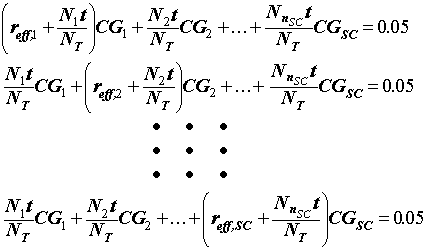
The mathematical model is obtained by deriving the equations that represent the mathematical formulation of the conceptual model. The derivation of the mathematical model to represent the mixing of shipping categories is an extension of the mathematical model for the case of single shipping categories documented in Section 3.4.4.4 of the TRUPACT-II SARP (NRC Docket No. 9218 1994). Extending the case of single shipping categories results in the following system of equations describing the build up of hydrogen due to multiple shipping categories:
where:
| CGi | = | Flammable gas generation rate per innermost confinement layer of a payload container of shipping category I (mole/sec) |
| Ni | = | Number of payload containers of shipping category I |
| NT | = | Total moles of gas inside the TRUPACT-II ICV cavity (mole) |
| t | = | 60-day shipping period duration (sec) |
| reff,i | = | Effective resistance of confining layers for shipping category I (sec/mole) |
This system of linear equations was solved numerically using the Gauss-Jordan elimination technique with full pivoting and the solution was used to calculate the total decay heat limit per TRUPACT-II.
DATA REQUIREMENTS
The operator must enter data into the program by filling in the blank fields contained in the interactive GUI windows, which are programmed into the MixCat program. The data requirements for each program run follow:
CLASS HIERARCHY
The software comprises three main panels. The first panel contains text fields for entering the site, operator, TRUPACT-II shipment number, and the type of payload containers. Depending on the type of payload container selected, either the drums or SWBs panel appears. In the payload container panel, the operator enters the container ID numbers, selects the shipping category of each container, enters the actual container wattages, and presses the Calculate Decay Limits button. The software then calculates the matrix of gas generation rate coefficients. The software then calculates the flammable gas generation rate limits for each container by solving the a system of linear equations numerically using the Gauss-Jordan elimination technique with full pivoting (as documented in Press et al. 1989). The software then calculates the allowable decay heat for each shipping category and the total decay heat limit per TRUPACT-II. If any container exceeds the limit, the flammable gas generation rate limit and the decay heat limit for the container are printed to the panel in red. The operator must select an alternate container so that no container is in the red (i.e., exceeds its calculated decay heat limit) before the program will finalize and write to the output file for that unique TRUPACT-II shipment number.
ANALYSIS OF PROGRAM RESULTS
In order to evaluate the potential impacts of the mixing of TRUPACT-II shipping categories methodology on waste shipments, a series of initial runs of MixCat were made using fictitious shipping configurations. These configurations were designed to demonstrate the effect of dunnage drums on allowable container wattages and the effect of mixing more restrictive (i.e. many layers of confinement) and less restrictive (i.e., fewer layers of confinement) shipping categories on allowable container wattages.
Effects of Dunnage Drums
Dunnage drums are empty drums that were to be used as part of a payload when 14 drums of the same shipping category could not be assembled in a TRUPACT-II. The use of dunnage drums can be minimized by using the mixing of shipping categories methodology. However, under some circumstances, the use of dunnage drums may be desirable to increase the allowable container wattage. The effect of dunnage drums is two-fold in the mixing of shipping categories methodology: 1) there is no gas generation from a dunnage drum and 2) the dunnage drum provides additional void space for gas to accumulate. Both of these factors combine to allow individual container wattages to increase; however, the magnitude of the increase is highly dependent on the packaging configuration of each drum. Two example runs of the MixCat software were completed to demonstrate the effects of dunnage packaging configuration on the allowable container wattage.
The first example considered a TRUPACT-II being filled with waste from the I.1A0 shipping category. The example consisted of 14 separate Mix Cat program runs beginning with all 14 drums being from the I.1A0 shipping category and progressing to only one I.1A0 drum and 13 dunnage drums by adding one dunnage drum to each simulation. This example represents the effect of dunnage on the most liberal packaging configuration (i.e., no inner layers of confinement). Figure 1 depicts the effect of increasing the number of dunnage drums on the container decay heat limit. This figure shows that the container decay heat limit increases by almost a factor of 2 from 14 I.1A0 drums to the configuration with 13 dunnage and only 1 I.1A0 drum.
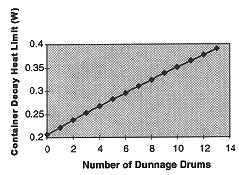
Fig. 1. Effects of Dunnage Drums on
Allowable Container Wattage for the I.1A0 Shipping Category
The second example considered a TRUPACT-II being filled with waste from the III.1A6 shipping category. The example consisted of 14 separate Mix Cat program runs beginning with all 14 drums being from the III.1A6 shipping category and progressing to only one III.1A6 drum and 13 dunnage drums by adding one dunnage drum to each simulation. This example represents the effect of dunnage on the most restrictive packaging configuration (i.e., 6 inner layers of confinement). Figure 2 depicts the effect of increasing the number of dunnage drums on the container decay heat limit. This figure shows that the container decay heat limit increases by less than 10% from 14 III.1A6 drums to the configuration with 13 dunnage and only 1 III.1A6 drum.
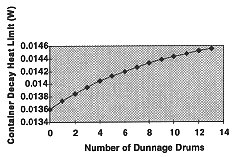
Fig. 2. Effects of Dunnage Drums on
Allowable Container Wattage for the III.1A6 Shipping Category
Comparing the two examples demonstrates that the number of inner layers of confinement has a direct effect on the benefits of shipping the waste with dunnage drums. This effect is due to the requirement that the atmosphere cannot become flammable (i.e., >5% H2) within any layer of confinement. For shipping categories that have many layers of confinement, the concentration in the TRUPACT-II ICV must remain very low to provide a sufficient gradient to allow gas to migrate from the innermost layer of confinement to maintain a non-flammable atmosphere. So, even though the volume outside the drum increases due to the dunnage drums, the concentration change in the innermost layer of confinement is minimal. However, even though the amount of increase will vary by shipping category, shipment with dunnage drums will cause the container decay heat limit to increase for all shipping categories. In the future, the increase in container decay heat limit caused by shipping drums with dunnage may be used as part of a cost/benefit analysis to determine if treatment/repackaging of a drum or shipment/disposal with dunnage drums would be more cost effective.
Effects of Mixing Packaging Configurations
Three different drum configurations were developed to examine general trends for mixing shipping categories within a single TRUPACT-II shipment. Each of the four configurations uses 14 drums with no dunnage. In addition, each configuration mixes thirteen I.1A0 drums with one other drum. Table I contains the configurations and the container decay heats calculated by the MixCat software. The table also contains the decay heat limit from the TRUPACT-II SARP for comparison.
Table I Results of Mixing Packaging Configuration Examples
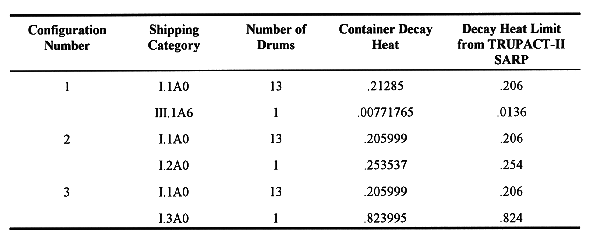
The first configuration is made up of 13 I.1A0 drums and 1 III.1A6 drum. This example illustrates the effect of mixing shipping categories with radically different packaging configurations. The I.1A0 shipping category has no inner layers of confinement allowing gas to freely migrate into the TRUPACT-II ICV; whereas, the III.1A6 shipping category has 6 inner layers of confinement, limiting the amount of gas that moves into the TRUPACT-II ICV due to the high resistance of the confinement layers. The net effect of this configuration is to cause the container decay heat limit for the I.1A0 drums to increase slightly because each of the drums can contribute more to the concentration in the TRUPACT-II ICV due to the fact that the III.1A6 drum contributes less. The container decay heat limit for the III.1A6 drum is halved due to the fact that the I.1A0 drums allow gas to migrate into the TRUPACT-II ICV much more freely. This configuration illustrates the that shipping categories of radically different packaging configurations should only be mixed if the drums with the more restrictive packaging configuration have a decay heat that is significantly below the decay heat limit from the TRUPACT-II SARP.
The second and third configurations are made up of 13 I.1A0 drums and either 1 I.2A0 drum or 1 I.3A0 drum. These two configurations mix drums of the same waste type and number of layers of confinement, but different waste material types. The result of this type of shipping category mixing is that the container decay heat limit for each of the shipping categories remains the same as if all 14 drums were of that shipping category (i.e., the same as the container decay heat limit in the TRUPACT-II SARP). This means that this type of shipping category configuration can be made with no change in the original TRUPACT-II decay heat limit.
BIBLIOGRAPHY
DOE 1996. Quality Assurance Program Document. Revision 1. CAO-94-1012. Carlsbad, New Mexico, Carlsbad Area Office, Albuquerque Operations Office, U.S. Department of Energy.
INEL. 1996a. Mixing of TRUPACT-II Shipping Categories Quality Assurance Project Plan and Software Procedure. Revision 0. INEL 96/0286. Idaho Falls, Idaho, Idaho National Engineering Laboratory.
INEL. 1996b. Mixing of TRUPACT-II Shipping Categories Project Methodology and Software Requirements, Design, and Implementation Documentation. INEL 96/0226. Idaho Falls, Idaho, Idaho National Engineering Laboratory.
NRC Docket No. 9218. 1994. Safety Analysis Report for the TRUPACT-II Shipping Package. Revision 14, NRC Docket No. 9218. Washington, D.C., U.S. Nuclear Regulatory Commission.
PRESS, W.H., B.P. FLANNERY, S.A. TEUKOLSKY, W.T. VETTERLING. 1989. Numerical Recipes: The Art of Scientific Computing (FORTRAN Version). Cambridge, UK, Cambridge University Press.