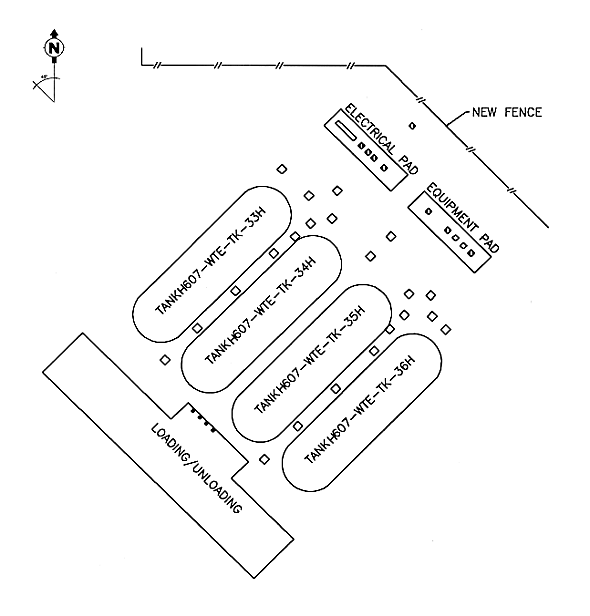
Fig. 1. NSST F facility layout
Subhash C. Sethi
BSRI
Mary L. Windmiller
DOE-SR
Bansi K. Patel and Peter L Nowacki
WSRC
Savannah
River Site
Aiken, SC. 29808
ABSTRACT
A graded approach to problems in waste management is a powerful and flexible tool that can provide the environmental engineer with innovative and cost-effective solutions--a better way to do more with less. Throughout the Savannah River Site (SRS) and the Department of Energy complex, requirements and Orders are being revised or eliminated as part of a new initiative, the "necessary and sufficient" process. The results achieved by using a simple and clear graded approach are twofold. Projects cursed from the beginning with high costs and tight completion dates can be brought in under budget and ahead of schedule. The graded approach used on the New Solvent Storage Tanks (NSST) project at SRS is applicable complex-wide and for private industry too. Using a graded approach process resulted in cost savings for the NSST project (a $6M project)of $2.5M (Reference cost data).
INTRODUCTION
The New Solvent Storage Tank (NSST) facility was built to replace the existing buried solvent storage tanks located in the Solid Waste Disposal Facility (SWDF) at SRS. The previously existing storage tanks did not comply with the Resource Conservation and Recovery Act (RCRA) requirements and posed an unacceptable risk to health and the environment. The NSST facility complies with RCRA, as well as South Carolina Department of Health and Environmental Control (SCDHEC) regulations.
The NSST facility consists of four double-walled, buried, 30,000 gallon, nominal capacity tanks. Two tanks store mixed radioactive and hazardous waste and low-level, while nonhazardous, radioactive, solvent-based waste are stored in the remaining two storage tanks. The tanks are provided with secondary containment leak detection, overfill protection, tank agitators, and inspection and sampling ports. Area lighting, access controls, and associated infrastructure are provided for the facility.
BACKGROUND
The previously existing solvent storage tanks were not equipped with secondary containment and therefore could not be used for continued waste storage beyond October 1996. These solvent storage tanks had to be emptied and decommissioned. In order to comply with new safety requirements and reduce environmental risks, the NSST facility was required to prevent the release of hazardous waste or hazardous constituents to the environment. Secondary containment that meets the requirements of SCHWMR (South Carolina Hazardous Waste Management Regulations) R61-79.265.193 has been provided for the new tanks. The existing solvent storage tanks at the SWDF were installed in October 1981 and would have reached the end of their regulatory life (15 years) in October 1996. Transfer of solvent into the newer tanks and the D & D of older tanks were performed under a separate contract.
PROJECT DESCRIPTION
The NSST project was originally envisioned as a category II General Plant Project. However, by April 1992, it became clear that the project cost would exceed $6,000,000 (CDR estimate) and had to be a categorized as line item category I project. Existing mixed and radioactive solvent waste is currently stored in buried, single wall carbon steel tanks in the E-Area of the Savannah River Site (SRS). Additional waste stored in the Canyons will also be moved to the new tanks. The majority of this waste is mixed waste and is stored in tanks that do not comply with the Resource Conservation and Recovery Act (RCRA) and must be removed from service. This provides a replacement facility to store liquid low-level mixed and radioactive waste in the H-Area of SRS until the Consolidated Incineration Facility becomes operational and can burn this waste.
The NSST facility is designed and constructed to comply with the most recent Federal and State hazardous waste management regulations. The new facility tanks will store non-hazardous radioactive waste and mixed waste. Facility Operational Safety Requirements will ensure that sufficient freeboard is available in the tank system to safely manage postulated off-normal conditions. Some of the stored waste is not considered hazardous under RCRA definitions, but, due to the similar characteristics of the waste, the entire inventory will be managed as mixed waste. Hazardous and non-hazardous portions will be segregated. The tanks are provided with secondary containment, leak detection, overfill protection, tank agitators, and inspection and sampling ports.
Area lighting, access controls, and associated infrastructure are provided for the NSST facility. A diagram illustrating the layout of the NSST Facility is provided in Fig. 1.
Fig. 1. NSST F facility layout
SUMMARY
Prerequisites and activities that must be completed to meet project startup and turnover phases are unique to every project. Normally, good project definitions (1) and baselines are addressed on the front end of a project through various standard documents (e.g., Configuration Management, Conceptual Design, and Functional Requirements). But problems can still arise. In addition, baseline documents rarely include or clearly define the programmatic aspects of a project that will have to be addressed at the end of the project (e.g., training, procedures, and operational readiness reviews). In fact, there may be unforeseen problems at the end of the project.
If both good definitions and bad definitions have the potential to cause liabilities during the project course, what is the correct project process to implement? For the NSST installation project, the first part of this answer was to use an innovative approach that we have all been encouraged to use--the "graded approach." Graded approach application means that the analysis, documentation, and actions necessary to comply with minimum core requirements (2) need to be commensurate with the magnitude of any hazard involved. "Grading" is always a function of hazard potential and complexity, as well as the programmatic mission of the facility.
The NSST facility was built to replace existing buried solvent storage tanks that did not comply with Resource Conservation Recovery Act (RCRA) requirements and posed an unacceptable risk to safety and health. The NSST facility was built to comply with RCRA and South Carolina Department of Health and Environmental control (SCDHEC) regulations. The initial hazard assessment document (3) and safety evaluation for new tanks classified the facility as a moderate hazard nuclear facility. However, when a graded approach was employed, it was discovered that the facility could be built to low hazard criteria in a buried configuration. Furthermore, the NSST project team realized that risks associated with below ground tanks were almost an order of magnitude less than that calculated for above ground tanks. This provided additional confidence that the risks for the NSST in a buried configuration were insignificant, compared to the risks of a similar facility constructed above ground.
Analysis was performed to show that NSST could be built as a low hazard nuclear facility without adding significantly to overall risks. The radiological consequences of accidents analyzed were based on the maximum allowable dose rather than total inventory because the dose was considered invariable and inventory was not. The entire evaluation process incorporated a graded approach, including evaluation of commercial practices, to allow for greater flexibility when considering technical risk, complexity, program need, and other factors. The national consensus code and standards were supplemented by the SRS engineering standards manual as the primary standards documents for performing engineering work. The lines of inquiry generated to assess operational readiness were based on repeated concerns identified by the lessons learned program assessments and evaluations of similar facilities.
For the purposes of the NSST project, implementation consisted of using clarity and simplicity to define the graded approach, along with teamwork concepts for keeping communications open.
The cost savings were a direct result of implementing the graded approach through the following avenues:
To maximize efficiency and consolidate lessons learned, a team of subject matter experts was assigned to act as a catalyst during the project completion stage. (Please note: a team may rotate between projects based on completion forecasts.) Conclusions and recommendation of this team of subject matter experts were then presented to the NSST project team for action. Cost savings could be realized by presenting the conclusions orally to project team on a routine basis.
CONCLUSIONS
The graded approach is not a new concept, but learning how to use it innovatively and creatively to achieve positive results is worthwhile. The graded approach can be used by any project team to correct deficiencies identified through lessons learned, resolve problems, or simply conduct a project more easily and cheaply. For example, the NSST project team had to complete phases where requirements and guidance were going through a transition period. Instead of allowing the transition phase to produce confusion and delays (e.g., "what shall we follow?, who has done this before?"), the NSST project team took the lead in making the transition process work for them by implementing the graded approach at every appropriate avenue. For example, national consensus codes and standards were used in performing design engineering work. Immediate cost savings were realized by implementing the same national codes and standards used for similar commercial applications and operations work (4).
During its initial stages of development, the NSST project team needed to develop a baseline on a short schedule (due to regulatory requirements). The NSST project team imposed ASME Section VIII without requiring a code stamp. The NSST project invoked a more stringent code (ASME Section VIII ), yet relaxed it somewhat for low hazard application (no code stamp required ) to meet compressed project schedule. The moment the NSST project team started reviewing and shaving down unnecessary burdensome requirements, they learned that the petroleum industry uses ANSI/UL 58 for similar applications. When the NSST project team reviewed ANSI/UL 58 for applicability, they realized that the primary intent of ANSI/UL standards is to address the petroleum storage segment, although other products, including hazardous chemicals, could be covered by these standards as well.
Additional research indicated that for identical size and features, ASME Section VIII storage vessels may cost 50 per cent more than UL 58 tanks (5). Thus, significant cost savings were realized by implementing commercial national codes and standards and using a graded approach. Similarly, DOE Order 64301A mandated that all exhaust outlets that may contain radioisotopes other than the ambient level of those occurring in the environment must be provided with isokinetic sampling devices. The NSST project team applied a graded approach based on potential emissions from the source as determined for the best available near-term operation.
An analysis was performed in accordance with National Emission Standards for Hazardous Air Pollutants (NESHAP) QA Plan. This analysis concluded that unmitigated emissions from tank systems were two orders of magnitude below the regulatory threshold requiring isokinetic monitoring. Approval of this deviation allowed significant cost reduction (capital, operation, and life-cycle) without diminishing the level of environmental protection, safety, or health (6). No programmatic concerns or vulnerabilities were created as a result of this deviation because all the regulatory requirements were satisfied (2). Similarly, tanks and piping vent lines were installed with a HEPA filter and carbon adsorber housing in accordance with DOE Order 6430.1A Section 1300-9, 1323-5.3, and 1589. (Fig. 2 provides an illustration of NSST Vent System Piping and Instrumentation.) The carbon units were designed to remove at least 95 per cent of total organic vapors in accordance with the proposed rule 40 CFR 264, Subpart CC. (The carbon filter were not installed at this time.) Thus housing was provided in anticipation of the future regulations. Consequently, the NSST project team demonstrated how DOE and WSRC contractors, by applying a graded approach, can work together in a win-win relationship to increase efficiency and cost economies.
In support of the Department of Energys contract reform initiatives, the use of fixed price contracting, where appropriate and cost effective, was implemented (4). The decision on whether or not to select subcontracting was made from a careful evaluation and consideration of core competencies, resource availability, make versus buy analysis, and best value determinations. Up-front planning was initiated whereby the scopes of work suitable for subcontracting were identified, developed, issued for bid, awarded, and executed.
The transfer of 43,000 gallons of solvent waste to the NSST was out-sourced. Solvents were transferred from old tanks into an 896-gallon LB-120B, epoxy-coated, steel liner by an explosion proof air operated diaphragm pump through a sleeved discharge hose. The solvent was passed through a 1/16-inch perforated basket strainer before being discharged into the liner to remove any large solids that might have accumulated in the tanks during the last 15 years. The liner was transported to new storage tanks inside an NRC licensed shipping cask (a dedicated liquid "Type B" DOT packaging category cask) that was mounted on a flatbed trailer. The liner remained inside the shipping casket during all solvent transfer operations. An illustration of a solvent waste transfer system is shown in Fig. 3.
Table I Cost Data, Project Cost Summary
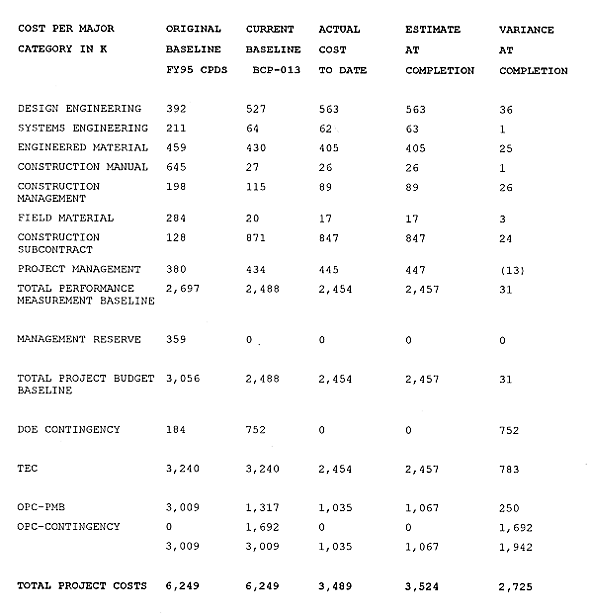
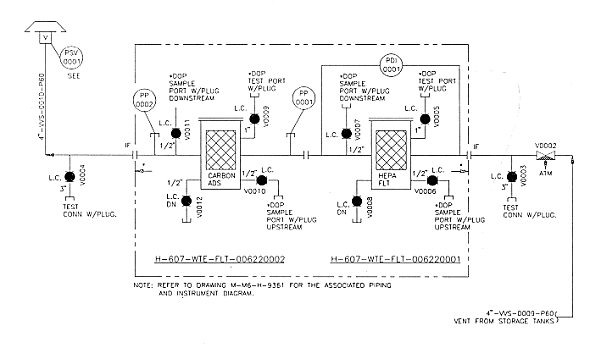
Fig. 2. NSST vent system piping and
instrumentation diagram
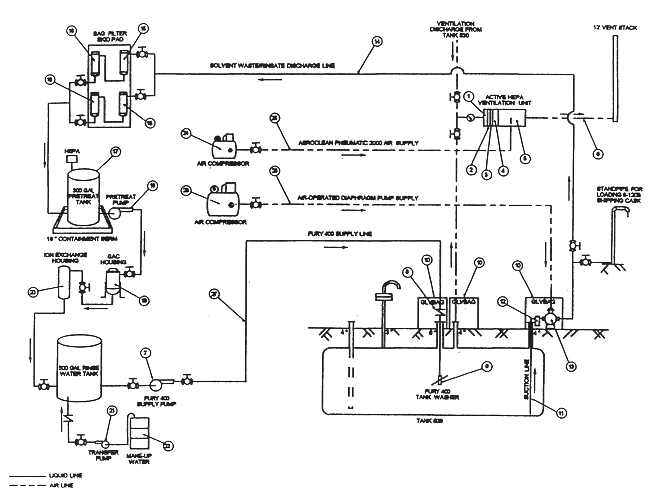
Fig. 3. NSST solvent waste transfer
system
The NSST facility developed an integrated configuration management program to ensure configuration control prior to startup and to maintain and control facility configuration throughout the facility life cycle. The initial configuration management (CM) plan and CM program were developed to ensure that the design basis, design baseline, and necessary operational documents were identified, documented, recorded, and change controlled. A graded approach strengthened the management process through a combination of integrated task execution teams; the application of improved work process in a structured, disciplined manner; the use of commercial practices, where appropriate; and a continued effort to execute work in a safe, efficient and cost effective manner. In short, implementing a graded approach on any project will result in a better understanding of customer expectations and a strengthening of team work that will improve cost effectiveness and overall performance and efficiency. A table illustrating project costs is provided in Table I.
REFERENCES