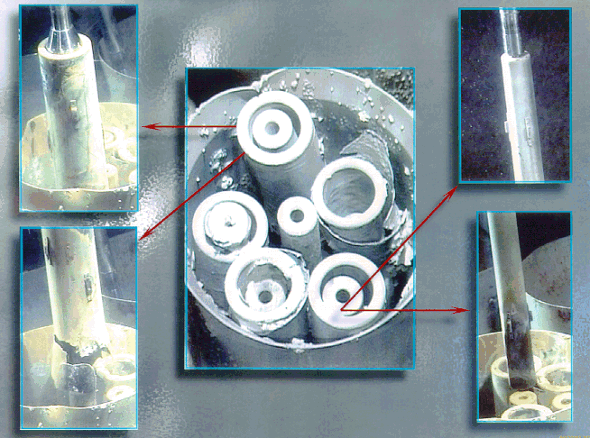
Fig.1. K East Basin fuel elements
(five inner and five outer) as seen during a comprehensive visual survey. (Note
that up to seven fuel assemblies in a canister barrel each contain concentric
inner and outer elements.)
B. J. Makenas, R. B. Baker, A. L. Pitner, D. J. Trimble and
R. P. Omberg
Duke Engineering & Services Hanford, Inc.
Post Office
Box 350
Richland, Washington 99352-0350
ABSTRACT
Characterization of N Reactor metal spent fuel and associated sludge stored in the two Hanford K Basins has entered a more mature stage. Previous campaigns had consisted of top-view visual surveys of open fuel canisters, limited collection of gas and liquid from sealed canisters, detailed examinations of only a few fuel elements and collection of sludge from the floor of only one basin. More recent work has included lifting fuel elements from both Basins to ascertain bottom end and circumferential cracks. Sludge collection has now been performed for material residing inside of spent fuel canisters in both Basins. Finally the number of gas and liquid samples from sealed canisters has been greatly expanded leading to a maximum observed cesium-137 content ten times higher than previous reports. Characterization has been a challenge because of the age of the fuel materials, the water environment, and the radiation field.
INTRODUCTION
Over 2,100 tons of zirconium alloy clad uranium metal fuel from the Hanford N Reactor are stored in the water-filled Hanford K Basins. Half of this fuel is in open-top aluminum and stainless steel canisters (in K East Basin) and half is in sealed vented canisters (in K West Basin). There are 3,600 to 3,800 double barrel canisters in each Basin with up to seven fuel assemblies (14 elements) in each barrel. Fuel elements are roughly 0.6m (2ft) long with the tops of the elements 4m (13ft) under water. On the Basin floor and associated with this fuel is an accumulation of sludge containing fuel, fission products, and/or wind blown particulate debris. Characterization is in progress for the fuel stored in the K Basins. These activities support the strategy for removal of fuel from the basins and storage of fuel in a dry condition at an area remote from the Columbia River. This strategy currently consists of placing fuel in a Multi-Canister Overpack (MCO), drying the fuel while it resides in the MCO and conditioning some portion of the fuel to reduce its chemical reactivity. Characterization includes the examination of fuel elements, canisters, and associated sludge. It consists firstly of in-basin activities such as visual examination, sludge depth measurements, and sampling of gas and liquid in canisters. Secondly characterization encompasses the examination of samples of fuel and sludge which have been removed from the basins and shipped to laboratories.
Characterization has proceeded beyond the initial survey examinations described in the references. Additional materials (fuel, sludge, liquid, and gas samples) covering additional storage condition and fuel history variables, have been examined in the Basins and sent to shielded laboratories for analysis.
K EAST BASIN FUEL
Previous visual surveys (1) classified the fuel elements stored in the open canisters in KEast Basin by the degree of damage visible from overhead. A recent survey of 39 fuel canister barrels was completed during which 450 individual elements (inner and outer elements) were lifted for inspection. Damage to bottom ends and cracking along element sides were ascertained. An example of one of these is shown in Fig. 1. Elements were also subjected to various candidate processes for removal of fuel corrosion product and a whitish adherent sludge (which was successfully dislodged with a metal brush). Nine elements were shipped to hot cells for closer examination as part of this ongoing campaign. These examinations will include ascertaining whether the adhering sludge contributed significantly to the water evolved during fuel drying. Prior to the recent efforts only fuel from the K West Basin had been retrieved for hot cell examination.
Fig.1. K East Basin fuel elements
(five inner and five outer) as seen during a comprehensive visual survey. (Note
that up to seven fuel assemblies in a canister barrel each contain concentric
inner and outer elements.)
K EAST BASIN SLUDGE
Previous efforts for sludge analysis concentrated on particulate accumulations on the floor of the K East Basin (2). A more recent survey by ultrasonic probe has determined the depth of sludge IN the actual K East open fuel canisters with results indicating over 12 inches sludge depth in some cases. Samples of the canister sludge (which is more radioactive and chemically reactive than floor sludge) have now been removed with specially designed equipment and shipped via cask to analytical laboratories several miles from the basin. Chemical/physical property comparisons are now being made versus floor sludge. Canister sludge has been found to be approximately 65 weight percent uranium whereas floor sludge was reported to be largely iron hydroxide. An example of the more reactive nature of canister sludge (hydrogen generation) is shown in Fig. 2 where bubbles are seen to form as the canister sludge resides in the laboratory. The reactive species appear likely to be discrete widely separated particles since most of the uranium has been shown (by X-ray diffraction) to be oxidized.
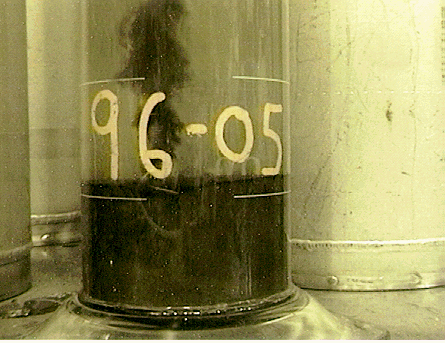
Fig. 2. Sludge from a K East Basin
canister erupts as a hydrogen bubble is released into water covering the sample
during laboratory examinations.
K WEST BASIN GAS AND LIQUID SAMPLES
During a previous campaign (3) samples of liquid and gas were taken from the sealed canisters in K West Basin. They indicated a maximum cesium-137 concentration of 0.5 Ci in liquid per canister barrel with a cover gas consisting mostly of hydrogen. The hydrogen has replaced the original nitrogen cover gas introduced in the early 1980's when canisters were sealed and purged. A second campaign has now been conducted for 50 additional canisters (100 barrels) covering a wider range of canister types, fuel grades, and known fuel damage. Greater cesium concentrations than previously reported have been found. A few barrels were found to contain over 3 Ci of cesium-137 (Fig. 3) during this campaign. Hydrogen was again found to be the primary gas recovered but the occasional presence of oxygen suggests that, although most hydrogen comes from corrosion reactions, some may be the result of radiolysis. These results are of significance to the design of water treatment scenarios which will be in place when all of the sealed canisters are opened for fuel relocation to interim storage.
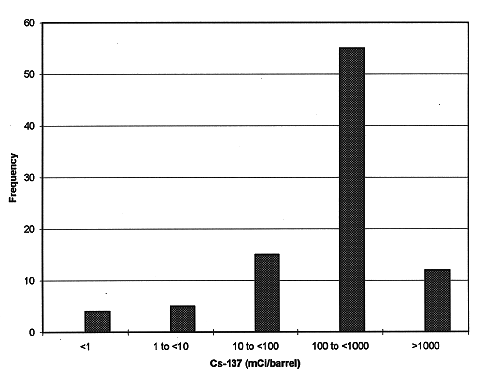
Fig. 3. Cesium content versus a
number of K West Basin sealed canister barrels as ascertained from a survey of
50 canisters (100 barrels).
K WEST BASIN FUEL
A campaign which resulted in the examination of three fuel elements from the sealed K West canisters is described in Ref. 4 and the hot cell examination results are given in Ref. 5. Based on the new gas/liquid samples described above, an additional 24 canister barrels have now been opened and the fuel elements inspected. The condition of the fuel elements was found to be very similar (from a corrosion damage point of view) to that of K East Basin elements (see Fig. 4). Various cladding surface coatings were quite different from K East Basin, however, including several different colors and degrees of translucency.
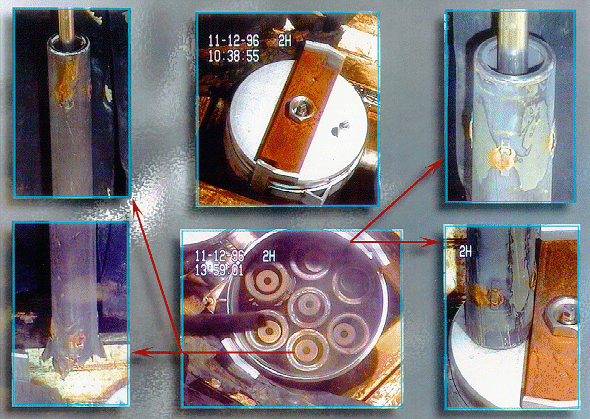
Fig. 4. K West Basin fuel elements as
seen during a comprehensive visual survey. Canister shown with and without lid.
K WEST BASIN SLUDGE
No measurements have yet been made on floor sludge in K West Basin but the total amount is not voluminous except in remote pit areas. Recent ultrasonic measurements of sludge depth in the sealed K West canister barrels ranged up to a maximum of 18 cm (7 inches) with depths being quite nonuniform across the bottom of any given barrel. These measurements can be confused however, by other non-sludge debris. Several samples of this sludge have been shipped to laboratories and chemical analysis is still pending. These measurements, in concert with the analyses of canister liquid discussed above, lead to an estimate of the total canister sludge inventory for K West Basin of over 1,000 liters.
CONCLUSION
Examinations of fuel and sludge in the Hanford K Basins have evolved to encompass a greater number of data points and a greater suite of variables than those previously reported (Table I). Fuel elements with bottom-end damage, more reactive sludges, and canister liquid with greater radionuclide concentrations have been identified. These will need to be considered as the processes and equipment development for interim storage of fuel and sludge move forward.
REFERENCES
ACKNOWLEDGMENT
This work was sponsored by the United States Department of Energy under contract DE-ACO6-96RL13200.