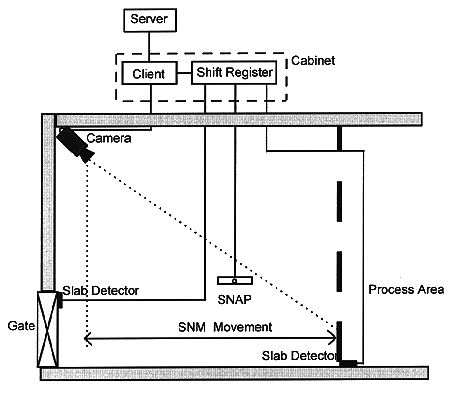
Fig. 1. Integration of video and
radiation monitors.
Ho Dong Kim, Young Soo Park, Jong Sook Hong
Korea Atomic
Energy Research Institute
ABSTRACT
As the concept of DUPIC (Direct Use of spent PWR Fuel in CANDU) has emerged as a new technological option for the nuclear fuel cycle in Korea, it became necessary to develop a viable safeguards system. To this end, this paper presents a neural network based diagnostic system for safeguarding radioactive material flow into and out of hot cell environments. While the surveillance system consisting of a CCD camera and NDA equipment continuously monitors the material flow, the sensory data are integrated to a neural network to automatically diagnose the normal and off normal conditions of material flow. Unlike other existing safeguards systems, the presented system facilitates detailed identification on the validity of material flow path, type of container and radiation source in real-time. The integral part of the multisensory system and analytical paradigm may provide an effective technological alternative for safeguarding of new conceptual hotcell facilities such as the DUPIC facility.
INTRODUCTION
Due to the increasing throughput of nuclear material in nuclear facilities, unattended continuous monitoring has become a mandatory technological option for increasing safeguard effectiveness. However, it results in large amounts of data, which require much time and effort to inspect. Therefore, it is necessary to develop software that automatically pinpoints and diagnoses the anomalies of the data. This will greatly alleviate the inspector time and effort required in operation of safeguards systems.
Recently, in Korea, the concept of DUPIC (Direct Use of spent PWR Fuel in CANDU) has emerged as a new technological option for the nuclear fuel cycle, and currently conceptual design of test facilities along with preliminary R&D works are in progress. Since the DUPIC facility involves number, complexity, and throughput of nuclear material that the nation has never seen, a more viable safeguards system has come into demand. In structuring a nuclear safeguards system for the DUPIC facility, of primary concern are the reception areas of various process cells and it is important to continuously monitor the flow of fuel transport casks in these areas.
In these regards, an R&D project is initiated at KAERI (Korea Atomic Energy Research Institute) to develop the safeguards system for this hotcell facility. The R&D effort is directed into two different areas: development of monitoring system hardware and software for monitored data analysis. The monitoring system hardware integrated the sensory unit of a CCD camera and an NDA instrument, which records the visual history of the material transport and the radiation level at the reception areas.
On the other hand, pertaining to the latter R&D scope, this paper presents a neural network based diagnostic software system that integrates the visual surveillance data from the CCD camera and radiation data from the NDA instrument, and performs analysis for safeguard purposes. This system utilizes the neural network's pattern recognition capability to recognize the anomalies of the monitored data and identifies the path and type of the transported nuclear material. Current R&D status remains at the prototypical stage and functionality testing is in progress. Upon completion, however, the integrated system is expected to be implemented in the DUPIC fuel development fabrication hotcell to provide a reliable and effective safeguards system.
SYSTEM OVERVIEW
The overall structure of the nuclear material safeguards system, as shown Fig. 1, consists of a visual surveillance camera, radiation detector and a neural network based diagnostic system. The CCD camera is mounted on a pan/tilt device to easily calibrate the camera's viewing direction. As shown in the figure, the camera is placed at the front end of the hot cell entrance in such a way that its view area covers the larger area of the normal material flow path. The camera is connected to an image processing board to transfer the live image of the work area in real-time. The image processing board, MVB02 manufactured by Samsung Electronics Co., is mounted in a PC, and capable of performing fast image capture and high speed image processing using a DSP processor.
Fig. 1. Integration of video and
radiation monitors.
Also, as shown in the figure, a radiation detector is mounted on the side wall of the entrance path to measure the type and intensity of the radiation emitted by the passing cask. In implementation, the Shielded Neutron Assay Probe (SNAP : model JSP-11) by CANBERRA Co. is used, and the data acquisition electronics module is Portable Shift Register (model PSR-B with PSR-AUX) developed by LANL(Los Alamos National Laboratory). The detector is again connected remotely to the PC.
The system functions as follows. At every 1.4 seconds, both camera image data and radiation data are collected. This time interval is the bottleneck imposed by the measurement time of the radiation detector system. At each time the spatial image data is converted to temporal data as explained in the next section, and stored temporary memory. This process is repeated over an extended time horizon of 1 minute duration. At the end of each time window, the temporal data sets stored over two time horizons - the current and a prior one - are processed to extract characteristic feature inputs to the neural network. If the diagnostic result reveals abnormality, the raw image data and radiation data of the respective time interval are recorded on the tape; this selective recording functionality is yet to be implemented at present. Otherwise, the prior temporal data are removed from the memory, and the data acquisition process is repeated over an updated time horizon.
ACQUISITION AND PROCESSING OF SURVEILLANCE DATA
The surveillance data is obtained from the camera and radiation detector. However, the camera data is vast and the time series data of the radiation detector is unsuitable for automation in its raw form. Therefore, to automate the process of identifying the path and the type of the transported material, data must be presented in a more compact form. To use them in a neural network, thus, we decided to extract quantitative features from the raw data through data processing.
Visual surveillance data is a collection of image data in time series. At each interval the following image processing is performed.
Through the above image processing, the visual data, which is spatial in nature, is converted to temporal data. This sets a basis for coherent integration of camera data with the radiation data, in addition to the apparent benefit of data reduction. The entire image processing is performed in a DSP processor within 500 msec. Collection of thus obtained features over a time period may give sufficient information to identify the path of the material passing through the surveillance zone.
The radiation detector (SNAP) is used to identify the type of transported material. The electrical signal from the detector is transferred to the portable shift register, where it is selectively counted as single and coincident neutron counts. These data are then collected at a PC and analyzed through NCCWIN software. As a result the amount neutron emission is recorded at each sampling time. In this system, the maximum time required for data acquisition and analysis remains less than 1.4 seconds.
SAFEGUARD ANALYSIS USING NEURAL NETWORK
Having recorded the surveillance data over a discrete time horizon as described above, these data are fed into the neural network to make safeguard decisions.
Structure of Neural Network
Specifically, the neural network accepts certain features extracted from the surveillance data as input, and yields the path and type of the radioactive material and container for its output. For this purpose, a multilayer network with an error back propagation training rule is used. Since this type of neural network is not suitable for processing time series data, discrete features are extracted from the temporal data and given to the input nodes. First, from the collection of the cask center positions, a straight line is obtained through linear regression. The slope of the line is given as input to the first input node, S. Also, the standard deviation, D, of the cask center positions to the regression line is computed. It should indicate the uniformity of the transport path. To identify the type of container, the average size, A, of the container's image is given as an input feature. Finally, the average neutron density, R, and the standard deviation from the average value, DR, are given as inputs.
As a result, the neural network has five input nodes (S, D, A, R, DR) and three output nodes, respectively for material path, source of material and type of container. It has two hidden layers of 10 nodes each, as shown in Fig. 2. The numbers of hidden nodes are selected in trial and error manner.
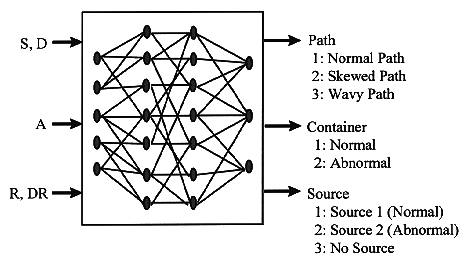
Fig. 2. Structure of neural network.
Network Training
The multilayer neural network is trained in supervisory manner. Therefore, to obtain training data set, experimental material transports are made. In the experimental, radioactive materials of three different types (S1, S2, S3), each contained in two different containers (C1, C2), are transported through the surveillance area along 8 different paths, numbered P1 through P8, as shown in Fig. 3 (a). In training, the paths P1 through P3 are considered to be normal, and P4 through P8 are considered abnormal. In total, 48 experimental transports are made, and relevant data (Vx, Vy, A, R) are recorded in time. Fig. 3 (b) shows the regression lines of the visual path of the transport. Also shown Fig. 3 (c) are the radiation data for three different sources upon transport along P1.
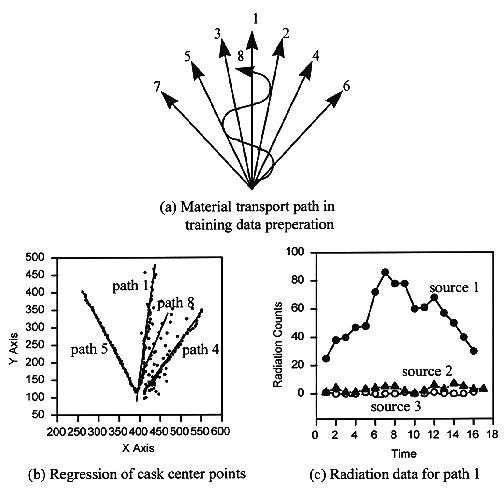
Fig. 3. Preparation of training data
set.
Training of the neural net is performed in batch mode, i.e., all 48 data sets are used for one training session. Training is performed until the Sum of Squared error becomes less than 0.02. To facilitate more efficient learning, training momentum and variable learning ratios are used. Also, the network weights are initialized according to the Neuyen-Widraw method.
Evaluation of Performance
The identification performance of the trained neural network is tested on a separately prepared data set. In total, 40 test data sets are prepared by performing material transports along normal paths and abnormal paths with various source and container types. By inputting the features from the test data sets into the neural network, the identification errors are evaluated as presented in Fig. 4. The summaries of average errors are given in Table I.
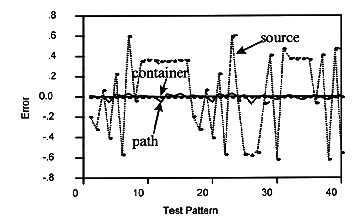
Fig. 4. Identification error.
Table I. Summary of Average Errors
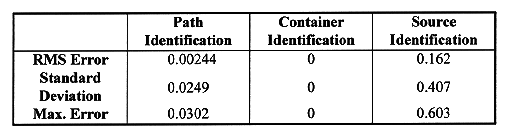
As shown in the figure and the table, the network predicts the path and container type successfully. On the other hand, identification of source incorporated relatively large errors, individually and on the average. Such errors result from the fact that the radiation levels of source 2 and source 3 remains very low in comparison with that of source 1. The neural network trained on the total RMS errors thus operate ineffectively on identifying between source 2 and 3. However, by appropriately truncating the individual identification results on the mid values, 0.5, correct results can be obtained.
CONCLUSION
A data management system for safeguards approach is realized by integrating the visual data and radiation data. Such integration is achieved by image processing of the camera surveillance data and temporal radiation data to extract useful features. The safeguards features are the presented to a neural network to identify the transport path as well as type of source and container. The neural network provides complete diagnostics on the material flow pattern in the hotcell. The developed system is suitable for automating continuous monitoring of nuclear material transport. With further improvement on the technology, the system will be implemented as a part of safeguards system of the DUPIC facility in Korea.
REFERENCES