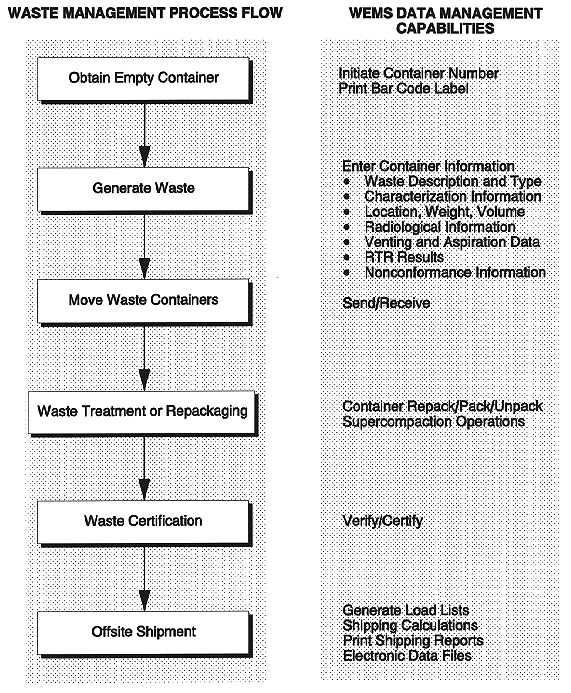
Fig. 1. WENS data management.
Pamela W. Edrich, Dwan A. Franks, M. Kay Prideaux, and
Veronica Santistevan
Rocky Mountain Remediation Services
ABSTRACT
The Rocky Flats Environmental Technology Site (RFETS) currently has over 70,000 containers of waste in storage, and approximately 225 new containers of waste are generated each month. A waste tracking and inventory database known as the Waste and Environmental Management System (WEMS) has been in use at RFETS since the early 1990s. The system is used daily by approximately 100 users to track waste, access a variety of information concerning individual waste containers, and acquire useful inventory data for waste planning and strategy determinations.
The WEMS database can accept up to 1200 pieces of information on each waste container, including container number, waste type, characterization and content information, weight and volume, radioassay results and radiation readings, generation and storage locations, generation start and fill dates, and information concerning waste non-conformances. In addition to accepting information concerning the generation and movement of waste, WEMS has several modules which allow the WEMS user to record waste management operations such as:
- repackaging a container
- correcting non-conformances
- venting and aspirating a container
- monitoring organic air emissions
- transferring liquid waste in tanks
- selecting drums for supercompaction
- shipping waste to offsite facilities
History files are maintained on every container of waste so that a user can quickly access information regarding every movement and operation that has occurred for that container.
The data contained in WEMS is considered a part of the RCRA Operating Record for the RCRA regulated waste generated and stored onsite. WEMS also provides information required by offsite waste disposers and treaters.
WEMS features a variety of standard reports, easily accessible by the WEMS user to query the database and print out a predetermined set of data for selected storage units and containers. Additionally, computer analysts supporting the WEMS users can create specialized reports to meet the requestors data needs.
WEMS HISTORY
RFETS generates a large variety of containerized wastes, including radioactive, non-radioactive, hazardous, non-hazardous, and mixed radioactive/hazardous wastes. Due to the lack of offsite treaters and disposers and budget constraints, very little waste is shipped offsite, resulting in an ever-increasing inventory of waste stored onsite. Waste movements onsite are frequent to allow for maintenance and closure of various storage units, for sampling, assay, or radiography of waste, or to consolidate similar types of waste. A waste tracking and inventory systems entitled the Waste and Environmental Management System (WEMS) database was originally implemented in January 1990. WEMS was designed and developed to provide "cradle to grave" tracking and control for waste containers accommodating all types of waste generated at the RFETS.
The utilization of WEMS is required to ensure compliance with several regulatory agencies, such as the Colorado Department of Public Health and Environment and the Federal Department of Transportation, and is mandated by the RCRA Operating Permit for RFETS. WEMS information is also used by the Department of Energy (DOE) and RFETS operating contractors to make waste management decisions, submit information to offsite waste repository facilities, produce environmental and waste reports, and transmit data to national databases.
In the fall of 1992, it was determined that it was necessary to re-engineer and convert the WEMS Ultra Mantis database to a new relational database. Even though the Ultra Mantis database was only three years old, it was no longer supported by the vendor, and programmers for this obsolete, fourth generation language were extremely hard to find causing system maintenance, enhancements, and upgrades to be a serious concern. Also, the mission of RFETS had changed from production activities to a clean up mission. Waste inventory was anticipated to double within five years and the Ultra Mantis system was unable to handle the additional volume. Consequently, in 1993 the WEMS Mantis to Oracle Conversion Project began. After schedule delays and cost overruns, the system was converted to Oracle in 1995 and is successfully functioning today.
WEMS TECHNICAL SPECIFICATIONS
WEMS is a large menu driven database which consists of 17 logical groupings of information called modules. Approximately 1200 data columns are located in 109 tables of information. A total of 89 screens are available to the user to enter or view information. WEMS accommodates over 70,000 waste containers, and uses approximately 5 Gigabits of disk space. Approximately 100 on-line users access WEMS information. WEMS resides on an unclassified VAX cluster and it is accessed by way of the RFETS Local Area Network (LAN).
MAJOR FUNCTIONS OF THE WEMS DATABASE
WEMS primarily tracks waste on a container-by-container basis. Each container of waste generated at RFETS typically flows through a number of waste management operations, and each of these operations can be recorded in WEMS. Figure 1 expresses this by showing a flow diagram on the left which demonstrates the typical waste management process flow and a listing on the right which shows the capabilities of WEMS to capture information concerning that waste management activity. The major functions of WEMS are described below. It is important to note that WEMS maintains a history of every container movement and operation, thus allowing for a clear picture of the lifetime of the waste.
Fig. 1. WENS data management.
Container Initiation/Bar Code Label Printing: Upon the issuance of an empty container from the warehouse, the container is "initiated" in WEMS. WEMS generates a container number, prints a bar code label, and records the container type and location.
Waste Generation: During waste generation and upon the filling of a waste container, the majority of the container information is entered in WEMS. The container information that can be entered into WEMS includes waste type (such as low-level, TRU, hazardous, etc.), Item Description Code, waste description, generation location, storage location, waste generating process stream number, accumulation start date, fill date, weight, volume, solid or liquid, RCRA EPA Hazardous Waste Numbers, land disposal restriction information, compatibility code, chemical constituents, TSCA information, notes, and other miscellaneous data. This information is entered on the "traveler" form, which includes three screens. Additional information which is typically entered after the waste has been generated includes real time radiography results, radio assay results, radiation protection information, fingerprint test results, waste nonconformances, and information concerning venting and aspirating of drums. This information is entered on a series of additional screens.
As data is entered into WEMS, much of it is "checked" by the database against a set of reference tables. For examples, the EPA Hazardous Waste Numbers applied to a container located in a certain storage unit are checked against the EPA Hazardous Waste Numbers approved for that storage unit. If there is disagreement, a warning message appears. Additionally, much of the other information including waste type, location, waste stream numbers and container type are checked for accuracy.
Waste Container Movement: Waste container movements are recorded by the container send and receive transfer functions within WEMS. Containers are "transferred from" one location to another location, and the same containers are then "received by" the new location.
Waste Treatment and Repackaging: The repack module within WEMS is very sophisticated and is used to reflect a variety of waste management operations. For example, the repack module is used when the contents of a number of containers are repacked into one container and when the contents of one container are repacked into several containers. Additionally, the repack module is used when waste is treated and is either consumed by the treatment process or becomes a "new" waste.
Another module available in WEMS tracks the RFETS supercompaction treatment process. The supercompaction module helps select batches of waste for supercompaction and tracks the waste as it is removed from one container, compacted, and combined with waste from other containers.
Waste Certification: Radioactive waste must be certified by a Waste Certification Official before it is shipped offsite for disposal. WEMS provides a verification function that performs a completeness and consistency check of all information entered in WEMS on a specific container. Missing information and discrepancies are noted and must be corrected before verification can be completed. The Waste Certification Official then uses the certification function to check WEMS information against container paperwork and then records the official certification of a container in WEMS.
Offsite Shipment: The offsite shipment module allows the user to select and assign loads of waste for shipment, perform a variety of calculations concerning that load, enter various transportation information, record final inspections, and approve final shipment of waste to Nevada Test Site, WIPP, and commercial disposal facilities. A number of reports can be printed from this module and electronic files are created for transmittal to the waste disposal sites.
SPECIALTY FUNCTIONS WITHIN WEMS
WEMS offers several functions not related to waste container management as discussed below.
Organic Air Emissions: This module is used by personnel responsible for inspecting and monitoring equipment affected by the RCRA organic air emissions regulations. An inventory of affected equipment is maintained in WEMS and monitoring results are "downloaded" into this module from a portable organic emissions monitoring device. Leak information and corrective actions are also recorded in WEMS.
Liquid Waste Tracking: This module tracks information regarding liquid waste stored in tanks, transfers between tanks, and transfers between tanks and other containment vessels including tanker trucks, sumps, and treatment units. Information contained in this module include tank description, volume, location, and tank closure data, and information concerning the waste including radiological and chemical characterization information and RCRA required data. Liquid waste transfer volumes, transfer date, and involved tanks are also recorded.
REPORTING CAPABILITIES
An extremely important aspect of WEMS is its ability to provide a large variety of reports. WEMS features a variety of standard reports, easily accessible by the WEMS user to query the database and print out a predetermined set of data for selected storage units and containers. Examples of the standard reports include:
Additionally, computer analysts in the WEMS user support group are skilled in producing specialized reports for a number of needs. Inventory reports of all types are regularly prepared to respond to DOE and other agency requests and to track waste generation and storage trends. Specialized reports are used for emergency planning, FSAR preparation, and long-range waste management and disposal planning. Approximately 100 specialized reports are produced by the WEMS user support group each month. Most specialized reports can be generated within 1 to 2 days.
PERSONNEL SUPPORT OF WEMS
Over 100 RFETS employees have access to WEMS. Most WEMS users have "read and report" access only, allowing them to view waste information and request and print standard reports. Approximately 30 employees have "update" access which allow them to enter and change certain information concerning waste containers, execute the transfer and repackaging of a container, transfer liquids between tanks, and prepare containers for shipment. These employees are called "WEMS Coordinators" and have the responsibility for keeping all information in WEMS accurate and up-to-date. Three computer analysts serve as the WEMS user support group, training and assisting WEMS users, producing specialty reports, specifying required software changes, and controlling all WEMS quality records and procedures. Two Oracle programmers are on staff to accomplish software changes and a database administrator devotes part of his time to WEMS database administration activities.
The WEMS Coordinators are made aware of changes required in WEMS from paperwork called a WEMS Container Worksheet. The WEMS Container Worksheet is typically generated by the waste container custodian. The WEMS Coordinator is required to enter the information from the WEMS Container Worksheet within 24 hours of receipt.
PLANS FOR THE FUTURE
Despite complications experienced in 1995 following the conversion of WEMS to Oracle, the system is now working well. Minor problems continue to be identified and the problems are corrected relatively quickly by software changes. Several additional standard reports are under development.
The system speed is lackluster which causes frustration among the WEMS users. To correct this problem, the Information Systems group is planning a hardware conversion, from the current VAX mainframe to Alpha servers. Additional software upgrades are promising to enhance system performance. The hardware conversion and software upgrades are scheduled to take place prior to 1997.
The offsite shipping module was not converted to Oracle in 1995, due to funding and schedule constraints, and still resides on the Ultra Mantis version of WEMS. Though the module is useable, it is unreliable and requires duplication of data entry. The offsite shipping module is currently being re-evaluated and the specifications are being re-written. The module will be reprogrammed in Oracle, with a target completion date of June 1997.
Waste custodians are keenly interested in using bar code reading equipment to conduct on-the-floor inventories of waste containers and electronically transmit the information into WEMS. The bar code equipment is being tested now and WEMS is being modified to accept this data. The use of the bar code reading equipment will reduce the time personnel must spend in radiation areas recording container inventory information by hand. The equipment will also be invaluable during a major container movement campaign planned during 1997. Containers will be scanned as they leave their current location and are received at the new location. The scanned information will be "downloaded" into WEMS and WEMS will be automatically updated. This will save time at both the sending and receiving locations by eliminating the completion of WEMS Container Worksheets, and by eliminating double data entry by the WEMS Coordinators.
SUMMARY AND CONCLUSIONS
With the large volume of waste at RFETS, a centralized computer tracking and inventory system is invaluable. The system is used daily by up to 100 WEMS users to read and record important information about waste containers and activities. The system is necessary to ensure regulatory compliance, to respond quickly and accurately to the myriad of data requests from DOE and other agencies, and to do important long-range planning at the Site. The complexity and completeness of WEMS allows for a single database to hold information on all aspects of waste management, from waste generation to treatment to offsite shipping. The database continues to improve in both its functionality and accuracy of information.