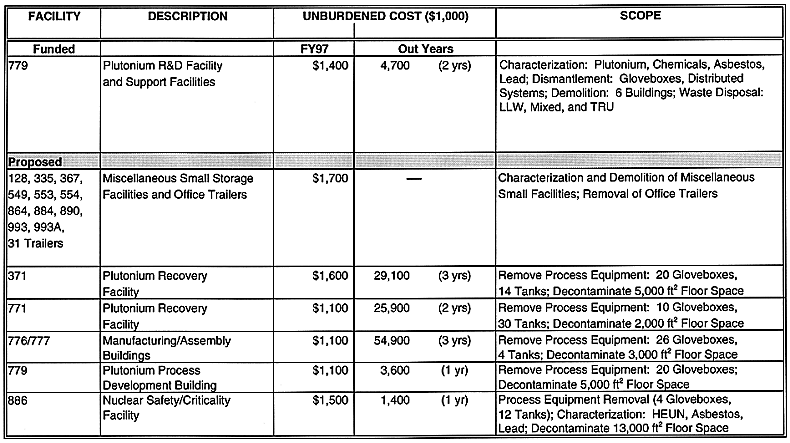
Table I Technology Demonstration Opportunities
John Chapin
Rocky Mountain Remediation Services L.L.C.
Terry Healy
Kaiser-Hill L.L.C.
ABSTRACT
The Department of Energy/Rocky Flats Field Office (DOE/RFFO) is faced with the challenge of decommissioning its weapons production facilities within the next ten years (i.e., 2006). Rocky Flats Environmental Technology Site (RFETS) has developed a comprehensive Decommissioning Program Plan and a 10-Year Site Plan to accomplish this monumental task.
The decommissioning projects at RFETS vary in complexity from simple, non-contaminated structures such as trailers, to large complex plutonium (Pu) contaminated buildings. The majority of these facilities will either be moved off-site for reuse or demolished. Of the over 500 facilities identified at RFETS, 8 are contaminated with Pu, 12 are contaminated with both uranium (U) and Pu, 34 have minor radioactive contamination, and the reminder have no known history of radioactive contamination.
The technical challenges reside within the small number of Pu and U contaminated facilities and are associated with gloveboxes, ductwork, and building surfaces.
TECHNOLOGY NEEDS
A broad spectrum of innovative technologies are required, including technologies for in-situ measurement of Pu contamination, technologies for decontamination of gloveboxes to levels which will allow disposal as low-level radioactive waste (LLRW) rather than transuranic (TRU) waste, technologies for remote size reduction of Pu contaminated gloveboxes and ductwork, and technologies for recycling Pu contaminated stainless steel.
The challenges at RFETS reside primarily with the approximately 900 Pu contaminated gloveboxes and their associated ductwork and internal components. These challenges include high internal Pu contamination (millions dpm/100 cm2), high radiation (100s mr/hr), mixed wastes (Pu, oil, solvent, organics, Beryllium [Be], etc.) and physical constraints (wall thickness, multiple sizes, lead lining, water lining, and large internal components such as lathes and mills).
While technologies being applied today are viable, they are labor-intensive. This results in: high costs, potentially greater risk to workers, and the generation of large volumes of secondary waste. Technologies are required which will demonstrate:
Current baseline technologies exist which can be used to accomplish decommissioning. These technologies consist of techniques such as: contamination removal by wiping and brushing; fixing contamination by applying coatings; removal of fixed contamination using abrasives; and dismantlement of gloveboxes using saws, grinders, nibblers, and torches. Table 1 lists several opportunities to demonstrate innovative technologies at RFETS.
Currently, approximately 900 gloveboxes at Rocky Flats are located in Buildings 371, 374, 559, 707, 771, 774, 776, 777, and 779. It is the intent of RFETS to decontaminate the TRU-contaminated gloveboxes and their associated equipment, in place, to achieve decontamination factors which will allow the majority of the material to be recycled and/or disposed as low-level waste.
At the present time, the method to measure the radioactive contamination is labor-intensive, resulting in high cost and potential exposure to workers, and is relatively inaccurate. Surface contamination is measured manually and the specific activity level calculated based upon the weight of the component being measured. After the component has been size-reduced and packaged, it is sent to a passive-active counter for assay and then determined to be either TRU or low-level waste. A quick, accurate method for in-situ determination of TRU activity would reduce exposure to workers by reducing the amount of time spent performing radiation surveys and by ensuring that only the necessary decontamination is performed to reach low-level status. Additionally, repackaging of boxes to achieve low-level status would be eliminated.
It is currently estimated that, for RFETS, approximately 67,000 m3 of low-level waste, 269,000 m3 of low-level mixed waste, and 4,500 m3 of TRU/TRU mixed waste will be generated as a result of decommissioning. It is estimated that innovative treatment/decontamination techniques could reduce these volumes by a high percentage. The costs to dispose of these wastes would be reduced accordingly, resulting in a savings in the hundreds of millions of dollars for RFETS alone.
TECHNOLOGY SELECTION
Technologies exist world-wide which could be applied at the RFETS. Selection of the technologies which provide the greatest cost/benefit for RFETS is of prime interest. Criteria for selecting technologies will include:
The final set of technologies will depend on the level of funding, flexibility in the operations schedule, and the significance of the technology for its ability to address serious risks, reduce mortgage costs, reduce generation of waste, worker health and safety, and enhance relationships between DOE, Stakeholders, and Regulators.
Table I Technology Demonstration Opportunities
FUTURE PLANS - COST PROJECTIONS
Scope, budget, and schedule estimates have been prepared for deactivating and decommissioning all RFETS facilities and are reported in the RFETS 10-Year Plan. Costs and methodology have been reviewed by two independent entities as described below.
A review by an independent contractor concluded that:
Additionally, a joint DOE-Headquarters and RFFO team similarly conducted an independent review of scope, cost, and schedules and recommended:
During FY97, detailed costs will be collected and used to help validate the order-of-magnitude estimates reported in the RFETS 10-Year Plan.
PLANNED WORK FOR FY97
The funded work being planned for FY97 centers around characterization, dismantlement, and decontamination activities in Building 779. Building 779 is a former Pu process development laboratory containing an assortment of equipment, gloveboxes, and associated piping and ductwork. The building is a two-story, concrete structure of approximately 65,000 square feet. The building/contents are contaminated with Pu, U, Be, and hazardous chemicals. Building 779 contains approximately 100 gloveboxes(i.e., 10% of total on-site).
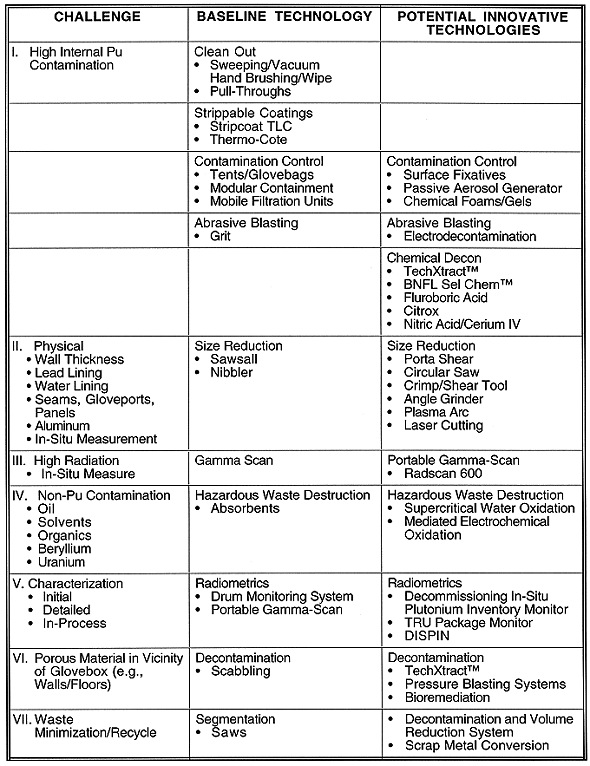
Other planning is underway to decommission several other facilities during FY97, contingent upon additional funding. Table 2 is a summary of the work being planned for FY97.
CONSTRAINTS/ISSUES
The strategy of DOE/RFFO is to deactivate RFETS facilities on a risk-reduction priority basis and place them in a safe, stable condition. This will lower the cost associated with the surveillance and maintenance (S&M) of these facilities. Eventually the facilities will be decommissioned.
Three issues which will affect decommissioning stem from:
Post Operation Conditions
Because of the abruptness in which facilities were shutdown and the initial intent to restart operations, the current conditions of the processes within facilities is quite varied. Significant quantities of Special Nuclear Material (SNM) remain in gloveboxes, vaults, and process equipment as well as significant quantities of holdup remain in filters and ductwork. The potential for criticality and the need for contamination control are significant concerns in performing decommissioning operations.
The current Pu measurement methods utilizing gamma spectroscopy with high purity germanium detectors lack the sensitivity and accuracy to adequately characterize the process equipment. Further, worker efficiency is severely reduced due to the large quantity of equipment requiring measurement. Because of these measurement uncertainties, quantities of SNM are conservatively reported resulting in additional protective measures, disposal requirements, and increased cost.
Administrative Controls
As a result of the change in mission from production to deactivation and decommissioning it is possible and sometimes necessary to change the manner in which certain activities are conducted. Equipment and techniques which could not be used during operations are viable under the new conditions. This requires retraining of workers such that they understand that what was not an acceptable practice during production may now be acceptable. As an example: segmentation of stainless steel gloveboxes was restricted to the use of reciprocating saws (i.e., sawsall); due to increased efficiency it is prudent to cut gloveboxes, with appropriate contamination/ off gas control, using plasma-arc torches.
Startup of Decommissioning
The condition that a facility is in prior to beginning decommissioning is dependent upon the availability of funding. If decommissioning is to be delayed several years after a facility has been placed in a safe condition, then the availability of decommissioning technologies is not as critical as it would be if work was to begin immediately. A later start might benefit decommissioning from the standpoint of new technology development.
Because of the short time period (i.e., 10 years) to complete decommissioning at RFETS the use of existing technology during the initial years is essential.
Table II Decommissioning Projects for FY97