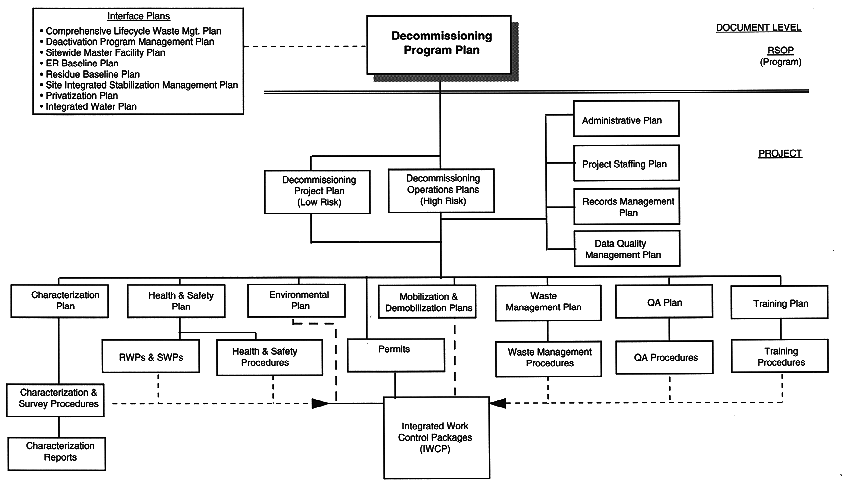
Fig. 1. Decommissioning program
document hierarchy.
Mary T. Aycock
Scientific Ecology Group
Rocky Flats
Colorado
Kent Dorr
Kaiser-Hill, L.L.C.
Rocky Flats
This presentation describes the lessons-learned, planning practices, and impacts on current waste management practices resulting from decontamination and decommissioning (D&D) activities at the Rocky Flats Environmental Technology Site (RFETS). The successful D&D of the RFETS site is dependent upon having waste management programs in place which address the eventual treatment, storage and disposal of D&D wastes generated as a result of the D&D process. This presentation discusses the impacts of the D&D process on waste management activities and the lessons learned in dealing with special waste considerations, including waste minimization for selected D&D projects at RFETS. The RFETS site has completed a series of D&D projects within the last year which have generated what are considered to be non-routine wastes which are not normally generated in day-to-day operations. The management of these wastes required technical as well as administrative modifications to the routine waste management practices at the site. The impacts discussed in this presentation include methods of performing waste characterization prior to and during D&D, waste packaging for unusual materials being generated (i.e. glove boxes, large tanks, etc.), waste storage considerations, waste recycling, and waste minimization techniques for decontamination of lead and other materials. The guidance for waste management planning is based on technical information presented in DOE/EM-0142P Decommissioning Handbook. The information presented implements the DOE program and would be of interest to others within the DOE complex who are performing D&D. RFETS has implemented a coordinated planning process between the D&D and Waste Management Divisions which incorporates the technical guidance provided in the DOE Decommissioning Handbook and the Rocky Flats Clean-up Agreement (RFCA).
INTRODUCTION
The processes of decontamination, dismantlement and demolition of RFETS facilities will result in the generation of solid and liquid radioactive waste, mixes waste, and hazardous waste which must be managed in accordance with applicable State and Federal regulations. The purpose of this paper is to address the applicable requirements for waste management activities associated with the decommissioning process and describe the program which has been implemented to insure that these requirements are met. Waste generating activities, waste characterization, and waste certification requirements, contingent upon the disposal waste acceptance criteria (WAC), identified during project assessment, are used to develop requirements for waste processing, packaging, storage, transportation and to satisfy the WAC for final disposal. The major waste management program functions associated with the decommissioning projects will be incorporated into the Decommissioning Operations Plan (DOP) for projects classified as "high"risk (refer to Fig. 1, Decommissioning Program Document Hierarchy). For projects which are considered to have a "low" risk, the Decommissioning Program Plan (DPP) will be utilized as the sole regulatory document to implement the action. Relevant information from all active projects will be integrated into the annual Waste Management Plan required by DOE Order 5820.2A, Radioactive Waste Management.
Fig. 1. Decommissioning program
document hierarchy.
The technical basis for development of the approach to waste management as presented in this section is outlined in the U.S. Department of Energy Office of Environmental Management Decommissioning Resource Manual, dated August 1995 and is described in the sections which follow.
DECOMMISSIONING /WASTE MANAGEMENT INTEGRATION
The decommissioning process is comprised of decommissioning planning, decommissioning engineering, operations phases. Waste Management activities are integrated into each phase of work as described below.
Facility Characterization
The decommissioning planning phase begins with the transfer of facilities to the Decommissioning Program . Once the transfer has occurred, the decommissioning program will develop a project plan to identify preliminary funding for decommissioning actions, to include costs associated with waste management activities. Also included in this phase is the planning and budgeting for further characterization activities associated with the facilities to be decommissioned. Characterization under CERCLA requires knowledge of the site and of the waste types to be generated by that action, therefore, a characterization plan will be developed for CERCLA actions for review by the responsible oversite agency. The characterization plan describes the number, type, location and analysis methods to be used. In addition, the plan describes the quality assurance policy, project organization,and functional activities and data quality objectives and measures necessary to achieve adequate data for the planning and documentation of the removal action.
The Characterization Plan also identifies waste characterization procedures to be utilized by the project to meet requirements established by State of Colorado 6 CCR 1007-3, 261 and 40 CFR 261, State of Colorado Low Level Waste requirements under 6 CCR 1007-14 and requirements established by DOE Order 5820.2A. Waste characterization is accomplished by several methods including visual inspections, use of process knowledge, sampling and analysis, nondestructive examination/ nondestructive assay, and radiochemistry. Where RCRA characterization is required, Test methods for Evaluating Solid Waste, Physical/Chemical Methods, U.S. EPA SW-846, 1986, Third Edition (or current version) are used for sampling and analysis. Process knowledge, quality control procedures, waste characterization, and WAC certification procedures are then implemented to support characterization requirements for waste certification plans.
Characterization is accomplished during the Engineering Phase of decommissioning. Once characterization is completed, activities associated with waste management and waste minimization are developed and incorporated into the Decommissioning Operations Plan, and/or the Integrated Work Control Program (IWCP) work package. For Projects considered to be "high" risk, the DOP will outline the proposed organization for decommissioning waste management activities associated with each project to include the scope of the work to be performed, the objectives of the project, the personnel organizations involved with waste management and their responsibilities, and the required indoctrination and training required for waste management activities.
Waste Generation
The DOP/IWCP describes the wastes which will be generated during the decommissioning operations phase. The information is based on preliminary characterization and process knowledge obtained prior to the start of the work and the methods which will be used to characterize wastes which will be generated during the decommissioning process. Waste estimates include a detailed description of the wastes that are to be generated by a specific project. The volumes and types of wastes to be generated, to include hazardous constituent characterization as well as radioisotope composition, are included in the volume estimates. Volumes for the amounts of LLW (low-level), mixed, hazardous, TRU (transuranic), TRU mixed, recyclables, and clean waste are projected based on engineering estimates for the project. Decontamination techniques are used in order to reduce Special Nuclear Material (SNM) contamination levels from waste that is initially classified as TRU(transuranic) to waste classified as LLW (low-level).
One section of the DOP/IWCP includes a description of methods for segregation of wastes into appropriate IDCs and possible methods of decontamination for some waste streams. If non-routine wastes will be generated, then appropriate documentation such as the Non-Routine Waste Origination Logs (NRWOLs) are completed and sent to the Waste Operations Division to determine temporary storage locations and final disposition requirements. From the information collected during this phase of the project, planning can be accomplished for waste certification, treatment and storage, packaging, and offsite shipment of wastes.
The management of Decommissioning Program wastes is accomplished in a manner that minimizes the generation of such wastes. The management program established by the DOP and IWCP includes 1) the identification of waste minimization requirements and techniques in project plans and procedures, 2) maintains awareness through training project personnel to these plans and procedures, and 3) evaluates and improves program performance through periodic assessments to these plans and procedures.
Waste minimization is accomplished through a hierarchial approach to waste reduction by first eliminating or reducing the generation of decommissioning wastes through application of source reduction methods, including input material changes, operational improvements, process changes and administrative steps. Those potential waste materials that cannot be eliminated or minimized through source reduction are minimized by recycling through reuse or reclamation activities, or treating through neutralization, compaction, filtration, evaporation, and stabilization processes, or packaging through segmentation, nesting, and void space management techniques during packaging. Commercial waste processing facilities are utilized if appropriate to minimize waste volume on a cost justification basis. One example of waste minimization includes the decontamination and free-release of low-level contaminated lead that is eventually recycled for shielding.
Release of clean material, debris, equipment and facilities from a facility contaminated with hazardous materials is accomplished by demonstrating that the wastes or materials do not exhibit any of the characteristics of hazardous waste under subpart D of 40 CFR 261 (6 CCR 1007-3, 264) or is excluded under the provisions of subpart D. Process knowledge and operating history related to the facilities is also used to segregate hazardous contaminant areas from unaffected areas.
Further sampling and analysis is required during decommissioning for various wastes to also determine if the wastes will be regulated as Land Disposal Restricted (LDR) wastes, or if the wastes can be exempted under the "hazardous debris rule". Under this provision, and in accordance with the debris treatment standards (40 CFR 268.45), treated hazardous debris is excluded from the definition of hazardous waste, provided that the debris is treated to the performance or design and operation standards by an extraction or destruction technology and the treated debris does not exhibit the characteristic of a hazardous waste. The excluded debris can be disposed in an industrial landfill (subtitle D) rather than a RCRA permitted landfill (subtitle C).
Waste Certification
Waste certification includes verification that waste characterization, treatment, storage and packaging have been conducted in accordance with the receiving sites WAC. Characterization of wastes requires a determination of the physical, chemical, and radiological properties of the wastes to the extent necessary to support informed decision making. Certification requirements are addressed through procedures identified in the DOP and/or IWCP. Specific procedures for certification of wastes which address individual Waste Acceptance Criteria (WACs) for the receiving sites is used to insure that wastes are characterized, treated, packaged, stored and transported in accordance with the applicable WAC. The two main plans which address RFETS waste certification requirements include the site-wide Low Level Waste Management Plan, and the TRU Waste Certification Plan.
In addition, the certification program for decommissioning includes qualified waste inspectors who are responsible for visual inspection and certification of all waste containers. Inspectors are integrated into the decommissioning operation to insure that waste drums and crates are packaged in accordance with approved procedures during decommissioning activities. Waste packages are certified at the point of generation and sent to on-site facilities for content verification through non-destructive assay (NDA) and Real-Time Radiography (RTR).
Waste Treatment and Packaging
RFETS has several operating waste management facilities with the objectives of processing and packaging liquid and solid wastes generated at the site for safe storage, transport and disposal. These facilities were not, however, specifically designed to treat mixed wastes to meet the required LDR treatment standards. Treatment and waste handling operations involve many waste types (e.g.TRU, mixed TRU, low-level, mixed low-level, hazardous and sanitary or clean wastes) and many forms (e.g., liquids, sludges, solids, and compressible solids). Waste treatment activities are conducted primarily in four existing treatment facilities: Buildings 374, 774, 776/777 and 995. Treatment methodologies and waste types are described in detail in the RFETS Part B Permit Application and other site treatment plans. Treatability groupings are also established to support the RFETS Proposed Site Treatment Plan (Rev.3, March 30, 1995).
Once decommissioning wastes are packaged for disposal, they are assayed prior to being transported from the point of generation to on-site storage or shipped offsite. RFETS has two(2) active units, the drum assay unit which is located in Building 371 and a crate assay unit, located in Building 569. Real-Time Radiography (RTR) is also utilized to examine the contents of drums prior to shipment. RTR provides additional information to assist in certification of the contents of a waste container prior to shipment.
Interim Storage, Transportation, and Final Disposition
For wastes that will not be shipped directly off-site, interim storage locations are designated for storage of the wastes in permitted on-site storage facilities. The RFETS has storage capacity to accommodate a total of 34,403 cubic yards of radioactive and mixed wastes. Storage requirements for future generation of wastes are currently under evaluation to determine if additional storage will be required (ref. Radioactive Waste Storage Environmental Assessment, Public Draft, February 1996). Site surveillance support will be provided to insure that wastes are being managed at each storage facility in accordance with the conditions established in the current RFETS Part B Permit.
The Decommissioning Project Manager works with the sites Transportation Committee in evaluating the requirements for off-site transportation of waste to the selected disposal or treatment site. Procedures are developed to address shipping requirements and insure that waste shipments meet DOT regulations and the receiving sites Waste Acceptance Criteria. The majority of RFETS low-level radioactive wastes are shipped to the Nevada Test Site (NTS).
RADIOLOGICAL SURVEYS AND WASTE ASSAY
During the progression of the decommissioning projects, various instruments are utilized to perform plutonium "Hold Up" measurements on facilities and equipment to estimate quantities of radioactive contamination present prior to and following decontamination. Measurements are performed in-situ, where possible, using portable gamma-neutron detectors so that estimates can be made concerning the radioactive contamination levels for the equipment or wastes being removed from the facility. In some cases, instrumentation is used to determine if waste or an equipment item is classified as TRU or Low-Level waste, depending on the in-situ measurement and resulting determination from engineering and nuclear criticality calculations, where applicable.
Once decommissioning wastes are packaged for disposal, they are assayed prior to being transported to on-site storage or shipped offsite. RFETS utilizes Gamma Spectroscopy to assay drums and crates prior to shipment to determine levels of radioactivity for waste classification purposes. When the radionuclides in a volume of bulk material, typically contained in a drum, box, or tank, emit gamma radiation, direct external measurements can identify and /or quantify the radioactive material inside. Gamma radiation is detected using plastic scintillators, sodium iodide crystals, or germanium crystals. RFETS has two(2) active units, the drum assay unit which is located in Building 371 and a crate assay unit, located in Building 569. For items that do not fit into the counters, direct survey measurements and smears are used to provide data to calculate radiological contamination levels and to characterize the waste.
RTR is also utilized to examine the contents of drums prior to shipment. The container to be examined is placed between an X-ray tube and a detector (screen, image intensifier, and television camera). The image formed is viewed on a real-time basis so that motion, such as free liquids, can be detected by viewing the container. RTR provides additional information to assist in certification of the contents of a waste container prior to shipment.
RESPONSIBILITIES FOR PROJECT WASTE MANAGEMENT
The functional management interfaces for decommissioning projects was previously presented in Fig. 1. This section outlines the responsibilities for waste management activities within the engineering/Construction/Decommissioning Organization (Fig. 2).
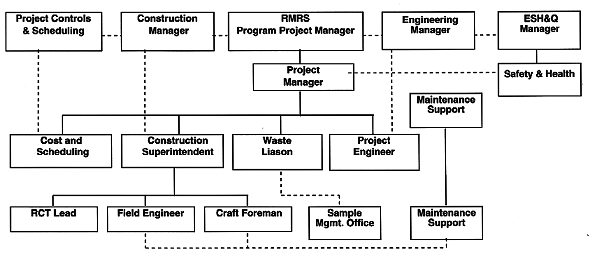
Fig. 2. Project Specific Organization
Breakdown Structure (OBS)-module glovebox removal.
The Decommissioning Project Manager(PM) reports to the Decommissioning Program Manager and is responsible for overall management of wastes generated by their specific project and all activities identified in the Project Decommissioning Plan. These responsibilities include obtaining volume estimates for the wastes that will be generated, procurement of proper containers for storage and transportation of wastes, characterization of wastes, identification of treatment, storage, disposal and recycling facilities, and coordination of all activities related to waste management planning and coordination for the project. The project manager coordinates activities such as meetings with the Waste Operations Group and other departments to assure decommissioning waste can be dispositioned prior to beginning decommissioning operations. Representatives from the various management groups involved are designated at the onset of the project and participate in routine meetings to discuss issues associated with waste management for the project. The meeting may include identification of appropriate Waste Acceptance Criteria (WAC) for receiving sites, container requirements, assistance for characterizing wastes including generation of Non-Routine Waste Origination Logs (NRWOLs), packaging and labeling requirements, and waste certification requirements (i.e. providing a program for waste inspectors). The Waste Operations Group is primarily responsible for providing technical support to the generators so that the generators can properly manage the wastes associated with the specific project in accordance with 6CCR 1007-3, 261 and 262 (40 CFR 261 and 262) and DOE Order 5820.2A.
The Decommissioning Operations Manager reports to the project manager and is responsible for coordination of waste management activities which involve the decommissioning team. These activities include coordination of generator responsibilities, waste operations for on-site treatment, storage and transportation and coordination with other groups such as Nuclear Materials Control and Nuclear Safeguards which may become involved in the methods selected for decommissioning or decontamination. The Operations Manager is responsible for ensuring that waste management activities are performed in accordance with appropriate procedures and work permits.
The Decommissioning Operations Supervisor reports to the Decommissioning Operations Manager and is responsible for daily operations conducted by crew members in the field at the decommissioning site. These responsibilities include providing direct oversite for decontamination and dismantlement operations, maintenance operations, insuring that workers have received necessary training to perform tasks, conducting waste management oversite in the field, and oversite of Craft Labor. The supervisor also coordinates field activities which involve providing oversite of technicians packaging containers and obtaining waste inspectors to inspect packaged containers in the field.
CONCLUSIONS
BIBLIOGRAPHY
DOE (U.S. Department of Energy), Order 5820.2A. Radioactive Waste Management. U.S. Department of Energy, Washington, DC.
DOE (U.S. Department of Energy), Revised March 1994. Decommissioning Handbook. U.S. Department of Energy, Office of Environmental Restoration, Washington, D.C.
DOE (U.S. Department of Energy), August 1995, U.S. Department of Energy Office of Environmental Management Decommissioning Resource Manual, Department of Energy, Washington D.C.
EPA (U.S. Environmental Protection Agency) 1986. Test Methods for Evaluating Solid Waste 3rd ed. SW-846. U.S. Environmental Protection Agency, Washington, D.C.
40 CFR. Revised January 1, 1993. Protection of the Environment. U.S. Government Printing Office, Washington D.C.
NUREG/CR-5849. June 1992. Guidance Manual for Conducting Radiological Surveys in Support of License Termination. U.S. Nuclear Regulatory Commission. Washington D.C.