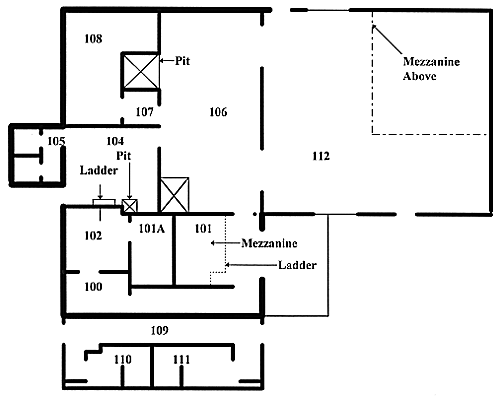
Fig. 1. Building 889 floor plan.
K. A. Dorr
Kaiser Hill
Rocky Flats Environmental
Technology Site
Golden, Co 80402
R. J. Sexton
Scientific
Ecology Group
Rocky Flats Environmental Technology Site
Golden, Co
80402
M. E. Hickman and B. J. Henderson
Rocky Mountain
Remediation Services
Rocky Flats Environmental Technology Site
Golden,
Co 80402
ABSTRACT
With the end of the Cold War the decontamination and decommissioning of surplus facilities at the Rocky Flats Environmental Site (RFETS) has begun. There are approximately 450 individual buildings to be dispositioned as part of the proposed 10-year plan. Only 35 of these facilities have significant levels of radiological and chemical contamination. The decommissioning of Building 889 was a major accomplishment for the Rocky Flats Environmental Technology Site and provided valuable lessons learned which are being incorporated in preparing for future decommissioning projects.
This paper discuses the Building 889 Decommissioning Project which was the first large scale decommissioning project of a radiologically contaminated facility at Rocky Flats. The scope of the project consisted of the removal of all equipment and utility systems from the interior of the building, decontamination of interior building surfaces, and the demolition of the facility to ground level. The project was performed using proven decontamination and demolition techniques, incorporating lessons learned from previous DOE and commercial decommissioning projects.
Details of the Project Management Plan, which include; schedule, engineering, cost, characterization methodologies, decontamination techniques, radiological control requirements, and demolition methods are provided.
BACKGROUND
Building 889 was designed and constructed in late 1960s. The ground floor space totaled approximately 2,750 square feet. See Fig. 1 for the layout of Building 889.
Fig. 1. Building 889 floor plan.
Building 889 was used as an equipment decontamination and repackaging facility for the uranium and beryllium manufacturing operations. The building foundation was poured reinforced concrete. The exterior walls were constructed of concrete masonry units (CMU). The roof was made of prestressed concrete with a built up roof. Rooms 106, 107, 108 were served by a HEPA ventilation system and provided the containment for all building operations. These rooms were the only portion of the building which had existing contamination. All other areas were considered radiologically clean.
In the mid-70's, shower/locker facilities (rooms 109,110, and 111) were added to the south end of the facility. This area encompassed approximately 613 square feet. The building addition was a framed stud structure. The interior of the walls were framed with metal studs and finished with gypsum board. This area had no history of radiological contamination.
A ventilation equipment upgrade building (room 112) was added as an extension to Building 889 in 1988. The addition was a two-story room on the east side of Building 889 which added on an additional 2390 square feet. The supporting structure was a ridged steel frame with pre-formed insulated metal siding. The roof was a built-up roofing system. This area had no history of radiological or chemical contamination.
PROJECT DESCRIPTION
Characterization
Characterization of the building was initiated by gathering and reviewing historical and current documentation of the building's previous mission, any past occurrence reports, construction drawings of the facility and equipment layout. This allowed the project team to gain familiarity with the processes involved. Walkdowns of the facility identified industrial hazards such as lead based paint, asbestos and beryllium. Discussions with operational personnel provided the history for determining the possible contaminants and the location for a biased sampling strategy. There were approximately 1200 characterization measurements made, which entailed radiological measurements, lead and dust samples, asbestos surveys and assessment of beryllium surface contamination. The characterization efforts, which included both the review of existing information and additional sampling and surveying, identified uranium, beryllium, lead based paint, and asbestos as the contaminants of concern. A building Characterization Report was maintained and updated throughout the project. This document provided a reference for project planning and waste management.
Project Planning and Engineering
The Integrated Work Control Program at RFETS was used to engineer and control decommissioning activities. In addition, the guidance in DOE/EM-0142P, "The Decommissioning Handbook" and DOE/EM-0246, "The Decommissioning Manual" were used to develop the overall decommissioning approach. A series of Integrated Work Control Packages (IWCPs) were developed to direct decommissioning operations. The IWCPs contained detailed work instructions for all activities required to complete the building decommissioning. The work instructions listed the methods and tools required for the isolation and removal of all services and utilities, the decontamination procedures, and waste reduction procedures.
During the planning of the work instructions, an Activity Hazard Analysis (AHA) was prepared for each activity. The AHA was prepared by Industrial Hygiene & Safety personnel and was used to ensure the safe conduct and thorough planning of each activity, from beginning to end.
The work task instructions were developed using Engineering, Industrial Hygiene and Safety, Radiological Engineering, and technical craft input. The project design and IWCPs ensured that cost effective waste minimization practices were utilized.
Decontamination
Initially the building underwent a rigorous housecleaning program. Excess equipment, chemicals, waste containers, tools, furniture and loose materials were removed, recycled and/or salvaged. Once the building was cleared, the physical removal of building utilities was initiated. This included the removal of the process waste piping, overhead crane, ventilation ducting, drum compactor and bailer.
A majority of the decontamination efforts were expended decontaminating the radiologically contaminated floors and walls of the facility. Characterization activities identified the presence of fixed beta/gamma contamination up to 120,000 dpm/100 cm2 on portions of the building's painted floors and walls. The surfaces were scabbled using a Pentek VAC-PAC (model 9) system with a pneumatic piston-driven Corner-Cutter needle gun (containing 3 mm reciprocating needles) and a pneumatically operated Squirrel III (with 3, 1-3/4 inch diameter, 9 point tungsten-carbide tipped bits). Training on system operation was provided to the decommissioning workers prior to use on contaminated surfaces. The scabbling tools were equipped with a Þ inch vacuum hose and shroud to collect the dust and debris removed from the surfaces. The system was very effective on floor surfaces but somewhat slow on wall surfaces. Overall the system protected the worker, was easy to operate, effectively decontaminated the concrete surfaces, generated very little waste and no airborne contamination was generated due to the efficiency of the vacuum and HEPA filtration unit.
Waste Management
Prior to beginning the decontamination tasks, a Waste Management Plan was prepared to identify the projected types and volumes of waste to be generated by the Building 889 Decommissioning Project. The plan also identified waste management activities to minimize waste volumes and addressed the disposition of materials to the Plant Utilization and Disposal (PU&D) organization, or to commercial recyclers. This plan was also used to determine the type and quantity of waste containers required to support the project.
Table I presents the actual decommissioning waste streams and the total volume or weight removed.
Table I Building 889 decommissioning Waste Streams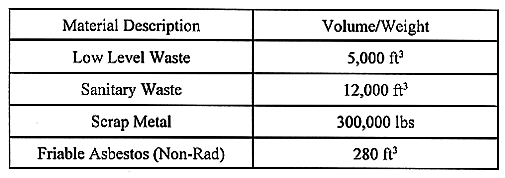
Project Closeout Survey
A comprehensive survey was performed prior to the physical demolition of the building. The project closeout survey was performed to demonstrate that any remaining residual radiological or chemical contamination were below the established RFETS release criteria. A Closeout Survey Plan was prepared to define the release criteria to be used, acceptable survey and sampling methods, instrumentation, quality assurance, data interpretation and statistical methods for demonstrating compliance with the release criteria. Since all areas of the building did not have the same potential for residual contamination, the survey was designed to include a higher survey density in areas with a higher potential for contamination. Two classifications of areas were used; Affected and Unaffected areas. The radiological survey plan was developed using the guidance contained in NRC Draft NUREG/CR-5849. The radiological release criteria was based on DOE Order 5400.5.
The survey included a 100% scan of all remaining affected area interior building surfaces, including the floors, walls and ceiling. The scan was performed to identify any locations of elevated radiological activity. A total of approximately 1200 measurements locations were identified by applying numbered stickers laid out in a one (1) meter grid pattern. At each measurement location, four (4) radiological measurements were obtained; total alpha, total beta, removable alpha, and removable beta. In addition, paint samples were collected to supplement direct survey methods to confirm the absence of contamination entrained in the remaining painted surface. Beryllium smear samples and asbestos abatement clearance samples were also collected.
The individual measurement results were compared against the average and maximum release criteria. In addition, the 95% confidence level of the mean was calculated. Survey results concluded was that the building residual contamination levels were a small fraction of the release criteria and the building was acceptable for unconditional release.
Demolition
A building demolition plan was developed in accordance with OSHA 1926.850, Subpart T, Demolition. An engineering survey of the building was performed by a licensed professional structural engineer to determine the sequence of demolition and to ensure the protection of workers and surrounding property. The plan also addressed the control of fugitive dust. The demolition was contracted to a outside vendor. Building demolition was performed using a backhoe outfitted with a hydraulic shear, as shown in Fig. 2, below.
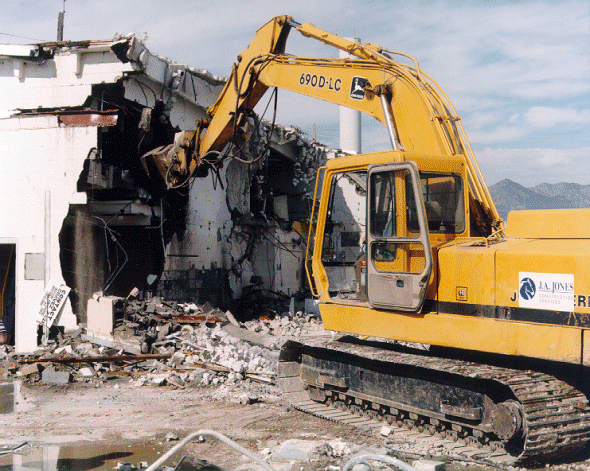
Fig. 2. Building 889 demolition.
The demolition operation was completed in 2 days. The final operation was the capping of all non-contaminated pipe penetrations remaining in the slab. The building foundation, underlying soil and capped sumps will continue to be controlled and monitored.
Radiological and Industrial Safety Performance
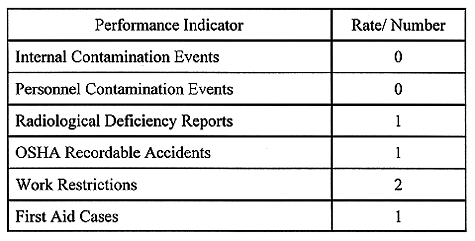
The decommissioning project had an excellent radiological and safety record as summarized in Table II. This performance was a result of an integrated project planning team that included Radiological Engineering, Industrial Hygiene & Safety, Engineering and decommissioning workers. This approach built a team that focused on safety during the work planning, implementation, and closeout.
Table II Radiological and Safety Performance Indicators
Cost and Schedule
The decommissioning project schedule was 8 months. It was initiated in January of 1996 and final demolition was completed in August of 1996. Despite some significant challenges, the project was completed within the original scheduled duration. Some issues that impacted the project schedule included:
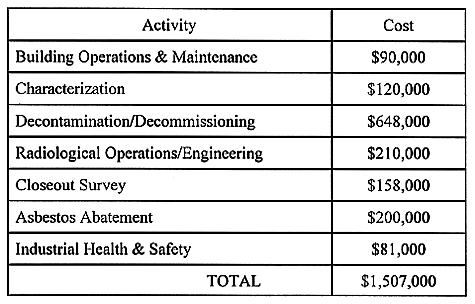
The project completion costs were within the original budget of $1.8 million. Provided in Table III is a cost breakdown for the project.
Table III Building 889 Decommissioning Cost Breakdown
CONCLUSIONS/LESSONS LEARNED
The decommissioning of Building 889 was a success. The project was performed within budget, on schedule and without any lost person hours. In addition the decontamination techniques employed minimized the amount of radioactive and hazardous waste produced and exposure to the worker. The demolition of the building also eliminated an annual facility mortgage cost of approximately $250,000 for routine surveillance and maintenance.
The decommissioning of Building 889 provided a unique opportunity to gain practical experience on decommissioning project planning, characterization, decontamination, closeout survey techniques, and the demolition of a radiologically contaminated facility. Some important lessons have been learned for project organizing, planning and decontamination techniques. Some of particular note are:
REFERENCES