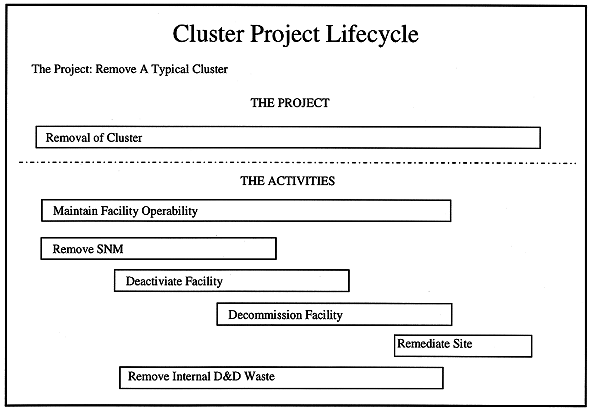
Fig. 1. Cluster project lifecycle.
Ben Evans
Kaiser-Hill L.L.C.
Rocky Flats Colorado
Paul Bengel
Rocky Mountain Remediation Services, L.L.C.
Rocky
Flats Colorado
ABSTRACT
Rocky Flats Environmental Technology Site has prepared a Ten Year Plan (Plan) that demonstrates how the Site would achieve accelerated cleanup and rapidly reduce the risks the Site currently poses in its workers, the public, and the environment. A major element of the Plan is the decontamination and demolition of over 500 Site facilities, including all of the former nuclear production facilities, by the end of 2006. Facilities used for the storage of plutonium, treatment of low-level mixed waste, and several office building would remain until the plutonium is removed or there is no longer a need for the facility, in which case it would be demolished. While the Plan considers all aspects of the cleanup and closure, this paper focuses on the challenges posed by the removal of highly contaminated equipment and the demolition of structures.
This paper describes near-term decommissioning projects as well as the long range plans and budgets. Cash flow ultimately controls schedule, and sharing of budget priorities among processing of special nuclear material, disposing of waste, and cleaning up the environment has to be juggled carefully to attain the goals of the Plan. The total cost of the Plan exceeds $5 billion, and over $1 billion will be spent on decommissioning activities. Following removal of the plutonium and the demolition of the plutonium storage and remaining Site facilities by the end of 2015, the cost to perform the long-term environmental monitoring at the Site is estimated to be $10 million per year.
INTRODUCTION
Purpose
The Rocky Flats Ten Year Plan (The Plan) describes the technical scope, schedule, and estimated cost to achieve accelerated risk reduction and significant cleanup of the Rocky Flats Environmental Site (Site) by 2006. The Plan is meant to achieve the Site Vision contained in the Rocky Flats Cleanup Agreement (RFCA). The Site Vision is the end objective which guides all future decision making at Rocky Flats.
The Plan represents a Site cleanup approach that employs DOE-stated funding level assumptions and is free of considerations not essential to accomplishment of the Plan. However, fiscal year 1997 annual work planning is proceeding in accordance with the Program Execution Guidance (PEG) funding, which is lower than that stated in the Plan.
In parallel with the development of the Plan, a Community Relations (CR) plan was developed. The CR plan describes public involvement in many of the major decisions outlined in the Ten Year Plan. It includes a decision making process which provides a framework for making complex decisions in a public process. Two major decisions which affect decommissioning costs and require public involvement in the near term are the soil action levels and low level mixed waste management. Soil action levels determine the volume of remediation waste generated which in turn impacts the methods used to treat the dispose of such wastes.
Scope
The Plan is a product of the integrated sitewide planning process at Rocky Flats and it addresses all aspects of cleanup and closure, including special nuclear material stabilization, facility decommissioning, waste management, environmental cleanup and infrastructure activities. However, this paper addresses only facility decommissioning. Other cleanup and closure activities are addressed only to the extent needed to show the impact on decommissioning.
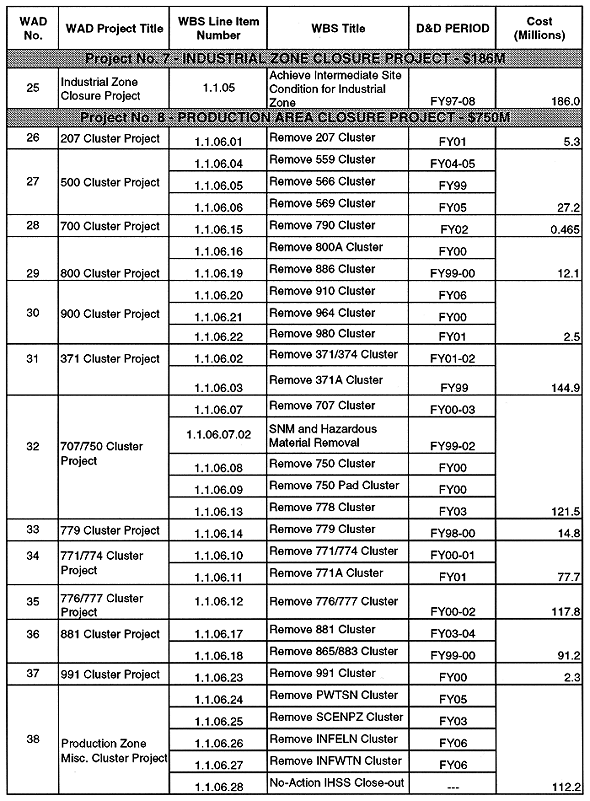
The Plan was developed around twelve major projects. The twelve major projects are delineated by the Site Work Breakdown Structure (WBS) which presents the Site as a single integrated project aimed at mission termination and Site closure. It is organized into fifty-seven groups or Work Authorization Documents (WADs) which are used to control work at the Site. Only two projects and 14 WADs are associated with decommissioning activities. These are listed in Table 1 along with titles and WBS line item numbers identified in the Plan.
DISCUSSION
Statement of Work
The Ten Year Plan would radically accelerate the reduction of Site risk, and it would cleanup almost the entire Site at a cost of about $5.4 billion. For comparison purposes, the current annual Site budget is about $600 million.
Under the Plan, the following would occur in ten years: SNM would be stabilized and either shipped offsite or stored onsite in a new, interim storage facility awaiting shipment. The vast majority of Site facilities would be demolished, including all of the former nuclear production facilities. Low level radioactive waste (LLW), including low level mixed waste (LLMW), would placed in consolidated long term storage facilities and treated either onsite or offsite. Transuranic (TRU) waste would be treated and shipped to DOEs Waste Isolation Pilot Project (WIPP) for disposal. The Site would be cleaned up to levels that would allow open space and other appropriate uses.
The vast majority of the Sites 500+ facilities and structures, including buildings, cooling towers, trailers, pump houses, etc., would be deactivated and demolished by the end of 2006. Facilities used for the storage of SNM, treatment of LLMW, and several office buildings (Buildings 130, 131, and 850) would remain until either the SNM is shipped offsite or a determination is made that there is no longer a need for the facility. Clean decontamination and decommissioning construction debris would be used as clean fill and disposed onsite.
At the end of ten years, the remaining facilities left onsite would be the new, interim storage facility for special nuclear material (SNM), the LLMW treatment Facility and several office buildings. All of the facilities would be demolished by the year 2015. Activities occurring after 2015 would consist primarily of long-term environmental monitoring.
The interrelationships between the Ten Year Plan major activities are diagrammatically represented in Fig. 1.
Fig. 1. Cluster project lifecycle.
Assumptions
Major assumptions affecting facilities decommissioning include:
Major Strategies
A number of major strategies were used to develop and prioritize the scope, schedule logic, and to estimate costs for the Plan. These strategies embody the guiding principles contained in DOEs Guidance On Ten Year Planning, Rocky Flats Cleanup Agreement (RFCA), and the Sites Accelerated Site Action Project (ASAP) document. These major strategies include:
While there were a number of assumptions made which impact the results of the Plan, the ones that significantly impact decommissioning are: the soil action levels and the waste disposal methodology. The Plan assumes that the radiological cleanup level of soil will be triggered by an 85 millirem/year dose limit, consistent with a draft EPA Radiation Site Cleanup Regulation. Application of a 15 millirem/year dose limit would quadruple the LLW and LLMW volume estimates. Also, the Plan assumes that WIPP will open in 1998 and will accept all TRU waste by the end of 2006. If WIPP opening is delayed by a year or two, an interim, onsite storage facility may have to be constructed. This will increase costs.
It is important to note that the Plan represents an integrated series of activities, and when assumptions such as the ones described above do not hold true, then the impacts to the plan can be significant. As a result, decommissioning would not be accomplished until sometime after 2006, and the resulting waste will then need to be treated and disposed after decommissioning.
Likewise, there are opportunities that may improve the results of the Plan. For example, for very large volumes of LLW and LLMW, it would be more cost effective to build an onsite Corrective Action Management Unit (CAMU). Also, the Plan assumes that the DOE-mandated process for dispositioning excess government property would be used. It is apparent that there may be significant cost savings if an expedited and cost-effective salvage process could be developed and implemented. Managing the cleanup as a project and early funding of critical path projects can realize significant project life-cycle cost savings. This is especially true for deactivating unneeded nuclear facilities.
RESULTS
Rocky Flats can achieve almost complete cleanup and closure by the end of fiscal year 2006 for a cost of approximately $5.4 billion. The total cost to manage the remaining plutonium from FY07 until it is removed by the end of FY15 and to perform environmental monitoring is estimated to cost and additional $600 million. Following removal of the plutonium and the demolition of the plutonium storage and remaining Site facilities by the end of 2015, the cost to perform the long-term environmental monitoring an the site is estimated to be $10 million per year.
The costs for decommissioning facilities is estimated to be over $1 billion. In this estimate, decommissioning include building deactivation, decontamination and demolition. It does not include costs for any on-site treatment, storage and disposal of wastes. The only waste-associated costs included with decommissioning costs are for the safe handling and containerization of decommissioning wastes to maintain control of contamination and to eliminate any double handing of wastes.
Figure 2 illustrates the funding profile for the Ten Year Plan for the 10 years involved in cleanup and closure as well as for the subsequent years covering maintenance and surveillance activities. It demonstrates when decommissioning becomes a significant portion of the Plan, i.e., about fiscal year 1999.
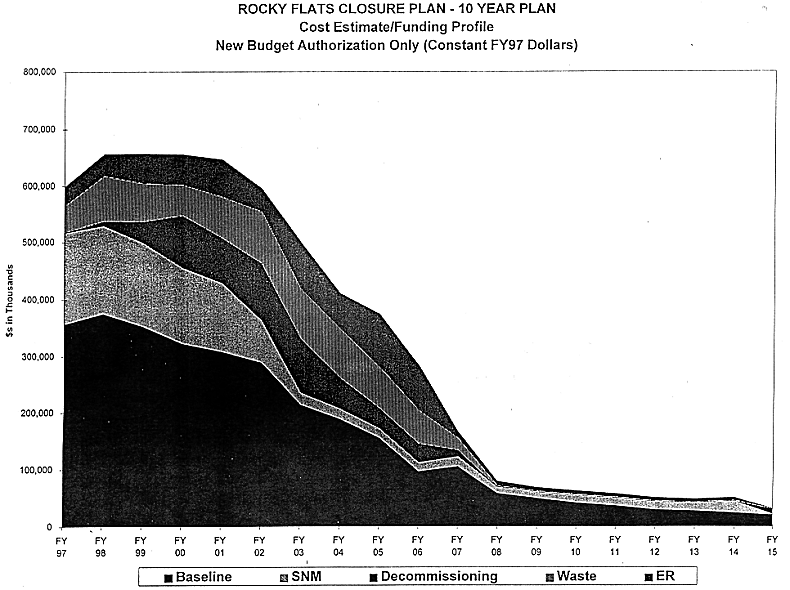
Fig. 2. Rocky flats closure plan - 10
year plan.
Table I shows the duration and the estimated costs of the decommissioning projects over the life-time of the Plan. While these costs are based on the assumptions of the Plan, privatization is being considered and is expected to reduce costs significantly.
Table I Rocky Flats Ten-Year Plan Decommissioning Project List
For decommissioning, privatization is defined as procurement process where, as a result of competition, a private vendor is awarded a fixed-price contract for decommissioning services. The vendor uses private funding to engineer, mobilize, decontaminate and decommission the facility as described in a performance specification. The basic approach will be to demolish the building to the slab at ground level. At the time of contract signing, DOE would obligate sufficient funds to cover construction costs and interest to be able to pay the vendor in the event DOE cancels the contract for its convenience. The vendor would be paid for providing decommissioning services to fixed work scope.
Payment to the privatized contractor will be negotiated and will correspond to the savings in the surveillance and maintenance costs realized by the Government. No payments will be made until savings is realized, and the final payment will not be made until the building is demolished per the performance specifications produced for the solicitation. The payment would be made from annual appropriations and by costing the original obligation for amortization of the capital costs.
FUTURE PLANS
The Plan was prepared as a one time request from DOE to provide a way to integrate the cleanup and closure activities at Rocky Flats with other facilities in the DOE complex. Based on the usefulness of this plan, it is likely that the Plan will be updated routinely to account for changes in regulations, budgets, and successes in completing planned activities.