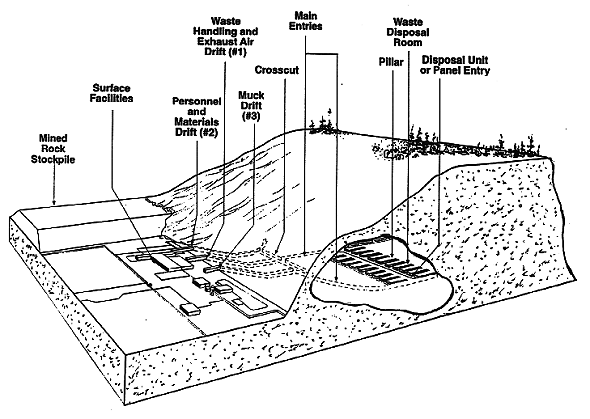
Fig. 1. Drift mine disposal method
surface layout and general underground arrangement.
P.J. Mayo
P.J. Mayo & Associates
C. D.
Breeds
SubTerra, Inc.
B. G. Goodale
Former Project Director
New York State LLRW Siting Commission
ABSTRACT
Drift mine disposal technology is recommended for disposal of most low-level radioactive waste, but is considered especially appropriate for greater-than Class C waste and reactor decommissioning waste. Drift mine disposal is believed to possess many inherent advantages over near-surface disposal methods being considered in the U.S. Some of these include: superior long-term containment of radioactive waste,
an economically competitive technology, superior stability, water intrusion resistance, less land use impacts, and siting flexibility. A drift mine represents a superior solution in terms of sociopolitical issues and acceptability; and a timely and technically superior solution for the disposal of decommissioning wastes, GTCC waste, and other problematic LLW.
INTRODUCTION
Disposal capacity for a major portion of commercial low-level radioactive waste (LLW) and virtually all greater-than Class C waste (GTCC) is not available, and will not be available at existing disposal facilities nor at those currently proposed for development. A case has been made that this capacity shortfall must be filled in the near future. This paper reviews the decided advantages of "drift mines" for meeting the long-term disposal requirements for these wastes.
BACKGROUND
The public and many government officials have demonstrated a significant level of discomfort with proposed near-surface LLW disposal facilities. These facilities inevitably invite comparison with troublesome near-surface disposal projects of all kinds, such as West Valley, Maxey Flats, Sheffield, and others. In spite of the advances in disposal regulation embodied in 10 CFR Part 61, and additional engineered enhancements proposed for new near-surface facilities, past experience has created substantial doubts that any near-surface facilities can permanently and safely isolate LLW from the environment. Other societal factors also have contributed in a major way to this concern with LLW disposal.
This lack of confidence may be attributable to:
Some of these factors can be viewed as reflections of past experience and the uncertainties associated with near-surface LLW disposal. Others are to some extent based on sociopolitical "realities" or misperception of technical issues. All told, they lead many observers to the conclusion that a permanent commitment of surface lands for disposal is, at a minimum, burdened with substantial uncertainty, and at the extreme, clearly inappropriate.
In fact, these issues do present significant technical, institutional, licensing, and sociopolitical challenges that are difficult to address. Nevertheless, the fact remains that LLW from operations at thousands of licensed facilities must be properly managed. In addition, many believe that it is irresponsible and unethical to continue to postpone decisions regarding the disposal of nuclear waste (1); and regulatory policy in many countries states that the objectives of radioactive waste disposal are to minimize any burden placed on future generations. Emphasis is therefore placed on finding a timely and permanent radioactive waste disposal solution. Finally, there is at least one bill before Congress (S-473) that seeks to limit future development of commercial nuclear facilities until the radioactive waste disposal problem is resolved.
The authors believe that drift mine disposal of LLW and GTCC can generate confidence among the general public and others in the ability to effectively isolate waste from the public and the environment. Some sociopolitical issues must be addressed in other ways; but the superior benefits of drift mine disposal, as detailed below, may aid in resolving these issues, as well.
NEED
In addition to the need to elevate the confidence level of various stakeholders in LLW disposal technology, a superior disposal alternative for low-level and GTCC radioactive waste in the United States is necessary for other important reasons:
By far the largest volume of future LLW will come from decommissioning of nuclear power reactors. A reliable estimate of the volume of reactor decommissioning waste is not currently available because the host states and compacts have used different and inconsistent methods in making projections. While some states have not yet published any decommissioning waste estimates for their states (2), New York State and Connecticut have prepared some of the more detailed projections of decommissioning wastes, and the results from these two states illustrate the magnitude of this waste source. For its six commercial power reactors (3 BWR and 3 PWR), New York State projected that 99,000 cubic meters (3.5 million cubic feet) of decommissioning waste would be produced over a 60 year operating period, 81% of the total projected volume of LLW for the state. The accumulated activity in the decommissioning waste at the time of facility closure (taking decay into account) is estimated to be 324,000 curies (3). Connecticut projects 28,300 cubic meters (1.0 million cubic feet) of decommissioning waste for its four commercial power reactors (1 BWR and 3 PWR), or 71% of the state's total over 50 years (1). It is clear that decommissioning wastes represent a significant future waste stream and a large percentage of the total volume of LLW.
Lending some urgency to the need for timely and reliable and long term disposal capacity for reactor decommissioning waste is the prospect of a competitive electric industry, which is being actively pursued in many states. The resulting economic forces of competition could lead to the accelerated retirement of older and less efficient nuclear units. This would mean having to face the prospects of disposing of large volumes of decommissioning waste much sooner than previously contemplated.
It is unlikely that all of the LLW from accelerated and subsequent decommissioning can be accommodated at existing or currently planned disposal facilities:
GTCC waste contains higher concentrations of radionuclides than are allowed in near-surface disposal facilities according to regulations developed by the Nuclear Regulatory Commission in 10 CFR Part 61. For this reason, GTCC is treated as a special waste. Its disposal is recognized as a federal responsibility, with geologic disposal being the preferred disposal method. It is estimated that approximately 3,250 cubic meters (115,000 cubic feet) of commercial GTCC waste will require disposal in the United States between now and 2035 (4).
SOLUTIONS
One possible solution to the likely shortfall in suitable disposal capacity, would be to provide separate, and possibly centralized, disposal facilities for problematic waste streams. These facilities could handle certain reactor decommissioning wastes, high activity resins and activated reactor hardware, as well as GTCC waste from reactors and other sources which require special disposal methods. The remaining, mostly Class A waste, could be placed in engineered, near-surface facilities. (Currently, several European nations are planning to dispose of short-lived waste in near surface engineered structures that provide safe isolation for 200-300 years; with long-lived waste disposed of in underground, or mined, waste repositories.)
The authors believe that an intermediate depth drift mine, located several hundred feet below the ground surface, in a suitable rock formation, and situated in a location with some surface topographic relief, would represent a particularly suitable method for disposal of GTCC waste, as well as some LLW wastes from reactor operations and decommissioning. As will be discussed below in greater detail, a drift mine offers a better opportunity to attain performance and other environmental objectives. In addition, by removing some of the more hazardous and troublesome reactor wastes from the LLW stream, it might make it easier for host states and compacts to successfully site and operate disposal facilities to deal with the remaining wastes. Drift mines also offer other advantages over near-surface methods because the disposal units are deep underground and do not require the permanent commitment of large, potentially useful tracts of land.
Drift and shaft mines are being used or are planned for use in Europe and at the Yucca Mountain site in the United States for LLW, ILW, and HLW disposal. Mine disposal technology also was extensively evaluated by one state in the U.S. for its LLW program and was judged to provide a technically superior means to isolate all types of LLW. The concept is considered technically suitable and economically viable for LLW and GTCC for most regions of the United States.
DRIFT MINE DESCRIPTION
Drift mines provide access to the subsurface via slightly downward sloping "drifts" or "declines." Rooms are mined off this main decline for entombment of LLW and GTCC waste. A full description of the design for both shaft and drift accessed LLW disposal units is provided in References 5 and 6. The concept is illustrated in Fig. 1.
Briefly, some of the attributes of drift mine disposal include:
All of these potential advantages should ultimately lead to greater confidence on the part of regulators and the public regarding the licensability, safety, and acceptability of LLW disposal.
Fig. 1. Drift mine disposal method
surface layout and general underground arrangement.
DISCUSSION OF FEATURES AND ADVANTAGES
Stability
One performance objective of 10 CFR Part 61 requires that the disposal facility be "sited, designed, used, operated, and closed to achieve long-term stability of the disposal site and to eliminate to the extent practicable the need for ongoing active maintenance of the disposal site following closure..." Although satisfying this objective is theoretically possible for near surface facilities, it is a tall order to convincingly demonstrate to local communities, the public in general, and politicians that stability can be maintained for hundreds or thousands of years. Weathering and deterioration of manmade barriers, erosion of disposal cell caps, seismic events, animal and vegetative intrusion, erosion of other site features and disposal cells are all possible or perceived as likely over extended time periods. It may be difficult to build confidence in the ability to deal with these factors due to perceptions related to the uncertainties associated with future events and the lack of positive experience with long-term man-made projects. These perceptions have led to a widespread movement to delay and replace LLW disposal with long-term, monitored storage.
Drift mines, on the other hand, inherently possess stability that is much easier to demonstrate. The "cap" over a drift mine facility would be the unmodified overburden that is likely to have existed in essentially that same form for thousands of years. Tunneling into such a formation would not significantly impact the stability of this natural "cap." Neither is this formation likely to be significantly impacted by seismicity (seismic effects are proven to be substantially less severe at mine depths), erosion, weathering, or other naturally occurring phenomena. In addition, it is less likely to be substantially modified by any human endeavors to depths that would impact the disposal cells (nominally several hundred feet below the surface). Stability issues therefore would be minimal relative to those for near-surface facilities.
Vulnerability to Extreme Events
Any LLW disposal facility would be sited, designed, operated and closed to withstand extreme natural phenomena such as earthquakes, floods, erosion, and tornadoes, and human-related extreme activities such as intentional intrusion, plane crashes, fires and explosions. Nevertheless, disruptions more severe than those anticipated in the design could occur under unusual circumstances, potentially causing the release of radioactive materials to the environment. The risk that this would occur would depend on the types, probabilities, magnitudes and timing of these extreme events, their impact on the facility's waste containment barriers, and the size and nature of the radioactive releases that would be associated with resulting barrier failures. The possibility of radioactive releases from extreme events would be much less for a drift mine than for near-surface methods. Many of the potential extreme events are associated with surface phenomena or activities which could have greater impacts on the concrete and earthen cover barrier systems used for near-surface methods. In contrast, a drift mine with several hundred feet of natural rock and soil cover would be less vulnerable to these types of events, as well as to other extreme phenomena such as earthquakes.
Resistance to Intrusion
Mined facilities constructed in formations possessing no known valuable resources could reasonably be expected to be resistant to intentional or inadvertent intrusion. Certainly, most or all of the inadvertent intrusion scenarios customarily evaluated for near-surface facilities would not apply to drift mine facilities located at depths of a few hundred feet or more. In fact, it may be difficult to postulate a reasonable inadvertent intruder scenario for such a facility, although deep drilling scenarios have been specified as appropriate for the high-level waste repository.
Groundwater Movement and Aquifer Contamination Potential
Aquifer contamination potential was one of the factors evaluated by the New York State Low-Level Radioactive Waste Siting Commission during disposal method selection. The results (7)(8) indicate that a drift mine in shale and deep mines in salt, shale, and limestone were superior to near surface methods with regard to aquifer contamination potential. The excellent performance of the mine methods was "due to the extremely low groundwater flow rates through the facility and the extremely long groundwater travel times.." (8). Of significance is that acceptable performance of near-surface methods was conditioned on the assumption that covers remained intact. Interestingly, this study indicated that a mined repository in fractured crystalline rock would not meet the performance requirements. This was due to the fact that the hydro geologic site characteristics that were used in the performance analyses for crystalline rock sites were for areas that had been characterized for well development. However, there is clear evidence that suitably tight crystalline rock sites, that would meet the performance requirements, are available in the US.
Reduced Performance Assessment Uncertainties
The reduced number of intruder scenarios that must be considered for a drift mine also reduces the uncertainties associated with performance assessments that must predict future facility performance. This is an issue whose importance should not be underestimated. The likelihood of inadvertent intrusion into an uncontrolled (following institutional control) near-surface facility cannot be denied. The perceived consequences associated with these scenarios is most often considered unacceptable by the public and activist groups, even if exposure levels can reasonably be shown to be minimal. The drift mine's elimination of likely intruder scenarios, such as farming or construction that must be considered for near-surface disposal, drastically reduces these concerns linked to uncertainties associated with intruder consequences.
Superior Performance in Terms of Human Radiation Exposure
If a suitable site and geologic formation are selected, mine disposal can be shown to provide superior protection of human health and the environment. Previous performance assessment analyses prepared for the State of New York have indicated essentially no human exposure for up to 10,000 years if a mined facility is sited in a geologic formation such as shale. Several European nations have reached the same conclusion regarding mined disposal in salt, clay, and crystalline rocks.
The superior long-term performance of underground disposal in suitable geologic formations has been validated by natural analogues. One example is the 1,300 million year old uranium deposit at Cigar Lake in Canada. That deposit is surrounded by 5 to 30 meters of clay which has isolated the ore over that time.
Superior Water Penetration Resistance and Water Management Ability
The undisturbed overburden above a drift mine serves as the "cap" which is intended to prevent penetration of rain and surface waters into the waste disposal cells. In properly selected competent geologic formations, the unweathered and undisturbed portions of the overburden provide a high integrity cap of a few hundred feet or more in thickness. These undisturbed "caps" have typically existed at these sites for thousands of years in essentially the same condition as they are found today. Left undisturbed, their integrity and stability are excellent high integrity barriers to water penetration that could not practically be duplicated by manmade structures, including those utilizing natural materials. In fact, very dry formations of the type considered suitable for LLW drift mine disposal have been developed for other purposes, including document storage and storage of liquefied natural gas. Experience at these facilities has shown that water intrusion into mined areas can be measured in, at most, a few tens of gallons per year, and that these waters may be principally from perched water within the formation
Water intrusion via the main access tunnels, or drifts, can be virtually eliminated, in locations with adequate topographic relief, by careful design of the main tunnel ramps. Entry and exit portals located well above maximum design basis floods eliminate the possibility of mine flooding, even after closure. Initially up-sloping ramps that result in high point tunnel elevations above elevations where water seepage into the tunnels could occur through the weathered zone of the host geologic formation can virtually eliminate this source of intrusion as well. This inherent feature of a drift mine can minimize, if not eliminate, dependence on long-term integrity of seals to prevent water intrusion.
Siting Flexibility
Of critical concern in developing a LLW disposal facility is the ability to find a site whose specifications are suitable to meet the performance and other required design objectives. The relative ease in finding a suitable site is dependent in part on the disposal method selected since it affects the land area required, the type and extent of suitable geologic media that is required for the disposal facility, and, in the case of near-surface methods, the proximity of groundwater to the surface.
In general, finding a site suitable for a drift mine should be no more difficult than in finding a site for near-surface methods. While not all geologic media or topographic conditions would be well suited for a drift mine, this limitation would apply to near- surface methods as well. Studies in New York State indicate that mines could meet performance objectives if located in a variety of rock types such as shale, carbonates and salt (7)(8); these rock types are abundant in New York as well as other states (9)(10).
An advantage of a drift mine is that land area requirements for the disposal facility would tend to be smaller than for near-surface methods, especially with methods requiring large earthen cover systems. For example, New York's proposed 5.5 million cubic foot waste disposal facility would require about 350 acres of surface land if a drift mine were used, compared to 600 acres for covered above-grade vaults and 470 acres for below-grade vaults (7).
Drift mines can be developed in a wide range of topographies and geographic locations. Although mountainous or hilly regions might be preferred, relatively flat formations can also be developed. Site locations are primarily limited by availability of competent host bedrock formations and are not directly related to surface features normally considered desirable for near-surface facilities. Depth to water table as normally defined, weather patterns and precipitation, and stable surficial geology are not as important as they would be for near-surface disposal. The desirability of hilly regions makes considerably more locations potentially available than would be so when developing near-surface facilities, where relatively flat land with suitable surficial soil deposits is desirable, if not necessary.
Monitoring and Observation
Monitoring and observation of a drift mine LLW facility can be somewhat more complex than performing these functions for near-surface disposal, due to the greater depths of disposal cells. However, during operations and post-closure periods when the mine has not been closed and sealed, monitoring and observation may be relatively straightforward, since the interior of the mine and the disposal cells can remain accessible. This may be true during institutional control, as well, if the mine portals and main declines are left open and accessible. Monitoring after backfilling and closure of the facility can also be performed through surface boreholes located to intersect the bottom of the access drifts (e.g., the low point in the constructed facility) and boreholes drilled down gradient of the site.
Reduced Emphasis on Stable Waste Forms
The stability of disposal units is critical to the performance of near surface facilities under Part 61. Facility stability is achieved by a number of disposal system elements, including stable waste forms. These technical criteria and techniques are intended to prevent subsidence of near-surface disposal cell covers so that rain does not penetrate cell barriers and carry radionuclides out and through various pathways.
Waste stability is not likely to be an important factor in drift mine facilities. Subsidence of the waste might contribute to relatively minor collapse of the host rock in mined disposal cell roofs. However, with the cells hundreds of feet below the surface, the integrity of the overburden would not be affected, and the ability of the formation to prevent water infiltration would not be compromised.
Minimum Dependence on Man-Made Materials
As alluded to above, a drift mine does not rely on manmade materials for long-term stability, human intruder protection, or water intrusion prevention. These functions are provided by the inherent and superior natural features of the geologic formation in which the mine is constructed. Although concrete linings, steel rock bolts, and retrievable concrete waste container overpacks may fill short-term roles, they are not required for enhancement of long-term performance. This characteristic of drift mines eliminates considerable uncertainty in long-term performance assessments. It therefore can eliminate public concern regarding durability and minimal historical experience with manmade materials. This in turn may lead to greater confidence that a reliable long-term solution is possible for LLW disposal.
Waste Recovery and Retrievability
Waste recovery or retrieval from the disposal facility may be necessary if there were to be a containment failure or if a superior technology for waste disposal were to be developed in the future. Waste retrieval allows for the removal of waste in intact containers, whereas recovery involves removal of the waste in whatever form that is possible. A disposal method that enables easier recovery or retrieval is advantageous since it provides greater flexibility in dealing with future uncertainty.
In terms of complexity and therefore cost, recovery or retrieval of waste from a drift mine should be no more difficult under most circumstances than for near-surface methods. During facility operation, it would be as easy, if not easier to enter disposal units in a drift mine to retrieve waste packages as with near-surface methods. After facility closure, waste recovery or retrieval from a mine would be more complex because of the high costs of having to reenter and refurbish a mine after it has been closed. However, comparable costs for near-surface methods would also be large because of the necessity of having to reopen the many massive concrete and earthen cover containment structures. If the goal were to recover or retrieve a small fraction of the waste (e.g. Class B/C waste), near-surface methods could offer an advantage, since only a small number of disposal units would need to be reopened. The importance of this advantage depends, of course, on the likelihood that there would ever be a need to recover or retrieve a portion of the waste after closure.
Land Use and Visual Impacts
Since the disposal units with a drift mine are located deep underground, the potential for conflicts with other surface land uses would be less than for near-surface methods. During operation, the major surface structures would be those needed to receive, process and transfer waste to the underground disposal units and to operate the disposal facility. Some rock spoils from the underground excavations might also be stored on the surface for future use during facility closure. After closure, there would be little visual evidence of the location of a disposal facility and non-intrusive land uses could be allowed on the land surface over the disposal units. In contrast, with most near-surface methods, extensive earthen mounds covering the disposal units would remain; these mounds and the relatively shallow depth of disposal would restrict the types of land uses that could take place and would also serve as a constant visual reminder of the presence of a disposal facility.
A drift mine disposal facility would not require commitment of important surface lands. Minimal surface land would be required for mine portals and administrative and operational facilities. If the mine was constructed beneath significant topographic relief (e.g., a hill or a mountain), the facility would be even less likely to impact otherwise usable land. Steep slope terrain, which is especially suitable for a drift mine would have a minimum of other uses such as farming, commercial, or residential. It is possible that the area could still be used for other endeavors (e.g., recreational), since the disposal facility would lie several hundred feet below the surface. An important consideration here is that usable or otherwise desirable and accessible near-surface land would not be irrevocably committed to disposal.
Some LLW siting programs have adopted a viewshed impact site selection criteria. This may be a relatively important environmental criterion for some regions. The authors believe that drift mine portals and support facilities can be designed and implemented with substantially less short-term and long-term viewshed impacts than can be achieved for near-surface disposal. If support facilities are located outside of the mine portal (entrance), they would occupy minimal surface areas and could be attractively designed as any other commercial office or light industrial facilities. It also would be possible to incorporate most if not all of the support structures underground, immediately adjacent to the mine entrance. Little viewshed impact would result in either case.
Licensability
For a disposal facility to be licensed, compliance with all regulatory requirements must be demonstrated and there must be public support for the facility. The ability to license a particular facility generally increases in proportion to the amount of regulatory guidance available, the number of precedents in licensing the disposal method, the relative ease to characterize or model the site and facility, and the public perception towards the facility.
A drift mine has some disadvantages compared to near-surface methods with regard to licensability, although the constraints are surmountable. Nuclear Regulatory Commission regulatory guidance for LLW disposal has focused on near-surface disposal methods and thus creates some uncertainty for licensing a mine disposal facility. However, there is precedent for drift mine disposal of LLW in several European countries and for high-level waste in the United States, so that necessary regulatory structures could be developed. In fact, the State of New York, in NYCRR Parts 382 and 383, has promulgated regulations for LLW disposal in mines. Regarding facility characterization and modeling, a drift mine in a suitable rock type such as shale, should pose no greater difficulties than for near-surface methods.
The superior predicted performance of the mined method should enhance public confidence in the disposal method and hence facilitate licensing. Public perception surveys in New York State showed greater support for above-grade over near-surface below-grade methods and mines (7), but surveys done in other states yielded contradictory or inconclusive results. Therefore, it is not clear whether a mine is perceived favorably or unfavorably by the public. However, it is believed that public confidence can be increased by drift mine disposal given its superior attributes and fewer uncertainties.
Favorable Economics
It is a common misconception that mined disposal options are prohibitively expensive relative to near-surface options. Two life-cycle economic studies have been prepared for the New York State LLW disposal facility development program. Both studies concluded that drift mine options compared favorably with near-surface disposal options being considered, including above-grade concrete vaults. Details of the designs and cost estimates prepared for New York State are contained in References 7, 9, 5, and 6. The most recent estimates, prepared using actual, generic site data from New York State (10), are provided in Table I.
Table I Summary of Estimated Life Cycle Costs for Six LLW Disposal
Methods
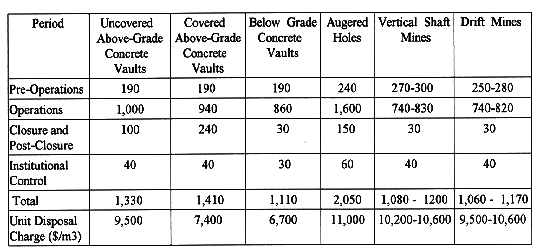
Note: The Unit Disposal Charge (UDC) is higher for the mines due primarily to the cost of constructing the mine accesses. This UDC calculation is significantly affected by the volume of waste available for disposal due to these fixed up-front costs. A higher annual receipt rate, or front loaded receipts from storage would therefore favor mines and result in a lower than projected UDC.
THE USE OF MINED LLW DISPOSAL FACILITIES IN OTHER COUNTRIES
A majority of industrial countries in the Western World, including Germany, UK, Sweden, Finland, and Switzerland are pursuing underground disposal of Low-Level Radioactive Waste (LLW), and most countries are planning to dispose of High-Level Radioactive Waste (HLW) in deep, underground facilities. Some details for active repositories and relatively advanced programs in Europe are provided below.
Forsmark, Sweden: The repository at Forsmark has been in operation since 1988 with a total planned capacity of about 90,000 cubic meters of operational and short-lived ILW. The initial construction of four caverns and one silo provide a capacity of 60,000 cubic meters of waste. The repository is located offshore at 60 meters to 140 meters depth in good quality gneiss/granites. Engineered containment is provided by the waste matrix and waste container (all waste), by concrete structures and backfill (ILW), and by a concrete silo surrounded by low permeability backfill (higher-level ILW). Site isolation is provided by low-permeability rock, by fault structures that control groundwater flow regimes, and by the hydraulic balance provided from overlying sea water of the Baltic sea.
Morsleben and Konrad, Germany: The Morsleben radioactive waste repository re-opened in 1994 and accepted its first shipment of LLW and ILW since unification. The repository is located in domal salt in what was Eastern Germany. Sufficient LLW and LLW is being produced by Greifswald to fill this repository requiring that a second repository be operated at Konrad. The Konrad repository is located in an abandoned iron ore mine isolated from overlying aquifers by a thick clay strata.
Sellafield, UK: The Sellafield site in Cumbria has been identified by UK Nirex for more detailed site characterization and repository design. The potential capacity has been stated as 400,000 cubic meters of LLW and ILW over 50 years. The proposed location for the repository will be in volcanic rocks underlying a series of limestone, shale, and sandstone. Engineered containment is to be provided by the waste matrix and waste container, and by groundwater isolation and chemical buffering using concrete structures and cement-based backfill. Site isolation is provided by the target depth of about 550 meters and the low permeability host rock.
Olkiluoto, Finland: The repository has an initial capacity of 8,500 cubic meters of LLW/ILW. It is located 70 to 100 meters deep in bedrock. Engineered containment is provided by the waste matrix and waste container (LLW/ILW) and by a concrete lining and backfill (ILW). Site isolation is provided by low permeability rock.
Other mined facilities have been developed or are being evaluated at Loviisa, Finland; WIPP, New Mexico, USA; Asse, Germany; Wolfenschiessen, Switzerland; Deux-Sevres, France; Main et Loire, France; and Ain, France.
CONCLUSIONS
The authors believe that mines, particularly drift mines, provide:
REFERENCES