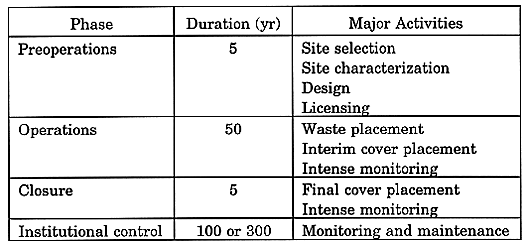
Table I Major Life Cycle Phases Of Both Disposal Facility Designs
Arthur A. Sutherland, Nam Chau, and Robert D. Baird
Rogers & Associates Engineering Corporation
P.O. Box 330
Salt Lake
City, UT 84110-0330
Phone: (801) 263-1600, FAX: (801) 262-1527
ABSTRACT
Recently, a novel approach to long term management of low-level radioactive waste (LLW) called assured storage has been proposed. It has been suggested that this concept offers several major advantages over the usual LLW disposal methods, including reduced siting costs. By reducing early expenditures, the present value of life cycle costs could also be reduced. This paper presents the results of present value analyses of costs associated with assured storage and disposal facilities for the management of LLW that are based on similar designs.
INTRODUCTION
All states and compacts that are developing new low-level waste (LLW) disposal facilities have met strong resistance to the placement of those facilities. Much of that resistance has centered around concerns about the ability of the facilities to protect public health and safety by containing the radionuclides in the waste. Recently, a novel approach to managing LLW has been proposed (Newberry 1995). In this approach the waste is placed in "assured storage," which uses manmade components similar to those used in LLW disposal concepts. Because they are not configured for minimum long-term maintenance, as disposal facilities are required to be, assured storage facilities allow better inspection and monitoring of waste containers and disposal vaults than that normally available with disposal facilities. The assured storage concept allows such monitoring to continue indefinitely, if desired.
The originators of the assured storage concept suggest it offers several major advantages over the usual LLW disposal concepts, including reduced site characterization and legal costs for defending the choice of a site (which for some compact facilities have approached $100 million). When the present value of the life cycle cost is taken into account, this reduction in early expenses should be significant. This paper describes comparative evaluations of the life cycle costs of assured storage and disposal as methods of managing LLW over the long term. The designs used in the cost analyses are representative of those thought to be generally acceptable to the public and protective of human health and the environment.
CONCEPTUAL DESIGNS
Four conceptual facility designs formed the basis for the comparative life cycle costs: a baseline and an alternative disposal facility, and a baseline and an alternative assured storage facility. Certain features were common to all four facility designs. These included the waste to be emplaced, the period over which the waste is assumed to arrive at the facilities, the annual rates of waste receipt, and certain gross characteristics of the disposal and storage units. Generally, these features are characteristic of waste and designs that have been studied for disposal of LLW in Connecticut. However, they do not necessarily represent what will eventually result in that state.
In all four designs, the waste is put in above-grade, reinforced concrete structures resembling vaults. Only the details and dimensions of the vaults differ. The disposal and assured storage units have engineered earthen covers, although the storage units do not have covers that are as elaborate as the disposal units. The total volume of LLW to be disposed of or stored is 1,454,000 cubic feet, of which 214,000 cubic feet, or about 15 percent, is Class B and Class C waste. All waste is placed inside cylindrical, reinforced concrete canisters that are approximately 9 feet high and 8 feet in diameter. The canisters are then placed inside the vaults. The waste was assumed to be received and emplaced over 50 years.
The Conceptual Designs for Disposal
The baseline conceptual design for LLW disposal involves placing concrete canisters in cells that are subunits of concrete vaults. Waste is grouted in place inside the canisters, and the canisters are loaded through the open tops of the vaults before the roofs are built. When all the cells in a vault are filled, the spaces between and above the canisters are filled with gravel and the vault roof is constructed. Eventually, the vaults in a disposal unit are covered with an engineered earthen cover system. Drains route any water that may reach the floors of the vaults into collection tanks, where it is removed and analyzed to ensure that significant amounts of radionuclides are not leaving the waste canisters.
Class B and C wastes are segregated from Class A wastes and placed in separate vaults. The designs for the vaults used for Class B and C wastes differ slightly from those used for Class A wastes. Each disposal cell within a Class A vault can contain up to 27 concrete canisters configured in 3 layers of 9 each. The Class B and C vaults are similar to the baseline Class A vault except that each cell can only contain up to 18 concrete canisters configured in 2 layers of 9 each. More space is left above the upper layer of canisters than in the Class A vaults; that space allows more gravel to be placed above the waste as shielding during vault roof construction and ensures that there are five meters of cover over the waste.
The final component of the baseline disposal unit is the cover system. After each vault is filled, a 7.5 foot thick interim cover is placed over it. When the disposal facility is closed, the top 4 feet of the interim cover is replaced with the materials that constitute the top 4 feet of the final cover, consisting of layers of the following materials from bottom to top: gravelly sand, compacted clay, high-density polyethylene, geotextile, coarse gravel and cobble, pea gravel, and topsoil. The life cycle of the disposal facility includes preoperations, operations, closure and postclosure, and institutional control periods. Table I lists the major phases of the disposal facility life cycles for both the baseline and alternative disposal facility designs.
Table I Major Life Cycle Phases Of Both Disposal Facility Designs
Generally, the alternative design represents a lower cost, less complex facility than the baseline design. The disposal vaults in the alternative design do not have the internal concrete walls that divide the vaults in the baseline disposal facility into cells. The alternative design also uses a single vault design for all three classes of LLW. The interior of this vault is high enough to accommodate three layers of concrete canisters, as is the vault used for Class A waste in the baseline design. To satisfy regulatory requirements for their disposal, Class B and C wastes are only put in the lowest layer of canisters. In this way all three classes of waste can be placed in the same vault. The area covered by the alternative disposal facility totals 123 acres, compared to 133 acres for the baseline disposal facility.
Conceptual Designs for Assured Storage
Like the baseline disposal design, the baseline assured storage design involves placing concrete canisters in cells within concrete vaults. However, in the assured storage design, granular materials such as gravel or sand are used to fill any void spaces inside the canisters. This feature facilitates retrieval of individual waste containers within the canisters. As occurs in the baseline disposal design, Class A waste is segregated from Class B and C waste and placed in separate vaults.
To allow continual monitoring of the condition of vaults and cells, the baseline assured storage facility incorporates a remotely operated mobile visual inspection device. This device, which is equipped with a television camera, is used to check the vaults and cells during the operations period, and for as long after the end of operations as inspection and preventive maintenance continue. The baseline designs for the assured storage vaults incorporate 5-foot-wide aisles between the waste canisters and the cell walls to allow operation of this inspection device.
Unlike the disposal facility designs, the roofs of assured storage vaults are constructed before waste placement begins, and the waste canisters are emplaced from the sides of the cells. Because access to the interiors of the cells is needed to inspect the condition of the cell walls, vault walls, and vault roof, the waste is loaded through openings in the cell walls. Each Class A storage cell can contain up to 27 concrete canisters configured in 3 layers of 9 each. Each Class B and C storage cell can contain up to 18 waste canisters configured in 2 layers of 9 each. All canisters are placed in the centers of the cells, in order to create the 5-foot-wide aisles needed for the inspection equipment.
The cells in the baseline assured storage vault are not as high as the corresponding disposal cells because the latter include several feet of gravel placed over the waste to shield workers constructing the vault roof after the vault has been filled. The cell height does, however, allow adequate room for inspecting the roof.
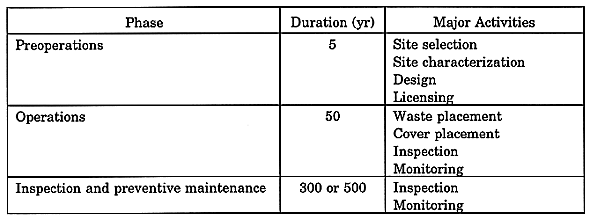
After closure of an assured storage vault, a 4.5 foot thick cover is placed. The cover consists of, from bottom to top, gravelly sand, compacted clay, and native soil. The cover is sufficiently deep to protect the concrete vaults from freeze-thaw temperature cycles and to help prevent intrusion of precipitation into the vaults, canisters, and waste. In case it is later decided to convert the assured storage facility to a disposal facility, the site design leaves enough space to build covers over the storage vaults that have the same thickness and slopes as those in the disposal facility design. Table II lists the major phases of the assured storage facility life cycle for both the baseline and alternative assured storage designs.
Table II Major Life Cycle Phases Of Both Assured Storage Facility
Designs
Generally, the alternative assured storage design represents a lower-cost, less complex facility than the baseline design. The storage vaults in the alternative design do not have the internal concrete walls that are part of the vault designs for the baseline storage facility. Furthermore, the width of the aisles that allow inspection of vault walls is reduced from 5 feet (in the baseline design) to 2 feet. Together, these two changes significantly reduce the size of the assured storage vaults, and consequently their construction costs. The alternative design also uses a single vault design for all three classes of LLW. The interior of this vault is high enough to accommodate three layers of concrete canisters, as is the vault used for Class A waste in the baseline design. To satisfy regulatory requirements in the event a decision is made to convert the storage facility into a disposal facility, Class B and C wastes are only put in the lowest layer of canisters. Finally, the Class B and C wastes are used to fill the entire lowest layers of a few vaults. This means that some vaults are used only for storage of Class A waste, which could allow early termination of inspection and preventive maintenance of those vaults. The area covered by the alternative facility totals 131 acres, compared to 162 acres for the baseline facility.
OPTIONS ANALYZED
In addition to the two conceptual designs considered for both disposal and assured storage, other options related to the development and operation of the waste management facilities were analyzed. These options include:
Present value cost estimates were calculated for the distinct cases listed below. Each case is designated by a three-character alpha-numeric code which indicates whether the case represents costs at a disposal facility or an assured storage facility, what phase in the facility's life cycle is represented, and which of the several options for that facility and life cycle phase is represented. For example, the code D1B indicates that the case is for a disposal facility (D), for the first(preoperations) phase, and for preoperations phase costing option B.
Disposal
Preoperations Phase
All three preoperations cases use the baseline disposal facility design.
Operations Phase
Closure Phase
Institutional Control Phase
Assured Storage
Preoperations Phase
All three preoperations cases use the baseline assured storage design.
Operations Phase
Inspection and Preventive Maintenance Phase
Only certain combinations of cases are plausible. For example, the combination D1A + D2B + D3B + D4D is plausible, but the combination D1A + D2B + D3B + D4B is not. There are 12 plausible combinations each for disposal and assured storage.
The size of the waste management site influences to a small degree the cost of preoperations, closure (of a disposal facility), and institutional control or inspection and preventive maintenance. To keep the number of cases reasonable, this fact was ignored and the size of the baseline facility was used to calculate costs for these phases. Those cost estimates were used for both of the corresponding disposal and assured storage designs.
COST ESTIMATES
Detailed estimates, expressed in 1996 dollars, were made for the costs for each of the cases described above. It was assumed that during the operations period, enough money is collected to ensure that all activities following closure of the facility can be paid for. Part of those monies are needed to ensure that after the end of operations both the disposal facilities and the assured storage facilities have sufficient funds available to cover the cost of retrieving all waste and placing it in another disposal or assured storage facility, as appropriate. In estimating the retrieval costs, it was assumed that for all facilities the concrete containers and the concrete vaults would be intact at the time of retrieval. To prepare the life cycle cost estimates, it was assumed that the monies put aside in a trust fund to cover the cost of retrieval must be sufficient to provide funds for retrieval any time following 100 years after the end of waste receipt.
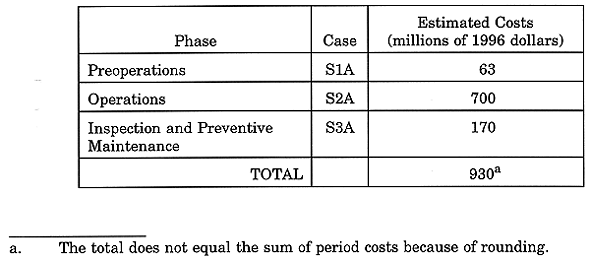
Space does not permit exposition of all the cost estimates developed. However, Tables III and IV show estimates for the major life cycle phases for selected cases involving the baseline disposal and assured storage designs.
Table III Example Summary Of Disposal Facility Costs By Period
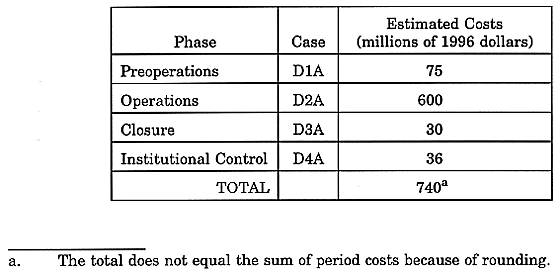
Table IV Example Summary Of Assured Storage Facility Costs By Period
PRESENT VALUE ANALYSIS
Present value analysis determines the amount of money that would have to be put aside now to have enough to pay for all activities anticipated to take place during a project's life cycle. One of the factors that must be taken into account when considering the cost of an activity that will not take place until a significant amount of time has elapsed is the effect of inflation. Another factor that must be considered is the net potential earnings on money put aside now for paying expenses well into the future, called the return on investment.
Present value analysis is used to compare life cycle costs of projects to help identify projects that can provide the most favorable return over a defined period of time. For many projects, such as road improvements or harbor dredging, there is a readily identifiable monetary return for the money spent on the work. For other projects, such as those involving environmental protection or improvements in safety features, the monetary return may be harder to define. Clearly, there can be a monetary benefit resulting from building a single LLW disposal or assured storage facility if the waste generators must otherwise provide on-site storage at multiple locations if such a facility is not built. The enhanced protection of public health and safety that will result from such a facility is a major benefit as well, even if it is difficult to express in monetary terms. For this comparison, it was assumed that the benefits of disposal or assured storage are essentially the same. This assumption allowed the comparison to proceed on the basis of the present values of the costs of these two facilities alone.
One characteristic of present value analysis is that, whenever the return on investment is greater than inflation, the present value of an activity decreases the farther that activity occurs in the future. Thus, for most analyses where the annual return on investment exceeds the annual inflation rate, costs that are deferred make smaller contributions to the present value life cycle cost than those that are incurred early in the life cycle. For the present value calculations described in this report, the inflation rate used was 4 percent and the return on investment was 7.5 percent. For those parameters, a dollar spent 25 years in the future is equivalent to 44 cents spent now (i.e., the present value of that dollar is 44 cents). A dollar spent 50 years in the future is equivalent to 19 cents now, and a dollar spent 100 years in the future is equivalent to less than 4 cents now. Beyond about 140 years in the future, the present value of a dollar is less than 1 cent.
COMPARISON OF LIFE CYCLE COSTS
The present value life cycle costs for the 24 sets of plausible combinations are given in Table V. The table shows that the life cycle costs for these combinations range from $310 million for assured storage to $400 million for disposal. As a general rule, life cycle costs are lower for disposal only when the baseline designs and the low preoperations costs in Case D1A are used. For all other combinations of cases, assured storage has a lower present value life cycle cost.
Table V Present Value Life Cycle Costs For All Plausible
Combinations Of Costs
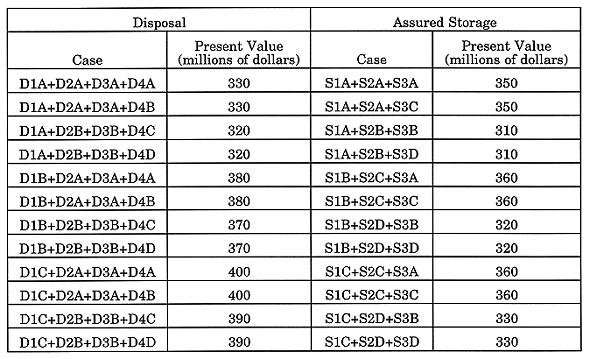
The largest life cycle costs for disposal all involve preoperations Cases D1B or D1C, both of which incorporate costs based on recent experience in siting and developing disposal facilities, resulting in very high preoperations costs. Present value calculations weight costs at the beginning of the life cycle very heavily; consequently, the use of these recent experience costs for disposal, as opposed to using relatively low assumed preoperations costs for assured storage, penalizes the disposal method. The lowest estimates for present value life cycle costs for both disposal and storage, $320 million and $310 million, respectively, occur when the cases with the lowest preoperations costs are combined with those for the alternative designs.
The effect of present value calculations on the importance of costs of activities that occur late in the life cycle is illustrated by the fact that all of the life cycle costs in Table V occur as pairs of identical costs (when rounded to two significant digits). The two members of each pair differ only in the duration of the institutional control period (for disposal)or of the inspection and preventive maintenance period (for assured storage). The fact that the different durations of these periods have essentially no impact on the present value life cycle cost illustrates how the present value calculation greatly reduces the significance of such distant future expenditures. On the other hand, as Table IV illustrates, if the costs for inspection and preventive maintenance for assured storage were expressed in 1996 dollars, they would equal about two or three times the costs in 1996 dollars for preoperations for assured storage.
CONCLUSION
Assured storage may result in slightly lower present value life cycle costs than disposal, but the difference is not striking. The advantage of lower costs at the start of the life cycle of typical assured storage facilities is largely negated by higher costs during the operating period.
REFERENCES
*Prepared under Subcontract No. C95-175661 to Lockheed Martin Idaho Technologies and for the U.S. Environmental Protection Agency Secretary for Environmental Management under DOE Idaho Operations Office Contract DE-AC07-94ID13223.