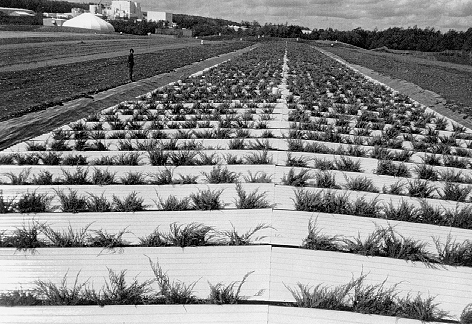
Fig. 1. September 1993, photo of the
bioengineering pilot project on trench 9 at the NYS licensed low-level
radioactive waste disposal at West Valley, New York.
Martin J. Willett
New York State Energy Research and
Development Authority
ABSTRACT
In response to rising leachate levels in waste disposal trenches at the State-Licensed, Low-Level Radioactive Waste Disposal Area (SDA), the New York State Energy Research and Development Authority (NYSERDA) has installed infiltration control technologies to remedy the water management problems caused by the wet climate and silty-clay soils found at the SDA.
In 1993, NYSERDA began the Bioengineering Management Pilot Project on a waste disposal trench at the SDA near West Valley, New York. The Pilot Project was initiated to evaluate the effectiveness of this technology for minimizing or eliminating water infiltration into the shallow, land burial disposal trenches and to assess the feasibility of a bioengineering management program as a longer-term alternative to geomembrane covers, which were placed over the remaining trenches. Installation of a bioengineered cover at the SDA marked the first demonstration of this technology on an actual disposal trench.
The bioengineering management system eliminates infiltration of water by placing fiberglass panels, mounted on wooden frames, perpendicular to the length of the trench. This design provides a hard cover to increase runoff to approximately 80 to 90 percent of precipitation. Shallow-rooted Hetzi junipers planted between the panels provide evapotranspiration (ET) of the remaining precipitation to prevent deep percolation of water through the trench cap soil.
Environmental data, which includes trench leachate elevations, radioactivity levels in vegetation, and soil moisture, along with observed maintenance requirements, are being used to determine the viability of this technology at the SDA. To date, the bioengineered cover has required minimal maintenance while maintaining the trench water level in a steady-state condition.
INTRODUCTION
The State-Licensed, Low-Level, Radioactive Waste Disposal Area (SDA) occupies approximately 6.07x10⁴ square meters (15 acres) of the 1.35x10⁷ square meter (3,340- acre) Western New York Nuclear Service Center (Center). From 1963 to 1983, Nuclear Fuel Services Company, Inc. (NFS) operated and maintained the Center under a lease agreement with New York State. In 1983, the New York State Energy Research and Development Authority (NYSERDA) assumed responsibility for the Center on behalf of the people of New York State with the exception of approximately 8.09x10⁵ square meters (200 acres) under exclusive use and possession of the United States Department of Energy (DOE) to perform the West Valley Demonstration Project (WVDP).
During the years 1963 to 1975, NFS placed approximately 6.8x10⁴ cubic meters (2.4x10⁶ cubic feet) of packaged, commercial, LLRW into 14 trenches at the SDA. The disposal trenches were constructed at the SDA because of the high clay content and over-consolidation of the Lavery till, which makes the till soil highly impermeable at depth. Typically, the trenches are approximately 170- meters (600 feet) long, 6-meters (20 feet) deep, and vary in width from 6 meters (20 feet) at the bottom to 11 meters (36 feet) at the top. Waste was placed in the trenches, covered with the silty-clay soil excavated during construction, and compacted. Disposal operations were terminated in 1975 after water that had accumulated in two of the trenches overflowed into nearby creeks.
Trench caps at the SDA are composed of a compacted silty-clay till that tends to become more permeable with time due to fractures caused by waste subsidence, soil desiccation, and the constant process of root growth, followed by death and decay, which creates water channels. Water enters the trenches by percolating down through the trench caps and tends to accumulate in the trench due to the low-permeability of the silty-clay till soils.
Actions were taken during the 1970's and 1980's to reduce the leachate levels in the trenches and to prevent additional leachate accumulation. However, these activities did not totally eliminate water from entering into the trenches (1).
In 1992, NYSERDA installed a slurry wall to divert horizontal groundwater flow and a geomembrane cover to prevent water from percolating through the trench caps on Trenches 13 and 14. This combined solution was implemented during 1992-93, and effectively stopped water from entering Trenches 13 and 14. In 1995, following the initial success of infiltration controls on Trenches 13 and 14, NYSERDA installed a geomembrane cover over the remaining grass-covered trenches (Trenches 1 through 8, 10, 11, and half of 12). The exposed geomembrane covers are expected to have a useful life of ten years (2).
During NYSERDA's initial investigation of infiltration control technologies, Bioengineering Management was identified as a potentially viable trench cover alternative. However, since the technology had not gone beyond the research stage, it was not selected for implementation on all the trenches. In 1993, NYSERDA installed the Bioengineering Management Pilot Project (Pilot Project) on a single trench cap (Trench 9) to evaluate the effectiveness of this technology at the SDA.
TECHNOLOGY DESCRIPTION
The Bioengineering Management technique utilizes a combination of engineered, enhanced runoff and vegetation in a moisture-restricted environment to control deep-water percolation through disposal unit covers. If horizontal groundwater flow into a waste disposal unit is negligible, then precipitation has three possible fates: it is removed by evapotranspiration (ET) or runoff, or it percolates through the cap into the waste disposal unit. Since ET has a defined limit governed by energy input, runoff is the only variable that can be reasonably manipulated to limit deep percolation. Surface runoff as high as 100 percent can be obtained by means of a leakproof cover (i.e., geomembrane cover), which, over extended time periods, is hard to guarantee. Alternatively, adequate but not total runoff can be obtained by covering part of the ground surface to achieve high and controlled levels of runoff. Vegetation planted between the covered areas extends over the cover to intercept incoming solar energy to evaporate water. Roots extend under the cover in all directions and eliminate water from the soil through ET (3).
The concept of Bioengineering Management was originally developed by Dr. Robert Schulz, University of California at Berkeley, under grants from the U.S. Nuclear Regulatory Commission. Initial investigations were carried out at the Maxey Flats Radiological Disposal Site in Maxey Flats, Kentucky, from 1984-1988 (4). Following the encouraging initial results, a large-scale field demonstration was established at the U.S. Department of Agriculture's Experimental Station in Beltsville, Maryland (1987-present). The results of these studies, which include water balance summaries, are described in NUREG/CR-4918, Vol. 9 (3).
INSTALLATION EXPERIENCE
Design work for the bioengineered cover at the SDA began in 1992 and was completed with the assistance of Dr. Schulz and local horticultural experts. The initial design was presented to the New York State Department of Environmental Conservation (NYSDEC) and reviewed during 1992-1993 before issuance of a permit by NYSDEC for installation and monitoring of the project on Trench 9.
Fig. 1. September 1993, photo of the
bioengineering pilot project on trench 9 at the NYS licensed low-level
radioactive waste disposal at West Valley, New York.
Construction of the bioengineered cover on Trench 9 at the SDA began in August 1993 and was completed in October 1993. Because it would be difficult to establish young plants on a compacted clay cap, the Trench 9 cap was regraded and reworked to accommodate the hardcover panels and junipers.
The hardcover panels used to increase runoff consisted of approximately 250 hemlock wood panel frames covered with corrugated fiberglass panels. Before deciding to use the hemlock wood panel frames, several different frame materials were investigated including pressure-treated lumber and Polyvinyl Chloride (PVC). The rough-cut hemlock wood frame was selected due to its resistance to rotting, low cost, and ability to provide a satisfactory design life with minimal labor costs. The hardcover frames were placed and secured to the trench cap with earth anchors. Before attaching the fiberglass panels, nursery crews planted approximately 3,000 Hetzi junipers between the anchored frames. Following planting, 8 oz/ft2 gray fiberglass panels (19.69 cm x 85.04 cm) (50 inches x 18 feet) were attached to the hemlock frames. Junipers were initially over planted by approximately ten percent in anticipation of initial die-off during plant acclimation to the SDA environment.
Drainage swales located along the sides of each trench carry runoff away from the disposal trenches. During construction of the Pilot Project, drainage swales located along both sides of Trench 9 were regraded and lined with a hypalon membrane to prevent runoff from entering the trench.
Because of the experimental nature of the Pilot Project, NYSERDA initiated an environmental monitoring program and installed monitoring equipment that may not be required for full-scale application of the technology. The monitoring equipment includes an air monitoring station, soil moisture access tubes, and a neutron soil moisture gauge. These installation costs, along with laboratory support for the evaluation of air and vegetation samples, added to the initial and ongoing costs of the Pilot Project.
Installation of the bioengineering cover did not require any specialized labor or materials. Material durability over time will determine whether design changes to extend the life of bioengineered covers would be required.
COVER MATERIALS ASSESSMENT
During the winter of 1993-1994, small rodents (e.g., field mice, shrews, etc.) damaged 50-80 percent of the 3,000 junipers, killing approximately three percent of the plants. The damage was caused by rodents girdling the plants' main stem and removing branches from the newly planted junipers. Nursery experts advised NYSERDA that the rodent damage may have occurred due to the consistent snow cover and the unusually cold weather experienced in the area during the 1993-94 winter. Rodent damage observed during the 1994-95 winter was much less severe. During the winter of 1995-96, limited rodent damage was only evident on small branches above the hardcover panels, posing no threat to the survival of the junipers. Because the junipers were initially over planted on the trench in anticipation of some early die-off, the loss of some junipers is not expected to affect the performance of the cover. However, approximately 100 new junipers were replaced in those rows where all or most of the plants were lost. The junipers were replaced to eliminate the possibility of localized wet areas between the hardcover panels where junipers had died and precipitation could accumulate. Rodent damage to the surviving junipers may slow the ability of the bioengineered cover to dry out the clay cap soils, but the plants have shown a remarkable ability to recover, attesting to the low-maintenance attributes of this technology. Since installation of the geomembrane cover on the remaining trenches at the SDA in October 1995, visual inspections of the bioengineered cover indicate that rodents may no longer be present or the plants are too large to be an attractive food source.
The corrugated, fiberglass panels and hemlock wood frames have required no maintenance since installation. As the junipers continue to grow and spread over the panels, the panels will be less susceptible to weather and solar degradation.
During field inspections in the spring of 1994, it was noted that small pockets of water had collected under the drainage swale liners at the southern ends of the swales. To remediate this situation and prevent additional water accumulation, french drains were installed under the liner on the southern ends of the swales. Since this repair, water has not accumulated in this area.
ENVIRONMENTAL MONITORING
Environmental monitoring data is collected to identify changes and trends that occur in the SDA's environment and to evaluate whether those changes may be attributed to the Pilot Project. To measure and track potential effects of the bioengineered cover, the following are routinely monitored: ambient air, soil moisture in the trench cap, leachate elevations, and radionuclides in vegetation. Results from routine monitoring are presented in the following sections.
Leachate Elevations
Leachate elevations are a direct measure of the effectiveness of the trench cap, assuming that lateral groundwater flow into the trench is negligible. Because Trench 9 is located between two other trenches with similar leachate elevations, this assumption is reasonable. Prior to installation of the Pilot Project, the leachate level in Trench 9 rose steadily (see Fig. 2).
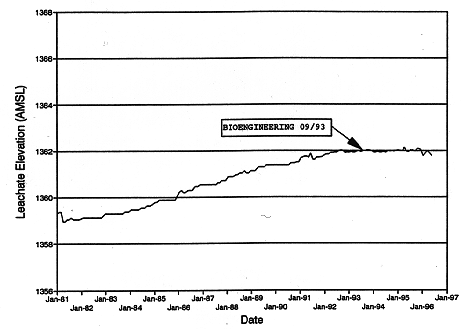
Fig. 2. 1981 - 1996 trench 9 leachate
elevations.
Since initiation of the Pilot Project, leachate elevations have stopped increasing and remained relatively stable. This stability is an indication that percolation through the cap was the primary water source; and the hardcover, in combination with ET occurring as the junipers grow, has been effective in preventing the percolation of precipitation through the cap.
Soil Moisture
Neutron-probe soil moisture measurements are conducted routinely to determine whether a loss or gain of moisture is occurring in the soil profile. Moisture measurements were collected from the three types of trench caps at the SDA (grass, bioengineered, and membrane covered) to assess the relative performance of the bioengineered cover. Soil moisture data are used to track soil moisture levels relative to location, depth, and trench cover type. Differences in soil moisture content between trenches and locations on the same trench can be due to a variety of physical factors including: soil type, compaction, relative trench cap elevation, cap slopes, and the influence of drainage swales. Thus, the long-term trend in soil moisture at a single location, rather than the difference in soil moisture between locations, is most valuable in assessing the effectiveness of the bioengineering technology.
Soil moisture is measured at three locations in the bioengineered cover (Trench 9), along with single locations on two previously grass-covered trenches (Trenches 8 and 10), and one location on a geomembrane-covered trench (Trench 13). By measuring soil moisture on three different trench covers, the bioengineered cover can be compared to other more conventional cover types. Since installation of the Pilot Project, Trenches 8 and 10, which had grass-covered caps during the first two years of the project, were covered with geomembrane in October 1995. The soil moisture levels obtained for these two trenches prior to their being covered are useful for comparing soil moisture in the bioengineered trench cap with levels previously measured on a conventional grass cover. The soil moisture data will continue to be collected to compare geomembrane-covered trench caps with the bioengineered trench.
Moisture measurements began in August 1994 and have continued monthly from March through November at each location. Measurements were made at one-foot increments from one-to-five feet below the trench cap surface. The relative soil moisture data for each location are depicted in Fig. 3.
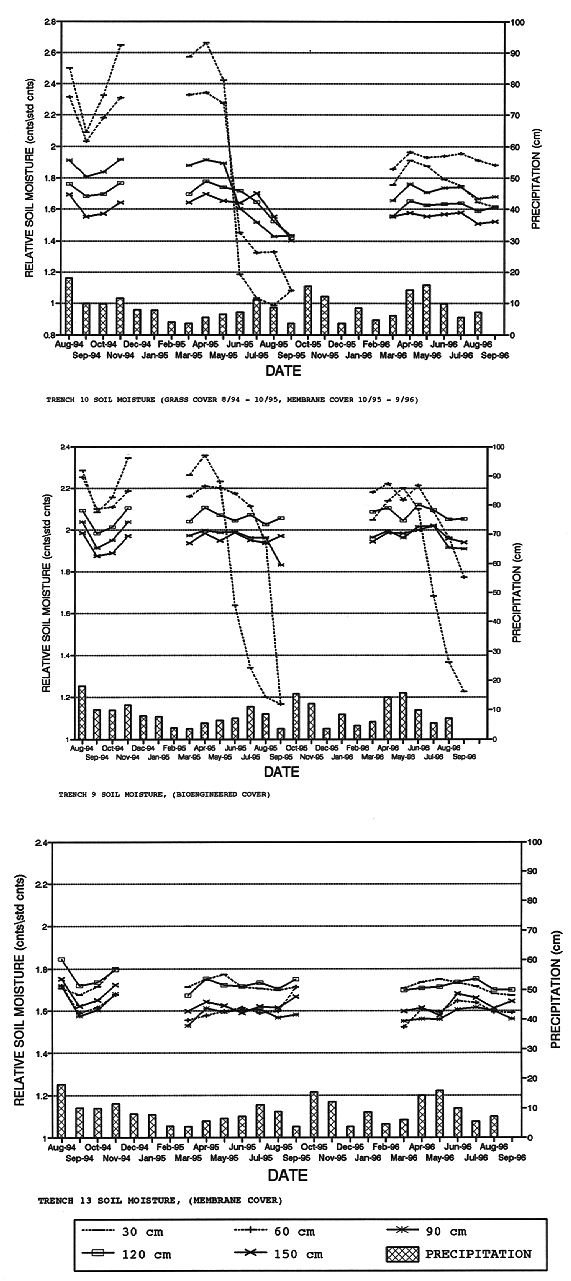
Fig. 3. Relative soil moisture data
for grass, geomembrane and bioengineered trench covers at the SDA.
Short-term seasonal changes (e.g., changes in precipitation, wind, temperature, and incident solar radiation), effect the amount of ET occurring in vegetation on the trench covers and have produced soil moisture variations in the upper cap soils at all the measured locations with the exception of Trench 13. These short-term changes were most notable when moisture levels dropped between May and June 1995 as a result of dry spring weather. Trench 13, which is covered with a geomembrane cover, maintained a relatively consistent soil moisture profile throughout the measurement period. To date, long-term wetting or drying trends were not evident from the data collected.
Vegetation Sampling
Vegetation samples are collected to evaluate the uptake and retention of mobile radionuclides in plants on conventional grass-covered caps, in the junipers on Trench 9, and at a control location outside the SDA. Results from the 1994 and 1995 sampling events indicate that only tritium and Carbon-14 (C-14) are mobile in the trench cap environment. When compared to grasses collected off the SDA, trench cap vegetation is consistently higher in tritium and C-14. These data indicate that tritium and C-14 in waste disposal trenches become available for uptake in vegetation planted on the trench caps.
Cyclical increases and decreases in tritium and C-14 concentrations in trench cap grasses occurred in response to vegetative growth cycles. Tritium concentrations in junipers on Trench 9 have remained relatively constant and do not show the same degree of seasonal variations as grasses on the trench caps. When soil moisture in grass and juniper root zones decreases during active growth periods, tritium levels appear to increase. This may be due to the plants need to withdraw moisture from deeper in the soil profile. Analytical results for tritium and C-14 from routine trench samples are graphically presented in Fig. 4.
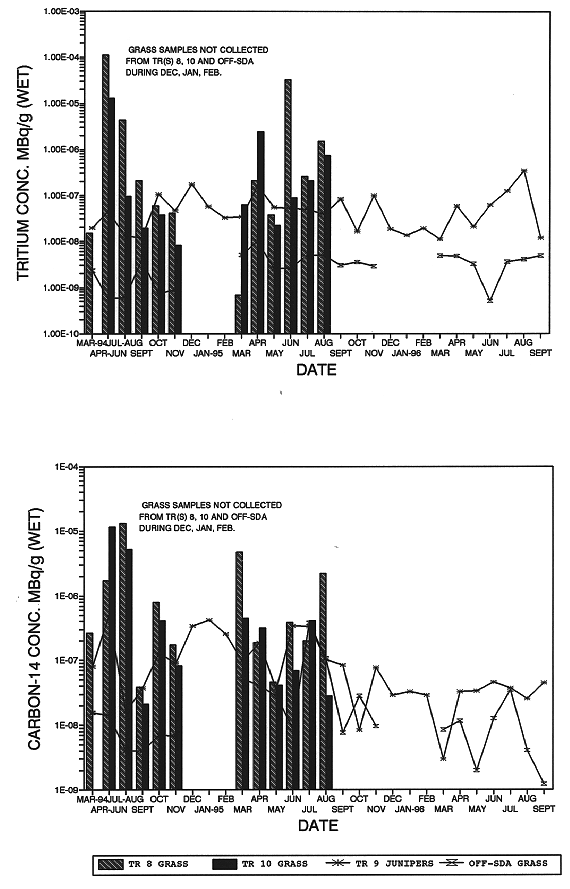
Fig 4. Tritium and carbon-14
concentrations in vegetation. Trenches 8 and 10 were covered with a geomembrane
cover in September 1995.
A one-time sampling event of the grasses from the remaining SDA trenches was performed in October 1994 to measure how C-14 and tritium levels varied over the SDA. Carbon-14 data from the October 1994 sampling event showed that Trenches 8 and 10 had higher levels of C-14 than those observed on the remaining trenches.
Junipers planted on Trench 9, although immature, have tritium and C-14 concentrations above levels measured in off-trench grasses, but below those measured in grasses from neighboring trench caps.
Air Monitoring
Ambient air monitoring was initiated to measure the levels of radionuclides in air near the Pilot Project, and will aid in identifying effects the project may have on those concentrations. Air monitoring will also assist in identifying contributions of radionuclides that may be present due to deposition from off-site sources.
Air in the vicinity of the Pilot Project is measured from a fixed-air monitoring station located on the southern end of Trench 9. The air monitoring station was positioned along a predominant wind direction (NW) and it continuously samples air through charcoal and glass fiber filters and a silica gel column.
Results from ambient air sampling indicate that the concentrations of radionuclides in air near the Pilot Project are similar to those of background locations used to evaluate air quality for the WVDP (5). Background monitoring stations are located from one-half to fifty miles away from the WVDP and the SDA.
PROJECT SUMMARY
The Pilot Project on Trench 9 has been evaluated over the past three years to see how well the bioengineering technology has performed at the SDA. Current Trench 9 leachate levels indicate that deep percolation of water through the trench cap has been reduced or eliminated. Although juniper growth and vigor have met expectations, a large number of the junipers sustained some damage as a result of rodent infestation during the winter months. However, most have recovered and are continuing to grow. The effect of the damage, which may be short term, has been a reduction in plant growth and in the junipers' ability to remove water from the cap soil (reduced ET). The loss of some of junipers was anticipated and, due to the initial over planting, is not expected to affect the performance of the cover.
The hardcover system required minimal maintenance during the first three years. As the junipers continue to grow and spread over the panels, the panels will be less susceptible to weather and solar degradation. The hypalon-lined drainage swales have worked well in removing runoff from the area surrounding the disposal trenches. The only maintenance required was the addition of french drains at the ends of the drainage swales to eliminate water pockets that were collecting under the liner.
Initial soil moisture measurements show that moisture in the soil of the bioengineered covered trench cap is similar to that measured in soils of more conventionally covered trench caps at the SDA. This is expected as the junipers are small and have not developed the extensive root system and foliage needed to provide the ET rate necessary to reduce the soil moisture in the clay soils found at the SDA.
Data collected to monitor radionuclide concentrations in grass and juniper vegetation have shown that the radionuclide concentrations in junipers fluctuate less than in the grasses. However, the junipers respond to the trench environment in much the same way conventional grass covers have in the past by fixing and transporting both tritium and C-14. As additional vegetation data are collected, differences in radionuclide concentrations attributable to location, soil moisture, amount of precipitation and vegetation type, both seasonally and annually, will be evaluated.
REFERENCES