
 and 4 GBq/te
 . HLW are vitrified at
Sellafield and all LLW in the UK are disposed of to BNFL's repository at Drigg
near to the Sellafield site.
. HLW are vitrified at
Sellafield and all LLW in the UK are disposed of to BNFL's repository at Drigg
near to the Sellafield site.
Graham A Fairhall
BNFL
Sellafield, UK
John D Palmer
UK Nirex Ltd
ABSTRACT
The UK Government Policy for the management of Intermediate Level Wastes (ILW) has been established for over a decade. It involves the packaging and ultimate disposal of the wastes in a deep geological repository.
Radioactive wastes have been generated in the UK for over four decades. The largest volume and most diverse range has been generated by British Nuclear Fuels plc (BNFL) at its Sellafield plant. In the early 1980s BNFL developed a strategy which involved the treatment and immobilization of ILW to produce packages that would be acceptable for storage and transport and would meet anticipated requirements for disposal. This strategy involved a systematic evaluation of options for the treatment of wastes and included a detailed decision analysis process to produce the best packaging options for each ILW. Each waste treatment option was evaluated against criteria relating to processing, storage, transport and disposal. The strategy has been successfully implemented by BNFL with a number of fully active plants in operation.
A key issue facing BNFL and other waste producers in the UK was how to ensure that packages produced would meet anticipated disposal requirements in advance of an available repository. UK Nirex Ltd (Nirex) were formed in the early 1980s as the disposal agency for developing and eventually operating future repositories for radioactive wastes. To ensure that waste producers plans for treating waste would be compatible with deep disposal NIREX have developed a number of specifications for waste packages over the past decade. These specifications relate to a generic repository concept and have been generated in collaboration with Nirex's customers. The specifications cover a range of requirements including quality assurance, wasteform, containers and data recording.
BNFL has worked closely with NIREX to agree packaging plans. BNFL and other waste producers gain advice from NIREX regarding the suitability of packaging plans, at different stages from concepts to the active operation of plants. Advice is based upon assessment covering fifteen technical areas for each packaging proposal and include the nature of the waste, wasteform, container design, accident behavior, transport and operational and post closure safety.
The approach adopted in the UK by BNFL and NIREX has been very successful. BNFL has been encapsulating ILW for over six years with an assurance from NIREX that the packages will meet anticipated disposal requirement when the deep repository becomes operational in the next century.
INTRODUCTION
In the UK, British Nuclear Fuels plc (BNFL) are involved in all activities
of the nuclear fuel cycle. At BNFL's largest site, Sellafield, operations have
taken place for over 40 years mainly associated with fuel reprocessing. These
activities have generated a wide range of radioactive wastes and account for
about two thirds of the intermediate level wastes (ILW) that will arise in the
UK. ILW lie between the categories of high level wastes (HLW) which comprise the
liquor from the first cycle of reprocessing and low level wastes (LLW) which are
defined as having activity contents below 12 GBq/te
and 4 GBq/te
. HLW are vitrified at
Sellafield and all LLW in the UK are disposed of to BNFL's repository at Drigg
near to the Sellafield site.
To facilitate the final disposal of ILW and LLW in the UK, the Nuclear Industry Radioactive Waste Executive was formed in 1982 and incorporated as a private limited company - United Kingdom Nirex Limited (Nirex) in 1985. Nirex is currently pursuing the development, design and construction of an underground repository for ILW and certain LLW in the UK.
A key objective of both BNFL and Nirex is to ensure that the treatment, immobilization and packaging of waste, prior to a deep repository becoming operational, will produce packages that will be acceptable for ultimate disposal. This paper describes the approach adopted by BNFL and Nirex to achieve this objective and emphasizes the importance of considering the complete waste management cycle when developing and implementing waste management strategies.
BNFL INTERMEDIATE LEVEL WASTE STRATEGY
The storage of unconditioned ILW fulfills the current requirements in respect of safety. However detailed technical studies by BNFL in the early 1980s highlighted the benefits from the early packaging of wastes and subsequent storage of waste in an encapsulated form as this represented a reduction in the risk level, savings in lifetime costs and reduced dose uptake to operators.
As a result of these findings BNFL developed a strategy to treat ILW by direct encapsulation. Future arisings would be treated as they arose with historic wastes retrieved and conditioned as appropriate. The timing for treating historic wastes would depend on the safety of continued storage in an unconditioned form and the availability of conditioning plants at Sellafield.
The adopted strategy is to produce essentially monolithic products suitable for 50 years on-site storage and a further 50 years in the disposal environment that will meet the requirements for both transport to and disposal in the deep waste repository. It has therefore been important for BNFL to work closely with Nirex as the company responsible for developing the transport and disposal systems.
ENCAPSULATION OPTIONS
An extensive R&D program was initiated by BNFL in 1982 to underpin the ILW strategy by systematically developing encapsulation processes and evaluating the properties of the encapsulated product. The objectives of this program were to:
Details about the scope of the program are given elsewhere (1, 2, 3,). A number of encapsulants were evaluated for each ILW including cement, polymer, bitumen, glass, polymer modified cement, low melting point metal and ceramic. The selection of preferred option was undertaken following an initial evaluation of all the matrix options, using data from practical studies for each ILW stream. Each matrix was evaluated for a number of properties including physical, chemical, thermal and radiation stability and mechanical performance.
It was necessary to define criteria which were important for all phases in the management of ILW including waste encapsulation, storage, transport and disposal. These covered the behavior of the waste and packages under normal and accident conditions.
This approach formed the basis of the selection methodology of the best matrix for each ILW. A detailed assessment was carried out using a multi-attribute decision analysis technique. This involved each potential encapsulation matrix being evaluated against a number of essential criteria for the waste management phases above. Provided the "essential" criteria were satisfied the matrices were ranked against a number of "desirable" criteria, which in turn were weighted to reflect their importance to establishing a safe, robust, cost effective process. Even during this preliminary selection process it was necessary that the requirements of Nirex as the ultimate disposer of proposed packages were fully considered.
For all ILW at Sellafield, cement was shown to be the best encapsulation matrix. In particular, cement has the advantage of being a simple, low cost yet very flexible process. It also produces excellent product properties when the correct specification cements and process conditions are used including low permeability, good thermal behavior, durability, excellent actinide retention and is chemically compatibility with the planned UK disposal concept. Therefore BNFL have developed a number of cement formulations for encapsulating the full range of ILW generated at the Sellafield plant.
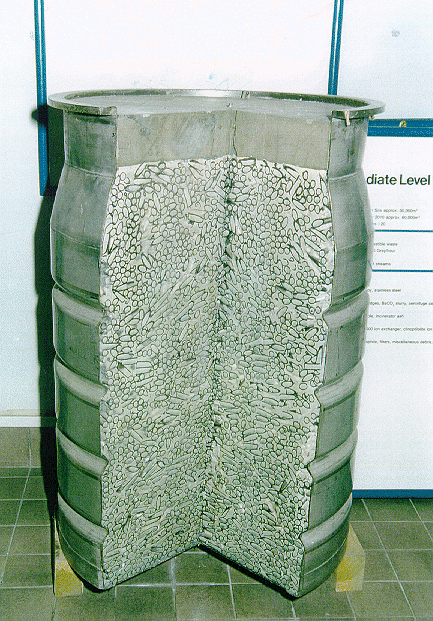
Fig. 1. Encapsulated cladding waste.
COMPATIBILITY WITH DISPOSAL
All formulations developed must be consistent with the eventual disposal requirements if the risks of double-handling and re-packaging of waste (and the associated costs and doses to workers) are to be avoided.
Since an authorization for disposal will not be granted until just prior to repository operation, and the planning date for first waste emplacement to a UK deep waste repository is 2012 (subject to receiving the necessary consents), then there is uncertainty as to what the eventual waste acceptance criteria will be.
Nirex has therefore produced a set of guidelines which specify the requirements for packages that are foreseen as being necessary for deep disposal in order to assist BNFL and other waste producers in developing their waste management plans. The development of the specifications involved Nirex working closely with BNFL and its customers taking account of waste producers proposed waste management plans. This integrated approach has allowed both BNFL and Nirex to work towards optimization of the overall waste management and disposal system. The result has been minimum overall lifetime costs for the treatment, storage, transport and disposal of waste whilst maintaining safety standards.
The specifications define dimensional, functional and performance criteria, establish minimum levels of performance for all waste package designs. As such they provide an essential link between waste package design and repository design (4).
To give the best possible assurance for the future - and above all to guard against the possibility of having to re-package the wastes - the present Waste Package Specifications are conservative because they must ensure adequate performance under a wide range of potential disposal conditions. As the repository program resolves these uncertainties, it may become possible to relax some of the criteria in the specifications.
It is not possible for a single specification to fully define all functional parameters for waste packages in view of the wide range of different waste types (currently numbering over 1000 separate streams in the UK) and the multiplicity of different packaging plans.
Therefore, in addition to generic guidance through the specifications, definitive assurances on individual waste packaging proposals are provided by Nirex to its customers following detailed assessment by issue of a "Letter of Comfort". "Letters of Comfort" provide assurances that the proposed packages are consistent with Nirex's disposal plans in all aspects of transportation to, operations at, and disposal in the waste repository. Detailed assessments are carried out against 15 technical areas to assess the compatibility of the proposed packages. These are:
| 1. Nature and Quantity of Waste | - how much waste? How many packages of what type? How does the activity vary between packages? |
| 2. Wasteform | - how does the wasteform behave under storage and disposal conditions? |
| 3. Criticality | - are the packages critically safe in a deep waste repository initially and after degradation over time? |
| 4. Container Design | - is the container consistent with Nirex handling and performance requirements? |
| 5. Container Corrosion | - does the container have adequate corrosion performance for handling and to offer containment of short-lived mobile activity? |
| 6. Impact Performance | - does the package (ie container and wasteform combination) have sufficiently low releases under impact accidents? |
| 7. Fire Accident Performance | - does the package have sufficiently low releases undercredible fire accidents? |
| 8. Transport Regulations | - can the waste be transported in accordance with IAEA and DoT requirements or does the proposed waste package compromise the requirements for transportation in the public domain? |
| 9. Quality Assurance | - are the packages produced under an appropriate Quality Assurance system to ensure parameters that effect disposal performance are suitably controlled? |
| 10. Data Recording | - is sufficient data on packages being recorded to allow packages to be transported and disposed of? |
| 11. Physical Protection | - will the packages contain materials that will necessitate special physical protection measures? |
| 12. Safeguards | - do the packages contain materials that need to be kept under safeguards? |
| 13. Post-closure Safety | - will the packages adversely affect the post-closure performance of the repository? |
| 14. Operational Safety | - are the package releases consistent with the likely operational safety requirements? |
| 15. Policy | - are the packages produced consistent with the intended use of the deep waste repository and UK and international regulatory guidance for disposal? |
An illustration of just one aspect of such assessments is given below. Assuming it is proposed to package an ion exchange resin contaminated solely with caesium in a cementitious matrix and the average caesium inventory per 500 litre package to be 10 TBq then fire accident releases can be assessed in the following manner.
Data generated by Nirex has indicated that, for cementitious wasteforms a pessimistic caesium release fraction at 300°C and 1000°C range from 2 x 10⁻⁴ and 2 x 10⁻¹ respectively (5). This release data is then considered against thermal models for waste packages to assess overall releases during fire accidents. Modelling, verified by full scale fire testing of simulant wasteforms by Nirex and major customers such as BNFL during their development programs, has shown that even in an extreme 1000°C fire of 2 hour duration, less than 0.05 of the wasteform could be up to 1000°C with the rest of the wasteform not exceeding 300oC. In such cases the release would be less than 0.1 TBq of Cs-137 (or 0.2A2) which is well within tolerable release targets being considered in the planning and design of the deep waste repository.
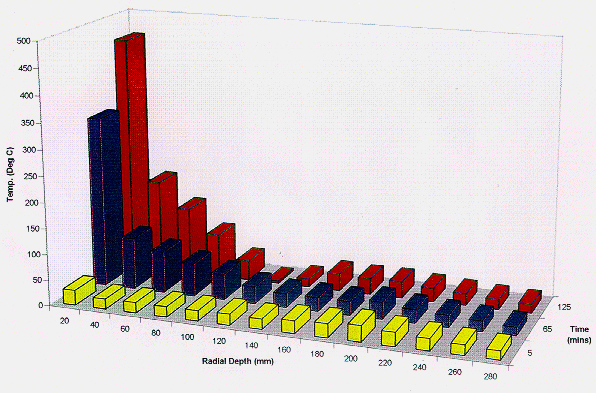
Fig. 2. Thermal performance of
encapsulated cladding waste.
Similar methodologies are applied in all assessment areas covering the full range of radionuclides present at both average and maximum inventory levels. If these assessments reveals no substantive unresolved issues in any of these areas Nirex can then issue a "Letter of Comfort".
Experience has shown benefits to seeking a "Letters of Comfort" at up to 3 stages in the development of packaging concepts and waste packaging plants. These include the conceptual stage when assurances are needed as to the feasibility of the plants; the pre-project commitment stage when assurances are needed that the plant design should be capable of making products consistent with disposal requirements and at the final or pre-operational stage when verification is needed that the 'as-built' plant does in practice produce products that are fully compliant with disposal needs. Issuance of these "Letters of Comfort" has therefore enabled BNFL to progress with the implementation of its waste management strategy.
IMPLEMENTATION OF THE ILW STRATEGY AT SELLAFIELD
An extensive program has been undertaken by BNFL over the past decade to implement its ILW strategy at Sellafield. This has involved the design, construction and operation of a number of major plants for the treatment and immobilization of ILW. Historic wastes are now being retrieved and packaged for disposal and over the next five years all proposed waste plants at Sellafield will be in operation.
Five cementation plants are planned for the encapsulation of ILW at Sellafield using two basic processes (6). Solid wastes, including supercompacts are grouted and sludges/flocs are in-drum mixed. The encapsulation plants at Sellafield are summarized in Table I.
Table I Encapsulation Plants at Sellafield
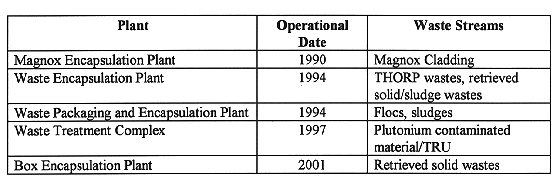
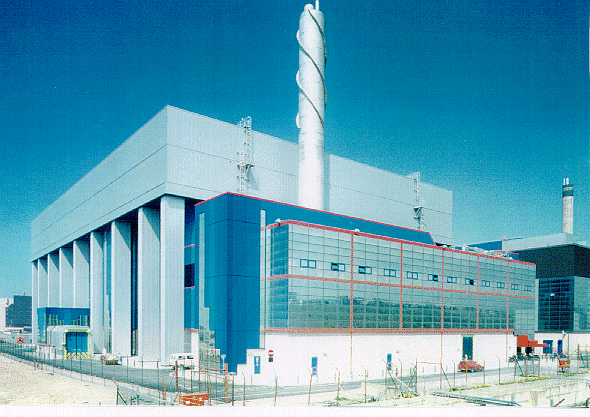
Fig. 3. Waste encapsulation plant.
The first four plants are in active operation with the final plant currently being designed.
BNFL have sought and received different stage "Letters of Comfort" covering the packaging of most major intermediate level wastes at Sellafield containing over 90% of the radioactivity to be disposed of. Final "Letters of Comfort" have been issued for a number of streams being processed in the operational plants and over twelve thousand packages of ILW immobilized in 500 liter drums have already been manufactured by BNFL at Sellafield. These are now in storage until the repository becomes operational. Pre-construction and pre-operational "Letters of Comfort" are now being sought for the final plant to allow this major capital project to proceed with confidence.
CONCLUSIONS
In the UK, BNFL has been able to minimize the risks associated with proceeding with its extensive waste management and packaging program before final disposal requirements are known by maintaining close collaboration with the Nirex, as the company responsible for waste disposal. An integrated approach involving waste producers and waste disposers have proved invaluable in developing optimized waste management solutions within the UK.
REFERENCES