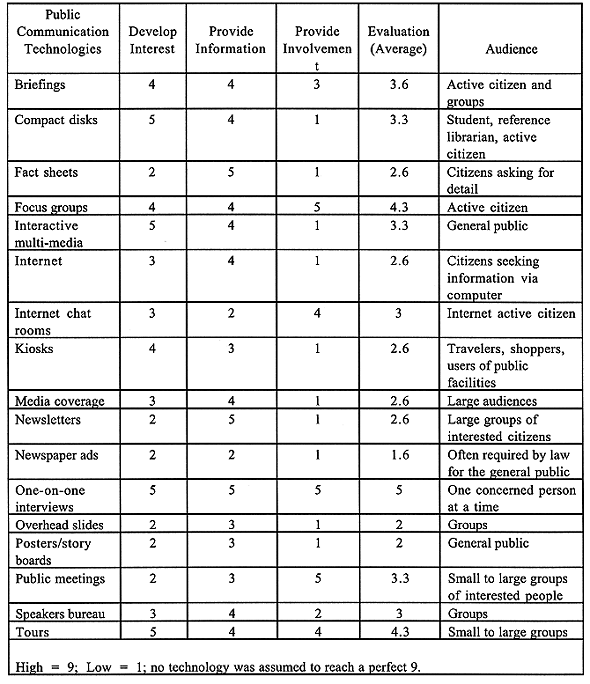
Table I Evaluation of Technologies for Public Involvement
L. Hutterman and R. Smith
Idaho National Engineering and
Environmental Laboratory
Lockheed Martin Idaho Technologies Company
P.O. Box 1625
Idaho Falls, Idaho 83415
ABSTRACT
This paper addresses the decreasing number of persons interested and participating in the Comprehensive Environmental Response, Compensation, and Liability Act (CERCLA) or "Superfund" process. It also looks at communications technology to bring people back into participation in the Superfund process. The material studied and the technologies evaluated involve the Environmental Restoration Program at the Idaho National Engineering and Environmental Laboratory. The conclusions are probably valid for most DOE Superfund activities.
Where has the public gone? The public has taken an interest in issues that they perceive have greater impact on their quality of life and that have an adverse impact on the environment, such as the shipment and storage of spent nuclear fuel. Will communications technology bring them back? Technology can do many things: it can reduce cost; it can allow quicker access to and from the public; it can offer more information; and it can increase interest because of its novelty for short periods of time, but it will not, in and of its own, create public involvement.
INTRODUCTION
The Environmental Restoration Program at the Idaho National Engineering and Environmental Laboratory (INEEL) is over 5 years old. The 5-year anniversary of the Federal Facility Agreement and Consent Order (FFA/CO) was December 9, 1996. During the course of Superfund activities at the Idaho National Engineering and Environmental Laboratory, we have spent over $3 million to meet public involvement requirements of Superfund, the FFA/CO, and the INEEL Community Relations Plan. While meeting requirements is a must, we also like to experience "public participation" and not just the "opportunity" for public involvement.
PROBLEM STATEMENT AND BACKGROUND INFORMATION
As you recall from the title, two questions are asked: "Where has the public gone?" and "Will communications technology bring them back?" The answer is short and easy for the first question. The answer for the second is difficult and involved. We will address the easy one first.
The first question is, "Where has the public, once interested in Superfund activities, gone?" In the Environmental Restoration Program at the INEEL we have experienced a decrease in interest and involvement in Superfund activities. Fewer people andinterest groups are requesting briefings or attending public meetings, and the number of comments received on cleanup plans is declining. Several reasons for these conditions were identified through interviews with people who had previously been very active in Superfund activities at the INEEL. They told us that a number of issues and personal demands had become more important in their lives than INEEL cleanup concerns. Aside from personal issues, the two most prominent concerns were DOEs spent nuclear fuel and the State of Idahos agreement with the federal government concerning the shipment and storage of spent nuclear fuel at the INEEL.
The public has limited capacity to deal with the host of public issues facing them today. Their ability to focus resources on a given public issue is something that we do not and cannot manage. Individuals decide where they will focus their time and energy, whether it be with the local PTA, sports club, work, or with DOE spent nuclear fuel and cleanup activities.
The second question is, "Will communications technology bring them back?" This is a more difficult problem. We will address this problem by 1) defining public participation, 2) explaining the four "Is" of public participation, 3) describing the 10 steps of public participation, 4) showing how the four Is interact with the 10 steps of public participation, 5) discussing how to use communications technologies to implement the 10 steps of public involvement, 6) reviewing Table I, which evaluates communications technologies, 7) describing the communications technologies used in the 10 steps of public involvement, and 8) concluding by answering the question of whether communications technology will bring the public back.
Table I Evaluation of Technologies for Public Involvement
What is Public Participation?
In the INEEL Environmental Restoration Program, we deal with the terms "public participation," "public involvement," "public interest," and "public awareness" to describe what we want the public to do. No matter how we describe the publics role, our goal is to have public participation impact final Superfund decisions that direct what happens at the INEEL. Relationships with the public that result in this kind of impact are based on true public participation.
The Four Is of Public Participation
Our approach to public participation and associated communications technology relates to the four Is: interest, information, involvement, and impact. The premise is that interest times information times involvement equals impact:
Interest * Information * Involvement = Impact
If any one of the factors is 0, then the outcome is 0. To have true public participation, we need to work the four Is:
Interest: We need to understand public interests and use those interests as a magnet to attract their attention to our projects. We have to cause them to pause a moment and decide whether their interest in the issue at hand is important enough to make themtake the next steps of committing time, obtaining information, and seeking answers to questions.
Information: We need to provide information in a way that links their interests with the essence of the problems we face. If there is no link between the public and the issues we are trying to solve, they wont want to wade through our information and take the time necessary to formulate an opinion or a solution. If they are poorly served while trying to get our information, they wont return. If they encounter bias and inaccuracies in our information, we loose credibility, and they wont be back for more.
Involvement: We have to plan involvement activities that allow the public to offer comments, ideas, and suggestions; and that support face-to-face interaction with government representatives and project managers who are part of the decision-making team.
Impact: We need to listen and act on what is heard. In the community relations world, when the public offers their comments, ideas, and suggestions, thats only half the deal. Something must be effected as a result of their participation. We have to show something in return. That is impact! Impact occurs when we listen, understand, and incorporate ideas from others to improve, strengthen, and validate decisions and project outcomes. Only when each party benefits in some way can real impact result from public participation. The public without the decision-maker cant impact a decision, and the decision-maker without the public cant say that the decision is in the publics best interests.
The 10 Steps of Public Participation
We see getting true public participation as a 10-step process:
Interaction of the Four Is with the 10 Steps of Public Participation
To be successful, these 10 steps must relate to the four Is. They must instill an interest, provide information, and involve people. These three Is all impact the action being taken by theprogram. As you review the list, you will see that we provide one of the Is--information--and determine the extent of the impact of public participation on decisions. We also provide the opportunity for the public to express themselves concerning the other two Is--interest and involvement.
Consider yourself as a business owner in one of 50 competing stores in a shopping mall. How do you get people interested enough to shop in your store, purchase your merchandise, and return another day to make other purchases? Most business owners say the secret to getting customers (or the public in our case) to come back is primarily how they are treated and if they are satisfied with the quality of the product they get in return for their hard-earned money.
It is our responsibility to "close the sale" with the public and instill in them a desire to return and participate again. We accomplish this when we make it easy for them to act on their interest, to get information, to be involved, and to impact decisions. The 10 steps provide the process to ensure that the public can impact decisions by providing their comments and suggestions. This is possible only if the four Is are present, and it is more likely to happen if all of the 10 steps are implemented.
Using Communications Technology to Implement the 10 Steps of Public Involvement
Table I outlines communication technologies and provides some assessment of their contribution to three of the four Is. If any of the three Is (interest, information, or involvement) are low or missing, public participation wont take place and there will not be an impact. Table I provides a general feel for communication technologies that influence one or more of the Is.
Description of Communication Technologies
This section describes in more detail the technologies referenced in Table I.
Briefings: Briefings offer a way to reach a limited number of interested and active citizens, and offer an exchange of information, but they do not offer a direct way to impact final outcomes.
Compact disks: Compact disks provide low-cost text, photographs, and sound, making them a very powerful tool to influence the public. CDs can offer the public the opportunity to get involved and can advertise and explain the issues, but they have not been an effective tool for participation. While computers and software to operate CDs are available to a limited audience at this time, this is an area of real growth.
Fact sheets: Fact sheets are an effective way to communicate information concerning complex issues but are effective only whenused with a mix of involvement technologies.
Focus groups: Citizens interested in specific topics are invited by agencies to meet and participate with other interested citizens. They are asked to identify their personal views concerning topics or issues of concern to the agencies and focus group members alike. This is one of the best ways for a citizen to impact the outcome of an issue.
Interactive multi-media: As a society, we do not read as we once did. In order to reach most of the public, we need to present information with sound, video, animation, and other tools that present material in the format the public is most likely to use and understand. Interactive multi-media offer this type of communication and are some of the most complex and versatile tools available to communicate and collect information from the public. They offer the public the opportunity to find information at their convenience and within their own time constraints, and can be programmed to allow them to express their opinions. These tools are new and come with all of the standard disadvantages that restrict the use of multi-media: high cost, specialized computer hardware and software, no standard format, lack of service providers, and limited public access. The impacts and contributions offered by this new and growing technology are still being evaluated.
Internet: The Internet is believed to reach millions of users through new services opening each year. An Internet connection allows individuals to search through documents, provide comments, and even share their address with others. No other communications tool has the ability to economically reach such a large and growing audience. Use of the Internet allows individuals, not disposed to public speaking, the opportunity to express their ideas without the confrontation of a public forum. Users need to plan carefully for the time and equipment it takes to download large documents with photographs, video clips, and sound.
Internet chat rooms: Chat rooms allow and encourage the public to interact with agencies and other concerned citizens. For chat rooms to work, interaction between the public and program representatives must occur on-line, which can be difficult and costly. Chat rooms are, however, not as costly as one-on-one interviews and help build relationships.
Kiosks: A kiosk is a free-standing computer screen that can be activated by touch. When available in public use areas, kiosks allow the public to interact whenever and however they see fit. Kiosks offer little or no opportunity to provide feedback. Kiosks are a tool that can raise interest and communicate information in locations where access to the Internet is limited.
Media coverage: One of the best ways to reach thousands of households with messages concerning activities going on at the site is to involve news reporters in site tours and specificproject briefings. However, air time is usually limited, with coverage of significant events and accomplishments receiving 2 to 3 minutes.
Newsletters: When we read, we often want to read material that is short and to the point. This type of writing makes a good newsletter. Newsletters get information out quickly and at a cost that most projects can afford. While it is hard to get good feedback from newsletters, reader surveys can be included, and toll-free phone numbers and notices of where to get additional information can be highlighted. Newsletters are designed to provide information and give notice of planned public involvement activities.
Newspaper ads: Ads are often required by law. They are the only way to reach an entire area, like a state. The cost of producing ads is low, but publishing cost can be high. Like newsletters, ads only provide information.
One-on-one interviews -- Interviews are the most effective communications tool and the most expensive, both in terms of cost and time. The public gets current information from the person that can influence what is going to happen.
Overhead slides: Slides are low cost and easy to produce. They provide a record of the information covered, and copies of the information can be kept by the public. Slide shows are generally not well received due in part to being overused and lacking support tools such as photographs, maps, and sound. Generally, slides produce little impact, with little involvement by the public.
Posters/story boards: For most settings, these visual aids are low cost and fairly easy to produce. The public are not interested in reading small print, and posters and story boards are eye-catching only when visual images are extremely interesting. Often, posters and story boards have little impact on the public unless used in strategic locations and in presentations concerning topics in the news.
Public meetings: The public get to talk directly to the people doing the work, and the information is more believable. This is one of the more costly and ineffective ways to communicate. Usually, more than one meeting is required, and turnout is often low. The greater the controversy, the greater the likelihood of poor communications. Results of public feedback, however, can impact decision-making.
Speakers bureau: Civic and special interest groups call upon the speakers bureau to bring a topic of interest to the group. The speaker chosen may not posses the technical knowledge to support an in-depth discussion. Typically, there are few opportunities for interaction between the speaker and an audience that might not otherwise be aware of or interested in the message presented. Speakers bureaus may be perceived as a public relations effort rather than a technical exchange. The cost to the program is lowfor the number of persons reached by speakers bureau presentations. The public involvement is often beneficial because the level of technical detail being presented is geared for their interest level and is presented in a location where the public are comfortable.
Tours: The public can see the real thing. This gives creditability to the tasks. Often, understanding the problem is half of the effort, and seeing the reality of the task is often the best way to understand it.
CONCLUSION
We return to our original questions: "Where has the public gone?" Some of the public that had participated in Superfund issues have found that other concerns impact their lives more. "Will communications technology bring them back?" Technology will do many things: it can reduce or increase cost; it can allow quicker access to and from the public; it can offer more information; and it can increase interest because of its novelty for short periods of time, but it will not, in and of its own, create public participation.
We need to rely on the same entrepreneurial spirit that businesses use to focus on customer (public) satisfaction to bring people back to participate in our Superfund program.
For now, we have a significant effort under way involving a citizens focus group. The group is having impact on improving the way the agencies involve citizens, and for the first time, the agencies are working with an external group to review draft documents prior to distributing them to the general public. Through this experience, focus group members and agencies alike are benefitting from the impact realized thus far in the relationship. This bodes well for the future of environmental restoration at the INEEL!
ACKNOWLEDGMENTS
This work was supported by the U.S. Department of Energy, Assistant Secretary for Environmental Management, under DOE Idaho Operations Office Contract DE-AC07-94ID13223.