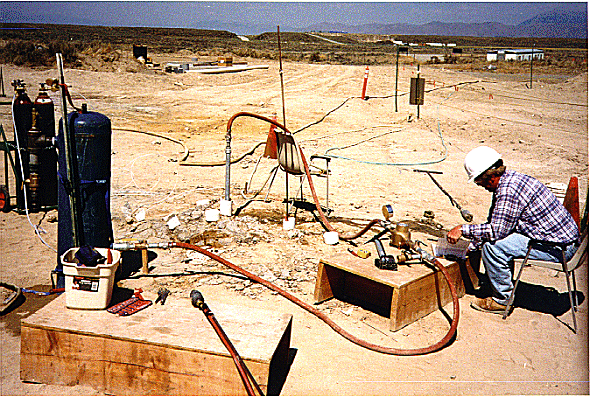
Fig. 1. Packer testing of south
culvert (INEL Graphic M96 0452).
Guy G. Loomis
Idaho National Engineering Laboratory
P.O. Box 1625
Idaho Falls, Idaho 83415-3710
Andrew P. Zdinak
MSE Technology Applications Inc.
P.O. Box 4078
Butte, Montana 59702
ABSTRACT
The Idaho National Engineering Laboratory (INEL) conducted field-scale hydraulic conductivity testing of simulated buried waste sites with improved confinement. The improved confinement was achieved by jet grouting the buried waste, thus creating solid monoliths. The hydraulic conductivity of the monoliths was determined using both the packer technique and the falling head method. The testing was performed on simulated buried waste sites utilizing a variety of encapsulating grouts, including high-sulfate-resistant Portland cement, TECT, (a proprietary iron oxide cement), and molten paraffin. By creating monoliths using in situ jet grouting of encapsulating materials, the waste is simultaneously protected from subsidence and contained against further migration of contaminants. At the INEL alone there is 56,000 m3 of buried transuranic waste commingled with 170,000-224,000 m3 of soil in shallow land burial. One of the options for this buried waste is to improve the confinement and leave it in place for final disposal. Knowledge of the hydraulic conductivity for these monoliths is important for decision-makers. The packer tests involved coring the monolith, sealing off positions within the core with inflatable packers, applying pressurized water to the matrix behind the seal, and observing the water flow rate. The falling head tests were performed in full-scale 3-m-diameter, 3-m-high field-scale permeameters. In these permeameters, both water inflow and outflow were measured and equated to a hydraulic conductivity.
INTRODUCTION
Field-scale hydraulic conductivity testing was performed on simulated buried transuranic waste sites that had been jet grouted with well-known and innovative grouting agents. The basic jet-grouting technique is to make the waste into a solid monolith, which is the same effect as simultaneous horizontal and vertical barriers while also providing stabilization against subsidence. The monolith is created by jet grouting adjacent columns with grouting material such that the soil/waste matrix forms a solid mass.
At the Idaho National Engineering Laboratory (INEL) alone there is 56,000 m3 of buried transuranic waste commingled with 170,000-224,000 m3 of soil in what is called the Subsurface Disposal Area at the INEL's Radioactive Waste Management Complex. Transuranic pits and trenches contain boxes and drums of sludge, cloth, paper, wood, concrete, asphalt, metal, and glass from the Department of Energy's Rocky Flats plant. Migration of the contaminants with water percolation down to the Snake River Plain Aquifer beneath the area is one of the scenarios being considered for the Comprehensive Environmental Response, Compensation, and Liability Act (CERCLA) process. The CERCLA process examines options for disposition of the buried waste, including no action, improved confinement, and removal. Therefore, knowledge of the reduction in water permeation due to the grouting action is required.
In the grouting phase, both closed field-scale permeameter systems and pits were jet grouted. For the closed system, high-sulfate-resistant Portland cement mixed 1:1 by volume was jet grouted into a full-scale buried waste system comprising a 3-m-diameter, 3-m-deep culvert with solid bottom. The buried waste inside the permeameter consisted of drums containing cloth, paper, metal, concrete, nitrate salts, and organic sludges commingled with soil--similar to the buried waste in the INEL Subsurface Disposal Area. Three buried waste pits (each 1.8(breve)1.8(breve)1.8 m) only confined by the surrounding soil were also grouted. One pit used as a grouting material a proprietary iron oxide cement-based grout called TECT. A second pit used molten paraffin at 60°C, and a third pit used high-sulfate-resistant Portland cement. In these pits, the hydraulic conductivity was assessed using the packer method.
In the closed systems, the hydraulic permeation was assessed using two techniques: the falling head method and the packer method. An additional identical ungrouted closed system was used for comparison of the pre and post grouting hydraulic conductivity using the falling head method only. This separate culvert was constructed identically to the grouted version and was reserved for baseline ungrouted hydraulic conductivity measurements.
PROCEDURES
The pits and permeameter were grouted using the CASA GRANDE C6S drill system and 400 bar Jet 5 pump.(1,2) Grouting involved driving the drill stem through the waste and starting the jet-grouting operation at the bottom of the pit. The drill stem was withdrawn in precise increments while rotating the bit. Grout test variables included withdrawal step, time on a step, grout pressure, and rotations of the drill stem per step.
Following the grouting phase and curing of the pit or permeameter system, core holes were drilled using water as a coolant. A 6-cm core was obtained, and the resultant core hole diameter was 9.1 cm. Following coring, hydraulic conductivity studies were performed including both packer testing in cored holes in both the pits and grouted permeameter and the falling head method in both an ungrouted baseline permeameter and the grouted permeameter. The report, "Field Application of Innovative Grouting Agents for In Situ Stabilization of Buried Waste Sites," describes the cores obtained in creating core holes and also the results of pit destructive examinations.(3)
Permeation Testing for Pits and Grouted Permeameter (Packer Testing)
Packer tests were performed in the grouted permeameter and pits grouted with TECT, paraffin, and high-sulfate-resistant Portland cement using the 9.1-cm core holes. In these tests, the isotropic hydraulic conductivity was measured at several axial positions by using an inflatable bellows system to isolate regions in the core. The packer tests were conducted using both single- and dual-bellows packer systems. Fig. 1 shows the packer apparatus during testing, including water supply tank, nitrogen pressure supply tank, flow meter, packer assembly, and associated equipment.
The packer test was performed according to standard practice wherein the packer was placed into the core hole at the desired depth, the packer bellows were inflated, and the resultant flow of water into the packed off hole for a variety of pressures (0-158 kPa) was noted. The flow of water was recorded for both ascending and descending pressure values. If, for instance, there was no measurable flow for 10 minutes at a pressure of 158 kPa, the local hydraulic conductivity was less than 10-7 cm/s. This is based on standards for packer testing (4) and on the use of the uncertainty in the flow totalizer of 0.076 L delivered in any interval of 10 minutes. In actual practice, there was no measurable flow registered for many of the core holes tested. Therefore, using the reading error of the flow totalizer gives a conservative estimate of the hydraulic conductivity. The equation (4) used in these calculations is:
K = Q/r*H*C (1)
where
K = hydraulic conductivity (length/time)
Q = total volume of fluid per time step (volume/time)
r = radius of core hole (length)
H = head of water in packed off section (length of water column)
C = saturated or unsaturated coefficient,(4) which is a function of head and radius of the core hole (dimensionless)
Any set of dimensionally correct values can be used in this equation.
Fig. 1. Packer testing of south
culvert (INEL Graphic M96 0452).
Hydraulic Conductivity Studies in the Field-Scale Permeameters
For the baseline ungrouted permeameter and the grouted permeameter, the hydraulic conductivity was assessed using the falling head method as follows. With the top of the culvert removed, the culvert system was first grossly saturated by adding water until a head of water was established on the top surface. This water filled the interstitial voids in the soil and the large assessable voids in the simulated waste.
Following the gross saturation, a specially constructed lid was installed on the top of the culvert that included a 3-m-high head pipe to provide an additional head of water to accelerate the time required to obtain the hydraulic conductivity measurement.
Figure 2 shows the baseline ungrouted permeameter with head pipe and associated collection system for water effluent out the bottom. The head pipe had a site glass to monitor the fall of water each day. Once installed, the bottom eight valves were attached to a covered water collection system to produce the mass balance of water into and out of the matrix. Once emplaced, water was introduced into the head pipe, and the system was allowed to fully saturate. Saturation was achieved when added water did not flow into the system with the bottom valves closed. Once saturated, the falling head method was employed. This involved filling the head pipe and noting how much volume drop in water occurred over various intervals, nominally 8-24 hours. A calibration head pipe with a semiclosed system (top vent but no bottom drain) was used to adjust the head pipes for changes in atmospheric conditions.
The increase in water in the collection system was checked daily and recorded, and the amount of water added to the top to maintain a constant head was performed daily and recorded. The equation used to calculate the hydraulic conductivity for the culvert was:
K = VL/T*H*A (2)
where
K = hydraulic conductivity (length/time)
L = length of soil/waste matrix (length)
T = interval between water additions (time)
H = Head above top surface of grouted or ungrouted matrix (length of water column)
A = Cross-sectional area of the culvert (length squared)
Equation 2 is based on the American Society of Testing and Materials (ASTM) Standard 2434--Standard Test Method for Permeability of Granular Soils (Constant Head)--July 1984.
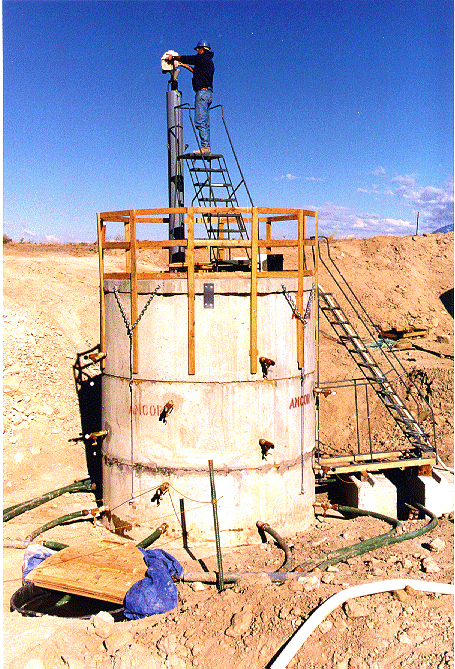
Fig. 2. Completed baseline culvert
with lid tie-downs; worker shown introducing water into the head pipe (INEL
Photo 96-658-2-30).V = volume of fluid added (length cubed)
RESULTS
Hydraulic conductivity data were obtained for all grouted pits and the grouted permeameter. The data were obtained using the packer technique for the culvert and all the grouted pits and, in addition, the full-scale falling head method was used in the grouted permeameter and the ungrouted baseline permeameter.
Packer Testing in Pits and Grouted Permeameter
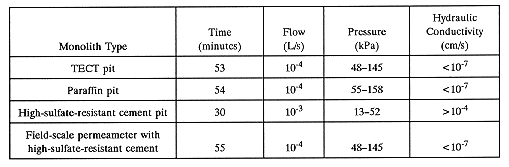
Packer test results show that for all the various grouted matrices involving TECT, high-sulfate-resistant Portland cement, and paraffin, there were positions that exhibited less than 10-7 cm/s hydraulic conductivity. Table I summarizes the packer testing results. In the pit involving high-sulfate-resistant Portland cement, however, for two core holes tested only 10-310-4cm/s hydraulic conductivity was achieved. This is thought to be caused by the fact that drums of pure sodium sulfate (simulating potassium nitrate) fouled the curing of the waste/soil/grout matrix such that the region of the grout hole was relatively porous.
In obtaining the values of hydraulic conductivity in Table I, several special actions were required partly due to the fact that the drilling process to create the core holes had a tendency to perturb the matrix. It was necessary, in some cases, to isolate one hole from another using individual packers and, in some cases, to cement sealant in that many of the holes were hydraulically interconnected for water pressures of 13.8158kPa in the packer. It became clear that the coring process affected the matrix, especially at the bottom of the pits, if the core hole penetrated below the region of the grout that was loose soil. Both double- and single-packer systems were employed. If a single-packer system failed to work because of a suspected leak out the bottom of the pit, a double-packer system was employed. In some cases, the bottom section of the hole was filled with cement grout and allowed to cure to provide a seal so that the single-packer system could be used. In other cases, adjacent holes once tested were sealed with bentonite or cement to isolate one hole from another. Through trial and error, successful tests (hydraulic conductivity less than 10-7 cm/s) were performed on the grouted permeameter, TECT pit, and paraffin pit. However, only 10-3 to 10-4 cm/s packer data were obtained in the high-sulfate-resistant Portland cement pit.
Hydraulic Conductivity Testing on Grouted and Ungrouted Field-Scale Permeameters
Good mass balance data were achieved for the ungrouted baseline permeameter and calculation of a hydraulic conductivity was possible. However, an unsteady mass balance occurred in the grouted permeameter resulting in only an estimated hydraulic conductivity. In the actual performance of the field-scale permeation testing, operational difficulties occurred that only allowed a net head of water above the culvert top of 1.22 m. Only being able to achieve a 1.22-m total driving head was the direct result of a top lid that was not heavy enough to withstand the upward force of the head of water in the head pipe, resulting in copious leakage out the seal between the lid of the culvert and the top ring of the culvert.
Table I Summary of Packer Tests for Grouted Permeameter and Pits
Prior to emplacement of the lids, the systems were saturated by maintaining a standing head of water of about 0.3 m inside the top ring as previously described. This was accomplished with the bottom valves both open and closed to ensure a flow of water through the system. Once saturation conditions occurred (evidenced by a weekend head check with no change in level in the top pool surface of the culvert), the lids were emplaced, and the head pipes and associated safety ladders were installed. Water was introduced to the head pipes, and it was immediately obvious that a 3-m head of water could not be obtained because of copious leakage out the seal between the lid and the top ring of the culvert.
After several attempts at sealing from the outside, it was discovered that the leakage was attributed to the lid actually lifting at the exact pound-force exerted by the water head (about 10cm of head up the head pipe) applied over the entire surface area of the lid. The decision was made to apply a new seal of the tar-like material and to tie the lid to the culvert rings using both steel plate and a turnbuckle system. These tie-downs are shown in Fig. 2.
Once tied down, it was discovered that a seal on the top lid could be maintained only if the water head in the head pipe was 56 cm or less. At 56 cm of water in the head pipe, there was a total head above the top surface of the grouted matrix in the grouted culvert or ungrouted waste in the baseline culvert of about 1.22 m. After sealing all visible leaks (basically just visible stains on the side of the culverts) with mortar mix, the permeation testing was started. In the baseline ungrouted system, the permeation testing involved attaching hoses to the eight collection ports and fitting them to manifolds connected to collection tanks. In the grouted system, simple collection buckets were utilized.
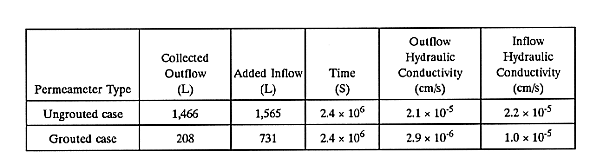
The hydraulic conductivity was calculated using either the inflow data or the measured outflow data and is summarized in Table II.
BASELINE (UNGROUTED) CULVERT
For the baseline culvert, the total amount collected as outflow was 1,466 L, and the amount placed in the culvert was 1,565 L over a period of 2.4 (breve) 106 seconds, which is close to a perfect mass balance in that the numbers are within 7% of each other. These numbers equate to a hydraulic conductivity on the order of 10-5cm/s as shown in Table II.
One possible reason for the slight imbalance is the potential for leaks in the system, causing the outflow to be slightly less than the inflow. There was little potential for evaporation because the collection tank remained covered. The hydraulic conductivity either figured from the outflow or inflow asymptotically reached a steady state (after about 2.4 (breve) 106 seconds) of about 10-5 cm/s, which is in poor agreement with the ungrouped buried waste pit estimate made in a 1987 experiment.4
Table II Summary of Field-Scale Permeameter Data
The 1987 study used an unrestrained pit and a different technique involving nominally 5-cm-diameter supply tubes placed into the matrix gravity fed by a central supply tank. In this previous experimental arrangement, water could flow horizontally as well as vertically, and there was strong potential for water to flow out the sides of the pit rather than in the compacted pit.
For the 1987 study, the soil/waste matrix had been compacted with hand compactors to simulate up to 30 years of buried condition. Therefore, it is possible that the surrounding backfill soils could have had a higher conductivity than the soil/waste matrix resulting in an overall measured value of 10-3 cm/s. Another possible explanation is that in the subject test, the bottom of the culvert had a 30-cm layer of soil, and the soil/waste matrix was placed on top of that soil layer. It is possible that the actual 3-m matrix of soil/waste had a relatively high hydraulic conductivity, and that the bottom 30 cm acted like a hydraulic valve, causing the overall measured value to be too low at 10-5 cm/s. Further study of permeation in the culverts should involve the use of higher access ports to collect the water to eliminate the possibility of the bottom soil layer falsely influencing the overall matrix conductivity.
GROUTED PERMEAMETER
Hydraulic conductivity for the grouted culvert based on outflow data was calculated to be on the order of 10-6 cm/s, which is only one order of magnitude less than the ungrouped culvert. However, the calculation is based on unsteady data. There was a large discrepancy between the hydraulic conductivity calculated from the inflow verses the outflow. There was 731L of water placed into the culvert and only 208 L collected in the buckets as outflow. Evaporation losses in the buckets have been estimated to be only 1.9L per day or approximately only 56L over the entire test. Therefore, 467 L more was placed into the culvert than was measured as outflow from the culvert, which is an unsteady condition.
There are two possible explanations for the large discrepancy between the inflow and outflow. The first possibility is that a combination of small unmeasurable leaks that could be visually classified as "weeps" accounted for the mass difference. The second explanation is that the cured high-sulfate resistant Portland cement itself may be absorbing the excess inflow fluid. There was no way to quantify the collected weeps nor the potential effect of absorption of the cement, so these ideas are only speculative. If the desired value of 10-7 cm/s had been achieved, no water would have been collected in the 2.4 (breve) 106-second testing period, because any water collected would have been on the order of evaporative losses.
There are three possible explanations for this relatively poor hydraulic conductivity performance for the grouted culvert. One explanation is that nitrate salts (one of the buried waste constituents) caused poor curing of the Type-H cement, resulting in a relatively porous preferred pathway for water flow. A second explanation is that water preferentially runs down the sides of the culvert because the waste/soil/grout matrix may shrink when cured, also resulting in a measured too high hydraulic conductivity for the matrix. A third possibility is a combination of the above two explanations. One of the explanations for the relatively poor hydraulic conductivity (10-6 cm/s) is that the matrix has a preferred migration path in connected zones involving one of the waste materials in the culvert--the nitrate salts. A nitrate salt drum was located in the top, middle, and bottom of the culvert, and incomplete mixing or poor curing of the Type-H grout during injection could have created a relatively porous zone with relatively high hydraulic conductivity.
In addition, when analyzed, the nitrate salt concentration in the collected effluent from the southern culvert was 5,360 p.m. nitrates and 0.25 mg/L cerium, a nonsoluble tracer placed as an oxide in each of the simulated waste containers. The nitrates were soluble in the flowing water. However, the cerium was not. The presence of the cerium in the collected water indicates a mechanical movement of the tracer through the medium.
Another explanation for the poor hydraulic conductivity measurement is that the matrix shrunk away from the walls during the curing process, and a preferred pathway ran down the walls. Metal rings were added to each of the rings to cause a damming effect for water flow down the walls to mitigate this potentiality. The idea was that these rings would focus water flowing down the walls back into the matrix.
It is possible that shrinkage of the matrix upon curing caused a gap formation. On any given day, approximately 26 L of fluid was added to the pool of fluid on top of the culvert to maintain a level during permeation testing. For the 3-m-diameter 3-m-high culvert, this much fluid could fill a gap only 0.09 cm. With this small of a gap, it is not clear whether surface tension effects would have kept the water from falling.
However, there is other evidence that supports the gap theory as follows. During packer testing, 12 of the valves in the system, including three of the bottom valves, were opened. In that testing, no water flowed out the valves, suggesting that the interior system was impervious to flow to the outside walls and that water could be flowing down the walls during the constant head permeation testing. It was also observed that water flow in the bottom valves started only after a head was established in the top of the culvert, although this explanation could support either the relatively high preferred path idea in the interior of the matrix due to the nitrate salts or the gap idea.
For the idea of water flowing down the gap, the presence of nitrate salts in the effluent could be accounted for due to a drum of nitrates near the outer gap. The jet-grouting operation could have thrown poorly cured and poorly mixed nitrate salts to the edge of the culvert, and water flowing down the gap could have dissolved nitrate salts collected in the bottom valves.
One puzzling problem with all of these ideas is the presence of up to 30 cm of compacted INEL soil covering the bottom valves, which should act as a filter to flow of any insoluble tracer (cerium oxide) and slow the general flow of water regardless of mechanism. This layer of soil may cause another effect in the overall mass balance of water flow in that the soil might not have been totally saturated prior to the start of permeation testing.
If the soil was not totally saturated during the so-called saturation period (a period of 20 days with a 30cm head on the top of the culvert prior to actual testing), any water that gets down to the bottom of the culvert could be saturating this soil. For example, the volume occupied by this soil is 2,207 L. At 33% voids in this soil, there was the potential to absorb up to 725 L of water.
Comparing the 725 L of potential void space in this 30 cm layer to the 467 L of the imbalance between what was added and what was taken out during the permeation testing shows that this saturation of the bottom soil could have accounted for the mass imbalance. The core holes did not penetrate to this lower level, so there is no way to actually determine if the jet-grouting operation actually grouted this region or if it remained intact. In destructive examinations, grouting in the INEL soils usually is limited to fairly well-defined columns of up to 71 cm in diameter, with small areas of hydrofractured grout tendrils at random positions.(1,2) Also, based on past experiments, a pool of Type-H cement grout in the bottom of the culvert would not have penetrated the fine INEL silty clay soil by permeation. The actual grouting started at approximately 40 cm from the bottom because the nozzles on the drill stem were 10 cm above the bottom of the terminal position of the drill, and, when this 10 cm is added to the approximately 30 cm of soil, the total is 40 cm of potentially ungrouped matrix that could either easily transmit water or absorb migrating water.
CONCLUSIONS
Results of the packer testing of both TECT and paraffin pits and high-sulfate-resistant cement indicated that the general matrix is less than 10-7 cm/s hydraulic conductivity. In addition, results of packer testing in select core holes in the high-sulfate-resistant cement pit suggested hydraulic conductivity as high as 10-3cm/s. This isolated high hydraulic conductivity is attributed to a poorly cured soil/waste/grout matrix that is porous due to the presence of sodium sulfate, which is a stand-in for potassium nitrate in the actual waste.
Hydraulic conductivity testing using the field-scale permeameter has shown that the ungrouped condition in an INEL-simulated buried transuranic waste pit has a hydraulic conductivity of about 10-5 cm/s, which is in poor agreement with previous data using 5-cm-diameter tubes placed atop the matrix and a gravity feed supply tank to introduce the water. In the previous data, a hydraulic conductivity of 10-3 cm/s was reported, and water was free to flow isotopically through the matrix as well as horizontally away from the matrix. The surrounding soil may have been loosely packed, and the water may have followed a preferred lower resistance pathway. In the subject test, a nearly perfect match of inflow and outflow data was achieved.
Hydraulic conductivity testing of the field-scale permeameter grouted with high-sulfate-resistant cement is inconclusive. There was a discrepancy between what was introduced into the culvert (731 L) and what flowed out of the culvert (208 L). The deficit could be accounted for by unmeasurable leaks or by absorption of water into the grout/soil/waste matrix. It appears that a combination of shrinkage of the matrix from the culvert wall plus the potential for incomplete curing of the nitrate salts in the grout matrix allowed only a one-order-of-magnitude reduction in measured hydraulic conductivity when comparing the grouted case to the ungrouped case. The measured hydraulic conductivity of the grouted culvert was on the order of 10-6 cm/s, which is one order of magnitude higher than the desired value of 10-7 cm/s. However, when combining the packer data and the permeameter data, it is possible that the actual matrix is at least 10-7 cm/s. This conclusion is based largely on the fact that no water flowed from the valves of the permeameter when the packer tests were being performed. During these tests, virtually no flow was observed for nominally 50 minutes under a pressure range of 48145 kPa.
Finally, it is recommended that the potential gap between the soil/waste matrix and the permeameter wall be sealed from the top surface (presumably using epoxy) to eliminate the possibility of water flowing down the postulated gap causing an erroneously high hydraulic conductivity measurement. Once sealed, the falling head hydraulic conductivity test should be repeated.
ACKNOWLEDGMENTS
Work supported by the U.S. Department of Energy, Assistant Secretary for Environmental Management, under DOE Idaho Operations Office Contract DE-AC07-94ID13223.
REFERENCES