HOW PERFORMANCE ASSESSMENT OF A GEOLOGICAL WASTE
DISPOSAL IN CLAY HAS CONTRIBUTED TO FOCUS THE RADIONUCLIDE MIGRATION RESEARCH
M. J. Put, J. Marivoet, G. Volckaert and B. Neerdael
SCK•CEN
Boeretang 200, B-2400 Mol
Belgium
ABSTRACT
Because of limited resources available for the research on geological waste
disposal we needed an effective research strategy. Therefore we used performance
assessment to determine the most critical components of the system. The results
of a preliminary performance assessment study indicated that the Boom Clay
formation was the main barrier and deserved the most attention. From the
interaction with this study we derived a list of radionuclides to consider in
the migration R&D program. We identified the sensitive phenomena and
parameters for the conceptual model, and focused the research on the study of
these phenomena and the measurement of the parameters. To study the migration of
radionuclides in the Boom Clay we used laboratory diffusion and percolation
experiments on small clay cores. To test the soundness of the approach and to
gain confidence in the obtained model and parameters we started large scale in
situ radionuclides migration experiments. After eight years these large scale
experiments still show good agreement with the predictive calculations.
INTRODUCTION
In Belgium, the Boom Clay Formation at the Mol site is studied as a
candidate host formation for the disposal of high-level radioactive waste (HLW)
(1). This formation is situated between -160 and -270 m, and is the uppermost
clay formation of an alternating sequence of clays and sands deposited about 30
million years ago. Boom Clay is a plastic clay and shows the following promising
properties to act as a barrier against the migration of radionuclides:
- a very low hydraulic conductivity,
- low diffusion coefficients for non-retarded species,
- high sorption capacity for cations,
- slightly alkaline and strongly reducing conditions limiting the solubility
and the mobility of many radionuclides,
- and a high plasticity resulting in the self healing of possible fissures.
Performance assessments of the geological disposal of HLW in the Boom Clay
have shown that the most effective and reliable barrier of the multi-barrier
repository system is the host clay layer (2, 3). The engineered barriers give
additional protection and prevent the transport of radionuclides during the
thermal and the radiation phases. An integrated and site specific research
program is carried out since 1974 on the following topics related to the Boom
Clay: thermal impact of the HLW on the host formation, geomechanical and
hydraulic properties of the host rock, radionuclide and gas migration,
repository backfill and sealing studies (1, 4). In case of the migration study,
the approach used consists of the following steps: identification of the
relevant migration mechanisms, development of a reliable model for the
calculation of the migration of radionuclides, measurement of the model
parameters by appropriate experiments, and validation of model and parameters by
large scale in situ migration experiments. The results obtained from the
research program are used in performance assessments, which provide feedback to
the R&D program. Large scale demonstration and validation tests contribute
to build confidence in the repository system and in the results of the
performance assessment calculations (5).
The reported research is jointly sponsored by the Belgian national waste
authority NIRAS/ONDRAF and by the European Communities.
PERFORMANCE ASSESSMENT INTERACTION METHODOLOGY
The interaction between the radionuclide migration program and performance
assessment can be applied at different levels:
- to select the radionuclides of most concern, with the potentially highest
dose to man, and to focus the research efforts on those radionuclides
- to determine the elements of the multi barrier repository system that are
the most sensitive for the release of radionuclides to the biosphere
- to determine the most critical model parameters by probabilistic safety
assessment studies, and determine the most sensitive parameters who contributes
the most to the uncertainty in the calculated dose to man
- to test the robustness of the conceptual models and the importance of the
different phenomena considered
The interaction is an iterative process, which is used to focus the R&D
program on the most critical issues. First a preliminary performance assessment
is done on the basis of limited information from the host rock characterization
and from literature data. The results of the preliminary performance assessment
are used to make a list of radionuclides, which deserves more research. As new
experimental data are introduced in the performance assessment studies, the
uncertainties in the results are reduced and the research priorities may be
reoriented. In these procedure however, one should be careful not to run in a
self confirmation cycle, but leave sufficient freedom for the test of
alternative conceptual models and scenarios.
APPLICATION TO THE MIGRATION PROGRAM
For the early performance assessment study, experimentally determined
migration parameters were only available for a small number of radionuclides
(Pu, U, Cs, Sr, Tc). For the other radionuclides the migration parameters were
estimated on the basis of literature data or chemical analogy; a strong degree
of conservatism had to be introduced in the estimated parameters (2, 3). From
the results of the assessment a number of very important radionuclides were
determined. Thereafter the migration parameters of these radionuclides were
experimentally determined in the R&D program on migration (4). In later
assessments the new migration parameters were applied, and for many
radionuclides the calculated doses were reduced with several orders of magnitude
if compared with the results of the first assessment. For some radionuclides,
especially for Tc, it appeared that the applied chemical conditions strongly
influence the measured parameter values. As a consequence, very high 99Tc doses
were calculated in the early assessment, whereas the 99Tc doses calculated in
the most recent assessments are about negligible (2, 6, 7).
In the case of the Mol site the PAGIS (2) and PACOMA (3)
projects were the first integrated performance assessment studies. PAGIS and
PACOMA were projects, co-ordinated by the European Commission (EC), on the
performance assessment of the disposal of respectively high-level and
medium-level radioactive waste in the various geological host formations
considered in the European Union, i.e. clay, granite and salt. The Mol site was
the reference site for disposal in clay. These studies clearly showed that the
Boom Clay formation is the most important barrier against the release of
radioactivity to the biosphere, and that the diffusion constant was the most
sensitive parameter. They also indicated that from the total inventory of
radionuclides in the waste, only 14C, 99Tc, 129I,
135Cs, 237Np, 79Se, 93Zr, 107Pd,
with the U-, Am-, Cm-, and Pu-isotopes are the most important. We used this
information to guide the radionuclide migration research (4).
In the UPDATING 1990 (6) the PAGIS and PACOMA studies are updated with the
new data acquired from the radionuclide migration research. This led not only to
an important reduction of the uncertainties, but also a change in the order of
importance for the different radionuclides. The function of the Boom Clay as the
main barrier was also confirmed.
In the case of rather expensive research programs, such as the one on the
role of organic matter on the migration of radionuclides, the program management
requested the performance assessment team to make a preliminary assessment of
the potential impact of organic complexation on the performance of the
repository system. On the basis of existing data for the mobility of the
dissolved organic matter (8) performance assessment calculations were done (7,
9). An important conclusion of this preliminary assessment was that the
potential influence of organic complexation is considerable especially for a
number of trivalent actinides, and therefore the research on the role of organic
materials is continued.
In the EVEREST (7) project of the EC, systematic scenario studies were
elaborated as well as various sensitivity studies to determine the parameters,
processes and assumptions that strongly influence the calculated doses. From the
study for the Mol site the importance of the solubility of the radionuclides in
the near field on the flux released to the biosphere was estimated. To improve
the reliability of the near field simulations the study of the speciation and
the solubility limits under in situ conditions of the important radionuclides
was included in the R&D program.
RADIONUCLIDE MIGRATION PROGRAM
The migration program of the 1991-1995 period was defined on the basis of
the migration data already available and the missing or incomplete data still
required by the performance assessment studies PAGIS and PACOMA.
The studied radionuclides are divided in three groups, the first two based
on the calculated dose rates, and the last group for the basic study of the
migration mechanisms:
- the critical radionuclides yielding the highest dose rates (> 10-6
Sv/y): 14C, 99Tc, 129I, 135Cs,
237Np, and organic matter as transport agent;
- the possibly critical radionuclides yielding non negligible dose rates (10-9
to 10-6 Sv/y): 79Se, 93Zr, 107Pd,
with the U-, Am-, Cm-, and Pu-isotopes, and;
- radionuclides used to study the migration mechanisms in a compacted clay
(HTO, Sr2+, Br), or as a chemical analogues for mobile humic
substances (14°C- labelled sucrose, or lactose), or for trivalent actinides
(Eu3+).
The migration of radionuclides in the Boom Clay has been studied by
laboratory diffusion and percolation experiments on small clay cores, and by
large scale in situ migration experiments (10,11,12,13). Because of the very low
hydraulic conductivity of the Boom Clay, the migration of radionuclides is
mainly controlled by molecular diffusion.
To study the basic phenomena governing the migration of radionuclides in the
Boom Clay, through-diffusion and percolation experiments with non-sorbed
radionuclides have been used. The studied radionuclides are: tritiated water,
iodide and bromide isotopes, 14°C labeled bicarbonate, and labeled small
organic molecules. The results of the experiments show that the key parameters
for the migration are: diffusion accessible porosity, retardation constant,
apparent diffusion coefficient and hydraulic conductivity. The clay fabric
influences the value of the migration parameters as observed clearly with the
non sorbed radionuclides. The values of the apparent diffusion coefficient and
of the hydraulic conductivity depend on the clay core orientation with respect
to the bedding plane, and on the consolidation pressure applied. The dual role
of the natural organic matter for the migration of trivalent actinides was also
pointed out: large immobile organic molecules contribute to its retention while
small mobile molecules (0.01% of total organic content) enhance its mobility.
LARGE SCALE IN SITU VALIDATION TESTS
For the validation of the migration model and the parameters, three large
scale in situ migration experiments with non-sorbed tracers are carried out in
the Boom Clay Formation from the HADES underground research facility (4). One
experiment with tritiated water (HTO), and two experiments with 125I-.
Their purpose is to validate the conceptual diffusion-advection migration model,
and the values of the migration parameters obtained from small scale laboratory
migration experiments. HTO has been injected in a filter located in the Boom
Clay in January 1988 and the HTO concentrations in the clay water are measured
at filters located at 1 and 2 meters from the injection filter. As shown in Fig.
1, a good agreement still exists between the model calculations with the MICOF
code and the experimental results. This experiment clearly proves that the
diffusion-advection model can be used at a metric scale and that the diffusion
parameter values derived from laboratory scale experiments remain valid for
large scale in situ conditions (upscaling of the considered length by a factor
50). This experiment is continued.
At two other filters 125I- has been injected in the host formation in June
1992. The agreement between the model calculations and the experimental results
is less good than for the HTO experiment. Due to the sampling of the injection
filter, a small systematic deviation between the calculated and the measured
concentration of the source exists. Nevertheless, the agreement between the
experiment and the model is fairly good. Because of the short half-live
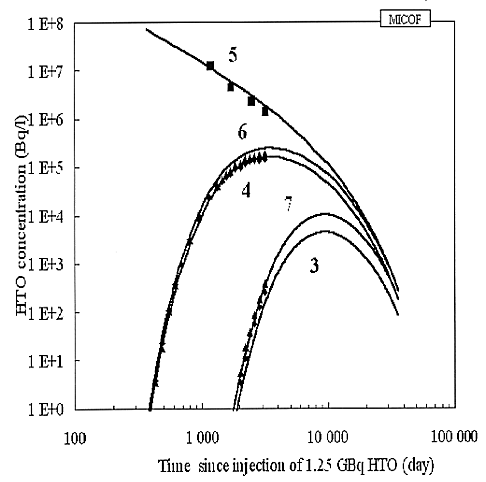
Fig. 1 After eight years we still
observe a good agreement between calculated (lines) and measured (symbols) HTO
concentrations for injection filter (5), for filters at a distance of one meter
(4 and 6), and for filters at a distance of two meters (3 and 7).
(60 days) the 125I isotope the experiment is finished. But now
the same filters are used for two new large scale in situ injection experiments
with 14°C labeled organic matter extracted from the Boom Clay water. These
experiments must allow for the validation of role of the organic matter in the
performance assessment.
CONCLUSIONS
A good interaction between performance assessment and basic research
provides feedback and can better focus the research on the really important
issues, and thus reduce the cost. A critical review of the results of the
performance assessment can drastically reduce the number of radionuclides to be
studied. In the case of a repository in Boom Clay the number of critical
nuclides to be studied was reduced to five.
The basic idea behind geological disposal was confirmed for the Boom Clay,
namely the host formation must be the main barrier. The most important model
parameters are the diffusion constant and the solubility under in situ
conditions.
Special attention has to be given to the importance of the complexation with
organic matter. Because the dissolved organic matter can act as a transport
agent and thus short-circuit the favorable sorption properties of the clay.
REFERENCES
- BEAUFAYS R., BLOMMAERT W., BRONDERS J., De CANNIERE P., del MARMOL P.,
HENRION P., Monsecour M., Patyn J. and Put M. (1994) Characterization of the
Boom Clay and its multilayered hydrogeological environment. Final report
EUR14961EN
- MARIVOET J. and BONNE A. (1988) PAGIS, Performance assessment of
geological isolation systems for radioactive waste. Disposal in clay formations.
EC, Luxembourg, Report EUR11776EN
- MARIVOET J. and ZEEVAERT T. (1991) PACOMA Performance assessment
of the geological disposal of medium level and alpha waste in a clay formation
in Belgium. EC, Luxembourg, Report EUR13042EN
- De CANNIERE P., MOORS H., LOLIVIER P., De PRETER P., and PUT M. (1996)
Laboratory and in situ migration experiments in the Boom Clay, Final report, EUR
16927 EN, 1996
- PUT M. J., De CANNIERE P., MOORS H., FONTEYNE A., and De PRETER P. (1993)
Validation of performance assessment model by large scale in situ migration
experiments, Proceedings int. symp. "Geological disposal of spent fuel,
High-level and alpha-bearing wastes", IAEA-SM-326/37, pp 319-326, 1993
- MARIVOET J., (1992) UPDATING 1990, Updating of the performance assessments
of the geological disposal of high-level and medium-level wastes in the Boom
Clay formation, SCK•CEN report, BLG 634, 1992
- MARIVOET J., VOLCKAERT G., WEMAERE I., and WIBIN J. (1997) EVEREST, Vol.
2a, Clay formations, Site in Belgium, EUR 17449EN
- PUT M.J., MONSECOUR M. and FONTEYNE A. (1992) Mobility of the dissolved
organic material in the interstitial Boom Clay water. Radiochimica Acta
58/59, 315 317
- VOLCKAERT G., DE CANNIERE P., WIBIN J. and MARIVOET J. (1995) Evaluation of
the potential influence of organic complexation on the performance of a
geological repository in clay. Proceedings of the OECD NEA workshop on "Binding
models concerning natural organic substances in performance assessment",
Bad Zurbach, Switserland, 14-17 September, 1994, OECD, NEA, Paris, 1995
- HENRION P.N., MONSECOUR M., FONTEYNE A., PUT M. and De REGGE, P. (1985)
Migration of radionuclides in Boom Clay. Radioactive Waste Management and
the Nuclear Fuel Cycle 6 (3-4), 313-359
- HENRION P.N., PUT M.J. and VAN GOMPEL M. (1991) The influence of compaction
on the diffusion of non-sorbed species in Boom Clay. Radioactive Waste
Management and the Nuclear Fuel Cycle 16 (1), 1-14
- PUT M.J., MONSECOUR M., FONTEYNE F., and YOSHIDA H. (1991) Estimation of
the migration parameters for the Boom Clay Formation by percolation experiments
on undisturbed cores. Mat. Res. Soc. Symp. Proc. 212, 823-829
- COME B. (1990) MIRAGE CEC Project Second phase on
migration of radionuclides in the geosphere. Third (and final) summary
progress report (work period 1989). Report EUR 12 858 EN