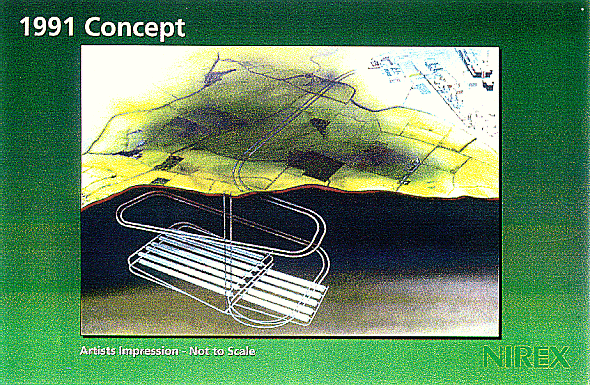
Fig. 1. 1991 concept.
Ann McCall
Nirex
Engineering Design Manager
ABSTRACT
This paper describes the design development of the UK's potential national deep disposal facility for radioactive waste. Nirex is developing the design and specification of this potential facility alongside the results of a site investigation program at the preferred site. This paper describes the three design concepts which Nirex is currently considering for a potential repository at the Longlands Site in Cumbria in the North West of England. It also describes the evolution of the design alongside the public consultation process and environmental, economic and regulatory aspects of such a project.
INTRODUCTION
In July 1991, Nirex announced that it was concentrating it geological investigation work for the siting of a potential underground repository at Sellafield near Gosforth in West Cumbria which is in the North West of England. At Sellafield, a repository would be excavated beneath land at the Longlands Site which lies adjacent to the nuclear generating and reprocessing plants operated by British Nuclear Fuels Plc (BNFL). The BNFL Sellafield site is the largest nuclear site in Britain and it is from here that approximately two thirds of the radioactive waste destined for the Nirex repository will be generated. The Nirex Longlands site is approximately 2km inland from the BNFL Sellafield site which lies on the Cumbrian coast. Site investigations in this area were started by Nirex in 1987.
The site investigation program at Sellafield is continuing and includes proposals to construct and operate a Rock Characterization Facility (RCF). This is currently subject to receiving planning permission following a planning inquiry which finished in early 1996.. The Rock Characterization Facility would give geologists access to the host rock at depth to perform in-situ testing of the potential repository zone beneath the Longlands site. The results of such tests will confirm (or otherwise) the extensive computer modeling that has been performed from borehole and survey data which have been obtained from the surface based site investigation program. It is for this reason that the design concepts presented in this paper are yet to be finalized.
The paper will give a brief description of the design concept presented in 1991. It will then go on to discuss the range of issues which have led to the development of these concepts and describe the three concepts currently being considered by Nirex.
Figure 1 shows a potential repository design concept presented back in 1991 to accommodate 2,000,000 m3 of waste. The quantity of waste destined for a potential repository is now much smaller at between 200,000 m3 and 275,000 m3. This was announced by Nirex in 1995 and meant that the 1991 concept which consisted of a series of underground vaults accessed by two drifts and two shafts had a capacity about ten times that which is now envisaged. The reason for this reduction in volume is described later.
Fig. 1. 1991 concept.
The 1991 concept evolved following a public consultation exercise of earlier design concepts. Then, as now, Nirex was keen to listen to the comments of local people and take their views into account.
As a result of public consultation Nirex noted the following issues which were of particular concern:
These issues have been noted and taken forward as key considerations into the design development process.
The main elements of the 1991 concept are summarized as follows:
This concept envisaged that the drifts would be used for spoil removal during construction, and personnel access during the construction phase of the deep waste repository (DWR). The excavated rock generated by this concept was of the order of 5,000,000 m3 - 6,000,000 m3 of which approximately 2,000,000 m3 was to be disposed of locally and the rest being disposed of elsewhere.
Both the drifts would be used for repository construction purposes up to first waste emplacement, at which time one drift would be designated for waste movements and the second drift would be used for on-going construction of additional vaults through time. Following excavation the two shafts would have the construction headgear removed and operational headgear installed for emergency egress. The shafts would also be used for ventilation purposes.
Although following construction some buildings would have remained, it was envisaged that there would be little need for above ground access to the Longlands Site and appropriate road access would be provided from the Sellafield site. This would be in the form of a road from the Sellafield site, directly across country to the Longlands Site and this access route was discussed during the consultation process.
The 1991 design concept was set against design criteria and requirements declared in the consultation documents published at the time. These are still valid today. However, there have been a number of technical changes over the years which have a potential impact on the continuing design development and since 1991 there have been two key developments which have had an impact upon the design.
First, in May 1992 the company viewed results from a preliminary safety assessment of the Longlands Site at Sellafield as encouraging and suggesting a "so far so good" picture of the site's potential suitability as a location for a DWR. However, a decision on whether to submit a planning application for development of a potential repository was postponed because the available data were insufficient to permit a firm view to be reached on a model of the hydrogeological system and to allow a robust safety assessment to be put to the regulators. The safety of the repository is of key importance to Nirex, and two safety cases will accompany a planning request for the repository.
However, the Company decided in September 1992 to break out the RCF as a necessary free-standing stage in its further site investigations, to inform a decision whether to propose development of a potential repository at Sellafield.
Secondly, in October 1995 Nirex completed a survey of future DWR customers' requirements and re-defined the anticipated volume of waste for disposal as a planning basis of two hundred thousand cubic meters and a potential for expansion of capacity up to two hundred and seventy five thousand cubic meters.
The main reasons for the reduction in the volume of waste for deep geological disposal are:
As a consequence the logistics and access routes required for a potential repository have been reviewed and Nirex has also investigated the option of single drift access to connect the surface receipt and underground emplacement areas of the repository.
THE 1996 CONCEPTS
The Nirex design team and the environmental assessors have developed three design concepts in the light of the developments described above. In particular Nirex has given careful consideration to the use of the Longlands Site in the design concepts. These concepts are:
For all three concepts, use will be made of the operational headgear and facilities of the RCF for the initial construction phase of the DWR. The construction period for the DWR is about eight years which on the current Nirex program is based on an assumed start of construction in 2004 and first waste emplacement in 2012.
As in the 1991 concept two ventilation shafts are required and would be accessed at the Longlands Site. The RCF shafts could only be used for the DWR provided that the U.K. regulatory requirements of the Nuclear Installations Inspectorate and the Health and Safety Executive were met and that planning permission was granted, to allow Nirex to change their use. Initially, access for personnel and materials to the underground works is proposed via the shafts.
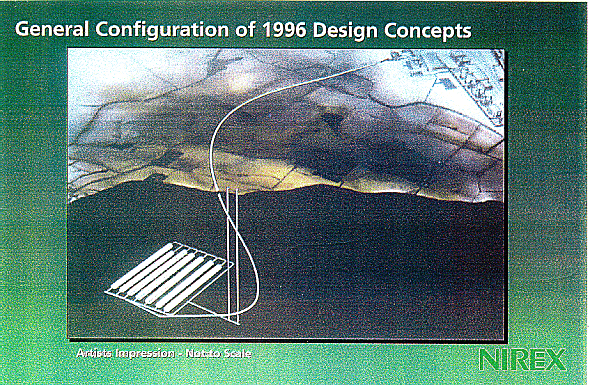
Fig. 2. General
configuration of 1996 design concepts.
The 1996 concept is shown in Fig. 2 and accommodates 200,000 m3 of waste, significantly less than the 1991 concept. The surface waste receipt facilities remain the same for the 1996 design concepts as they were for the 1991 concept although smaller in scale.
The main elements are:
The disposal of excavated spoil is proposed to occur on land near to the development. The total quantity of spoil generated from the entire repository would be approximately similar to the quantity identified for disposal on site in the 1991 concept. This is due to the reduced capacity of the repository and because the repository will only go ahead if the RCF has confirmed the site suitability.
TWIN DRIFTS
The twin drift concept uses the Longlands Site facilities from the start of construction in 2004 to 2008 i.e. for a period of four years allowing a reduction in the use of the Longlands Site including removal of the construction headgear and the spoil conveyor before the DWR becomes operational in 2012. Construction and spoil removal will be an ongoing activity alongside waste emplacement and the second drift will be used intermittently for construction of additional vaults. Due to the reduced capacity this would be a relatively low usage compared to the 1991 design due to the reduction in the number of vaults.
SINGLE DRIFT
This then introduces the possibility of constructing the required vault capacity up front and removing the need for the second drift for ongoing construction activities. Man and materials access in support of DWR construction will still be required via the north shaft throughout the initial DWR operating period when the backlog of waste is being disposed. However, once this backlog has been received ongoing construction support activities can take place via the drift and the construction headgear can be removed. Headgear would still be required for a second means of egress whilst underground operations are ongoing. All vaults could be constructed within approximately twelve years after the start of construction and the facilities for spoil removal and construction support at the Longlands Site removed once vaults had been excavated. The construction traffic associated with fit-out of the vaults at the appropriate time would gain access via the drift. There is no need for a second drift in this case.
DUAL USE DRIFT
The dual use of the drift for both radioactive waste movements and construction activities including man access may be possible once the drift has been excavated and equipped and this is from 2004 to 2010, some six years after the start of construction allowing reduced use of the Longlands Site before DWR operations commence. This option does not require the construction of the second drift and allows the removal of the construction headgear from the north shaft prior to first waste emplacement. Headgear would still be required for a second means of egress while underground operations are ongoing. However, in order to accommodate the increased number of transport movements in the drift the waste throughput would need to be reduced requiring Nirex Customers to increase the period allowed for removing the waste backlog from surface storage facilities. Under this concept the surface receipt facilities and the drift itself would effectively become an extension of the on-site transport system as no nuclear operations take place until the containers are underground. Based on current practice and precedent the drift could be used for transport of both waste packages and construction materials and personnel. The details and logistics of this concept are the subject of further investigation by Nirex, its shareholders and the regulators.
This is summarized as follows:
Table I Comparison of Concepts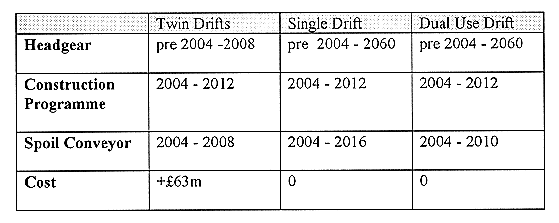
The features of the 1996 concept are as follows:
OPTIMIZATION OF THE REPOSITORY SYSTEM
Changes to the requirements of the repository system are documented in a specification document being developed by Nirex. The most recent development has been the reduction in the total volume destined for the repository as a result of future customers' perceived needs. This has influenced the design solution proposed for the repository as described in this paper. The net result is that the capital cost of the repository project has been reduced by some £360m to £713m and the construction program reduced from 105 to 92 months. The cost and program are under continuing review and it must be stressed that the designs described are at concept stage pending the development of the specification document and further information from Nirex's continuing site investigation program at the Longlands Site.
CONCLUSION
The main difference between the 1991 and 1996 design concepts arises as a result of the reduction in the volume of waste for disposal. A second drift in the 1991 design was required due to the extent of the underground development to accommodate 2,000,000 m3. Construction of disposal vaults was an ongoing requirement during DWR operations. However, the reduction in capacity for disposal gives an opportunity to construct vaults up front and removes the need for extensive facilities for the long term disposal of spoil.
These three concepts were recently presented to the local people in Gosforth and the surrounding parish to the Longlands Site as part of Nirex's ongoing public consultation process. Nirex is optimising the specification and design of a future possible repository at the Longlands Site. This process is the subject of a further paper at this conference (Ref. Ses. 2 "Multinational Repositories").
A decision on the final concept to be taken forward into the design process will be made during 1997. This will allow the design and the associated safety cases to be presented at the turn of the century prior to a planning application by Nirex to develop the UK's radioactive waste disposal facility at the Longlands Site, should that site be suitable.