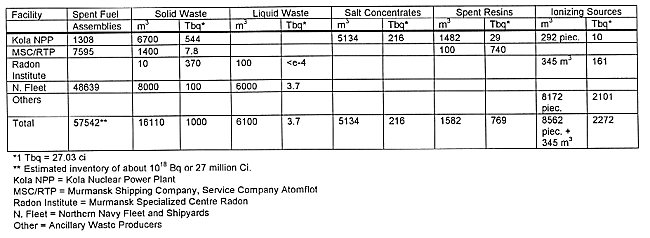
Table I Total Accumulatedc Radioactive Waste in the Murmansk and
Arkhangelsk Regions (European Commission, 1996)
R.S. Dyer
Office of International Activities
U.S.
Environmental Protection Agency
Washington, DC
P.D. Moskowitz, C.J. Czajkowski, M. Cowgill and T. Sullivan
Environmental & Waste Technology Center
Brookhaven National Laboratory
Upton, NY
ABSTRACT
Past practices associated with the civilian and military use of nuclear power in NW Russia present large environmental security risks of international concern. These risks arise from a variety of practices associated with weapons production, testing, power production and waste management. The threats presented by these activities are multimedia in nature, span political boundaries and cannot be simply or inexpensively remediated. Today, cooperative efforts are being undertaken to improve environmental security by remediating existing and potential emission sources. Initial efforts focused on the upgrade and expansion of the Murmansk Low-level Liquid Waste Treatment Facility, Murmansk, Russia. This facility handles wastes generated during the decommissioning of Russian Nuclear Navy submarines and from the operation of the Russian commercial nuclear-powered icebreaker fleet. This upgraded facility is now being constructed and is expected to be completed by March 1998. Completion of this facility will result in the cessation of any future dumping of liquid radioactive wastes into the Barents and Kara Seas. Another large environmental security risk is the LEPSE. The LEPSE is a ship docked in Murmansk, Russia, that contains ~650 spent fuel elements as well as other solid and liquid wastes from Russian nuclear vessels. International efforts are now being mounted to remove the spent and damaged fuel from this ship, including the safe removal and storage/disposal of the fuel elements. This paper will summarize the environmental security problems presented by these different sources and the likely environmental security benefits associated with their remediation.
INTRODUCTION
Widespread concern over the dumping of nuclear material into the Arctic Seas was first raised in 1991. In the Spring of 1993, the Russian Federation issued a report on nuclear waste disposal in the Arctic by the Former Soviet Union (FSU). This report often referred to as the "Yablokov Report" or "White Book" suggested that a total of 3 million curies of radiation had been deposited into the Kara and Barents Seas (Edson et al., 1996). On October 11, 1996, The Washington Post published a feature article titled "Nuclear Specter Rises from Naval Graveyard - Old Soviet Base Harbors Risk of Catastrophe." The article discusses major problems confronting Russia in the Murmansk Region arising from the improper handling of spent nuclear fuel (SNF) and related hazardous/radioactive wastes, and draws on information assembled by the Bellona Foundation in Norway. These wastes arise from both the past operation and current decommissioning activities associated with Russian civilian and military nuclear ship operations. The article also notes that many of these problems have been further aggravated by the accelerated rate of Russian submarine decommissioning required by the START Conventions. In response to these concerns, the U.S., Norway and Russia are now engaged in cooperative efforts to improve environmental security by remediating facilities containing large inventories of radioactive materials. This paper describes the context in which these efforts are being conducted and presents technical details for the first two projects undertaken in the Kola Region of NW Russia with U.S. participation: The Murmansk and LEPSE Initiatives.
BACKDROP
In the Kola Peninsula region specifically and in northwest Russia in general, many facilities exist that are now or were formally engaged in Russian military nuclear-powered ship operations. These sites include shipyards where Russian nuclear-powered submarines were commissioned (Severodvinsk), facilities where commercial and military nuclear powered vessels were serviced (Murmansk), and sites where spent nuclear fuel has been placed (Andreeva Bay). The wastes generated by activities conducted at some of these sites can present large health and environmental risks to current and future generations.
With the warming of international relations following the end of the Cold War and in response to the environmental security threat presented by improperly stored nuclear materials, Russia, Norway and the U.S. are now working together to apply innovative technology solutions to these problems.
The key government organizations involved in these efforts include:
In the U.S., these efforts are being conducted under the umbrella of:
The essence of the U.S. doctrine as expressed by former Secretary of State Warren Christopher is that Environmental issues, like National Security and Energy issues, are of critical importance to U.S. international policy.
NUCLEAR WASTE PROBLEMS IN NORTHWEST RUSSIA
In Northwest Russia, nuclear waste problems arise from both former and current commercial and military nuclear-related operations. Table I presents estimates of the total accumulated volume and activity of radioactive waste now present in the Murmansk and Arkhangelsk regions (European Commission 1996). These wastes present current and future risks to human health, especially if they are not properly managed. In the past, the FSU was indifferent to these risks and mismanaged these materials as evidenced by the dumping of reactor components, reactor compartments, fuel rods and liquid wastes in the Arctic Ocean, and the inadequate storage of spent naval nuclear fuel at Andreeva Bay. Trilateral efforts are now underway to remediate these types of problems. The Murmansk and LEPSE Initiatives are clear examples of the type of International cooperation that is emerging to reduce environmental security risks presented by military and civilian nuclear operations in the FSU.
Table I Total Accumulatedc Radioactive Waste in the Murmansk and
Arkhangelsk Regions (European Commission, 1996)
THE MURMANSK INITIATIVE
In the Murmansk Region, there are about 70 nuclear-powered submarines that must now be defueled and decommissioned. The ability of the Russian Navy to safely decommission these submarines is greatly hindered by the lack of finances and physical infrastructure needed to handle the solid and liquid radioactive wastes generated during the decommissioning process. Accidents occurring within the reactors onboard these submarines or from inadequate handling during the decommissioning process may result in radioactive contaminant releases that could have health impacts on the populations living near the Kola Peninsula and beyond.
In response to this concern, the Murmansk Initiative (Dyer et al., 1996) was started about three years ago. The purpose of this initiative is to upgrade and expand the Murmansk Low-Level Liquid Radioactive Waste Treatment (LLRW) Facility so that Russia will not further dump these liquid wastes in the Arctic Seas. This facility handles LLRW generated during the decommissioning of Russian Nuclear Navy submarines and from the operation of the Russian commercial nuclear-powered icebreaker fleet. This upgraded facility is now being constructed and is expected to be completed between December 1997 and March 1998. This upgrade is being jointly financed by the governments of Norway, Russia and the U.S.; each is a partner in providing financial support for the upgrade of this facility. Unlike some other international activities, the baseline technology being incorporated into this facility is largely innovative and Russian in origin.
In a technical context, the facility will treat up to 5000 cubic meters per year of LLRW from the following specific sources:
The LLRW Facility is essentially a concentrator for the wastes, except for tritium which remains in solution. The waste streams are filtered to remove particulates, undergo ion-exchange for both softening and solids precipitation, and electro-separation and concentration before final filtering. The activity reduction in the waste water is greater than five orders of magnitude. Thus, the purified waters can be safely discharged, while the solids and residues from the treatment processes are transferred to the cementation unit for solidification with cements for storage.
Pretreatment provided is intended to reduce the water hardness by removing primarily calcium (Ca), magnesium (Mg), and non-radioactive strontium (Sr). Removal of radioactive strontium occurs as a beneficial secondary result of the process, and the decontamination factor (DF) for removal of radioactive strontium is estimated to be about 100.
There are two primary reasons why hardness must be reduced. First, some of the sorbents are intended to remove radioactive strontium selectively. However, because of its relative abundance compared to the radioactive strontium, if non-radioactive strontium is not removed first, it would be trapped on the selective absorbents, significantly reducing their useful lifetime. Reducing the hardness of the high-salt waters is necessary also to ensure proper operation of the electrodialysis and electroosmosis components of the Electromembrane Desalinator (see Fig. 1) which is also used to treat this stream. If calcium, magnesium, and non-radioactive strontium ions were allowed to enter the desalination unit, they would quickly foul the unit's membranes. This would cause premature failure and increased maintenance. Calcium oxalate fouling would also be a problem for electrodialysis/electroosmosis, if hardness is not reduced.
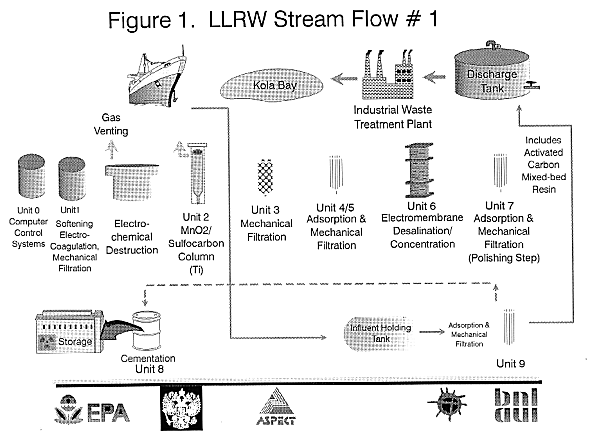
Fig. 1. LLRW stream
flow #1.
Because each waste stream is different (in salinity, particulates and activity), the plant is designed in a modular fashion, within designated functional Units, which allows for some degree of standardization of the treatment path for each waste stream and for the manufacturing replication of filters, pumps and fittings wherever possible.
The system provides treatment trains for processing of High-salt Waters, Decontamination Waters, and Low-salt Waters respectively. Laundry Waters are processed using some of the equipment provided for the last two processing trains. At the inlet of each train, there is a large Accumulation Tank for receiving the waste water. All but the Decontamination Waters/Laundry Waters are pumped from ships at dockside to these tanks. The Decontamination Waters/Laundry Waters come from the Atomflot repair facility on site.
This project is of considerable interest to Norway, Russia and U.S. because of its environmental security implications. In an environmental context, this facility represents a large source of potentially uncontrolled LLRW releases to the Barents and Kara Seas. With the completed expansion and upgrade of this facility, much of the LLRW associated with nuclear submarine decommissioning will be accommodated and the threat of uncontrolled LLRW release removed.
THE LEPSE INITIATIVE
A ship named the LEPSE is moored in Murmansk Harbor and serves as an interim storage site for ~650 spent nuclear fuel elements derived from the defueling of Russian nuclear submarines and icebreakers. Approximately 30% these fuel assemblies are damaged. There is growing international concern that the LEPSE could sink and release a substantial fraction of the 750,000 to 6 million curies of radioactivity present aboard the LEPSE into the Arctic Seas. A release of this magnitude would present environmental security threats throughout the high Arctic and elsewhere. Plans for the removal of this damaged fuel pose technological challenges, including the lack of containers for the safe transport and interim storage of these fuel elements. Therefore, design and construction of a prototype transportation container for interim storage of removed damaged and undamaged fuel elements needs to be undertaken before any fuel removal occurs. In response to this need, Norway, Russia and the U.S. are working together to modify an existing Russian container design used for storing spent fuel from nuclear power plants to make the container suitable for storing damaged spent fuel from nuclear powered submarines and icebreakers.
In another paper presented at this Conference by Mote et al. (1997), the efforts being undertaken to design this cask are presented. This discussion focuses on the residual risks involved with the mismanagement of the spent nuclear fuel during the defueling and interim storage steps. These risks fall into several categories: those associated with an increase of radiation in the environment, and those associated with non-nuclear-related health and safety concerns. The radiation related risks, especially those associated with criticality, are of principal importance.
Criticality Concerns
In the U.S., transportation and dry cask storage systems must be designed so that criticality cannot occur. The fuel must remain subcritical (i.e. unable to sustain a chain reaction) under the maximum credible accident. In addition, it must be shown that criticality cannot occur unless two unlikely and independent events occur. Typically a number of conservative assumptions are made in the calculation to demonstrate that criticality will not occur. These are: fresh fuel (fresh fuel has a higher percentage of U-235 which is more likely to fission than U-238, the predominant uranium isotope under natural conditions); moderator density; geometry.
Unfortunately, many of the fuel elements aboard the LEPSE are damaged from physically pounding them into storage channels. The result is many fuel pins lying broken in close proximity at the bottom of these channels. Physical movement of these could lead to geometries resulting in criticality.
Other possible conditions where water could surround the fuel resulting in a criticality scenario are:
During the ship-to-shore transfer operation, the ship will be adjacent to a dock which may be integral with the land or be of a peninsular-type, surrounded by water on three sides. In the first type of dock layout, dropping the cask into the sea will be a very low probability event as any cask drop would occur either on board the ship or over land. The probability would increase very slightly in the second type of dock layout as a potential may exist for the cask, having been dropped onto the dock, to then roll off it into the sea. In both instances, water may enter the cask and surround the fuel, but only if the cask is breached. In the case of direct drop into the sea, this is considered unlikely.
The current remedial program provides for both a transfer cask and an internal storage bottle, a double containment that should provide for retrieval of the fuel intact. The ship had these fuel assemblies aboard since 1982. The fuel rods are stored in two sealed dry storage silos. A once per hundred year flood event would not be expected to impact this fuel, however, worst case scenarios have demonstrated possible breach of the fuel.
Increased Radiation Release Concerns
During handling of the fuel, loading into the transportable cask, removal from the floating vessel, and transfer to the dry storage cask, workers will be exposed to radiation. Their exposure is carefully monitored to ensure that regulatory limits on exposure are not exceeded.
Accidents may occur that would increase worker exposure. Typical accidents generally increase the time it takes to perform a task and thereby increase the amount of exposure. For example, misalignment of components during transfer of the fuel may cause a jam. This would be fixed by removing the fuel and realigning the components. These types of accidents will not create a major change in the operation of the process and worker exposures would be measured and controlled to ensure that regulatory limits are not exceeded.
The worst case accident during the fuel handling phases of the project would result from breaching of the cask and fuel cladding, thereby providing a pathway for release of radioactive gas contamination. Design measures, such as engineering controls, are taken to minimize the risk of this happening. For example, transfer of the fuel from the storage pool to the bottle to the transfer cask is under sealed conditions. Therefore, any release of radioactive contaminants will be contained and treated through the waste management equipment on the vessel. Once the fuel is in the certified transportable storage cask, releases of solid radioactive material from the fuel rods following damage in subsequent accidents will be contained within the cask.
After incorporation of the fuel into the dry storage cask, a number of events can occur that may potentially lead to increased radiation exposure. Under normal dry storage operating conditions, limits are placed on the amount of radiation that exits the cask. For example, in both the U.S. and Russia, the cask exterior surface dose rate must be less than 200 mrem/h (2 mSv/h).
Fuel Rod Cladding and Storage Cask Seals Failure
If the conditions exist that would cause failure of a large proportion of the fuel rod cladding, two circumstances can occur that will influence radiation release. First, the release of the fission gas may cause the sealed cask to pressurize, possibly causing failure of the seals. In the U.S. and Russia, this accident condition is examined as part of the safety evaluation. In the second instance, the assumed release of fission gas will distribute the contaminants within the cask and reduce the radiation attenuation supplied by the cladding. In both Russia and the U.S., the regulatory agencies require radiation shielding analysis, criticality, and reliability analyses.
In the U.S., analysis of the off-site doses to the general public are performed following U.S. Nuclear Regulatory Commission guidance. In Russia, certification of storage casks for SNF is conducted by Gosatomnadzor and is coupled with an environmental analysis by the State Committee on Environmental Protection. The analysis projects the consequences of failure of the fuel cladding and the cask seals resulting in fission gas release to the atmosphere. These analyses must demonstrate that the maximum credible dose to an off-site individual is below the maximum permissible dose limit under accident conditions. Doses below the maximum permissible dose limit are of concern, but do not cause acute fatalities.
SUMMARY
Trilateral efforts are now moving forward to resolve some of the nuclear legacy issues created by the Cold War. The "Warm War" that Norway, Russia and the U.S. are now engaged in will not be won quickly, but will have very important long-term Environmental Security benefits.
BIBLIOGRAPHY
EDSON, R., VARELA, M.E., and JOYA, T., 1996. Arctic Nuclear Waste Assessment Program Summary - 1995. ONR 32286-16, Office of Naval Research, Arlington, VA.
"Nuclear Specter Rises from Naval Graveyard - Old Soviet Base Harbors Risk of Catastrophe," The Washington Post, October 11, 1996.
European Commission, 1996. Inventory of Radioactive Waste and Spent Fuel at the Kola Peninsula Region of North-west Russia. EUR 16916EN, Brussels, Belgium.
DYER, R.S., DUFFEY, R.B., PENZIN, R., SORLIE, A., and CZAJKOWSKI, C.J., 1996. U.S. and Russian Innovative Technologies to Process Low-Level Liquid Radioactive Wastes: The Murmansk Initiative. Brookhaven National Laboratory, Upton, NY.
MOTE, N., GUSKOV, V., DYER, R.S., and MOSKOWITZ, P.D., 1997. Demonstration of a Prototype Dual Purpose Cask System for Russian Submarine Spent Fuel, to be presented at WM 97, Tucson, AZ.