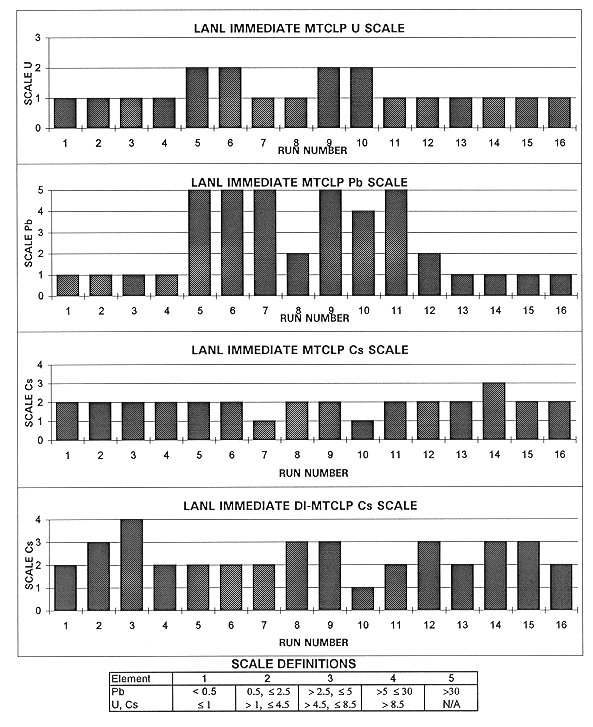
Fig. 1. LANL immediate leaching
results.
Ernest F. Stine
IT Corp.
ABSTRACT
A bench-scale treatability study was conducted to provide data to the Los Alamos National Laboratory (LANL) Mixed Waste Disposal Facility (MWTF) on stabilization of mixed waste soils at the site. The site soil may potentially be contaminated with RCRA metal and organic compounds and Nuclear Regulatory Commission (NRC) materials. In the treatment process the soil was to be mixed with reagents to form a soil-like or easily friable material which would pass the Toxicity Characteristic (TC) regulatory criteria and minimize the leachability of the NRC materials. This product must easily release from the holding container after 2 to 48 hours of curing. After this initial cure period, the treated material was to be placed in a landfill and recompacted, with water addition - if necessary. The recompacted material must obtain an unconfined compressive strength of greater than 60 psi, pass the TC regulatory criteria, and have low effective diffusion coefficients (Lx ~ 6) for the NCR materials as measured by the 5-day ANS/ANSI-16.1 procedure.
In this project, tests were conducted on surrogate material spiked with the worst case concentrations of materials that would be sent to the MWTF. A Plackett-Burman design with sixteen formulations that varied the loadings of Portland cement, flyash, blast furnace slag, carbon, clinoptilolite, and 85% phosphoric acid were investigated. Effective formulations that met all the short term and long term physical and leaching requirement were identified.
INTRODUCTION AND BACKGROUND
In 1995, Los Alamos National Laboratory (LANL), operated by the University of California for the Department of Energy (DOE), was preparing the design of a Mixed Waste Disposal Facility (MWDF). The intent of the MWDF was to treat, store and dispose of (TSD) the expected volume of hazardous and radioactive contaminated soils (mixed waste) to be generated by LANL's Environmental Restoration (ER) Project over a period of approximately 12 years. Moreover, this TSD facility was being designed to comply with the regulatory and operational requirements of RCRA and DOE.
At that time, the preliminary estimate of the waste volumes to be generated by the ER Project and treated in the MWDF was 211,000cubic yards of contaminated soil and 95,000 yards of building debris. Allowing for a 50 percent bulking factor in stabilizing the contaminated soil, the total volume of material to be disposed was forecasted to be 411,500 cubic yards of material. The design basis of the treatment process, to handle this projected volume of waste in 12 years, was to treat 150 cubic yards per day and to operate 24 hours per day, 5 days per week.
The waste treatment processes included in the design of the MWDF were material handling with dust collection, thermal desorption for the removal of organic concentrations greater than the Land Disposal Restrictions (LDR) levels, and stabilization of metals. It was the design of the stabilization process that prompted the Cement Stabilization Treatability Study.
The stabilization process was being designed to handle contaminated soil with a density of 110 pounds per cubic foot, a maximum lump size of 24 inches (largest dimension), and an occasional piece of concrete without reinforcing bars. After passing through a sizing process, the contaminated soil was then to be conveyed to the stabilization process. The stabilization process was to consist of additive silos and pug mills to fix or immobilize the metals in the soil. Any organic contaminants such as grease and oil remaining after the thermal desorption process would also be immobilized.
The problem faced by the design team was what additives would be required to immobilize the worst contaminants that the facility was expected to receive. Besides the types of additives, the design team also needed to know the ratio of additives in the worst case stabilization formulation for sizing the additive silos.
The problem faced by the treatability study team was the final waste form performance characteristics imposed by the design team. These seven performance characteristics, three driven by the facility design and four driven by regulatory requirements, were:
The first three performance criteria impacted the economics of material handling from the stabilization unit to the disposal pit. The second and third performance criteria were imposed to facilitate the placement and compaction of the waste form during the life of the facility and the long term stability of the disposal pit after closure. The fourth requirement was imposed because the treated soil could not be placed in the disposal pit until the results of the Toxicity Characteristic Leaching Procedure (TCLP) were known.
The contaminated soils to be treated at LANL's MWDF consisted of soil overburden and volcanic tuff. IT used a 10 to 1 weight ratio of volcanic tuff to soil overburden to create the soil sample for these experiments. Clean soil overburden and volcanic tuff samples from the stockpile adjacent to the recently excavated pit at the Los Alamos County Landfill were used in this study. This combination will be denoted as "soils" for the remainder of the report. Suspected contaminants in the site soils include Resource Conservation and Recovery Act (RCRA) organic and metal compounds, and radioactive metals. The soils to be considered in the treatability study were spiked at an expected "worst case" scenario of expected contaminants. The soils were spiked with Cr2O3, PbO, HgS, UO2(NO3)2*6H2O, CsCl, K3Fe(CN)6, hexachlorobenzene, naphthalene, methyl ethyle ketone, trichloroethene, tetrachloroethene, and benzene.
OVERVIEW OF TECHNICAL APPROACH
The treatability study followed a tiered approach. In the first tier, Stage 1, the effectiveness of the selected additives were determined. In the second tier, Stage 2, the levels of additives were fine-tuned. In both tiers, the soil-additive mixtures were recompacted and, if necessary, water was added to the mixture after approximately 48 hours cure. The added water was to assist the formulations by further hydrating the additives and providing a mixture near optimum density in meeting or exceeding the UCS criterion.
Stabilization additives chosen for this study were Portland Type I cement (PC), Class F fly ash (FA), activated blast furnace slag (BFS), activated carbon, clinoptilolite (clino) and 85 percent solution of phosphoric acid (H3PO4). These reagents were chosen to meet the performance criteria.
Stage I experiments used a screening statistically-designed approach. The 16 experiment design was a basic 8 run Plackett-Burman design with its refection. The matrix is in Table I. This approach isolated the most important additives.
All 16 of the formulations were made using approximately half of the water loading that would be used to make a fluid soil-additive grout. By limiting the extent of hydration and eliminating a fluid consistency of the soil-grout mixtures, the structural integrity and UCS of the samples were depressed. This process favors the formation of soil-additive mixtures with a soil-like consistency or a friable material after a 48-hour cure period. These samples were tested for physical characteristics and chemical leachability.
After evaluating results from Stage 1, the two best formulations were modified and carried forward into the Stage 2 study. Stage 2 testing was performed to confirm that the formulations met the performance criteria and to confirm the screening results of Stage 1. Testing in Stage 2 followed certified testing procedures rather than the screening procedures of Stage 1.
RESULTS AND DISCUSSION
Stage 1 to 48-Hour Experiments Physical Characterization
Physical characterization tests were conducted on these samples after 48 hours of curing. These included the "qualitative friability" test (QFT), "drop" test (DT), and the ease of crumbling the treated materials as determined by using a modified ASTM C-136 procedure.
These results were used to determine the ease and practicality of using a conveyor belt, storing fresh grouts in holding bins and removing them after approximately 48 hours of curing.
The QFT was a qualitative determination of how easily a treated material that is sealed in a bag crumbled, recompacted, or expressed liquid when squeezed with one's hand. In addition, it was observed if the material stuck to the bag. The most promising QFT samples were chosen for the DT. The DT was a qualitative determination of how easily a 50- to 60-gram monolith in the bottom of a plastic container would free release when the inverted container was bumped against one's hand. In this test the ease of material removal was noted. Also it was observed if the material stuck to the sides or corners of the container, and if the released material consisted of one or multiple clumps.
The QFT and DT were assigned an arbitrary index number so that they could be semi-quantitatively described. The QFT index values were based on a scale from 1 to 5, 1 being the best, 3 a marginal value, and 5 the worst. The values were measured against an empirical sense of how well the curing soil-additive mixture could be managed by a bulldozer or a backhoe in the field and free released from an inverted storage bin, front- end loader, or conveyor belt. Desirable formulations were not sticky/mushy or contained free liquid. They were soil-like or friable, recompactable, moderately hard.
The DT index values were assigned using the same scale as the QFT. These values were based on the ease of a treated material to be freely released from an inverted storage bin, bucket of a front-end loader, or a conveyor belt. Desirable formulations cleanly released from the sides and seams of the inverted container.
The modified ASTM C-136 was a quantitative test of the ease of crumbling the treated materials. In the modified ASTM C-136 procedure, the treated materials were not dried prior to the sieve analysis since this would bias the results.
Figure 1 summarizes the sieve analysis (Modified ASTM C-136), QFT and DT results for the treated materials after 48 hours of cure for material from both stages. The cumulative percentage passing each sieve size is graphed verses the formulation number. The length of the bar shows the extent that the soil-additive mixture broke up with moderate agitation on a nest of sieves. The two numbers that follow each bar are the QFT and DT indices assigned to each formulation. Formulations 3 and 16 had most of the mass retained on the 75 millimeter (mm) sieve. These two samples were very sticky and stuck to the sieves i.e., indices values of 5,5. Formulations 7, 8, 11, 12, 13, and 14 had greater than 75 percent passing a 37.5 mm sieve i.e., indices values generally < 3,3. These latter samples had low to moderate stickiness and promising friability.
Fig. 1. LANL immediate leaching
results.
As shown on Fig. 1, there is a general relationship between the QFT index and the particle size distribution of the ASTM C-136 analysis. Samples 14, 13, and 8 were not sticky (qualitative friability index = 1) and had long bars on the graph i.e., they crumbled well in the sieve-shaker. In addition, all samples with a QFT less than or equal to 2 had approximately 50 percent of the mixture or more passing a 19 mm sieve size. This would suggest that these formulations were not sticky, were relatively dry and had moderate compressive strength values. The shorter bar graphs with higher indexes would suggest that these samples were either too hard or too sticky to be friable.
On the basis of the above results, formulations 7, 8, 11, 12, 13, and 14 were the most promising formulations. Formulation 14 had the best overall physical characteristics. Formulation 8 had the second best. Formulations 7 and 12 stuck to the inverted cup indicating that these two formulations may be hard to empty from a holding bin, etc. It was believed the structural strength of Formulation 13 was too high for the material to crumble or be friable with longer cure times.
Stage 1 Immediate MTCLP For 0.5 to 4.0-Hour Cured Materials
Two sets of Stage 1 screening leaching analyses were performed. The first set was after 0.5- to 4-hour cures and the second set after 28-day cures. For the 0.5 to 4-hour cured samples, the RCRA and NRC metal leachabilities were determined using a Modified Toxicity Characteristic Leaching Procedure (MTCLP) and a deionized water extractant MTCLP (D.I. MTCLP).
The MTCLP data for the 0.5- to 4.0-hour cured materials will be denoted as immediate MTCLP for the remainder of this report. The leachabilities of chromium and mercury were near detection limit for all formulations and therefore will not be addressed. The immediate MTCLP and DIMTCLP leachabilities of lead, uranium and cesium are depicted in Fig. 1. The scale definitions are listed in the figure. In this figure the lead concentrations are scaled to 5 different levels. Levels 1 and 2 denote formulations with less than or equal to 2.5 mg/L lead, which is the internal laboratory pass/fail goal for lead; level 3 denotes leachate concentrations between 2.5 and 4.9 mg/L inclusive; levels 4 and 5 are for formulations that exceed the TC regulatory criteria of < 5.0 mg/L. The uranium and cesium leachabilities are also scaled. The uranium and cesium concentrations are arbitrarily scaled between 1 to 15 mg/L. The internal laboratory pass/fail goal for uranium and cesium was set at 8.5 mg/L for this project. All formulations with levels 3 or below meet this goal.
Lead was the only RCRA metal to significantly leach in the immediate MTCLP. Its leachate concentrations varied from non-detected to well above the TC regulatory criteria. The 7.5 percent PC samples, formulations 5 through 12, all had higher lead leachabilities than the 15 percent PC samples, formulations 1 through 4 and 13 through 16 (see Fig. 1). Six of the 7.5% PC formulations exceeded the TC regulatory criteria.
Uranium and cesium also leached in the Immediate MTCLP. There are no TC regulatory criteria for these two elements. Uranium and lead leachabilities follow the same basic trend. Uranium generally leaches less at the higher PC loadings. The cesium leachability in the immediate MTCLP did not follow any obvious trend.
Stage 1 D.I. MTCLP for 0.5 to 4.0-Hour Cured Materials
A gross screening analysis was performed on the samples to determine the leachability of uranium and cesium using the same leachant as used in the ANS/ANSI-16.1 procedure. The screening procedure was a modification of the MTCLP where deionized water (D.I.) was used as the extraction fluid. The screening procedure is denoted in this report as D.I. MTCLP.
The spike concentrations for uranium and cesium were significantly elevated to facilitate the determination of these metal leachabilities. On the basis of 1000 mg/kg spike level and on the ratios of geometric surface area and sample volumes for 9.5x9.5 mm cylindrical samples versus several size potential cylindrical samples to be used in the ANS/ANSI-16.1 procedure, a preliminary pass/fail value of 10 milligrams per liter (mg/L) for uranium and cesium in the D.I. MTCLP was selected. The internal pass/fail goal was lowered to 8.5 mg/L.
Cesium leached in the D.I. MTCLP analyses, while the uranium concentrations were below the detection limit. Only formulation 3 exceeded the internal pass/fail goal for cesium leachabilities.
Stage 1 Selection of Six Formulations for 28-Day MTCLP
All 16 formulations were crumbled then recompacted after approximately 48-hour cure. Six of these recompacted formulations were selected for 28-day MTCLP analysis. The samples for the 28-day MTCLP differed from the 4-hour MTCLP sample by total cure time and further addition of water prior to recompaction. The formulations selected were 3, 8, 10, 11, 12 and 14.
Two sets of criteria were used to select the six formulations. The first set of criteria was whether the MTCLP, D.I. MTCLP and physical characteristics were promising. The second set of criteria was whether the formulation had reagent variations that could be used to determine the effects of the reagents on the leachability of the two elements that exceeded either the TC regulatory criteria or an internal pass/fail goal i.e., cesium and lead.
In order to determine the effect of the reagents on the cesium and lead leachabilities, a matrix of reagent loadings was devised. On the basis of the immediate MTCLP results, the reagents exhibiting the largest effect on the lead and cesium leachabilities were PC, H3PO4, clino and FA. In the devised matrix of experiments, the formulations to be investigated would have a minimum of two formulations with each reagent at the maximum and minimum loading levels.
The selected formulations had widely varing leachabilities and physical characteristics. Three of the selected formulations, 8, 12, and 14, were a subset of the six formulations with the best physical characteristics, i.e., formulations 7, 8, 11, 12, 13 and 14. Two of the formulations, 3 and 10, had notably poor physical characteristics. All six formulations had no free water in the paint filter test. Two samples exceeded the TC regulatory criterion for lead, formulations 10 and 11. Formulation 3 exceeded the internal goal for cesium leachability. (see Fig. 1).
Stage 1 28-Day MTCLP
The uranium, chromium, mercury and cesium concentrations were below the detection limit for all six formulations. Only formulation 8 had lead values greater than the detection limits. Its lead value was at 18.5 mg/L which exceeded the 5 mg/L TC regulatory criteria.
Excluding the lead results for Formulation 8, the lead leaching performance either remained the same or improved after curing for 28 days compared to curing 0.5 to 4.0 hours. The MTCLP cesium leachate concentrations increased to some extent with the longer cure time. Therefore, only formulations with the higher clino loadings (6 percent ) were considered for the Stage 2 testing program.
Selection of Stage 2 Formulations
On the basis of the physical characteristics, immediate MTCLP, 28-day MTCLP, and D.I. MTCLP results, two formulations were designed for the Stage 2 study. The MTCLP leachate concentrations for mercury and chromium were close to or at the detection limit for all 16 formulations. Their leachate concentrations were therefore not used in this evaluation. The lead, uranium and cesium leachate concentrations were used in this analysis.
The selected formulations for Stage 2 were modifications of formulations 12 and 14. These formulations are denoted as formulations 12M and 14M for the remainder of this report. In Formulation 12M the percent loading of carbon was decreased from one to zero and clino was increased from one to six. In Formulation 14M the percent loading of clino was increased from one to six. The loading of carbon was decreased to identify the effect on organic compound leaching. Clino was increased to decrease the leachability of cesium. As in Stage 1, after approximately a 48-hour cure, water was added to further hydrate the additives and soils to produce a recompacted product that should have a least a 60 psi UCS after a 28-day cure.
Geotechnical characterization and leaching tests were conducted on these two samples. The 48-hour cure analyses included Direct Shear (ASTM D-3080), Proctors (modified ASTM D-558 and ASTM D-1557), and Sieve (modified ASTM C-136) analyses. The 28-day cure analysis included UCS (ASTM C-109). The results from the ASTM D-3080, D-558 and D-1557 are not presented in this report.
TCLP was performed after approximately 0.5-hour cure. After 28-day cures, TCLP and ANS/ANSI-16.1 leaching analyses were performed on the recompacted samples. An abbreviated 5-day duration ANS/ANSI-16.1 was performed instead of a 90-day or longer duration due to the time limitations of the project.
Stage 2 Qualitative Friability Tests, Drop Tests and ASTM C-136 Analyses for the 48- Hour Cured Material
QFT, DT, and ASTM C-136 results are summarized in Fig. 2. As with Stage 1 data, the bars are followed by the QFT and DT indexes for the formulations. In the figure, formulations 12M and 14M are of 48-hour cured samples results for the modified formulations 12 and 14. Formulations 12P and 14P were the same formulations as 12M and 14M except the samples had undergone a proctor analysis by ASTM D-1557 before sieving.
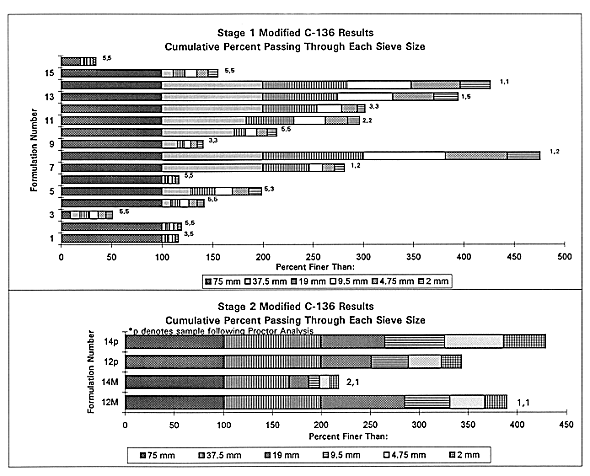
Fig. 2. Stage 1 modified C-136
results cumulative percent passing through each sieve size.
Formulation 12M, as observed from analysis of Fig. 2, had a better QFT result (index values 1 as compared to 2), a better size fraction distribution, and a higher percentage passing the 19 and 9.5 mm sieve size, than formulation 14M. The indexes and size distribution of formulation 12M and 12P were nearly identical. The greater distribution of size fractions seen in the proctored formulation 14P would suggest that after adding water and recompacting, the sample had become brittle and fractured into many fines. The smaller range of sizes in proctored formulation 12P indicates that fewer fines were produced.
Stage 2 TCLP for 0.5 Hour and 28-Day Experiments
TCLP analysis was performed using SW-846 method 1311 immediately after grout mixing and at 28-days of cure. The immediate TCLP extracts were analyzed for total cyanide, chromium, lead and mercury at the Quanterra Laboratory in St. Louis, Missouri. There were no detected values for chromium lead, or mercury greater than 0.1, 0.5, or 0.001 mg/L, respectively, for either formulation. Formulation 12M had a cyanide concentration of 0.03 mg/L cyanide and formulation 14M had 2.54 mg/L cyanide. At 28-days of cure TCLPs were performed on formulations 12M and 14M and on the untreated spiked material for all the constituents of interest. Both of the treated formulations had nondetectable values for all constituents except cyanide. The cyanide for formulation 12M and 14M of 1.01 mg/L and 0.16 mg/L, respectively. The cyanide value for formulation 12M increased from the immediate TCLP while all the other constituent concentrations decreased or remained constant.
The lack of organic leaching in either sample would suggest that carbon was unnecessary in the stabilization formulas since formulations 12M and 14M had no carbon and two percent carbon, respectively, and neither formulation leached organic compounds. The untreated spiked material had significant values (mg/L) for cyanide, 9.97; chromium, 0.032; lead, 986; mercury, 0.013; methyl ethyl ketone, 2.0; and hexachlorobenzene, 0.005. These results show that these materials can be stabilized to below TC regulatory limits.
Stage 2 ANS/ANSI-16.1
The 28-day cured formulations 12M and 14M were tested to meet the leachability of low-level radioactive wastes by ANS/ANSI-16.1. The test was performed to specifically test the leaching of uranium and cesium. The abbreviated 5-day test was used. All of the results for formulation 12M were less than the detection limit of 0.5 mg/L. Formulation 14M had two detected cesium values at 24 and 48 hours. These were 0.578 and 0.573 mg/L, respectively. The average leachability index values (Lx) for both samples are greater than or equal to 8.9 for both uranium and cesium. The samples showed no signs of degradation. The standard deviation for Li was less than or equal to 0.23 for all analyses.
Stage 2 UCS
Materials that were recompacted after curing for 48 hours were tested for UCS at 28-days of cure by ASTM C-109. The UCS values for both formulations exceeded 500 psi. Formulation 12M had higher UCS values than formulation 14M. The average for formulation 12M and 14M were 907 and 506 psi, respectively.
The sieve size analysis results at 48-hours and the differences in the UCS results may potentially be explained by the FA and BFS contents of the two formulations. Both FA and BFS would be expected to have slow reaction and curing rates. Formulation 14M had double the cement and half the BFS of formulation 12M. It also had no FA in it. The majority of the early strength was expected to come from the cement. With formulation 12M the early strength would be expected to be lower than formulation 14M because of the lower cement content. The higher early strength would lead to fewer fines being produced in the ASTM C-136 sieve analysis for 14M. As the cure time increased, the effects of the BFS and FA added strength to the sample. The increased reagent content (32.5% versus 22.5% loading of PC + FA + BFS for 12M compared to 14M) for formulation 12M would be expected to give a higher 28-day UCS value.
CONCLUSIONS
Successful formulations were designed that meet or exceed all the performance criteria. The TCLP RCRA metal concentrations are below the TC regulatory criteria after both 0.5-hour cure and 28-day cure. The TCLP RCRA organic compound concentrations are also below the regulatory limit in the 28-day cured material. The leachability index for both uranium and cesium are significantly greater than the desired minimum value of six.
The 48-hour cured samples have the appropriate consistency to be easily removed from a storage bin, front-end loader or a conveyor belt. That is, the samples are relatively dry, not sticky, and are friable.
The waste form can be recompacted and allowed to cure to achieve a UCS value greater than 500 psi. This value significantly exceeds the minimum value of 60 psi required in the RFP.
It was shown that carbon and likely FA additions are not necessary to stabilize the soils. In order to maintain the friability of the 48-hour samples, neither an excess nor a deficiency of water can be added to the soil-additive mixture.
If future studies are conducted, it is recommends that formulations without FA or carbon be investigated. A recommended range of additive loadings to investigate are 5 to 7.5 percent PC, 1.032 percent phosphoric acid (85 percent stock solution), 6 percent clino, 10 to 15 percent BFS and 30 percent water. The phosphoric acid solution would need to be diluted prior to addition to the contaminated soil to maximize its fixation effect.