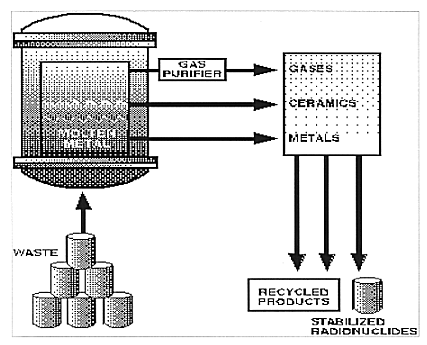
Fig. 1. Quantum-catalytic extraction
process.
Kenneth P. Guay, Frederick Evans, Tom Price, Bobby Cross,
Duane Smith, Tom Bratton, Ed Triplett, Craig Simon
M4 Environmental L.P.
1000 Clearview Court
Oak Ridge, TN 37830
ABSTRACT
M4 Environmental L.P. (M4) has processed radioactively contaminated mixed wastes from the U.S. Department of Energy (DOE) and Duke Power Company using Quantum-Catalytic Extraction Processing (Quantum-CEP®). Quantum-CEP® is an innovative and proprietary technology developed by Molten Metal Technology, Inc. which can process radioactive and mixed wastes to decontaminate and recover resources of commercial value while achieving radionuclide stabilization and significant volume reduction. The U.S. Environmental Protection Agency has recognized CEP technology as achieving the Best Demonstrated Available Technology requirements for processing all wastes for which incineration was previously the only approved processing method.
This paper discusses the results obtained from three campaigns processing mixed wastes, which were conducted in 1995 and 1996 in M4's Radioactive Processing Unit number 3 (RPU-3). The first campaign processed sludge from the West End Treatment Facility at DOE's Oak Ridge Y-12 Plant. The second campaign processed mixed hazardous and radioactive waste generated by the commercial utility, Duke Power Company. Both campaigns led the State of Tennessee to grant a "use/reuse" designation for the technology. The third campaign was treatment of DOE organic liquid waste contaminated with radionuclides.
Ten processing runs have been completed in RPU-3 for the purpose of conducting treatability studies, process optimization tests, and evaluation of commercial recycling campaigns on mixed wastes. The unit contains a molten metal bath operating at temperatures between 1,400-1,650°C. The waste material processed has included surrogate sludge materials, virgin solvents, fuel oil, mixed waste solvents and sludges, and contaminated scrap metal. About 1,800 kilograms of waste and surrogate material were successfully treated and processed. Each run campaign was characterized by system assembly and preheat, melting the metal bath, injection of the waste material, removal of the metal inventory, disassembly of the reactor vessel, and reporting of the data. Major parameters measured during system operations include throughputs and injection rates, equipment performance, partitioning of radionuclides and heavy metals to the desired phase, and quality of synthesis gas generated such as carbon monoxide and hydrogen. The various projects have demonstrated safe operations with full compliance of regulatory and permit requirements, significantly reduced the volume of primary, secondary, and tertiary waste streams, properly containerize, track and manage all residues, and demonstrated the ability of nonproduct residues to meet disposal requirements.
INTRODUCTION
Mixed wastes generated from the private and government sectors have posed significant problems for utilities, government facilities, the environment and surrounding communities. Processing and/or disposal options have been limited by the physical form, chemical composition and radionuclides present in the various waste streams. Lack of processing and/or disposal capacity for the more difficult mixed wastes such as freon filters, sludges, greases, paint sludges and solids, and batteries have required some utilities and government facilities to store their mixed waste while waiting for commercial processing capacity to come on-line. The proper storage and monitoring requirements have been proven to be very expensive to the government and private utilities. Until now, only long term storage and limited treatment options, which often require destruction of the waste followed by stabilization to prevent leaching of radionuclides, have been available.
The Quantum-Catalytic Extraction Process (Quantum-CEP®) is a patented technology that allows processing of various waste streams to be recycled into high-quality manufactured commercial products such as synthesis gas (syngas), hydrogen chloride, metal alloys, and specialty ceramics. M4 Environmental® has been evaluating the processing of radioactively contaminated mixed waste since 1995 in its Radioactive Processing Unit number 3 (RPU-3). RPU-3 conducted its first run in December 1995 and has since completed ten processing runs in 1996 for the purpose of conducting proof-of-process tests, treatability studies, process optimization tests, and evaluation of commercial recycling campaigns on mixed wastes. The waste material processed has included surrogate sludge materials, virgin solvents, fuel oil, mixed waste solvents and sludges, and contaminated scrap metal. To date, about 1,800 kilograms of waste and surrogate material have been successfully treated and processed in the pilot scale unit.
The overall program processing Duke Power Mixed Waste is presented in another paper at the Waste Management '97 Symposia entitled, "Processing of Duke Power's Mixed Waste via Quantum-Catalytic Extraction Processing (Q-CEP®), A Case Study" by Evans, L. et.al.
M4 ENVIRONMENTAL®
M4 Environmental® is a limited partnership between the Lockheed Martin Corporation and Molten Metal Technology Inc. (MMT) which was established in 1994. M4 Environmental® originally had the exclusive license from MMT to provide Quantum- CEP® technology to the U.S. Departments of Energy and Defense and has since been expanded to include the United States Enrichment Corporation and commercial mixed waste. M4 Environmental® acquired a building with more than 9,300 square meters (7,000 in the plant area and about 2,300 in office space) in August 1995 and immediately began renovations to accommodate bench-, pilot- and commercial-scale Q-CEP® systems for processing mixed wastes. The M4 Environmental Technology Center, as it is referred to, is located in Oak Ridge, Tennessee. There are currently four Q-CEP® systems referred to as Radioactive Processing Units (RPU) at the M4 Environmental Technology Center.
RPU-1 was designed and constructed under contract to the United States Enrichment Corporation (USEC) and is used to demonstrate the conversion of uranium hexafluoride (UF6) to products that can be used by the nuclear industry. The commercial technology could be deployed to process USEC's existing and future inventories of depleted UF6. RPU-2 consists of three bench-scale units used for rapid proof-of-process demonstrations for potential customers and support processing operations. Two units are used for radioactive tests while one is used for nonradioactive tests. RPU-3 was the first commercial scale Q-CEP® unit commissioned at M4 Environmental®. Mixed waste processing has been demonstrated on wastes generated at the U.S. DOE's Y-12 Plant, Oak Ridge National Laboratory (ORNL) and Duke Power's nuclear facilities. RPU-4 is the largest Q-CEP® system at M4 Environmental Technology Center that will be used for processing mixed waste for government and commercial customers, conducting limited research and development, recycling of waste products, and providing data on product development.
THE CATALYTIC EXTRACTION PROCESS
MMT's proprietary waste recycling technology known as Quantum-CEP® uses a molten metal bath to effectively reduce the volume of radioactive and mixed wastes into products. Q-CEP® units can process all physical forms of waste such as solids, sludges, liquids and gases. The catalytic extraction process uses a molten metal bath to dissociate the feed material into elemental constituents which forms singular dissolved elemental intermediates (see Fig. 1). The major components of the process are the feed handling system, catalytic processing unit systems, and the gas handling train.
Fig. 1. Quantum-catalytic extraction
process.
Feed material goes through two reaction stages upon being fed to the molten metal bath; a catalytic elemental dissociation and dissolution, and product synthesis. The catalytic effect of the molten metal causes complex compounds in the feed to be dissociated into their elements, which readily dissolve in the liquid metal solution to form elemental intermediates as a consequence of the binding energy between the feed element (e.g., carbon-hydrogen) and bath metal (e.g., iron). The formation of dissolved elemental intermediates makes Q-CEP® technology insensitive to the physical form or component molecular structure of the feed. Product synthesis depends on manipulation of the elemental reaction pathways through the addition of co-reactants and variation in operating conditions. The Quantum-CEP® process tolerates a high variability of feed compositions, however, optimal operation of the system requires monitoring and adjustment of a few critical feed chemical parameters. These parameters are monitored during processing and adjustments made on-line with the co-feeds to achieve the desired end products. Reaction thermodynamics are important in determining the control of potential reaction pathways and assessing relative likelihood of their occurrence.
Synthesis gas, also known as syngas, is one of the products created from processing waste in Q-CEP® units. Reaction thermodynamics are controlled to form the carbon monoxide and hydrogen gases from the incoming carbon, hydrogen and oxygen. Carbon, in a variety of forms, can then be added into the system to achieve the targeted carbon:oxygen ratio. Syngas, which consists of a mixture of carbon monoxide and hydrogen, generated by RPU-4 will be used to produce steam for waste drying, wastewater evaporation and to supplement the Technology Center's heating system.
Quantum-CEP® technology is different from incineration or other thermal treatment technologies because it does not rely on flame combustion to alter the character and composition of the waste. Instead, Quantum-CEP® relies on the catalytic properties of the molten metal to dissolve waste compounds. Due to its ability to recycle hazardous waste elementary in a sound, environmentally safe manner, the technology has led to a number of key certifications, approvals, and designations. The technology has been designated by the U.S. Environmental Protection Agency as a best demonstrated available technology equivalent for all wastes for which incineration had been the only approved processing method.
RADIOACTIVE PROCESSING UNIT NUMBER 3
M4 Environmental® uses the RPU-3 (see Fig. 2) system to conduct pilot scale tests of the Quantum-CEP® process at the Technology Center for a variety of feed streams from multiple customers. This is typically done by building on successful bench scale experimental test operations and results. The unit was designed for actual feed processing to assess stability and operability issues. Liquid wastes are delivered to the reactor through a triple concentric tuyere into the molten bath iron. Solid wastes are delivered to the reactor through a screw feeder system and injected into molten bath iron using a lance made of composite material. A lock hopper is installed on the top of the reactor for bulk addition of feed materials. For delivery of the liquid and solid waste forms, argon or nitrogen is used as the carrier gas. Some feed preparation is required by grinding of solids or mixing of liquids prior to processing.
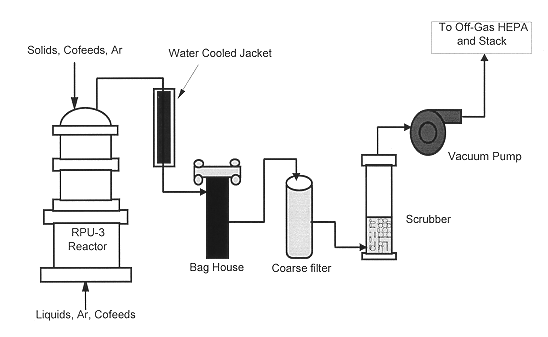
Fig. 2. Schematic of RPU-3 reactor
and off-gas system.
The reactor is normally charged with iron and a refractory system installed throughout the unit. The gas handling train consists of a baghouse, coarse filter, caustic scrubber, and water sealed vacuum pump as shown in Fig. 2. Additional baghouse, coarse filter, and scrubber units are piped in parallel for increased throughput and on-line maintenance. A ceramic or metal tapping system is also implemented in the pilot scale unit for removal of the ceramic or metal inventory. This system consists of a tapping valve and a receiving vessel (tapping chamber).
WASTE STREAMS PROCESSED IN RPU-3
Low Level Radioactive Waste (LLW) streams from three different plants have been successfully treated in the RPU-3. These wastes included dried sludge from the West End Treatment Facility (WETF) located on the U.S. DOE Oak Ridge Reservation, liquid mixed waste from Duke Power Incorporated, the second largest utility in the United States, and liquid mixed waste from the ORNL also located on the U.S. DOE Oak Ridge Reservation located in Oak Ridge, Tennessee.
U.S. Government Mixed Wastes
The U.S. Government is responsible for cleaning up enormous amounts of waste, much of it radioactive, that has accumulated on military bases and at government laboratories around the world. The 1992 Federal Facility Compliance Act made waste cleanup a priority by requiring the federal government to fully comply with the stringent environmental regulations previously applied only to the U.S. industry. The U.S. Departments of Energy (U.S. DOE) and Defense (DoD) have identified nearly 2,000 sites requiring environmental solutions.
WETF sludge is a byproduct of primary industrial wastewater treatment at the U.S. DOE Y-12 Plant on the Oak Ridge Reservation. The major constituents present in the WETF sludge includes water, carbonate (CO3-2), calcium (Ca), aluminum (Al), sodium (Na) and iron (Fe). The sludge is normally dried as a pretreatment and exists in a powder form. After drying, the major constituents present in the sludge are Ca, hydroxide (OH-) and CO3-2. The major radionuclides in the WETF sludge are uranium, technetium, and cesium. Processing of WETF resulted in M4 Environmental® receiving its first "use/reuse" (recycling) designation from the Tennessee Department of Environment and Conservation.
ORNL organic mixed waste consists of various oils and solvents generated from plant operations. After generation, the waste is normally stored in tanks at ORNL, packaged in DOT 55-gallon drums (208 liters) and transported to the K-25 Site for interim storage. The major constituents identified in the ORNL organic mixed waste include oils, spent halogenated solvents, chlorine, phosphorus, and sulfur. The major radionuclides present in the waste stream include; carbon, strontium, thorium, tritium, and uranium. The waste was generated as a result of Tank 7830A being used as a waste receptacle for used oil, a solvent-water mixture, slightly radioactively contaminated xylene and a mixture of waste oils from several buildings at the ORNL complex.
Commercial Mixed Waste
LLW is a mounting problem for commercial generators around the world, from utilities to medical and research facilities. Most of the country's 1,300 radioactive waste generators can no longer send their waste to central repositories, leaving them to seek technological waste processing solutions. Organic liquids are commonly used in commercial industry and government sectors as cleaners and solvents. Typical uses for the liquids include parts washing and flushing of process equipment. The use of halogenated organic solvents has decreased due to government regulation, however many of these waste streams are still produced. In addition, stockpiles of previously unregulated halogenated organic liquids exist at sites where the non-halogenated materials are now being implemented.
The Duke Power Company Mixed Organic Liquid Wastes processed at M4 Environmental® came from two different nuclear stations, Oconee Nuclear Station in South Carolina and Catawba Nuclear Station located in North Carolina. The major radionuclides identified to be present in the different waste streams included; cobolt, cesium, iron, nickel, and tritium. The major chemical constituents identified to exist in the waste streams included; C9-C13 hydrocarbons, PF Degreaser™ solvent, Safety Kleen™ solvent, ZEP DYNA™ solvent, dirt, oil, and grease. These wastes were chosen because they are considered to be representative of other wastes found within the nuclear utilities involved with the Electric Power Research Institute (EPRI).
OPERATIONAL ACTIVITIES
Operational activities conducted at the M4 Environmental Technology Center included: receipt of process feed material from the client, experimental test activities, pilot scale feed material processing, analytical processing support, disposition of the recycled end-product(s), residuals, and any secondary wastes, and reporting of the experimental results.
The process usually followed in preparing and conducting a waste processing run is shown in Fig. 3. Each run campaign was characterized by system assembly and preheat, melting the metal bath, injection of the waste material, removal of the metal inventory, disassembly of the reactor vessel, collection of post-run samples and reporting of the data. Major parameters measured during system operations included throughputs and injection rates, equipment performance, partitioning of radionuclides and heavy metals to the desired phase, and quality of synthesis gas generated (carbon monoxide and hydrogen).
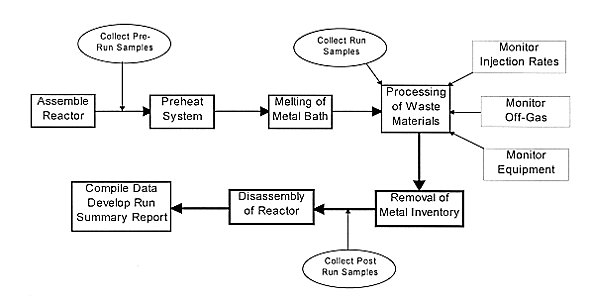
Fig. 3. Process flow diagram.
Baseline samples were generally collected prior to a run beginning. Samples were sometimes taken of the refractory to determine initial amounts of silica, alumina, and zirconia. Samples were also taken of the scrubber solution when various mixtures of sodium hydroxide or potassium hydroxide were used to obtain a baseline of the concentration of sodium or potassium due to the presence of these elements in the different waste streams processed. Baseline samples were normally collected of the different waste streams to be processed to obtain a fingerprint analysis of the elemental constituents (i.e., C, H, O, Cl) and to verify characterization data supplied by the generator of the waste.
During the runs, many different types of samples were collected and analyzed. Gas samples were collected and off-gas was measured by a mass spectrometer and gas chromatograph for real time analysis to ensure syngas quality was determined. Samples of the scrubber solution were also collected to ensure removal of acidic byproducts has occurred. Once a run was completed and the waste processed, samples were collected from the solidified metal bath to determine radionuclide and heavy metal partitioning. Samples may be collected from different sections of the refractory system to determine corrosion rates or if any partitioning of radionuclides or heavy metals has taken place. If a ceramic layer was present during the processing, samples from this phase were also taken to determine composition and partitioning concentrations.
RESULTS
Volumes and Types of Waste Processed
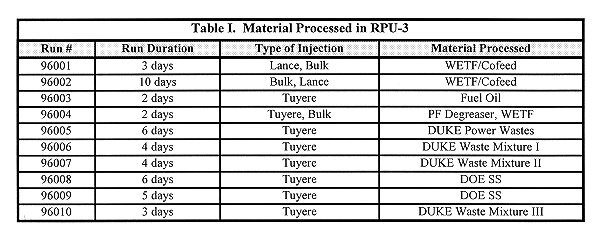
Since February, 1996, about 1,800 kilograms of hazardous (2%), surrogate (8%) and mixed wastes (90%) have been successfully processed in RPU-3. The hazardous wastes consisted of clean fuel oil and PF Degreaser™, the mixed wastes consisted of dried WETF sludges mixed with co-feed material, Duke Power wastes and various mixtures, and DOE Sole Source (SS) waste. This waste existed in solid and liquid form which required two methods of injection. Liquid wastes were introduced into the bottom of the bath using a triple concentric tuyere whereas solid wastes were processed using a lance which is made of refractory material and is inserted into the bath from the top of the reactor. Some solid feeds were also bulk charged into the reactor. Table I summarizes the amounts and types of wastes processed during the different processing runs conducted through the year. Total processing time (i.e., preheat, additional charging of metal, leak checks, sintering of refractory, on-line maintenance, feed activities, and removal of metal inventory) spent during the runs was 955 hours (8 hour days) or 5.5 months. The actual time spent processing the waste was 372 hours or about 2 months.
Table I. Material Processed in RPU-3
A couple of the waste streams required some pretreatment prior to injection into the metal bath. The WETF sludge originally had the consistency of a thick oil which had to be dried into a powder form. The dried sludge was then ground up into a consistent particle size and mixed with ceramic formers to reduce attack on the systems refractory and improve product use. The DUKE Power waste streams were processed individually and in different mixtures by combining several waste streams together to achieve different feed compositions.
Material Balances
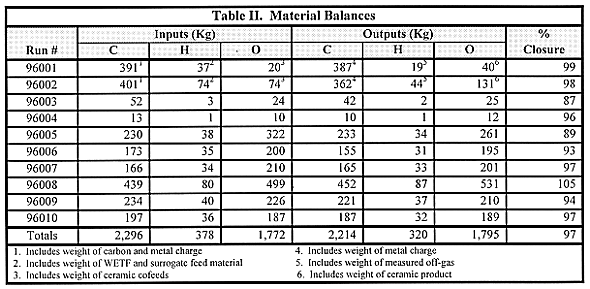
Material balance calculations are conducted to indicate the input and output of the materials and to demonstrate the operability of the system with predicted performances. Table II summarizes the mass balance of representative pilot-scale experiments, demonstrating the consistency of mass balance closure and scalability of the Q-CEP® systems. The material balances conducted were restricted to input and output of materials only during processing of wastes. The wastes are broken down into their elemental constituents of C, H, and O for the inputs (e.g., for organic liquid injection runs only). The outputs are determined also from the elemental constituents from dust collected and off-gas measured. During the first three processing runs of the RPU-3, material balances were conducted by measuring the input of the WETF sludge, cofeed and metal charge whereas the output measured the total off-gas, ceramic product, and metal charge. For the year, the material balance has a closure of 97.3 % for inputs and outputs.
Table II. Material Balances
Off-Gas Composition and Quality
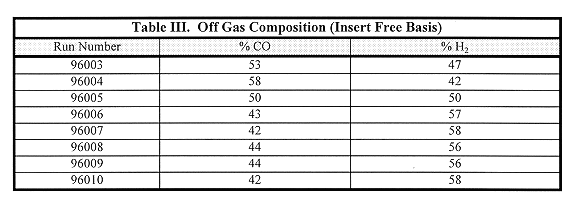
Mass spectrometry was used in the first few runs to determine the composition of the off-gas from the process. Eventually gas chromatography, and SUMMA™ gas canisters were added for determining off-gas composition and hydrocarbon analysis. Off-gas analysis showed essentially no detection of C2+ hydrocarbons to the minimum detection limits of 0.001 ppm. This demonstrated the ability of the process to convert the organic mixed wastes to carbon monoxide and hydrogen found in DOE and commercial mixed waste processing. Typical off-gas composition measured for the different runs is presented in Table III.
The off-gas produced is commonly referred to as synthesis gas (syngas) and is usually composed of carbon monoxide, hydrogen and inerts. M4 Environmental® plans on recycling the syngas produced within the facility due to the high heating value (>5,000 BTU/lbm) of the mixture without the inerts. The syngas may be recycled to produce steam for waste treatment or processing or for supplemental heating of the facility. The syngas produced as a primary product has generally been greater than 99 volume percent without the inerts.
Table III. Off Gas Composition (Insert Free Basis)
SYSTEM OPERABILITY
As experience was gained by the RPU-3 operations team in using the new reactor system and as modifications were made, the process efficiency (total injection hours/total operation hours) was increased substantially to 80%. On-going upgrades have been implemented to further enhance process operability since the fourth quarter 1996, including gas handling train enhancement for full-scale particulate removal efficiency, programmable logic controlled on gas injection skid providing computer sequencing and control, and controlled use of facility gas systems, etc.
CONCLUSIONS
RPU-3 pilot-scale unit operations at the M4 Environmental Technology Center initiated the commercialization of Quantum-CEP® for mixed wastes applications in 1996. Processing of over 1800 kg of mixed wastes, including both U.S. government (DOE Oak Ridge Reservation) and major industrial customer feeds (Duke Power, the second largest nuclear utility in the United States), demonstrated consistently effective partitioning and stabilization of radionuclides while destroying hazardous constituents. Scalability, operability, and reliability of Quantum-CEP® was demonstrated via established operational experiences in RPU-3, excellent mass balance closure (>97% in average), and high quality synthesis gas product generation, as outlined in the paper. Continued effort in communicating with the regulatory have been established, as exemplified by the 'use/reuse' recycling designations for Quantum-CEP® technology from the Tennessee Department of Environment and Conservation. These applications in mixed wastes will further be enhanced in 1997 with continuous operability optimizations of the RPU-3 unit and deployment of the RPU-4 unit, also located in M4's Technology Center, for full-scale processing of mixed wastes.