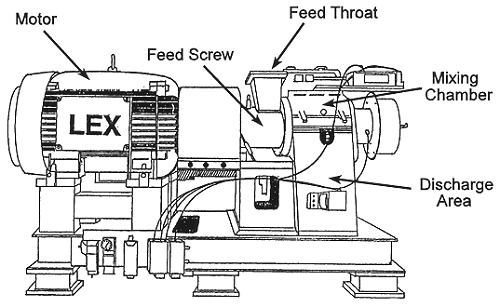
Fig. 1. Schematic of kinetic mixer
supplied by EcoLEX.
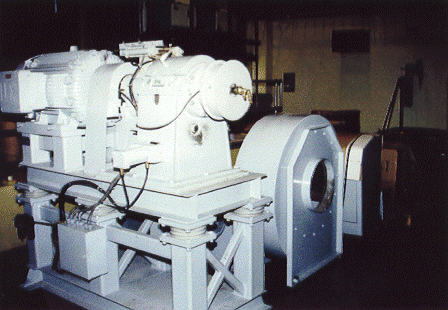
Fig. 2. Kinetic mixer supplied by
EcoLEX after arrival at BNL EWTC.
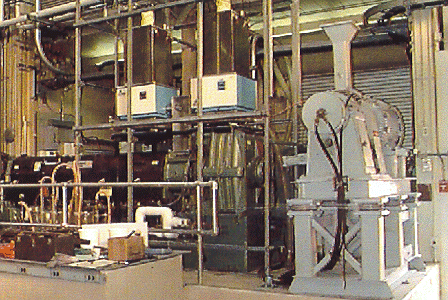
Fig. 3. Kinetic mixer installed next
to extruder on the Polyethylene Encapsulation Test Facility pad.
P.D. Kalb, P.R. Lageraaen, and B.R. Patel
Environmental &
Waste Technology Center
Brookhaven National Laboratory
D. C. Sangster
EcoLEX, Inc.
A. Poste
GenTech Engineering, Inc.
ABSTRACT
The presence of moisture and/or volatile organics (VOCs) contained in low-level radioactive or mixed waste can adversely affect polyethylene microencapsulation processing. Extrusion processing can also be limited by the range of particle sizes that can be successfully processed. This paper describes the development of a kinetic mixing process to remove moisture and volatile contaminants and broaden the range of particles amenable to polyethylene microencapsulation. Kinetic processing uses high shear and rapid rotational mixing to create frictional heat sufficient to drive off volatile constituents and/or melt thermoplastic materials. A pilot-scale processor (rated at approximately 450 kg/hr) provided by EcoLEX, Inc., was installed at BNL's Polyethylene Encapsulation Test Facility. Preliminary testing with waste surrogates indicated that up to 23 wt% moisture can be successfully removed but the maximum limits for moisture content and optimization of processing parameters are currently being evaluated. Because of its robust agitation and mixing action, kinetic processors are less sensitive to particle size limitations for waste additives than conventional extrusion systems. The ability of kinetic processing to expand the range of acceptable particles sizes beyond current limitations is currently being investigated. The work is supported by the U.S. DOE Mixed Waste Focus Area and is being conducted under a Cooperative Research and Development Agreement (CRADA) between Brookhaven National Laboratory and EcoLEX, Inc.
INTRODUCTION
The Environmental and Waste Technology Center (EWTC) at Brookhaven National Laboratory (BNL) is investigating the feasibility of kinetic mixing as a pre-treatment for polyethylene microencapsulation extrusion processing and as a potential stand-alone process for microencapsulation. Since project start-up in July 1996, facility modifications, pilot-scale equipment installation, shake-down testing of the system, and preliminary feasibility testing using surrogate waste materials were completed. Research and development is continuing in FY 1997 to optimize the process and complete "hot" testing using actual mixed wastes. This work is sponsored by the U.S. Department of Energy (DOE) EM-50 Mixed Waste Focus Area (MWFA) and EcoLEX, Inc., Jacksonville, FL, which is providing equipment and engineering assistance under a Cooperative Research and Development Agreement (CRADA).
Polyethylene encapsulation is emerging as one of several valuable technologies needed for the improved treatment of DOE low-level mixed wastes. Advantages of polyethylene encapsulation by extrusion have been well documented.(1-9) One process limitation for this technology is the quantity of moisture and/or volatile organics contained in the waste. In most cases, processing of materials containing > 2 wt% moisture and/or organics leads to a gas-entrained, foamy product with poorer performance (e.g., waste loading, leachability, mechanical strength). Extrusion processing can also be limited by the range of particle sizes that can be successfully processed. Kinetic mixing promises to provide improvements in both of these areas.(10)
This approach will expand the types of waste that can be processed and provide potential cost savings over other (thermal) pretreatment technologies. For example, kinetic processing should improve process applicability for blowdown salts, sludges and ion exchange resins, in addition to ash, dried salts and other finely divided solids that can be processed without pretreatment. Kinetic mixers have been used to process heterogeneous recycled plastics that cannot be processed by extrusion alone, opening the possibility for using this plentiful and inexpensive resource for waste treatment applications. Thus, system benefits can also be achieved through the application of recycled feedstocks for waste streams that have been successfully processed by extrusion technologies. Potential high volume end-users of an improved polyethylene microencapsulation process include Idaho National Engineering Lab (evaporator salts, contaminated soils), Oak Ridge National Laboratory (TSCA incinerator ash, storm sewer sediment, pond sludge), Savannah River Site (CIF incinerator ash, blowdown solution), Pantex (burning ground ash), and Rocky Flats Environmental Technology Site (evaporator concentrates, saltcrete). These waste streams comprise over 14,500 m3.
TECHNOLOGY DESCRIPTION
Kinetic (also referred to as thermokinetic) processing uses high shear and rapid rotational mixing to create frictional heat sufficient to volatilize moisture and organics and melt thermoplastic materials. A batch, consisting of plastic materials combined with filler (e.g., waste) materials, is charged into the mixer, rapidly brought to melt temperature flashing off moisture and volatile materials, then discharged as a homogeneous molten mass. This process has been used successfully for the processing of recycled polymers and non-hazardous process wastes.
As a pretreatment technology, the kinetic mixer will combine waste and binder to form a homogeneous mixture, remove residual moisture and/or organics, and discharge the mixture for further processing by conventional extrusion. The waste-binder mixture can either be discharged as a molten (fluxed), well-mixed product or as a mixture of dried waste with unmelted (unfluxed) polymer, depending on the residence time in the mixer. Maximum moisture and volatile organic content for successful processing will be established. A secondary objective of this work is to confirm the ability of kinetic processing to expand the range of acceptable particle sizes beyond current limitations (approximately 50 - 3,000 µm). Kinetic processors, because of their robust agitation and mixing action, are less sensitive than conventional extrusion systems to particle size limitations (both large and small) of the waste.
EQUIPMENT DESCRIPTION AND INSTALLATION
A pilot-scale (rated at approximately 450 kg/hr) kinetic mixing system has been installed at BNL's Full-Scale Polyethylene Encapsulation Test Facility to investigate its use as a pretreatment technology for extrusion processing and as a stand-alone treatment technology for low-level mixed wastes. The mixer was manufactured by LEX Technologies, Brampton, Ontario, Canada and was supplied by EcoLEX, Inc. It has a 10 L batch mixing chamber, a helical screw feed section, a 7 cm rotating shaft with 4 mixing paddles, water cooled bearings, and a pneumatically controlled inlet slide gate and discharge door. The shaft, powered by a 150 HP electric motor, rotates at a constant high RPM resulting in a paddle tip speed of approximately 40 m/sec. Operation is controlled by a programmable logic controller (PLC), enabling the operator to coordinate feeding, charging, mixing and discharging of the materials. Charge and discharge functions can be automated based on motor load sensing (ammeter), a temperature probe signal, or pre-determined time intervals. Alternatively, these functions can be manually controlled by the operator. Figure 1 is a sketch of the pilot-scale kinetic mixer and Figs. 2 and 3 are photographs of the mixer after arrival at BNL.
Fig. 1. Schematic of kinetic mixer
supplied by EcoLEX.
Fig. 2. Kinetic mixer supplied by
EcoLEX after arrival at BNL EWTC.
Fig. 3. Kinetic mixer installed next
to extruder on the Polyethylene Encapsulation Test Facility pad.
Final installation, inspection and equipment testing were conducted under the guidance of two EcoLEX engineers who also provided training on the operation and maintenance of the kinetic mixer equipment. Preliminary process shakedown testing was performed using a variety of polymers and filler materials to trouble-shoot operation of the components and to familiarize BNL staff with controls and system operation. Variables examined included type of polymer, type and quantity of filler, batch size, and cycle time (residence time). Thermoplastic feed stock used during shakedown testing included virgin low-density polyethylene (LDPE), recycled linear low-density polyethylene (LLDPE), and recycled high-density polyethylene (HDPE). Filler materials (surrogate wastes) included incinerator ash and sawdust. Shakedown testing was successful, as expected. Feasibility for mixer-extrusion system integration was demonstrated by processing the fluxed product discharged by the mixer through the extruder.
PROCESS DEVELOPMENT
Following successful equipment shakedown testing, a series of process runs were initiated to gauge the influence of varying process parameters on the mixer operation. A total of 15 test sequences (average of 12 batch trials per sequence) were conducted. Moisture content, batch size, waste type and cycle time were each varied while a constant nominal waste loading of 50 wt% was used for all testing. LDPE with a melt index of 50 g/10 min was used as the binder material during experimental testing, although recycled LLDPE and recycled HDPE were successfully processed during shakedown testing. Waste surrogates that were tested included a nitrate salt recipe, soil and sand. Moisture content in the waste was varied from 0 to 23 wt%. Batch size was set at either one or two kilograms. The acceptable batch size range for this mixer is approximately 0.5 to 3 kg, depending on the densities of the feed materials. Fluxed and unfluxed (combination of unmelted polymer and dry waste) products were successfully produced by adjusting cycle times. For fluxed product, successful moisture removal was judged based on observation of the consistency of the product and the lack of gas entrainment. For unfluxed product, moisture measurements of the dried waste product were conducted. Dry unfluxed product produced by slightly shorter cycle times in the mixer provides a viable pre-treatment alternative with potential benefits. In this mode, the mixer operates as an effective pre-treatment dryer, facilitating successful microencapsulation by extrusion.
Test sequences were conducted with a nitrate salt waste surrogate based on waste characterization data from Rocky Flats Environmental Technology Site to determine the moisture tolerance of the kinetic mixer and to evaluate the effectiveness of the mixer in volatilizing or removing residual moisture. Successful removal of excess moisture was demonstrated for the nitrate salt surrogate with moisture contents of 4.8 and 23.1 wt%. As expected, residence time (batch cycle time) required to flux feed materials increased with increasing moisture content. Frictional heat developed by the mixer is used as the latent heat of vaporization to volatilize residual moisture prior to fluxing the polymer, thereby increasing cycle time. Cycle times ranged between 8 seconds for salt surrogate/LDPE batches containing no residual moisture to 1 minute 48 seconds for similar batches with 23.1 wt% moisture. Cycle times were approximately twice as long when the mixer and mixing chamber were cold and not at a steady-state operating temperature. Five to ten cycles are typically required for the mixer to achieve steady-state temperature. Cycle times were less than 20 seconds for batches containing 4.8 wt% residual moisture. Batches containing 23.1 wt% moisture were successfully processed producing well fluxed molten samples, with no evidence of entrained gas. Additional testing is planned to determine the maximum moisture content that can be successfully processed.
Integration of the kinetic mixer with the extrusion process was demonstrated during test sequences with the nitrate salt surrogate. Batches containing 4.8 wt% moisture were fluxed or brought to dryness (unfluxed) in the mixer and were manually fed to the extruder. Both methods resulted in successful extrusion, but unfluxed materials were more readily introduced to the extruder feed throat. Salt-LDPE mixtures pretreated in the kinetic mixer produced a uniform and continuous extruder output. The extruder product (extrudate) was homogeneous with an improved surface appearance compared with output from the kinetic mixer, resulting from additional mixing and additional polyethylene on the outer surface of the molten product. This results from the inherent design of the extruder in which gradual distributive mixing occurs along the screw enabling the thermoplastic to coat the waste or filler material. In contrast, the kinetic mixer uses an aggressive mixing action which throws the materials against the mixing chamber wall resulting in improved homogeneity but less surface coating.
Feasibility testing was also conducted using soil collected from the BNL site as a surrogate waste material. Test sequences with soil were conducted at a waste loading of 50 wt%, 1 kg batch size, and a moisture content of 6, 10 or 15 wt%. As-received soil with a residual moisture content of 6 wt% was successfully processed with repeatable results. The abrasive nature of the soil resulted in rapid frictional heat generation with a corresponding batch cycle time of approximately 10-20 seconds depending on the temperature of the mixer. The fluxed product appeared well-mixed without any observable foaming or entrapped air/moisture. Batches containing LDPE/soil with 10 and 15 wt% moisture were also readily fluxed producing well-mixed product devoid of moisture. Additional testing was conducted using sand as a waste surrogate. One kg batches of sand with moisture contents of 3 (as-received), 10 and 15 wt% were tested at a 50 wt% waste loading. These batches were readily fluxed with reproducible results yielding excellent product samples. Cycle times were approximately 18, 30 and 45 seconds for the batches containing 3,10 and 15 wt% moisture, respectively.
SUMMARY AND CONCLUSIONS
A kinetic mixing system provided under a CRADA by EcoLEX, Inc., was installed at BNL's Full-Scale Polyethylene Encapsulation Test Facility. Final inspection and equipment shakedown testing was provided under the guidance of two EcoLEX engineers who also provided training on the operation and maintenance of the kinetic mixer equipment to BNL engineers. Shakedown testing was performed using a variety of polymers and filler materials to trouble-shoot operation of the components and to familiarize BNL staff with controls and system operation.
Feasibility testing of the kinetic mixing system for application to waste encapsulation was demonstrated. Experimental testing was conducted through a series of test sequences to gauge the influence of varying process parameters on the mixer operation. Moisture content, batch size, waste type and cycle time were each varied at a constant waste loading. A nominal waste loading of 50 wt% was used for all testing. LDPE with a melt index of 50 g/10 min was used as the binder material during experimental testing, although recycled LLDPE and recycled HDPE were successfully processed during shakedown testing. Waste surrogates included nitrate salts, soil and sand.
The process was operated with waste surrogates containing up to 23 wt% moisture and was effective at volatilizing residual moisture during processing. Process optimization is expected to facilitate operation with higher moisture contents. Feasibility of integrating kinetic mixing with extrusion processing was demonstrated during test sequences containing LDPE/nitrate salt with 4.8 wt% residual moisture. The mixer successfully dried the feed materials and depending on the cycle time, produced two distinct products: fluxed or dry, unfluxed material. The mixer product was then manually fed to the extruder feed throat. Both the fluxed and unfluxed material that was fed to the extruder produced a glossy, uniform, homogeneous and continuous extruder output. The glossy appearance, indicative of improved microencapsulation, was a result of the extrusion processing and was not observed in the fluxed kinetic mixer product.
During the last quarter of FY 1996, installation, shakedown testing, and preliminary development of the kinetic mixing process was successfully conducted at BNL. The mixer was shown to readily process wastes with high moisture contents, successfully removing water vapor prior to entrainment in the polymer. Pre-treatment options include fluxing the waste-polymer mixture, or removing moisture without melting the polymer. Both alternatives can be used in conjunction with microencapsulation by extrusion. Work is continuing in FY 1997 to optimize the system for maximum moisture content, investigate particle size compatibility and demonstrate the process using actual mixed wastes.
REFERENCES