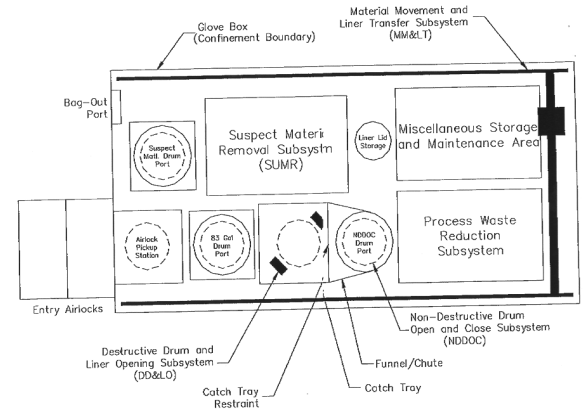
Fig. 1. HANDSS-55 system layout.
Marcela R. Stacey, Kevin C. Croft, David Pace, Derek
Wadsworth and Miles Walton
Idaho National Engineering Laboratory
Robotics Technology Development Program
U.S. DOE Mixed Waste Focus Area
ABSTRACT
An automated system is being developed within the US Department Of Energy to prepare 55 gallon drums of mixed low-level and mixed transuranic waste for transport from DOE sites to a disposal facility. This system provides for the reclassification, treatment, and final disposition of stored mixed waste drums. The system has application to sites requiring equipment to perform similar tasks and will be evaluated and improved as it is used.
The Handling and Segregating System for 55-gallon drums, (HANDSS-55), is composed of three main subsystems, an integrated control system, and other support subsystems. The first subsystem is a non-destructive drum opening/closing system that provides access to the contents of a drum. The second subsystem is a drum liner transfer system that extracts liners from corroded or otherwise damaged drums, and places them in DOT acceptable drums. The third subsystem is a selective waste removal system that is able to remove selected non-compliant waste items from a drum so that it can be reclassified as acceptable for transport. The three subsystems are controlled by an integrated control system that provides a high level of automation and a consistent operator interface. The support subsystems provide containment and access to the main subsystems and handling for process wastes.
The design of this system is being developed under the direction of the Robotics Technology Development Program (RTDP) in conjunction with the Mixed Waste Focus Area Program. The effort is coordinated by the Idaho National Engineering Laboratory and supported by Savannah River Technologies Center, Sandia National Laboratory, Los Alamos National Laboratory, and a users' group formed with representatives from the various DOE sites that reported a need for the technology at their sites.
BACKGROUND
The U.S. Department of Energy (DOE) Office of Science and Technology (EM-50) is developing technology to assist the DOE complex treat their mixed wastes. A survey of facilities in the DOE revealed multiple needs that could be addressed with robotics and automation technologies. In particular, the Idaho National Engineering Laboratory (INEL) is party to the Idaho Settlement Agreement between the DOE and the State of Idaho. This agreement states that at least 15,000 drums of waste will be removed from the INEL by the year 2002. Currently, there are approximately 129,000 drums stored at the INEL with waste that potentially can be transported to the Waste Isolation Pilot Plant (WIPP). Much of this waste has been stored in 55-gallon drums for many years, with the drums experiencing varying degrees of degradation. It is apparent that a significant percentage of these drums can not be shipped in their current condition. The INEL drums also contain items that are not acceptable under the current WIPP Waste Acceptance Criteria (WAC) that must be removed prior to shipment.
After careful consideration of the DOE complex needs, and the INEL's needs to meet the Idaho Settlement Agreement, a development effort, the Mixed Waste Handling and Segregation System for 55-Gallon Waste Drums (HANDSS-55), was started to create a system to provide acceptable waste drums for transport to WIPP. The identified functions of the system are to open and close waste drums non-destructively, to transfer drum liners and contents from unacceptable drums to acceptable drums, and to remove items from drums that are not acceptable for disposal under the current WIPP WAC.
HANDSS-55 is a collaborative effort between INEL, Savannah River Technologies Center (SRTC), Sandia National Laboratory (SNL), Los Alamos National Laboratory (LANL), and a Users Group formed with representatives from the various DOE sites.
Currently, the DOE does not own an integrated handling and segregating system such as described above. There have been previous systems developed that address specific portions of the main subsystems, yet a complete integrated system does not currently exist. During 1994, SRTC demonstrated a full-scale prototype that included much of the functionality of HANDSS-55. This SRTC prototype also demonstrated a large number of other functionalities that HANDSS-55 does not offer under the current work scope. The HANDSS-55 is a newly developed integrated system using some previously developed technologies, not a modification of an existing system.
During Fiscal Year 1997, development will focus on handling 55-gallon drums. The reason for this seemingly narrow scope is that the TRUPACT II transporter is the only transporter that has been certified by the U.S. Department of Transportation (DOT) to transport mixed transuranic waste (MTRU) and mixed low level waste (MLLW) over U.S. public highways. The TRUPACT II was designed to operate at highest packaging efficiency when transporting fourteen 55-gallon drums per shipment. Two other supporting reasons for focusing on 55-gallon drums are: 1) the largest percentage of the waste across the DOE complex is already stored in 55-gallon drums, and 2) the non-intrusive characterization technologies at the INEL site are strictly limited to handling 55-gallon drums.
Another optional packaging configuration for the TRUPACT II is a set of four overpacked 83-gallon drums in TRUPACT II Standard Waste Boxes (SWBs). In this optional configuration, a non DOT-acceptable 55-gallon drum is packed in a DOT-acceptable 83-gallon drum. Unfortunately, the packaging efficiency is greatly reduced and renders the 83-gallon drum overpack configuration expensive, lengthy, and impractical for transferring large amounts of waste.
TRUPACT II SWBs have also been designed to transport bulk waste, however, these boxes are very expensive and less efficient than 55-gallon drums. Another challenge with the SWBs is that the drums contents, that were likely sorted originally, would become all mixed again if the SWBs are filled in "bulk mode."
SYSTEM OVERVIEW
The HANDSS-55 will consist of three main subsystems:
These three subsystems will be fully integrated by an overall control system. Other support subsystems are also an integral part of the HANDSS-55. They include a Process Waste Reduction (PWR) subsystem, Destructive Drum and Liner Opening subsystem (DD&LO), material handling equipment, an overpacking station, glove ports, and etc.
The HANDSS-55 handles 55-gallon drums and is designed to operate inside a glovebox built for each end user. The HANDSS-55 system is capable of handling and processing drums of MLLW and/or MTRU waste that contain items not acceptable at WIPP, and/or drums that have degraded and are not certifiable for transportation. Originally, the HANDSS-55 was to be designed as a portable system/facility, however, further consideration and evaluation of this requirement indicated that the HANDSS-55 be a modular architecture operating in a fixed facility. Throughput requirements are calculated to meet the Idaho Settlement Agreement and used to generate specific throughput requirements for the individual subsystems.
Figure 1 shows a schematic view of the HANDSS-55 system layout. A receiving station receives the drums. At this station, identification and inventory information are cataloged and tracked as well as any other information needed to determine the process route for each drum. A process flow diagram has been developed that details actions and material movements through the system. Three basic scenarios are considered: DOT acceptable drums with WIPP non-compliant items inside; DOT non-acceptable drums, with or without WIPP non-compliant items inside; and overpacked DOT non-acceptable drums with or without WIPP non-compliant items inside. The output of the system are DOT acceptable drums that meet WIPP acceptance criteria. Debris generated during the processing are packaged as acceptable drums. WIPP non-compliant items that are removed from drums are directed to other appropriate waste streams.
Fig. 1. HANDSS-55 system layout.
MAIN SUBSYSTEMS
Non-Destructive Drum Open/Close subsystem (NDDOC)
The primary function of the Non-Destructive Drum Open/Close (NDDOC) subsystem is to open drums while maintaining confinement. The NDDOC provides the flexibility to reuse drums if necessary. The end user will make a determination on a drum-by-drum basis if the drum is to be reused or not. The NDDOC also closes drums, seals them as applicable, and detaches the drums from the glovebox. Specific operations performed in this substation include:
Material Movement and Liner Transfer Subsystem (MM<)
The primary function of the Material Movement and Liner Transfer (MM<) subsystem is to extract a drum liner from a 55-gallon drum that is not DOT-certifiable and move it to a certifiable one. This subsystem also performs multiple auxiliary tasks in support of other subsystems. Specific operations performed in this substation include:
Suspect Material Removal Subsystem
The primary function of the Suspect Material Removal (SUMR) subsystem is to remove the suspect materials that are not acceptable under the current WIPP WAC. Specific operations performed in this substation include:
SUPPORT SUBSYSTEMS
Integrated Control System
The primary function of the control systems for the HANDSS-55 is to provide integration and continuity to the operation of the subsystems. The control system remotely controls and/or monitors the subsystems from a single location. The subsystems are also able to be operated from separate or individual stations. Data collections are available offsite for statistical analysis and other data manipulation as needed by facility operations personnel. The control system is able to detect off-normal conditions and provide adequate correction/response to the process.
Process Waste Reduction (PWR)
The primary function of the Process Waste Reduction (PWR) subsystem is to accept old steel drums, liner, poly bags, and other materials generated by the various subsystems that need to be excessed from the HANDSS-55. This subsystem will potentially shred and/or compact these materials and package for storage and/or disposal. Specific operations performed in this substation include:
Destructive Drum and Liner Opening Subsystem (DD&LO)
Working in conjunction with the MM<, the function of the Destructive Drum and Liner Opening subsystem (DD&LO) is to destructively open damaged drums to allow access to the liners for transfer. It also can destructively open the drum liner to allow access to the drum contents. Specific operations performed in the substation include:
Glovebox and Airlocks
This housing structure provides protection from the elements for the system hardware and confinement for materials that being processed by the HANDSS-55. Other functions of the glovebox are: to provide access to the various subsystems hardware; access by gloveports to the entire structure for decontamination; storage space for process materials such as new liner lids; interfaces to power, heating, ventilation, and air conditioning, and other utilities; and camera ports to allow real-time monitoring of operations inside the glovebox. The airlocks provide the ability to transport materials in and out of the glovebox while maintaining confinement. Specific operations performed in this substation include: