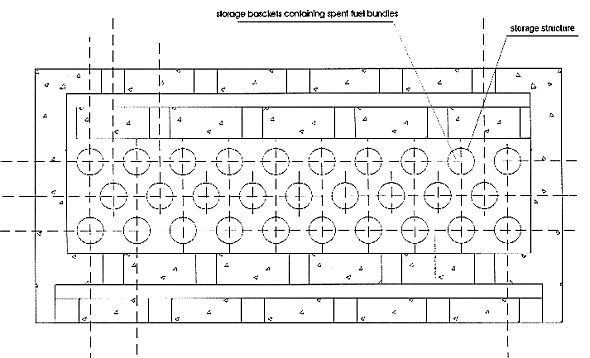
Fig. 1. Monolytic reinforced
concrete module type spent fuel interim dry storage.
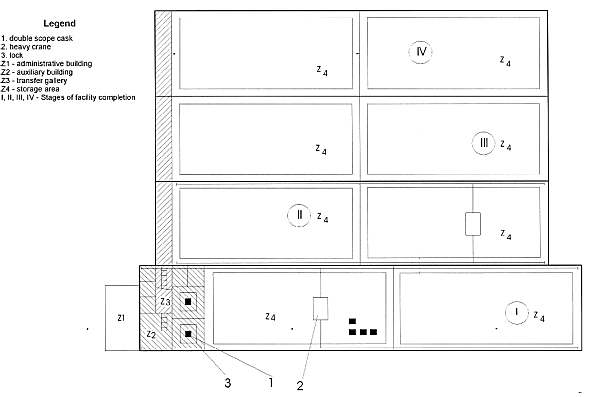
Fig. 2. Double scope
cask type spent fuel interim dry storage.
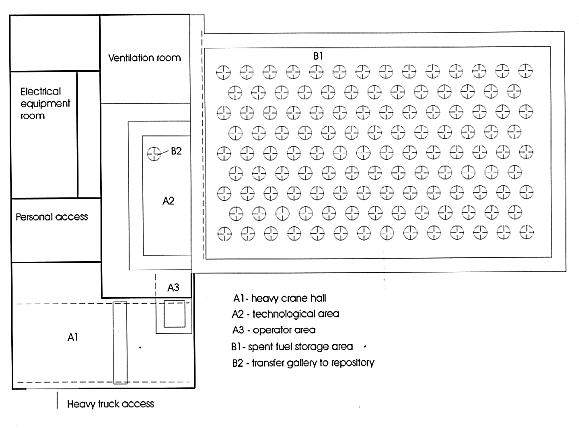
Fig. 3. Vault type
spent fuel interim dry storage.
F. Glodeanu, V. Andrei, D. Popescu, G. Barariu, C. Mingiuc
Romanian Electricity Authority, Nuclear Power Group
Magheru Blvd. 33,
Sector 1
Bucharest, Romania
ABSTRACT
The Romanian Electricity Authority operates a CANDU-6 reactor at the Cernavoda site, a Fuel Manufacturing Plant and a Nuclear Research Centre at Pitesti and a Heavy Water Plant at Drobeta Turnu Severin. All our branches involved in the nuclear sector are generating nuclear and toxic wastes which require treatment, packing and disposal.
For the Cernavoda NPP, the waste management system, now in place, is based on the Canadian technology and consists of:
- low and intermediate wastes are collected, packed and temporarily stored on site;
- spent fuel is temporarily stored in the reactor bay for 10 years.
The waste management strategy for the Cernavoda NPP, now under consideration, aims at the following objectives:
- to have, in 2005, a near surface repository operational for low and intermediate wastes on the Cernavoda site;
- to have, in 2007, an interim dry storage facility operational for spent fuel at the Cernavoda NPP;
- to define and promote a solution for final disposal of spent fuel.
The Fuel Manufacturing Plant and the Nuclear Research Centre at Pitesti have a common facility for treatment and stabilization of low and intermediate wastes, including wastes containing natural uranium. The spent fuel from TRIGA research reactor will be returned to US for disposal, within the framework of the project supported by the American Government.
Additionally to the nuclear waste, the utility waste management strategy includes provisions for toxic waste generated at Heavy Water Plant, the main goals being the following;
- to operate a facility for sludge treatment and disposal;
- to upgrade the facility for treatment of liquid effluents from heavy water technology.
Starting with 1992, the company is firmly committed in a waste management program, providing large resources and R&D facilities. On this basis the approached topics are in connection with the feasibility study for the near surface L/ILW repository and the conceptual design for the spent fuel interim dry storage facility on the Cernavoda site. Our strategy for radioactive and hazardous waste management is open for co-operation and its successful implementation will be an important argument for the promotion of nuclear power in our country.
THE NUCLEAR SECTOR AND THE WASTE MATTER
Starting with 1997 about 8 % of the electric power produced in Romania will be generated by the first of five CANDU - 6 reactors under construction at Cernavoda site. Analyzing the perspectives of the nuclear power program in Romania (1) in connection with international situation three scenarios are relevant:
To ensure the commissioning and the operation of Cernavoda NPP, Romanian Electricity Authority operates a Fuel Manufacturing Plant with a yearly output of 5,000 CANDU - 6 fuel bundles, a Heavy Water Plant with a yearly operational capacity of 180 tons, a Nuclear Research Institute and a Centre of Technology and Engineering for Nuclear Projects which provides design and engineering services for nuclear projects. All the branches involved in supplying products and support services for the safe and economic operation of the power reactor generate hazardous and/or radioactive wastes.
According to the national law and IAEA recommendations, a radioactive waste management strategy has been developed by our company. The management strategy of radioactive wastes generated during the operation of NPP is implemented in three stages:
The First Stage
The Second Stage
The Third Stage
The capacity of the L/ILW near surface repository (2) will have a proper size to enable the disposal of all L/ILW coming from the operation of the five CANDU - 6 units for a 30-40 years lifetime as well as the radioactive wastes coming from the decommissioning of the Cernavoda NPP. The following aspects were taken into account:
The management of radioactive wastes generated by the Fuel Manufacturing Plant and the Nuclear Research Centre at Pitesti is done in a common facility for treatment, stabilization and packaging for the disposal of low and intermediate wastes, including wastes containing natural uranium.
The L/ILW on this site are generated by:
The spent fuel from TRIGA reactor will be returned to US for disposal within the framework of the project financed by the American Government.
The waste management strategy of the company includes also the hazardous wastes generated during the process of heavy water production. The process is based on the isotope exchange between water and hydrogen sulphide followed by a stage of vacuum distillation.
Main objectives in this field are following:
To reach the proposed objectives, RENEL is implementing a well defined research and development program for radioactive and hazardous waste management.
THE RENEL'S RADIOACTIVE WASTE MANAGEMENT PROGRAM
RENEL has promoted starting with 1992 a Radwaste Management Program to provide technical support for the adopted strategy. The program is based on the general principles (3) promoted by IAEA:
The first stage of this program will be completed by the end of 1996 and it was devoted to the establishment of a general strategy for management of radioactive waste generated by the nuclear installations of the company. The following objectives (4) were taken into account:
The main achievements in the field of L/ILW are:
In the field of spent fuel disposal, the following objectives (5) were achieved:
Fig. 1. Monolytic reinforced
concrete module type spent fuel interim dry storage.
Fig. 2. Double scope
cask type spent fuel interim dry storage.
Fig. 3. Vault type
spent fuel interim dry storage.
The second stage of R&D program will be implemented in the period 1997-2002 and will contain:
To promote the nuclear project, the technical and economical arguments are no more sufficient, the public acceptance becoming of equal importance. The public needs to know that the operator has the solution for the radioactive wastes without burden the environment and human health. The company has in attention the establishment and the implementation of a public information component of the Program mentioned above. The content will be addressed to different groups of public and the information will be timely evaluated through the public opinion research.
REPOSITORIES FOR RADIOACTIVE WASTES
The near surface L/ILW disposal facility dedicated to Cernavoda NPP will be built in the exclusion area of the plant on a rich clay site. The facility will be designed to cover the disposal capacity required by Cernavoda plant (five reactors) over life-time, including the decommissioning wastes. The first capacity of Cernavoda L/ILW repository, dedicated for two CANDU reactors, will be completed in 2005. The waste packages are placed inside modular concrete containers that in turn are stacked within engineered disposal structure (Fig. 4.). The floors of the disposal structures collect any infiltrating water and channel it away from the structure for monitoring. The disposal structure will be covered with layers of artificial and natural materials designated to prevent the effects of infiltration or erosion by wind or water as well as the intrusion by plants and animals. The multiple barrier system is designed to last for 300 years.
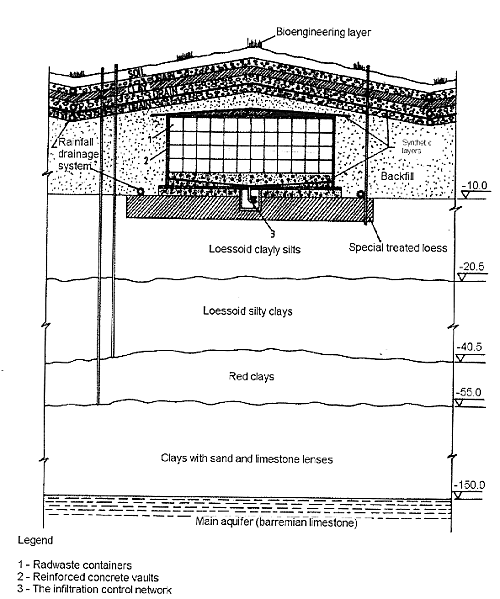
Fig. 4. Simplified Draft of the
Cernavoda Multibarrier System
The spent fuel assemblies are declared as waste and a disposal strategy is considered, based on the international practice. Taking into account the opposition against a further expansion of reprocessing and the difficulties and delays in implementing the disposal of spent fuel, the long term storage is the most probable interim solution of the back end of the fuel cycle. For CANDU fuel, there is a good experience with dry storage in Canada and Argentina using concrete canisters or containers. A similar solution is now under development for Cernavoda NPP, aiming to be operational in 2007.
For the HLW, there is a broad international consensus among experts that the preferred solution is deep geological disposal. Our long term strategy for HLW management includes development of a spent fuel repository hosted in a salt geological formation.
The company' s strategy for waste management is open for co-operation . In this context the approached topics are:
We really believe that a successful implementation of the waste management program will be an important argument for the promotion of nuclear power in our country.
REFERENCES