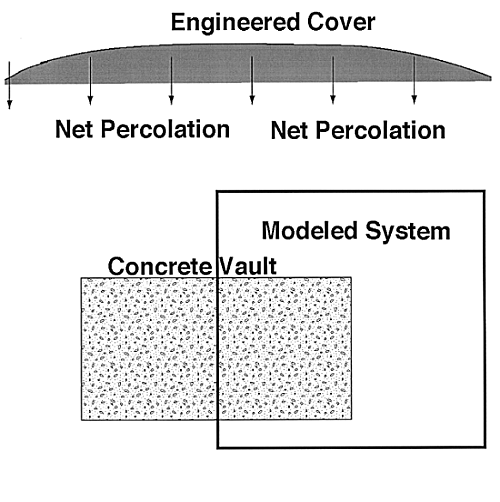
Fig. 1. Schematic of
modeled system.
John C. Walton, Ahmad Arif Shahjahan, David LeMone, Saifuddin
Ahmed, and Aida Velasquez University of Texas at El Paso
El Paso, Texas
79968-0516
ABSTRACT
Hydraulic performance of below ground concrete vaults located in the unsaturated zone was examined in relation to design. Design parameters considered were soil layers placed around the vault, size or scale of vault, roof slope, and degree of degradation of the concrete. Performance was estimated as the rate of water flow predicted to pass through the vault using a numerical model. Clay layers placed adjacent to the concrete were found to lower water flow through the vault in most simulations. Smaller vault sizes result in lower flow rates giving a demonstrable scale effect. Roof slope, within the range considered, has a relatively small influence on hydraulic performance. A revised design strategy for below ground vaults provides improved performance at lower cost.
INTRODUCTION
Hydraulic performance is an important aspect of the ability of concrete vaults and concrete canisters to isolate low level radioactive wastes from the environment. In order to design improved concrete vaults we must understand the relationship between vault design parameters and hydraulic performance. The relationship between hydraulic performance and design is complicated by location of concrete vaults in the unsaturated zone. Unsaturated flow is more complex and is subject to scale and gravity effects not present in saturated flow. The unique aspects of unsaturated flow have significant implications for the relationship between design and long term performance. A number of researchers have studied flow and transport through engineered covers (Booth and Price, 1989; Brun et al., 1994; Weeks et al., 1992) but less work is available on controls on flow through below ground concrete vaults.
Prior work on flow through vaults (Walton, 1991; Walton and Seitz, 1992) has indicated that perched water has a tendency to form on the roofs of large low permeability vaults. Because gravity acts directly on the perched water, the hydraulic gradient through the vaults is then greater than unity. This contrasts with typical hydraulic gradients of 0.01 or less in the saturated zone. This leads to the interesting and unexpected result that placing a large low permeability concrete vault in the unsaturated zone may increase the flow rate through the vault by a factor of 100 or more over expected values if the same vault were located in the saturated zone. At the same time the unsaturated zone is, in general, a more aggressive environment for concrete than is the saturated zone. The unsaturated zone has greater exposure to soil gases (oxygen and carbon dioxide) and the potential for buildup of ion concentrations (sulfate and chloride) when evaporation is enhanced by low permeability zones in the cover (ACI, 1984; ACI, 1990; Clifton and Knab, 1989; Walton et al., 1990)
In this work we take the average flow (leakage) rate of water through the concrete vault as the measure of hydraulic performance. A range of computer simulations were performed to study the influence of scale, roof slope, and adjacent soil properties on flow through vaults located in the unsaturated zone. The simulations were performed for an intact vault and a partially degraded vault. The broader implications of the results are discussed along with recommendations for enhanced vault design.
Methods
This study compares four different classes of design for the disposal vault. In order to keep the focus of the study on the vault the engineered soil cover overlying the vault is represented simply as an input infiltration rate. A low infiltration rate can represent either a relatively arid site and/or a high performance cover at a humid site. Each design assumes that the vault is buried in a loam soil. The four designs are:
The designs are named by listing the soil layers beginning from the concrete and moving outwards. The vaults are either considered to be intact, giving a low permeability for the concrete or partially degraded, giving a much higher concrete permeability.
Fig. 1. Schematic of
modeled system.
The concrete vault is 10 meters high, 20 meters wide and infinitely long (two dimensional simulation) (Fig. 1). The vault is located in the unsaturated zone with a specified infiltration X m above the vault roof, a water table 4 m below the vault floor, and a no flux plane at the vault center. The domain is split into variably spaced finite difference grids, with the modes more closely spaced near material boundaries. All simulations represent steady state flow. Van Genuchten curves combined with the Mualem integral are used to relate the hydraulic conductivity to negative pressure head and saturation (Jury et al., 1992). The code has been previously described (Walton, 1991). The numerical method is integrated finite difference for variably saturated steady state flow. Nodal spacing is variable with closer node spacing used near high contrast boundaries to improve accuracy. The code automatically calculates the mass balance of water at each horizontal plane, which must be equal at steady state for our boundary conditions. The solutions are considered to be converged after the mass balance error is less than 0.1%.
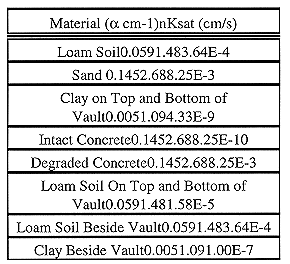
The hydraulic properties of the partially degraded concrete vaults are simulated by assuming that the vault itself has the unsaturated flow properties of coarse sand (i.e., fracture flow). The effective permeability of fractured concrete is, in general, a function of the hydraulic conductivity of surrounding porous materials since most resistance to flow is in the form of entrance/exit head losses (Walton and Seitz, 1992). Permeability of adjacent layers has been modified to reflect this. Since the precise properties of a concrete vault over time are highly variable and uncertain, simple assumptions are used to reflect the fact that any concrete vault or canister will eventually crack and become more permeable to water. The difficult challenge is to design vaults such that they work well not just with new, intact materials, but also work well as the materials degrade over time. Material properties assumed are listed in Table I.
Table I Material Properties Assumed in Simulations
Results
Influence of Roof Slope: Roof slope was considered by mathematically turning the vault slightly with respect to gravity. Sloped roofs improve hydraulic performance by promoting lateral drainage around the vault. A series of computer simulations were performed for a partially degraded vault. The improvement from roof slope is significant but not large for all designs. Improvement is greatest for the clay and sand design.
Importance of Infiltration Rate and Overlying Engineered Cover
An important question when spending allocating extensive construction and maintenance costs to the engineered soil cover over a disposal facility is: To what extent does the engineered cover enhance performance of the disposal facility? In this work we do not explicitly model the cover. Instead we begin the simulation just below the cover. Cover performance is reflected in the assumed infiltration rate. A low infiltration rate may indicate either a well performing cover or location in a semi-arid climate. The infiltration rates that have been studied range from 0.01 to 100 cm/yr for both intact and partially degraded vaults. The results for partially degraded vaults are shown in Fig. 2.
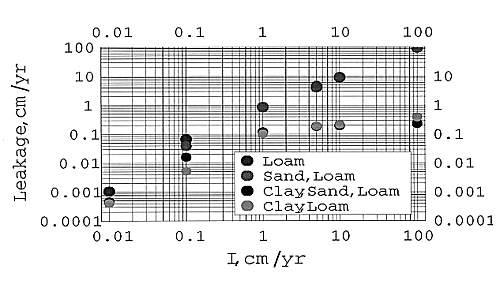
Fig. 2. Influence of infiltration
rate and design on flow through partially degraded vault.
For intact concrete vaults (not shown) the flow rate through the vault rapidly becomes independent of leakage rate through the cover. For the degraded vault the flow rate through the vault with increasing infiltration depends strongly upon design. The degraded loam vault (default) allows nearly 100% of the infiltrating water to pass through the vault. The sand design has performance identical to loam at higher infiltration rates but provides the best performance at very low infiltration rates. The performance of the sand when infiltration is low results from the sand acting as a capillary barrier to flow. The clear limitation of capillary barriers is that they are easily overwhelmed by high flow rates and are subject to compaction induced hydraulic changes.
The two designs with clay adjacent to the concrete have performance that is nearly independent of infiltration rate when the infiltration rate is above 0.1 to 1 cm/yr. For perspective consider that a clay layer in the overlying engineered cover under a unit gradient flow will leak at a rate of 3 cm/yr if the clay has a hydraulic conductivity of 1E-7 cm/s. Since the cover is more vulnerable to degradation than the vault, it is unlikely that an engineered cover overlying a degraded vault will leak at a rate lower than a few cm per year (unless located in an arid climate). The vaults with clay adjacent to the concrete thus have hydraulic performance independent of cover leakage for climatic conditions covering most of the US.
Size of Vault (Scale)
The influence of vault size was evaluated by scaling the horizontal dimension of the system. Net infiltration through the overlying cover was fixed at 1 cm/yr for all the simulations as an upper boundary condition on the model domain. For large vaults the leakage rate through the vault is independent of the vault size. The loam design shows very little scale dependence. However, for the clay/sand design, the leakage rate drops rapidly as vault size decreases resulting in improved performance. The combined clay/sand design works well at small vault size because the sand acts as an effective capillary barrier to flow at small sizes. However the capillary barrier is quickly overwhelmed as vault size increases.
DISCUSSION
Current concepts for design of below ground concrete vaults evolved from the concept of placing an engineered soil cover over landfills. This paradigm leads to designs where the same type of engineered soil cover used for landfills is placed over below ground concrete vaults in order to reduce water infiltration through the soil above the concrete vault. The major problem with this logic is that the hydraulic performance of a concrete vault with a flow barrier placed adjacent to the concrete is relatively independent of the flow rate through the overlying engineered soil cover. An important additional consideration is that surficial related degradation and weathering processes operate most rapidly at the earth's surface and decline rapidly with depth of burial. Thus the engineered cover represents the portion of the disposal system most subject to degradation processes including oxidation of the geomembranes, plant roots, and burrowing animals.
A revised paradigm, suggested by this research, is that the flow barrier portions of the engineered cover should be incorporated adjacent to the concrete vault and be considered an integral portion of the vault design. Concrete vaults are good at providing structural stability but can have very high hydraulic conductivity when cracks develop. Low permeability porous materials are very valuable in reducing leakage rate through flawed impermeable barriers such as flawed geomembranes and cracked concrete. The low permeability porous materials increase entrance/exit head losses that generally control flow through flaws and cracks.
Flow barriers placed adjacent to the concrete vault, rather than near the earth's surface are likely to:
Two examples of improved designs are illustrated in Fig. 3 and Fig. 4. Figure 3 is a large concrete vault design. Larger vaults are sometimes more cost effective. The concrete is covered with protective coatings and geomembranes followed by clay and sand layers. It is important that the clay be the closest soil material to the vault to reduce flow through cracks that may develop in the concrete. Above the clay is an optional layer of sand to promote drainage and provide a partial capillary barrier. Below the vault is a layer of fine sand. Coarse, well sorted gravel should generally be avoided below the vault because during unsaturated flow, the gravel represents a flow barrier and thus will increase moisture content of the waste. The fine sand can provide good compaction properties and sufficiently high hydraulic conductivity to allow for drainage. Below the sand at the edges of the vault is a gravel or other drain to move water away. Most infiltrating water travels along the outside of the vault through the sand layer in this design.
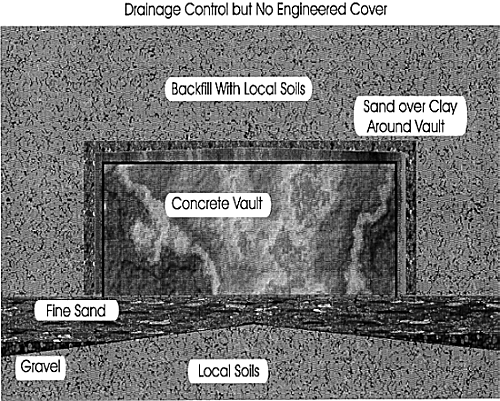
Fig. 3. Enhanced
lower cost design for concrete vaults.
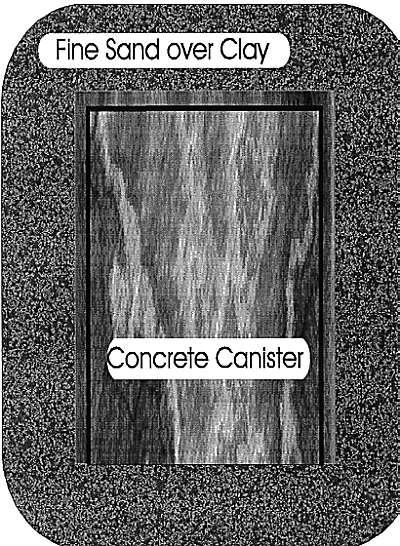
Fig. 4. Enhanced
design for concrete canisters.
A second design is for individual cylindrical concrete canisters. The concrete canisters could be placed either inside a large concrete vault or without a surrounding concrete vault. The simple design places a clay layer around the canister followed by fine sand. The clay layer could be a geosynthetic consisting of a geomembrane with attached clay. The fine sand promotes drainage around the concrete canisters for both unsaturated and saturated flow conditions.
In summary placing the flow barriers against the vault at greater depth and fully considering unsaturated flow effectively allows for elimination of expensive and relatively rapidly degrading engineered covers from the disposal system while improving long term performance.
REFERENCES