Fig. 1. Certification
regulatory and technical requirements.
Pamela S.Z. Rogers, Barbara Sinkule, David R. Janecky, Marji
Gavett, Saundra Wander, Jane Enter, Stan Bodenstein, Dave Yeamans, Dan Taggart,
Gene Mroz, Ines Triay, Johnny Harper
Chemical Sciences and Technology
Division
Los Alamos National Laboratory
John T. Zoltai
Computer, Information and Communications
Division
Los Alamos National Laboratory
Bruce Le Brun
DOE
Los Alamos Operations Office
Los Alamos, New Mexico, 87545
ABSTRACT
The Los Alamos National Laboratory (LANL) has full capability to characterize transuranic (TRU) waste for shipment to and disposal at the Waste Isolation Pilot Plant (WIPP) for its projected opening. LANL TRU waste management operations also include facilities to repackage both drums of waste found not to be certifiable for WIPP and oversized boxes of waste that must be size reduced for shipment to WIPP. All characterization activities and repackaging are carried out under a quality assurance program designed to meet Carlsbad Area Office (CAO) requirements. The flow of waste containers through characterization operations, the facilities used for characterization, and the electronic data management system used for data package preparation and certification of TRU waste at LANL are described.
DISCUSSION
The Los Alamos National Laboratory has developed a TRU waste characterization and certification program to obtain data necessary to support WIPP compliance activities as well as to ensure the readiness of certified TRU waste for shipment to the WIPP beginning in 1997. The Waste Isolation Pilot Plant Waste Acceptance Criteria (1) (WIPP WAC) serve as the primary directive for assuring the safe handling, transportation, and disposal of TRU waste generated at Department of Energy (DOE) sites. They consolidate and summarize requirements and criteria that must be met for TRU waste transport to and disposal at the WIPP disposal facility. The WIPP WAC reference the controlling documents, such as the TRUPACT-II Certificate of Compliance (2) (C of C) and Safety Analysis for the TRUPACT-II Shipping Package (3) (SARP), the RCRA waste analysis plan, and the Quality Assurance Program Plan (4) (QAPP) for detailed information regarding compliance. The Quality Assurance Program Description (5) (QAPD) and the TRUPACT-II C of C define the quality assurance requirements that must be met by programs preparing waste for certification and transportation.
A challenge at LANL, like at all DOE TRU waste generator and storage sites, is to ensure compliance with the increasing TRU waste management requirements with decreasing DOE funding. To meet this challenge, LANL has implemented three major programs to reduce TRU waste certification costs:
PROGRAM CONSOLIDATION
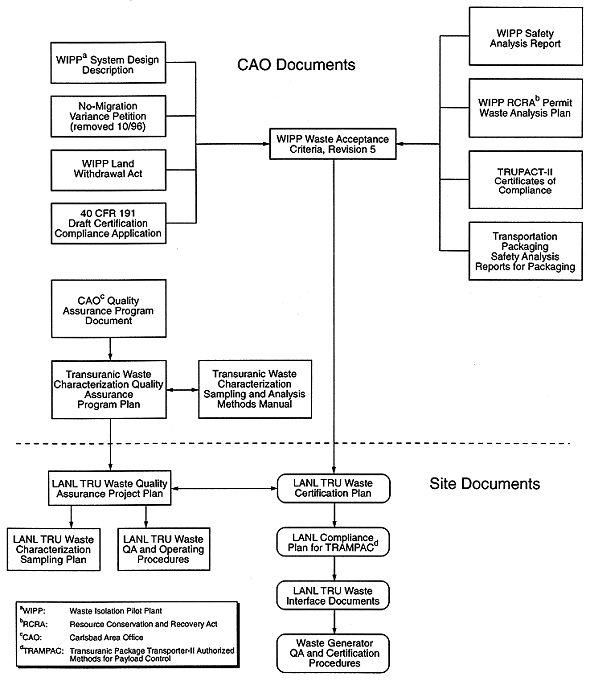
This process was initiated when program documents, including the Los Alamos National Laboratory Transuranic Waste Quality Assurance Project Plan (6) (QAPjP), Los Alamos National Laboratory Transuranic Waste Sampling Plan (7) (LANL 1995b), Los Alamos National Laboratory Transuranic Waste Certification Plan (8), and the LANL Compliance Plan for TRUPACT-II Authorized Methods for Payload Control (9) (TRAMPAC) were still under development. Decisions were made early on to follow the same format for all of these documents, to adopt the same quality management document and reduce repetition of overlapping WIPP WAC requirements. When new CAO guidance to reflect QAPD requirements in the site QA program was received, it was implemented by rewriting the QAPjP and using this document as the overriding QA plan for the certification, transportation , and characterization programs. The QA plan description required in the Certification Plan (Chapter 5) is thus simplified to one table that provides a road map between the QAPD elements and the implementing procedures. A separate QA plan for compliance with 10 CFR 71, Subpart H, for transportation packaging, is not used. Instead, the specialized requirements for packaging use are implemented through operating procedures under a QA program that includes the necessary NQA-1 elements. An overview of the CAO requirements documents and the LANL site implementing documents is shown in Fig. 1.
Fig. 1. Certification
regulatory and technical requirements.
TRU WASTE CHARACTERIZATION AND TREATMENT
LANL has developed mobile and portable systems for addressing the various tasks to ready waste for disposal at WIPP. A mobile system, by LANLs definition, is a system that is completely self contained; it does not require any support to operate in the field. A portable system can be easily moved from one facility to another, but requires the infrastructure support of a facility (power, ventilation support, etc.) to operate. Mobile and portable systems are advantageous because they provide varied waste characterization capabilities without the need to construct expensive, large, permanent facilities. They are flexible in their deployment (i.e. portable systems can be moved in and out of facilities as waste characterization needs change), and they allow characterization at a lower cost than in fixed facilities. These systems provide the required capabilities, although with limited throughput, to fully characterize TRU wastes at LANL.
A flow diagram of the characterization and treatment steps used to prepare the LANL TRU waste inventory for disposal at WIPP is shown in Fig. 2. Retrievably stored waste is removed from under earthen cover, drums are washed, vented, inspected, and waste containers are placed in inspectable arrays within storage domes. The drum venting system, designed and built at LANL, is fully mobile and will be fielded at the retrieval site. It provides complete explosion containment, measures the hydrogen gas concentration in the drum headspace at the time of venting, and has a sampling port that can be connected to an on-line analysis system or to a SUMMA canister for gas sample transport. LANL plans to use only the hydrogen analysis capability, to simplify field operations and provide high venting throughput of about 50 drums per day. The CAO QAPP requirement that drums undergo 72 hour thermal equilibration in a heated enclosure before sampling and analysis for headspace VOCs also is more easily met at a later point in the characterization process.
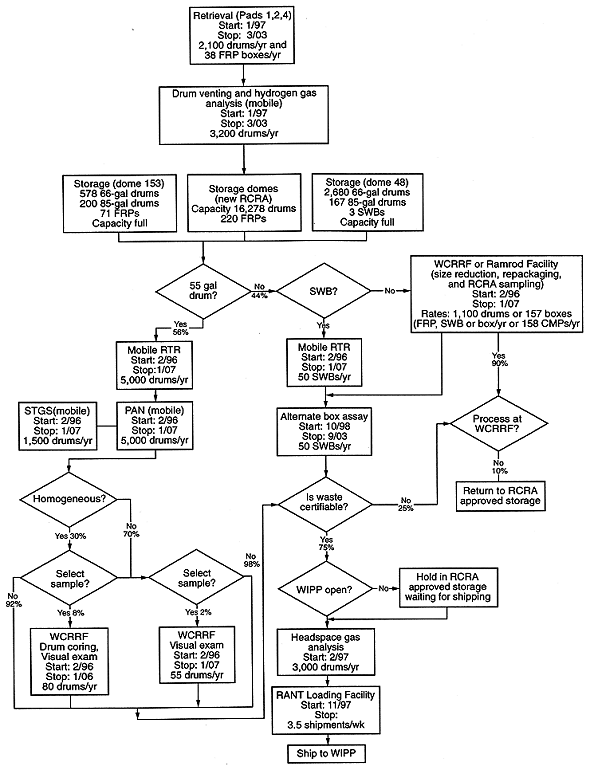
Fig. 2. Flow diagram
of TRU waste characterization.
QAPP-mandated characterization activities begin with nondestructive assay and examination of waste containers. LANL capabilities include two mobile radioassay units, one for passive and active neutron interrogation (PAN) and one combined unit for segmented or to magraphic gamma scanning (S/TGS) used for locating and quantifying gamma and x-ray sources within waste drums. The S/TGS can determine isotopic ratios of radioactive materials in wastes, which can enhance the accuracy of characterization when used in conjunction with the PAN system. Less than one-third of the LANL inventory is expected to require S/TGS assay in addition to PAN assay. One mobile real-time and digital radiography unit allows examination of drums and standard waste boxes. These systems will be fielded at the drum storage area to facilitate drum staging and avoid extra drum transportation costs. In addition, LANL maintains one stationary PAN system and one stationary RTR system at the Radioassay And Nondestructive Testing facility (RANT), the same facility slated for transportation loading activities. These can be used as required to increase throughput or to provide radioassay of newly generated waste that can bypass long term interim storage once shipments to WIPP begin. The radioassay systems are the only such systems qualified through the Performance Demonstration Program (PDP) at LANL. Throughput capabilities for each PAN unit are 5,000 drums per year, the S/TGS operates at one-third that rate, and each RTR unit is capable of examining 5,000 drum per day (all single shift).
Drums from the legacy inventory, that are observed through radiography to contain prohibited articles (such as unpunctured spray cans) or that are found through radioassay to be above the shipping wattage limit, must be repackaged to meet WIPP criteria. The number of drums requiring repackaging to meet shipping wattage limits is conservatively estimated to be ~2,600 (10). An unknown percentage of an additional 3,200 drums may have to be opened to lance layers of plastic packaging. The actual percentage will not be known until the results of matrix depletion studies are approved by the NRC to revise gas generation values used to determine shipping wattage limits. The number of drums with prohibited articles can not be accurately estimated until a larger fraction of the inventory has been processed through radiography. The LANL TRU waste inventory also contains ~45% by volume oversized wastes packaged in large plywood boxes that must be repackaged for shipment to WIPP. These boxes contain predominately discarded gloveboxes, lengths of ductwork, or contaminated heavy equipment such as milling machines.
To maximize throughput, LANL plans to use two fixed facilities for repackaging, since this is the major form of treatment required by the inventory. The Waste Characterization, Reduction, and Repackaging Facility (WCRRF) contains an extremely large glovebox (~30L x 20W x 15H) that can be used to decontaminate, size reduce, and/or repackage oversized waste items into Standard Waste Boxes (SWBs). The contents of a minimum of one "standard sized" plywood box can be cut and repackaged into a standard waste box per week (single shift). The WCRRF also houses a small, portable glovebox used to visually characterize drums of waste according to QAPP requirements, which mandate that a statistical sample of drums undergoing RTR must be unloaded and manually characterized as an independent check on the RTR interpretation of drum contents. This small glovebox is equipped with a powered lift that raises a drum from the floor to a horizontal position so that it can be bagged on to the glovebox at working level and the contents easily removed. It can also be used for removal of prohibited items from drums or minor repackaging, at an estimated throughput of two drums per shift.
The second facility, the radioactive Materials Research, Operations, and Demonstration facility (RAMROD), is scheduled to begin operations in April, 1997. It houses a fixed, multiple station glovebox train that will be used for large scale repackaging of noncompliant drums. A germanium well detector surrounds one drum output port so that repackaged drums can be counted to ensure they remain below the allowable shipping wattage, Pu fissile gram equivalent, and Pu equivalent Curie limits of the WIPP WAC. The RAMROD facility also houses a second, portable glovebox, with drum lift to be used for drum repackaging, and a portable drum coring glovebox. The latter glovebox is equipped with a coring machine capable of obtaining full length core from cemented waste drums. QAPP-required core samples are drilled, coarsely crushed, and packaged into vials within the glovebox. A companion portable glovebox contains chemical analysis equipment to provide total volatile organic compound, semi-volatile organic compound, and PCB analysis of the core samples. A high-pressure solvent extraction system, designed specifically for difficult extractions from Portland and Envirostone cements, is included. Future plans are to design and install another portable glovebox containing instrumentation for analysis of RCRA metals as required in the QAPP. Full laboratory analysis capabilities for TRU waste samples also are in place at the Chemistry and Metallurgy Research (CMR) building at LANL. Shipment of refrigerated samples is conducted over the public roads between the RAMROD and CMR facilities using certified Type B shipping containers (6M canisters).
Waste containers returning from treatment and new waste containers generated from treatment activities can be stored in inspectable storage domes to await further characterization activities, if necessary. Characterization activities continue at the RANT facility, where newly generated waste undergoes radioassay. Most waste containers are then thermally equilibrated and sampled through the drum filter to obtain headspace gas samples for analysis of volatile organic compounds, flammable gases, and hydrogen. (For some waste containers, it may be preferable to perform headspace gas sampling before coring or repackaging activities; in these cases, gas sampling usually does not have to be repeated.) A small, portable pumping system designed at Idaho National Engineering Laboratory is used to obtain the samples, which are stored in sample loops for up to eight hours before being automatically loaded and analyzed by gas chromatography/mass spectroscopy. Short-time sample holding allows manual drum sampling to proceed at an optimal rate during the normal work-day, while the more time consuming sample analysis is automated to continue overnight. Drum throughput is 20 per day.
With these activities, characterization of TRU waste for WIPP WAC compliance is complete. The data obtained during each characterization operation are evaluated on a waste stream basis to judge consistency with documented acceptable knowledge information and to obtain waste stream certification. Data for each waste container is then compared to the WIPP WAC and that information documented to provide proof of certification for each container. To reduce costs and speed the data reporting and certification process, an electronic data management system will be implemented early in 1997, as described in the next section.
ELECTRONIC DATA MANAGEMENT AND CERTIFICATION
The flow of data and information leading to certification of waste streams, individual waste containers, and finally shipping payloads is multistage. The information and analysis from characterization activities must be documented in the form of data packages specific for each technique. This involves managing two types of information: the data packages for evaluation, review, QA and audits, and the certification data results. Data packages require review and sign-off by the technical supervisor, independent technical reviewer, and a QA reviewer. With all approvals in place, the data results are automatically staged for certification processing. The data must be compiled and evaluated on a waste stream basis for conformance with acceptable knowledge information, for assignment of additional EPA hazardous waste numbers if warranted by the results of chemical analysis, and for documentation of the waste stream information in a form acceptable for review by WIPP. Data compilation at this level is reviewed by the site project-level staff (the site QA officer and the site project manager) then forwarded electronically to the WIPP Waste Information System (WWIS) for certification of the waste stream for shipment to WIPP. Characterization information is then recompiled on a waste container basis, and results of the characterization activities compared to the certification criteria to document suitability of waste container for shipment to WIPP. Container certification data is also transmitted to WWIS for WIPP certification approval. When sufficient containers in a shipping category have been certified, a TRUPACT-II payload can be planned, certified for shipment to WIPP through WWIS, loaded, and a shipping manifest generated.
The volume of records generated in the characterization activities is necessarily large, principally because a large amount of quality control and quality assurance information and the raw data accompany the report of the final characterization results. For example, a data package for the headspace gas analysis of twenty drums consists of over 500 pages! Considering that headspace gas analysis is required for every waste container, the enormity of the document management task is apparent. The data packages themselves are required by CAO to be maintained at the sites for audit, but only summary information is transferred to WWIS at WIPP. Therefore, LANL has decided to reduce the cost and enhance quality control/quality assurance (QC/QA) associated with data generation, reporting, and document management by implementing electronic data reporting and storage systems. A diagram of the information flow in the system is shown in Fig. 3.
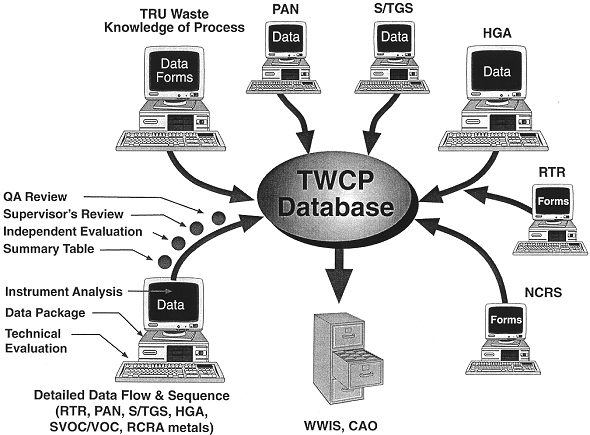
Fig. 3. Detailed data
flow and sequence.
Electronic management of the characterization data begins at the level of raw data acquisition. Databases (ACCESS or Oracle, as appropriate) have been associated with LANL instruments or analytical suites. Data reduction and quality control checks are performed by software programs controlled under stringent software QA, and the raw data, calibrations, quality control information, quality assurance information, and results are assembled in databases. Forms generation routines automate the generation of the data packages from the database, and data packages are available to reviewers as image files. When data packages are approved, they are signed using an electronic signature process. Image files of the data packages are stored electronically in a centralized system for network access by project personnel or auditors, and multiple copies (minimum of two of each data package) are stored on microfiche and electronic media by the records management center in separate locations. Image files have been chosen for archival quality assurance purposes; they can be protected from alteration and they are stored efficiently. Information flow between databases associated with instruments or analytical suites and the centralized data package database is designed to be flexible, utilizing the level of electronic connectivity available from direct ethernet transport to removable storage media.
The central characterization database, is used to compile data for reports to WWIS at WIPP. Data can be sorted and printed on a waste stream basis to aid in project-level review of the waste stream properties and to facilitate preparation of the Waste Stream Profile Form for approval by WIPP. Use of the database and forms generation programs makes it efficient to prepare Waste Container Certification Statements, Payload Container Transportation Certification Documents, Payload Assembly Transportation Certification Documents, and other reporting forms. A software system is used to compare information from the central database with the WIPP WAC, automating the container certification process for local site approval. The central database is used to submit records to the WWIS at WIPP, as required for site certification.
The split of information between instrument-based databases and the central database is based on operations and efficiency. It allows the large amount of raw data and quality control information to be reviewed and reported by those most familiar with it, while focusing the amount of information that must be handled by the central database, thus minimizing complication and cost of the central database. Electronic transmittal and storage of the data packages eliminates costly management of huge volumes of paper-copy, while keeping the linked information easily retrievable over the computer network. Finally, automation of forms preparation and much of the certification process saves significant personnel time and QC/QA operations associated with validation of data entries and forms at each stage. This provides significant time and cost saving.
CONCLUSIONS
LANL has full capability to characterize TRU waste, repackage waste if necessary to meet the WIPP WAC, and provide data packages and QA information required for waste certification. Depending on available budget, existing throughput capacity for waste characterization and repackaging is sufficient to certify 3,000-4,000 drums of TRU waste per year, and it can be easily increased (without the need for additional facilities) to work off in excess of 5,000 drums per year. Use of mobile and portable characterization systems, consolidation of documentation and quality assurance functions, and electronic data transfer, management and reporting are being used to provide waste characterization and certification at the lowest possible unit cost.
REFERENCES