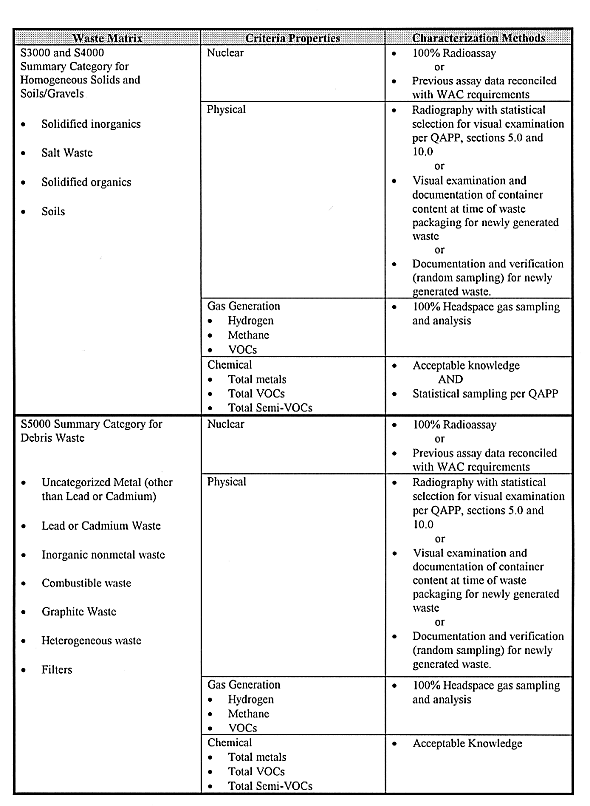
Table I Summary of WIPP TRU Waste Characterization Methods (2)
Edward D. Derr, Johnny R. Harper, Stanley J. Zygmunt, Daniel
P. Taggart, and Stephen E. Betts
Chemical Sciences and Technology Division
Los Alamos National Laboratory
Los Alamos, New Mexico 87545
ABSTRACT
Los Alamos National Laboratory has implemented mobile and portable characterization and repackaging systems to characterize TRU waste in storage for ultimate shipment and disposal at the Waste Isolation Pilot Plant (WIPP) near Carlsbad, NM. These mobile systems are being used to characterize and repackage waste to meet the full requirements of the WIPP Waste Acceptance Criteria (WAC) and the WIPP Characterization Quality Assurance Program Plan (QAPP).
Mobile and portable characterization and repackaging systems are being used to supplement the capabilities and throughputs of existing facilities. Utilization of mobile systems is a key factor that is enabling LANL to: 1) reduce its TRU waste work-off schedule from 36 years to 8.5 years; 2) eliminate the need to construct a $70M+ TRU waste characterization facility; 3) have waste certified for shipment to WIPP when WIPP opens; 4) continue to ship TRU waste to WIPP at the rate of 5000 drums per year; and, 5) reduce overall costs by more than $200M.
Aggressive implementation of mobile and portable systems throughout the DOE complex through a centralized-distributed services model will result in similar advantages complex-wide.
TRANSURANIC WASTE AT LOS ALAMOS NATIONAL LABORATORY
Los Alamos National Laboratory (LANL) has been accumulating transuranic (TRU) waste generated by Laboratory operations since 1970. The waste is being stored awaiting permanent disposal in a deep geologic repository and is currently intended for disposal at the Waste Isolation Pilot Plant (WIPP) near Carlsbad, NM. As of December 31, 1995 the total volume of TRU waste in storage at LANL was 11,167 m3 of which 2,596 m3 could potentially be reclassified as "buried" TRU and be removed from the inventory of waste to be sent to WIPP. The remaining volume of 8,571 m3 is currently considered stored for disposal at WIPP. In addition, ongoing operations at LANL will continue to generate TRU waste into the foreseeable future at a projected rate of approximately 200 m3 per year. Ninety-nine percent of the waste in storage is contact handled (CH) TRU (waste container surface dose rate 200 mrem/hr) and approximately ninety-five percent of the waste is currently classified as TRU mixed waste (MW) under the Resource Conservation and Recovery Act (RCRA). Waste is generally packaged in metal drums, metal boxes, plywood boxes, and fiberglass reinforced polyester (FRP) coatedplywood boxes, however some waste is packaged in other containers. The waste is divided into seven major waste categories that include: soil (1%), remote handled waste (1%), special case/unknown waste (4%), cemented waste (8%), non-combustible waste (40%), combustible waste (18%), and metallic waste (28%).(1)
TRANSURANIC WASTE CHARACTERIZATION REQUIREMENTS
Transuranic waste must be characterized for several reasons including: 1) assuring that the waste meets the waste acceptance criteria for safe storage at LANL; 2) assuring that the waste meets all regulatory requirements for storage at LANL; and, 3) certifying that the waste meets the waste acceptance criteria for transport and final disposal at WIPP. Of these characterization requirements, the requirements for transport and disposal at WIPP are currently the most comprehensive and the most difficult to meet. It can be assumed that if the waste is characterized to the level required for WIPP disposal, the other characterization requirements will be met. Therefore, meeting only the WIPP characterization requirements will be discussed further.
All waste destined for WIPP must be fully characterized to demonstrate compliance with the WIPP Waste Acceptance Criteria (WAC). All characterization must be accomplished in accordance with the requirements of the WIPP Characterization Quality Assurance Program Plan (QAPP). All sites intending to ship waste to WIPP must develop approved site specific Quality Assurance Project Plans (QAPP) that detail how that site will meet the requirements of the WIPP QAPP. Table I summarizes the WIPP characterization requirements and acceptable methods for completing that characterization.(2)
Table I Summary of WIPP TRU Waste Characterization Methods (2)
TRANSURANIC WASTE CHARACTERIZATION APPROACH AT LANL
LANL developed a TRU waste work-off plan in 1986.(3) This plan detailed the activities and facilities that would be required at LANL to prepare its waste for acceptance for final disposal at WIPP. The plan required approximately 36 years to work-off all the TRU waste in inventory at LANL and required the construction of a new TRU waste characterization facility with estimated construction costs of over $70M.
Beginning in about 1992, LANL personnel began investigating alternative approaches to the 1986 work-off plan that would enable faster and less expensive work-off of the waste in storage. The 1996 LANL TRU Waste Management Plan (DRAFT) details the new approaches to working-off the waste in storage at LANL. The 1996 plan fully utilizes existing LANL facilities and increases their capabilities by supplementing them with mobile and portable waste characterization systems. This new approach has enabled LANL to decrease its work-off schedule from approximately 36 years to only 8.5 years, eliminating the need for construction of a TRU waste characterization facility, and has reduced total work-off costs by over $200M. This new approach has also enabled LANL to be ready to ship TRU waste to WIPP when WIPP opens in November 1997 and continue shipping TRU waste at the rate of approximately 5000 drum equivalents per year.
MOBILE/PORTABLE CHARACTERIZATION SYSTEMS IN USE AT LANL
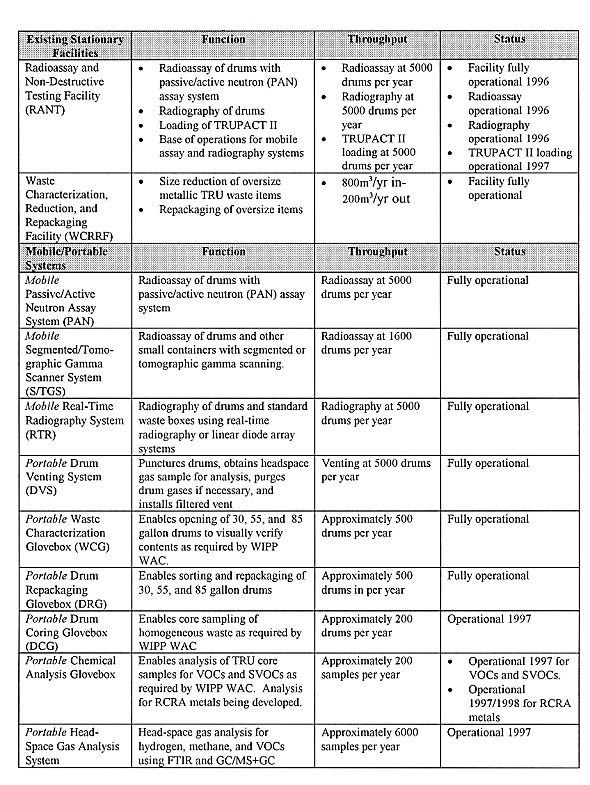
Table II lists the characterization systems being used at LANL, their function, throughput, and operational status. Note that the existing stationary facilities and their capabilities alone would not allow LANL to meet the characterization requirements for WIPP disposal. Supplementing the existing facilities with mobile and portable systems, however, provides LANL with all characterization capabilities required to characterize and certify 5000 drums/year for transport and disposal at WIPP.
Table II Summary of LANL TRU Waste Characterization Systems
Mobile Passive/Active Neutron Assay System (PAN)
The mobile PAN system is a neutron counter for 55 gallon drums of TRU waste. For TRU wastes produced by LANL, this type of instrument is particularly well suited to assay weapons grade or heat source plutonium. The mobile assay unit is fully contained in one trailer unit and can be operated at virtually any location with no need of supporting capabilities (i.e. has own power supply system).
Operating in a passive counting mode, it detects neutrons resulting from the spontaneous fission of 238Pu or 240Pu. In the active mode, a small pulsed neutron generator produces interrogating neutrons as a result of fusion reactions. A deuterium ion beam is directed at a tritium impregnated target. The resulting 14 MeV neutrons are thermalized and subsequently interact primarily with the fissile materials in the wastes (239Pu, 235U). Neutrons produced by induced fissions are counted to determine the total fissile content of the drum.
The mobile PAN system has passed the current Performance Demonstration Program (PDP) requirements as required by the WIPP WAC. The throughput of the mobile PAN system is approximately 5000 drums per year.
Mobile Segmented/Tomographic Gamma Scanner (S/TGS)
The S/TGS system is a fully mobile, single trailer unit system capable of executing a variety of scanning protocols, including segmented gamma-ray scanning and tomographic gamma-scanning. The instrument consists of a sample positioning system, a transmission source assembly, and a high resolution gamma-ray spectroscopy system.
Segmented gamma scanning provides quick assays of low density waste packages. Tomographic gamma scans provide a low resolution image of both the matrix material and the location and quantification of radioactive material in a package. The instrument was developed to assay waste packaged in 30, 55, and 85 gallon drums and in small boxes. The maximum throughput of this system is 18-20 drums per shift.
The mobile S/TGS system has passed the current Performance Demonstration Program (PDP) requirements as required by the WIPP WAC. Data obtained from the S/TGS provides not only the assay data required for WIPP characterization, but provides valuable tomographic images useful for sorting and repackaging operations.
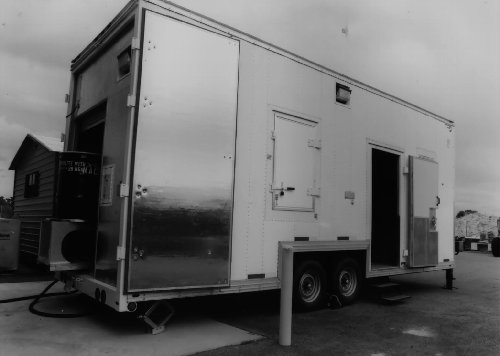
Fig. 1. LANL Mobile
Segmented/Tomographic Gamma Scanner (S/TGS).
Mobile Digital and Real-Time Radiography System (RTR)
This system provides a completely mobile facility to allow inspection of the contents of closed waste drums and standard waste boxes. The trailer contains the operator control room, a lead lined shielded x-ray inspection chamber, multiple storage rooms and compartments, an AC power generator, a climate control system, an automated fire suppression system, and container handling equipment.(4)
The mobile system can be operated in either real time mode or in a digital mode utilizing a linear diode array acquisition system. The shielded x-ray inspection chamber allows the mobile unit to be operated at full power at any location. The maximum throughput of this system is approximately 5000 drums per year.
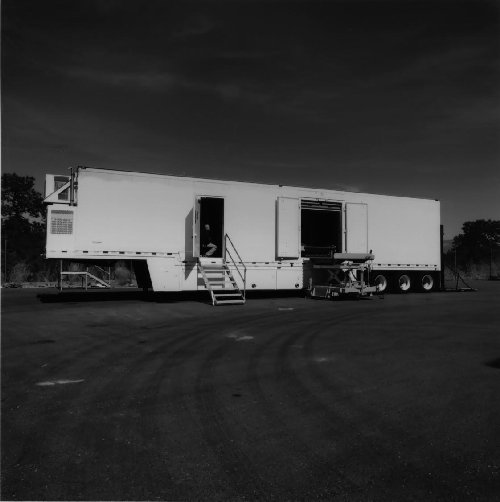
Fig. 2: LANL Mobile Digital and
Real-Time Radiography System (RTR)
Portable Drum Venting System (DVS)
The DVS is a portable computer controlled system that safely penetrates unvented drums of radioactive and/or hazardous waste, obtains and analyzes head-space gas samples, purges flammable gases, and installs a filtered vent in the drum. This unique system conducts all operations inside an American Society of Mechanical Engineers certified pressure vessel that provides complete containment of any gases or particulates should flammable gases be ignited. The pressure vessel is also capable of being purged with inert gas prior to beginning venting operations on particularly hazardous drums. This portable system has a throughput rate of approximately 5000 drums per year.
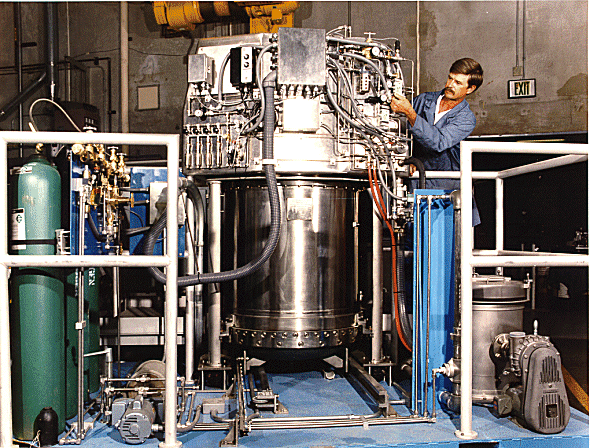
Fig. 3. LANL Portable
Drum Venting System (DVS).
Portable Waste Characterization Glovebox (WCG) and Portable Drum Repackaging Glovebox (DRG)
The WCG and DRG are essentially identical portable glovebox systems. The single unit glovebox systems have material handling capabilities that enable the system to position a drum in a horizontal position and mate the drum to the glovebox unit. From inside the glovebox system, the lid of the drum can be removed and the entire drum contents emptied into the glovebox. Video equipment films the contents of the container for comparison and verification with radiography results as required by the WIPP WAC. The entire drum contents, or any portion thereof (including any unacceptable items in the original drum), can be sorted and repackaged into either of two additional drums coupled to the glovebox. Therefore this system provides visual characterization, sorting, and repackaging capabilities for drums of TRU waste. The throughput of these systems is approximately 500 drums per year for visual characterization and approximately 500 drums per year for sorting and repackaging.
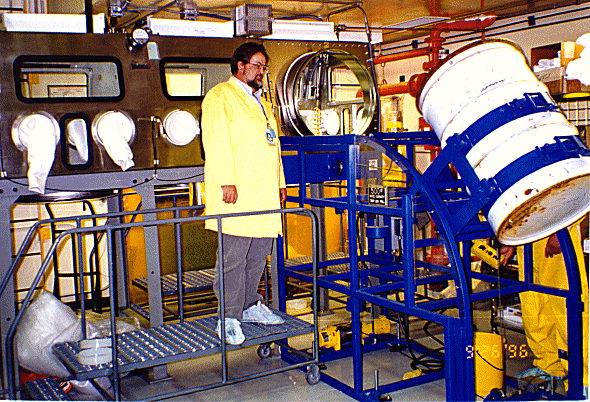
Fig. 4. LANL Portable Waste
Characterization Glovebox System (WCG).
Portable Drum Coring Glovebox (DCG)
The WIPP WAC requires a statistical sampling of drums containing solidified inorganics, salt waste, solidified organics, or soils (Summary Category S3000 and S4000 for homogeneous solids and soils/gravels). The DCG is a portable system that enables core samples to be obtained from drums containing these waste matrices and provides the capability to prepare the core samples for removal from the system for analysis. A drum of homogeneous TRU waste can be coupled directly to the DCG using a bagless posting system and then all coring and core preparation activities occur inside the glovebox system. Samples are then passed out of the glovebox system for constituent analysis. The DCG is capable of coring up to 200 drums per year. This system is fully designed and major components have been fabricated and tested on actual TRU waste. The portable system will be fully operational in early FY 1997.
Portable Chemical Analysis Glovebox
This portable system is currently undergoing test at LANL. It consists of a mobile glovebox and analytical systems for the semi-automatic sample preparation and analysis of VOCs and SVOCs in solidified TRU waste samples. The glovebox system will be deployed wherever coring and sampling is being conducted for on-site analysis. The system for analyzing VOCs, SVOCs, and PCBs will be operational in 1997. An additional portable glovebox system for analysis of solid samples for RCRA metals will be designed in 1997 and will be operational in 1998.
ADVANTAGES OF MOBILE/PORTABLE SYSTEMS AT LANL
The "Mobile Systems Capability Plan" published by the U.S. Department of Energy, Carlsbad Area Office, September, 1996, states that: "Over the past decade DOE has explored the use of mobile systems, and it has found that mobile systems are the equal of fixed site installations in characterizing TRU waste to meet WIPP waste acceptance criteria. (Mobile systems have also been proven suitable for characterizing and treating mixed low-level waste to meet the requirements of the Federal Facility Compliance Act.)" Additionally, the report concluded that "there is a need for mobile systems at DOE sites, that their use could produce significant cost savings, and that they could be rapidly deployed."(5)
These statements have proven true at LANL. Existing facilities at LANL did not have the capabilities or throughput required to characterize the TRU waste in storage to WIPP WAC. By supplementing the existing facility capabilities with mobile and portable systems, LANL has been able to acquire all the characterization capabilities and throughputs necessary, has been able to reduce the schedule for working-off the LANL TRU waste from 36 to 8.5 years, has eliminated the need to construct a TRU waste characterization facility, and projects savings of over $200M in the process.
A MODEL FOR MOBILE SYSTEM USE COMPLEX-WIDE
The Department of Energy Carlsbad Area Office has identified 140,000 m3 of TRU waste at 10 large quantity sites and 15 small quantity sites across the U.S. that is currently intended for disposal at WIPP.(6) Very little of this waste can meet the WIPP WAC and be shipped to WIPP without significant characterization, repackaging, or treatment.
Mobile and portable characterization, repackaging, and even treatment systems, fielded and operated at the various DOE sites by private sector companies, could be utilized complex-wide to realize similar benefits to those that are being realized at LANL. Existing DOE plans call for construction of approximately $1B of new TRU waste management facilities and TRU waste work-off schedules running through the year 2033. Aggressive utilization of mobile and portable systems could eliminate the need for much of this new construction and will dramatically reduce work-off schedules complex-wide.
No single private company has all the necessary capabilities to fully characterize, repackage, and process TRU waste to meet the WIPP WAC. There are, however, numerous private companies that can provide certain components of a full characterization and repackaging system. Some mobile/portable capabilities required for a comprehensive system do not currently exist in either the private sector or DOE (i.e. repackaging and size reduction of large boxes or large metallic items). Additionally, not all DOE sites have the same system needs.
To most effectively address all these issues, the following system model components are recommended:
Utilizing all qualified private companies and capabilities through a centralized-distributed services model with a single integrating contractor and a complex-wide authorization basis, will provide efficient implementation of mobile and portable systems complex-wide. This model will result in schedule improvements, elimination of many planned costly new facilities, and an overall significant reduction in costs of certifying TRU waste for disposal at WIPP.
CONCLUSIONS
Mobile and portable characterization and repackaging systems have been implemented at LANL to supplement the capabilities and throughputs of existing facilities. Utilization of mobile systems is a key factor that is enabling LANL to: 1) reduce its TRU waste work-off schedule from 36 years to 8.5 years; 2) eliminate the need to construct a $70M+ TRU waste characterization facility; 3) have waste certified for shipment to WIPP when WIPP opens; 4) continue to ship TRU waste to WIPP at the rate of 5000 drums per year; and, 5) reduce overall costs by more than $200M.
Aggressive implementation of mobile and portable systems throughout the DOE complex through a centralized-distributed services model will result is similar advantages complex-wide.
REFERENCES