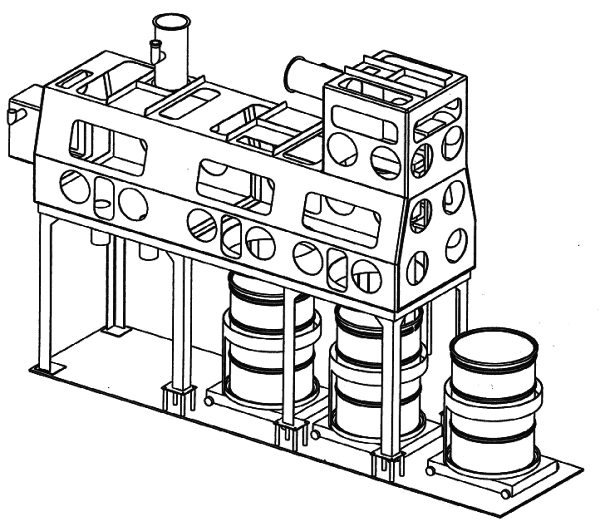
Fig. 1 Conceptual
drawing of existing drum coring glove box
David R. Yeamans, Pamela S. Z. Rogers, and Eugene J. Mroz
Chemical Sciences and Technology Division, Los Alamos National Laboratory
Los Alamos, New Mexico, 87545
The Los Alamos National Laboratory (LANL) has begun characterizing transuranic (TRU) waste in order to comply with New Mexico regulations, and to prepare the waste for shipment and disposal at the Waste Isolation Pilot Plant (WIPP), near Carlsbad, New Mexico. Sampling consists of removing some headspace gas from each drum, removing a core from a few drums of each homogeneous waste stream, and visually characterizing a few drums from each heterogeneous waste stream. The gases are analyzed by Gas Chromatograph/Mass Spectrometry (GC/MS), and the cores are analyzed for volatile and semi volatile organic compounds (VOCs and SVOCs) by a combination of spectroscopic techniques. The sampling and examination projects are conducted in accordance with the "DOE TRU Waste Quality Assurance Program Plan" (QAPP) and the "LANL TRU Waste Quality Assurance Project Plan," (QAPjP), guaranteeing that the data meet the needs of both the Carlsbad Area Office (CAO) of DOE and the "WIPP Waste Acceptance Criteria, Rev. 5," (WIPP WAC). No discrepancies have been observed between interpretation of radiography and visual characterization of the waste, and most of the TRU waste inspected so far contains both Resource Conservation and Recovery Act (RCRA) hazardous and radioactive materials.
Drivers For Sampling
Two documents require LANL to sample its TRU waste. First, the New Mexico Environment Department (NMED), being the enforcing agency for the United States Environmental Protection Agency regarding the Resource Conservation and Recovery Act (RCRA), issued the unilateral Federal Facilities Compliance Order that, among other directives, orders LANL to place its mixed TRU waste into a compliant storage configuration. Compliance requires several activities including a sampling and analysis program to determine the hazardous constituents of the waste. Second, the Department of Energy (DOE) Order 5820.2b requires sites to evaluate their waste for disposal at suitable sites including the WIPP. The evaluation requires sampling and analysis to determine compliance with "WIPP Waste Acceptance Criteria, Rev. 5,"(1) (WIPP WAC). The program quality is guided by the DOE Carlsbad Area Office "Quality Assurance Program Description" (2) that calls for adherence to American Society of Mechanical Engineers NQA-1 standards, and by the DOE "TRU Waste Characterization Quality Assurance Program Plan"(3) (QAPP), and by guidelines approved by NMED. Site specific activities are carried out by the "LANL TRU Waste Characterization Quality Assurance Project Plan"(4) (QAPjP). The program also meets Department of Transportation and Nuclear Regulatory Commission requirements for characterizing the waste prior to transporting it to WIPP.
Data Quality
Waste generators and waste managers classify LANL TRU wastes that are produced from the same location, process, and materials into waste streams. The TRU Waste Characterization Program Site Project Manager randomly selects a statistically significant subset of drums to represent a waste stream, and specifies the samples to be taken or the drums to be inspected. To insure that data quality meets the requirements of the WIPP WAC, detailed iall characterization activities conform with approved methods, detailed technical requirements, and data quality objectives presented in the DOE Methods Manual (5) and the QAPP. Independent technical and quality assurance reviews are conducted for all analyses. In addition, each analysis system that LANL uses, qualifies in the CAO Performance Demonstration Program.
Types Of Sampling
LANL performs three types of sampling or intrusive characterization: 1) headspace gas sampling, 2) coring of homogeneous (cemented or solid) waste forms, and 3) visual examination that verifies existing documentation of the matrix and contents. LANL takes headspace gas samples from every drum of waste for, but takes core samples and visual characterization data from only a statistically significant portion of the waste streams. Analysts test the headspace gas samples for gas volatile compounds and for hydrogen and methane. They analyze solid waste samples for non-gaseous RCRA hazardous constituents, PCBs, and metals.
Analysts sample the headspace gas of a drum by inserting a needle through the filtered vent on the drum lid and pumping the headspace gas into a steel vessel. After sampling up to 20 drums, analysts attach an array of up to 24 samples, control standards, and field duplicates to an analytical instrument and set it to analyze them automatically and sequentially over night. Operators replace the punctured filtered vents with new ones. Chemists analyze the gas for 30 VOCs by GC/MS (alcohols and ketones by gas chromatograph/flame ionization detector (GC/FID)) and for hydrogen and methane by GC.
After gas sampling, personnel take cores from drums in each waste stream of homogeneous waste. The waste form is cemented or solidified process residues or is soil and gravel. Personnel use the Drum Coring Glove (DCG) box to extract the samples by rotational coring methods and then separate a sample of the core in an isolated section of the DCG. The sample is sent to either the mobile Analytical Glove box or to a fixed laboratory facility for analysis.
The DCG is a glove box and drill machine designed and assembled at LANL (Fig. 1). It is about 10 feet long, 10 feet high at its maximum, and 36 inches wide. Its compact size allows it to fit into a mobile container, currently being developed, so it can be shipped and operated at any of several DOE sites. Drillers attach drums to the glove box by either the conventional bag-on method or by the bagless posting method that reduces secondary waste to near zero and eliminates the use of an overpack container for the cored waste drum. The drill head is composed of industrial machine components typically found in milling machines. The 5 kW head traverses on a slide rail system and feeds up and down on a dovetail slide, allowing full depth coring on 55-gallon drums from any location across the radius of the drum. Random location sampling is accomplished by rotating the drum to a randomly chosen angle beneath the spindle.
Fig. 1 Conceptual
drawing of existing drum coring glove box
Operators control the position, speed, and feed rate of the drill, to collect a 30-inch (76 cm) core in less than five minutes, by driving an auger that was developed jointly by DOE and hard rock drill manufacturers. (6) The auger is composed of an outer shell that cuts the matrix and elevates cuttings to the top of the hole, a concentric core barrel that does not rotate, and a Teflon® liner that closely surrounds the core. Rotation is near 300 Hz with a feed rate of 0.25 cm per second at up to 4400 newtons vertical force. After retracting the auger assembly with an intact core, the drillers remove the core barrel, with liner and core inside, from the auger and transfer it to the sampling side of the DCG.
The samplers cut the liner and core at a randomly selected location and break pieces from the cut area of the core for packaging as required for analysis by a qualified Los Alamos chemical laboratory. As permitted by the QAPP, the core is not composited or mixed with other core pieces in an effort to assure uniformity. Sample sizes are 5 grams for VOCs, 5 grams for metals, 30 grams for semi-volatile organic compounds (SVOCs), and 30 grams for an archive sample to be held for further study as required. Following sampling, the drillers remove the drum from the glove box and return it to the waste stream. Throughput of the DCG system is one to two samples per day.
The QAPP lists over 30 gas volatile or total volatile organic compounds, 10 semi-volatile organic compounds, 7 PCB's, and 14 metals to be sought by analysis of the core samples. Two laboratories are available at LANL to analyze core samples for RCRA hazardous constituents, the Chemical and Metallurgical Research building, and the portable Analytical Glove box (AG). The AG has not been used yet for analysis of TRU waste samples, so neither it nor its accelerated solvent extraction method are described here.
The methods used for VOC analysis are based on SW846 6 (7) for GC/MS, or on the DOE Methods Manual Procedure 440.2 7 (5) for GC/FID for nonhalogenated VOCs. To minimize handling of the samples in the analysis glovebox, the VOC samples are packed at the coring site into two separate vials with septum tops. Water is injected into one vial, methanol into the other, and the two leachates are then analyzed for VOCs using GC/MS. For SVOCs, approximately 25 gm. of sample is pulverized and extracted for 24 hours with methylene chloride, and the leachate is analyzed by GC/MS using method SW846.
CAO requires measurement of the total hazardous metal content of waste samples. LANL has performed the Toxicity Characteristic Leach Procedure on waste samples and has determined that the leachability of metals from the waste matrix is low. The total metal content of samples has been measured by the following method. Analysts take a 5 gm split of the pulverized SVOC sample, microwave digest it in a mixture of HNO3 and HCl, and then analyze the solution by ICP/MS and ICP/AES. Mercury analysis is performed by cold vapor atomic fluorescence spectroscopy. Analysis for PCBs is required for organic sludges, and this data will be collected in the future.
The SPM selects a random statistical sample of the drums in each heterogeneous waste stream for visual characterization. To characterize the waste, personnel introduce a drum of waste to the portable Waste Characterization Glove box (WCG), which is four work stations long and one wide with an introductory airlock at one end of the box. It has a horizontal bag-on at one end for introduction of the waste drum, and it has vertical bag-off ports underneath for repackaging the waste and for removing samples. The box has compressed air and electrical service for pneumatic tools and scales. Video cameras mount outside the box for documenting the waste container contents. Drums from homogeneous waste streams are visually characterized in a similar manner during coring and sampling operations.
Using approved procedures, operators open drums of waste and count and weigh the contents of all inner bags. Each item is recorded on audio/video tape and in the operator's logbook. The results of the characterization are compared with real time radiography (RTR) records and other documentation for the drum. If the two sets of documentation match, the drum was properly described in the first set. If they do not match, the drum was miscertified and this information contributes to the miscertification rate for this waste stream. A high miscertification rate would require that more drums from the waste stream be visually characterized in future efforts. So far, no discrepancies have been found between RTR results and visual characterization results.
The SPM uses the analytical results from sampled drums to calculate upper and lower 90 percent confidence limits for the mean concentrations of RCRA-regulated constituents, and compares those limits to the regulatory threshold limits for the constituent. Drums are sampled in batches of 20, or the number that can be taken in two weeks if that is less than or equal to 20, and field duplicate samples are taken to ensure sampling accuracy. The data are used to determine if the waste stream is RCRA hazardous and if it meets the WIPP WAC chapters 3.4. and 3.5, qualifying it for certification and emplacement at WIPP. Results from headspace gas analysis data are treated similarly to confirm the presence or absence of F-listed solvents. The SPM also evaluates data from headspace gas sampling that determine whether the drum has more than 500 ppm total flammable VOCs, a condition that would prohibit their shipment in a TRUPACT-II container.
Table I is a summary of data from a typical sampling batch of 20 drums. Results from the VOC and SVOC analyses indicate that methanol is the only RCRA hazardous substance in the core samples. Trichloroethylene, known to be used in the plutonium processing stream, is not present in the core samples. Waste water treatment sludge that is F001-listed* did not contain detectable quantities of the target compounds. Metals analyses reveal that the wastes contain regulated amounts of cadmium, chromium, nickel, and zinc, all of which are expected as the result of plutonium processing operations.
Table I Summary Data from a Typical Sampling Batch
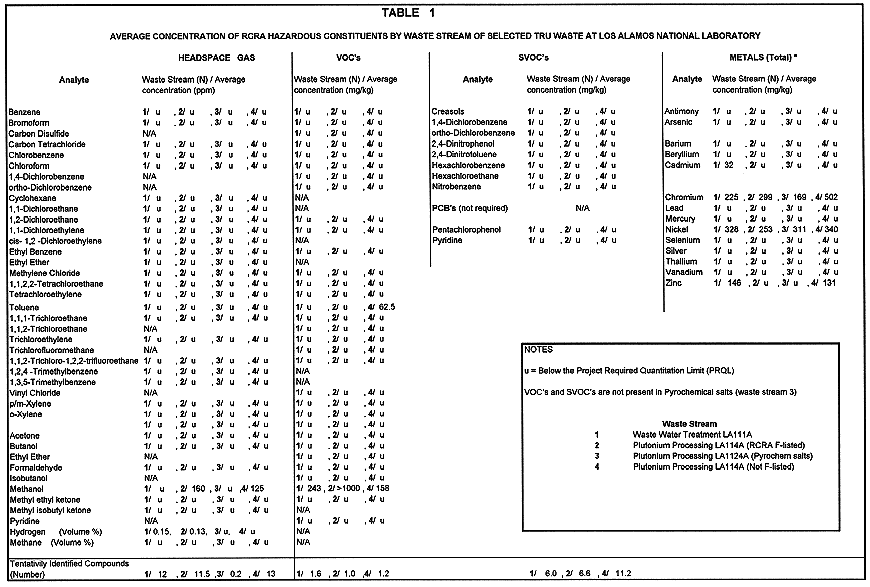
Headspace gas analyses indicate that toluene is present in the headspace of nearly all of the waste containers except for those in the pyrochemical salts waste stream, but that it is below the program required quantitation limit of the QAPjP. Trichloroethylene and other F-listed constituents were not observed in any of the headspace samples. Over 10 tentatively identified compounds (TICS) have been noted in the cemented waste streams but only one from the pyrochemical salts. There is no requirement at this time to identify or quantify TICs. Hydrogen was found in two of the waste streams at about 0.2 volume percent.
Visual characterization to date has been consistent with RTR with the exception of one drum of cemented waste. Radiography did not show water, but 2.5 liters were present as a result of natural dewatering of gypsum cement. To help overcome difficulties of radiographing a cement monolith with lead shielding, looking for water in a very narrow annulus, LANL now places a wedge under the drums so that a water meniscus has a higher probability of intersecting a drum chine where it is more easily detected.
Through a combination of visual verification, 100% headspace gas sampling, and statistical core sampling, LANL is characterizing its TRU wastes by waste stream so the wastes can be shipped to WIPP. The data meet quality assurance objectives and are valid for certifying waste to requirements of the "WIPP Waste Acceptance Criteria, Rev. 5," (WAC). Most of the waste is mixed waste, containing RCRA hazardous as well as radioactive materials.
*Containing the following spent solvents used as degreasers-tetrachloroethylene, trichloroethylene, methylene chloride, 1,1,1-trichloroethane, carbon tetrachloride or chlorinated fluorocarbons.