Table I Current inventory of Contact Handled (CH) and Remote
Handled (RH) TRU waste retrievably stored at LANL (12/31/95) as defined by DOE.

Davis V. Christensen, Pamela S. Z. Rogers, and Stanley T.
Kosiewicz
Chemical Sciences and Technology Division
Los Alamos
National Laboratory
Donald B. LeBrun
Department of Energy
Los Alamos
Area Office
Los Alamos, New Mexico, 87544
ABSTRACT
This paper represents an overview of evaluations conducted on the Transuranic (TRU) waste database maintained by the Los Alamos National Laboratory (LANL). This evaluation was conducted to support the "TRU Waste Workoff Strategies" document and provides an estimate of the waste volume that potentially could be certified and ready for shipment to Waste Isolation Pilot Plant (WIPP) in April 1998. Criteria defined in the WIPP Waste Acceptance Criteria (WAC), including container type, weight limits, plutonium fissile gram equivalents, and decay heat were used to evaluate the waste for compliance. LANL evaluated the containers by facility and by waste stream to determining the most efficient plan for characterization and certification of the waste. Evaluation of the waste presently in storage suggested that 40%-60% potentially meets the WIPP WAC, Rev. 5 criteria based on potential changes to the wattage limits.
DISCUSSION
Transuranic (TRU) waste generated at Los Alamos National Laboratory (LANL) is stored at Technical Area 54 (TA-54), Area G prior to shipment to the Waste Isolation Pilot Plant (WIPP) for permanent disposal. The activities involved with storage include, among other things, maintenance of the LANL TRU waste database. The TRU waste database is a compilation of TRU waste storage records completed by the generators. These records span from 1970 to the present. As of December 31, 1995, the total volume of TRU waste recorded in the database was 11,167 m3. Based on an evaluation of the database, a portion, 2,596 m3 potentially could be reclassified as "buried" TRU waste and removed from the inventory of waste to be sent to WIPP. The remaining 8,571 m3 is considered retrievably stored as defined by the Department of Energy (DOE).
Table I Current inventory of Contact Handled (CH) and Remote
Handled (RH) TRU waste retrievably stored at LANL (12/31/95) as defined by DOE.
This volume includes combustible, noncombustible and cemented wastes, metallic scrap, special case and remote handled wastes, and soil. The percentage of these wastes are listed below in Fig. 1.
WIPP CRITERIA EVALUATION
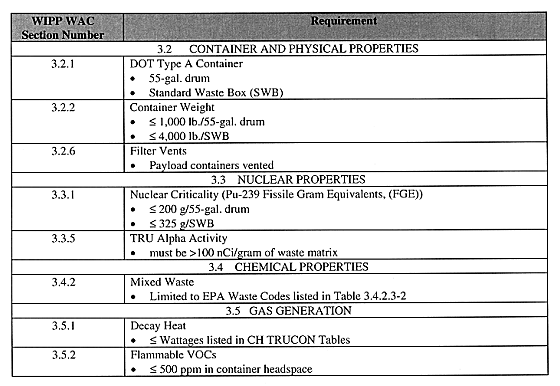
This volume was evaluated against a subset of the WIPP WAC, Rev. 5 criteria, to determine noncompliant volumes (see Table II for their description). The entire set of WIPP WAC could not be evaluated from the information presently in the database. A complete evaluation of the WIPP WAC will be conducted by LANL as part of the Characterization and Certification Programs to be conducted in FY97 and beyond .
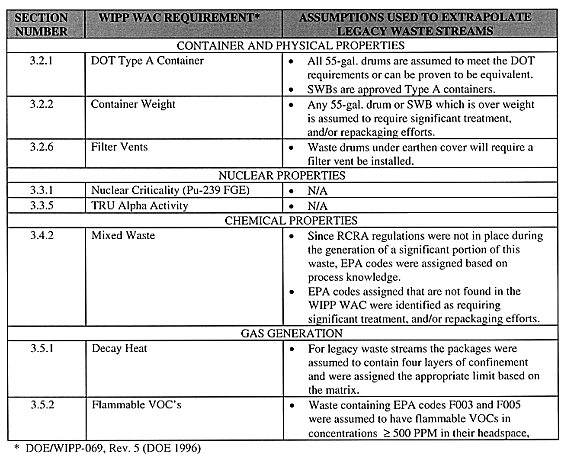
In evaluating the entire volume of TRU waste in the database, some of the documentation associated with legacy waste streams lacked critical information required for WIPP WAC, Rev. 5. Conservative assumptions, based on historical practices, were used to extrapolate these legacy waste streams so that over 25,000 waste containers could be evaluated.
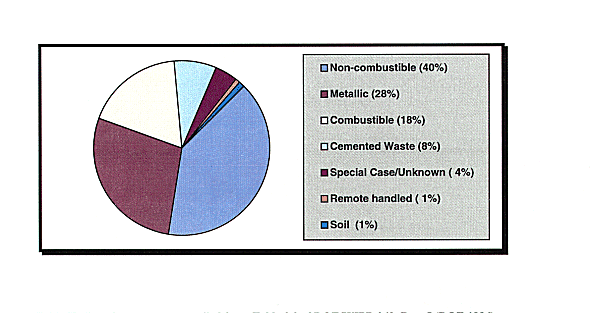
Fig. 1. Percent of major waste
categories as detailed in the LANL TRU waste database. This is equivalent to
more than 41,000 55-gal. drum volume equivalents (DVE).
Table II Requirements set compiled from Table 3.2 of DOE/WIPP-069,
Rev. 5 (DOE 1996)
KEY ASSUMPTIONS
Since all of this waste was generated before the WIPP WAC, Rev. 5 criteria were published, several key assumptions were used in evaluating the data. These assumptions are listed below for each criterion.
RESULTS
Container and Physical Properties
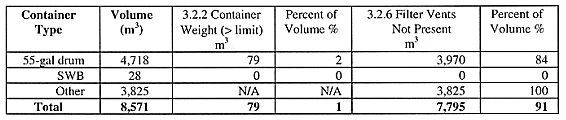
The first criterion evaluated in the database was container type. The three categories identified included:
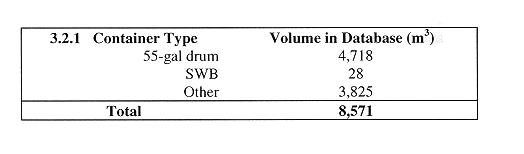
These volumes were then used to determine the percent volume which requires major treatment or repackaging efforts to meet the criteria, and implies the percent volume that will meet the criteria with minimal or no treatment and repackaging.
Nuclear Properties
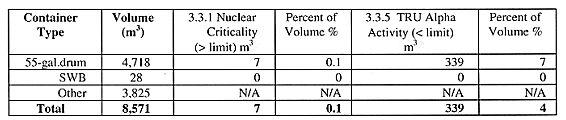
Nuclear properties associated with the waste were evaluated to determine compliance. Established limits for 55-gal. drums and SWBs were compare to the values reported by the waste generators in the database. Only a small fraction of the drum and SWB inventory was reported to be above the limit. Completion of the double data entry process and the nondestructive characterization activities planned for this waste will confirm these values before the waste is shipped to WIPP. A slightly larger fraction of the waste, 7%, was identified in the database as being below 100 nCi/g. The majority of this waste can be attributed to the 10 nCi/g limit established in the early 70s.
Chemical Properties
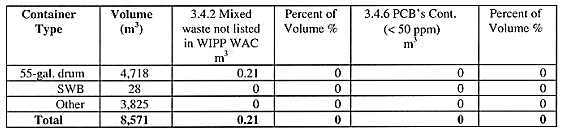
The only EPA Code identified with a drum of waste, which was not listed in Table 3.4.2.3-2 of the WIPP WAC was U080 "Methylene chloride." Identification of this compound and the disposition of this drum with respect to sending it to WIPP will be evaluated at a later data. No PCBs have been identified by the generators for TRU waste at LANL.
Gas Generation
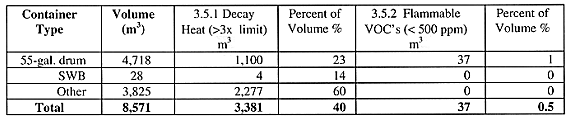
Wattage limits for individual payload containers in the LANL database were calculated and compared to the limits presented in the TRUPACT-II Content Codes. The Safety Analysis Report for the TRUPACT-II Shipping Package (SARP) limits were specific for the waste matrix and assumed four (4) layers of packaging. In support of the WIPP WAC matrix, depletion studies are being conducted to determine gas-generation values for waste matrixes. Initial results from these studies have shown a decrease in hydrogen generation over time, which will eventually lead to increasing the wattage limits for payload containers when the study is concluded. Based on preliminary results, the decay heat limits for this evaluation were increased by a factor of three. Flammable VOCs were assumed to be a subset of the EPA Codes F003 and F005. All waste packages with these codes listed were assumed to have concentrations greater than 500 ppm in the headspace.
CONCLUSION
This evaluation suggested that 40%-60% of the waste, presently in storage, potentially meets the WIPP WAC, Rev. 5 criteria (minimal or no treatment and/or repackaging required). This evaluation may include some overlap of data, but serves as a reasonable initial estimate. Noncompliant waste will require additional repackaging and size reduction. This activity will require upgrading of existing facilities.
REFERENCES