Table I Requirements and Drivers for TRU Waste Activities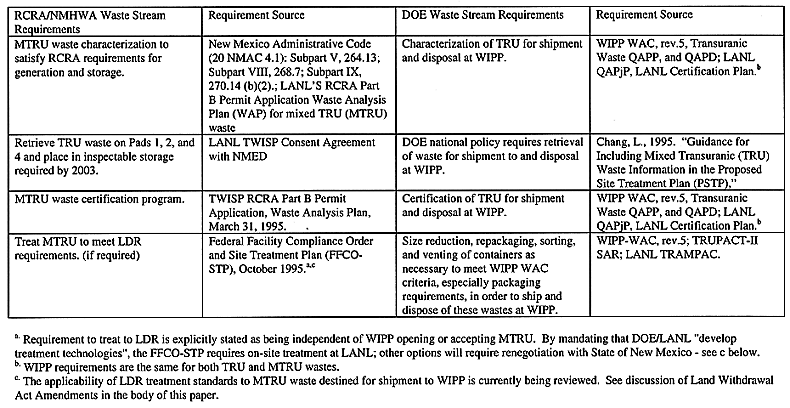
Paul B. Schumann, Gian Bacigalupa, Barbara J. Sinkule, and
Stanley T. Kosiewicz
Los Alamos National Laboratory
Deirdre M.
Boak
Sandia National Laboratories
ABSTRACT
A number of key regulatory drivers affect the nature, scope, and timing of Los Alamos National Laboratorys (LANLs) plans for mixed transuranic (MTRU) waste shipments to the Waste Isolation Pilot Plant (WIPP), which are planned to commence as soon as possible following WIPPs currently anticipated November, 1997 opening date. This paper provides an overview of some of the key drivers at LANL, particularly emphasizing those associated with the hazardous and radioactive waste components of LANLs MTRU waste. The key drivers discussed here derive from the federal Resource, Conservation, and Recovery Act (RCRA) and its amendments, including the Federal Facility Compliance Act (FFCAct); the New Mexico Hazardous Waste Act (NMHWA), and the Atomic Energy Act (AEA).
These statutory provisions are enforced through several general mechanisms: RCRA permits; the New Mexico Hazardous Waste Management Regulations, set forth in the New Mexico Administrative Code, Title 20, Chapter 4, Part 1; compliance orders issued to enforce these requirements; and U.S. Department of Energy (DOE) Orders or policy directives. Requirements in these categories will apply to MTRU waste management and characterization activities at both WIPP and LANL. In addition, LANL is subject to facility-specific requirements in its RCRA hazardous waste facility permit, potential permit conditions as proposed in RCRA Part B permit applications presently being reviewed by the New Mexico Environment Department (NMED), and facility-specific compliance orders related to MTRU waste management. Likewise, permitting- and compliance-related requirements specific to WIPP indirectly affect LANLs characterization, packaging, record-keeping, and transportation requirements for MTRU waste.
LANL must comply with this evolving set of regulatory requirements to begin shipments of MTRU waste to WIPP in a timely fashion. Additionally, LANL and the Department of Energy must work on an ongoing basis with the regulatory agencies and the public in order to manage their compliance responsibilities as proactively as possible.
INTRODUCTION
This paper discusses regulatory requirements, including federal and state laws and regulations, and DOE requirements as they apply to the management of LANLs transuranic waste (TRU) inventory. It focuses specifically on LANLs key requirements as a generation and storage facility for MTRU waste governed by RCRA. Mixed wastes contain both hazardous and radioactive waste components.
The LANL TRU waste universe intended for shipment to WIPP includes both newly-generated wastes and historical ("legacy") waste streams currently maintained in interim storage, as well as some legacy wastes intended for retrieval from under earthen cover. Other legacy TRU wastes historically had been placed on-site using procedures constituting disposal. Some of these may or may not eventually be retrieved for transfer to WIPP. Current LANL TRU waste management practices are focused on retrieval, interim storage, characterization/certification, transportation, and ultimate disposal at WIPP (see Table I for requirements).
Table I Requirements and Drivers for TRU Waste Activities
These waste management practices have different regulatory requirements which apply at each stage in the TRU waste life cycle. TRU wastes may receive some form of physical and/or chemical processing during one or more stages of this life cycle to facilitate safer, more efficient, or more cost-effective management, or to meet certain internal or external regulatory requirements. Such practices may or may not be defined as "treatment" under RCRA, but if so, may trigger additional statutory, regulatory, and compliance-driven requirements, as will be discussed subsequently in this paper.
Different requirements are applicable to the radioactive and hazardous components of MTRU waste. The radioactive component of MTRU waste is regulated by the DOE for management and disposal, and by the Department of Transportation and the Nuclear Regulatory Commission for transportation on public roads. At LANL, management of TRU waste has been directed toward storing and preparing the waste for eventual shipment to and disposal at WIPP.
Title 40 of the Code of Federal Regulations (40 CFR), Parts 191 and 194, provide general standards for management and disposal of spent nuclear fuel, and high-level and TRU waste (1, 2, 3). 40 CFR 194 provides specific criteria for determining WIPP compliance with these standards. WIPP imposes these, as well as additional site-specific and transportation-related requirements, through the WIPP Waste Acceptance Criteria (WIPP WAC) (4). The WIPP WACC must be met for all TRU wastes intended for disposal at that facility. DOE Order 5820.2A defines DOE requirements for managing radioactive waste, including TRU, and is being implemented at both WIPP and LANL. The WIPP WAC and DOE Order 5820.2A requirements will be discussed in more detail subsequently in this paper.
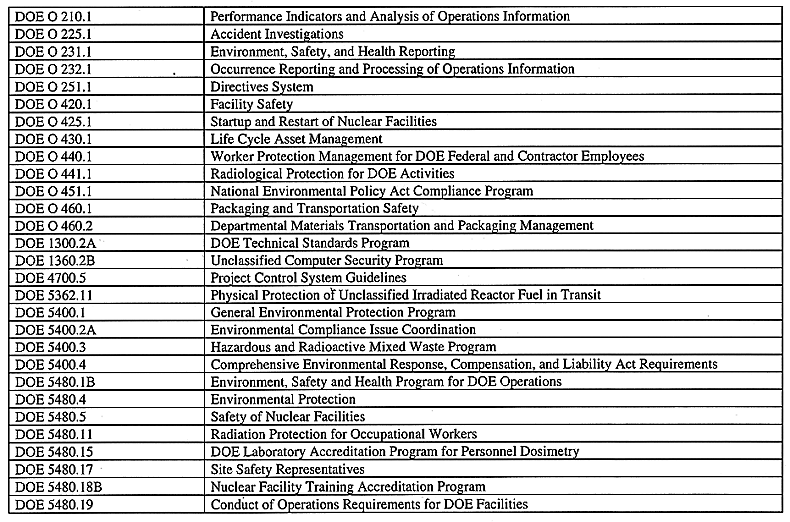
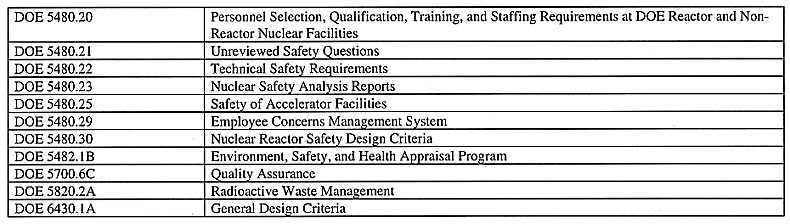
Other DOE Orders, standards, and regulations pertaining to LANLs management of the radioactive components of TRU waste prior to WIPP shipment address industrial safety, nuclear facility operations, quality assurance, and radioactive waste management. These are included as examples (see Table II) but will not be discussed further in this paper.
Table II Statutory, Regulatory, and DOE Drivers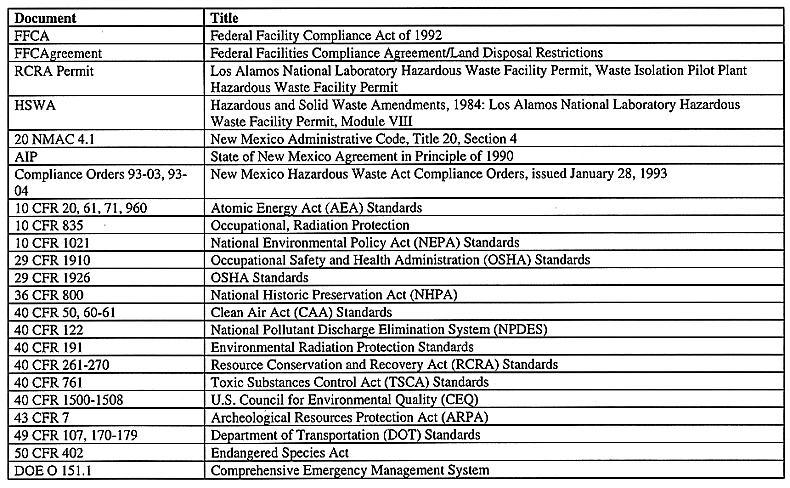
LANL estimates that up to 95% of its TRU wastes may be MTRU wastes. The hazardous waste component of these mixed wastestreams is subject to regulation under the federal RCRA (42 USC 6901), as well as the New Mexico Hazardous Waste Act (NMHWA). The State of New Mexico has been delegated authority to implement RCRA requirements in lieu of the federal program. The applicable New Mexico regulations are found in the New Mexico Administrative Code, Title 20, Chapter 4, Part 1, (20 NMAC 4.1), as revised January, 1997, which adopt, with a few minor exceptions, the requirements of 40 CFR, Parts 260-265, 268, and 270 (note that the New Mexico regulations are currently in the process of being updated and revised) (5, 6). Included are requirements for waste characterization, documentation, container labeling, waste storage, monitoring and inspections, emergency preparedness, treatment, and ultimate disposal of the hazardous waste component of MTRU waste.
Other RCRA requirements and drivers for the management of the LANL MTRU inventory stem from ongoing permitting actions addressing these requirements, or orders addressing former or continuing noncompliance with RCRA or NMHWA mixed waste requirements. Two key compliance orders are an October, 1995, Federal Facility Compliance Order (FFCO), issued unilaterally to LANL by the State of New Mexico Environment Department (NMED) to enforce requirements of the 1992 Federal Facility Compliance Act (FFCAct); and a December, 1993, Consent Agreement (CA) related to the retrieval of legacy MTRU waste currently stored at LANL (7, 8). These permitting actions and compliance orders will be discussed in the following sections of this paper.
Many other non-RCRA requirements and drivers for the management of the LANL MTRU inventory likewise may apply to the waste management practices at each stage in the TRU waste life cycle. Non-DOE, non-RCRA requirements and drivers include requirements of the Clean Air Act and the Clean Water Act and their state equivalents; the Toxic Substances Control Act; the Occupational Safety and Health Act; National Fire Protection Association standards (including life safety code, lightning protection, fire protection, and electrical code requirements); International Commission on Radiological Protection guidelines and criteria; American National Standards Institute standards and guidelines; and the National Environmental Policy Act, among others. More information on these other laws, standards, and regulations is available from a variety of sources (see, for example, 9 and 10), DOE-EM-STD-5502-94, DOE Limited Standard - Hazard Baseline Documentation (DOE, 1994a), and LANLs Environmental Surveillance Reports, published annually (LANL 1995d). They will not be discussed further in this paper.
DISCUSSION OF KEY DRIVERS
DOE Order 5820.2A: Management of the Radioactive Component of TRU Waste
Radioactive wastes at DOE facilities, including the radioactive waste component of LANLs MTRU wastes, must be managed in accor dance with DOE Order 5820.2A. Site-specific management requirements are found in the Los Alamos National Laboratory Waste Acceptance Criteria (LANL WAC). For transuranic waste, the LANL WAC requirements will be at least as stringent as the requirements of the WIPP WAC. LANL generators fulfill these requirements through their waste management practices and document these activities on specific forms that are used by LANL waste manage ment groups to further store, treat, ship, and/or dispose of the waste, as necessary. The specific forms and management practices for TRU waste are found in the LANL WAC and the LANL TRU Waste Certification Plan(11).
WIPP-Specific Requirements: WIPP WAC - Requirements for Trans portation to and Disposal of Transuranic Waste at WIPP
WIPP is currently scheduled to open for receipt of waste in November, 1997. The WIPP WAC serve as the primary directive for assuring the safe handling, transportation, and disposal of TRU waste generated at DOE sites. The WIPP WAC address fulfillment of WIPPs operational safety and performance assessment criteria, compliance with RCRA requirements, preparation of waste packages that meet all transportation technical requirements prior to acceptance for disposal at WIPP, and summarize the transportation requirements for shipping transuranic waste.
Preparation of both non-RCRA TRU and MTRU wastes for final disposal at WIPP includes characterizing the waste to meet the requirements of the Transuranic Waste Characterization Quality Assurance Program Plan (QAPP) (12) and certifying waste containers to the WIPP WAC and the Transuranic Package Transporter-II Authorized Methods for Payload Control (TRAMPAC) (13). The QAPP requirements are based on characterization through nondestructive testing, including radiography and radioassay, and chemical sampling and analysis of homogeneous waste forms. The QAPP establishes the performance-based requirements for TRU waste characterization to meet the data quality objectives (DQOs) associated with WIPP compliance programs, including the RCRA general waste analysis requirements under 40 CFR 264, the RCRA Land Disposal Restrictions (LDR) under 40 CFR 268 (if applicable), and the performance assessment under 40 CFR Parts 191 and 194.
To comply with the WIPP WAC, QAPP, and TRAMPAC, LANL, as an individual generator site, must prepare site-specific documentation including: a transuranic waste certification plan, a transuranic waste characterization quality assurance project plan (QAPjP), and a site-specific TRAMPAC document. Each generator site must also prepare a quality assurance plan (or plans) that documents the quality assurance program(s). Quality affecting processes must be documented and controlled using procedures that meet the quality assurance requirements of the Quality Assurance Program Description (QAPD) (14) and additional quality assurance requirements that are found in the QAPP.
LANL-Specific Requirement: Unilateral Federal Facility Compliance Order - Treatment of MTRU to Meet LDR
Key among the RCRA and NMHWA requirements pertaining to the storage and ultimate disposal of the hazardous waste component of LANLs MTRU waste are the LDR established by the 1984 Hazardous and Solid Waste Amendments to RCRA, which greatly restrict the land disposal of hazardous waste without treatment (6). The Federal Facility Compliance Act of 1992 mandated that federal facilities, including DOE facilities, prepare site treatment plans (STP) for developing and using treatment technologies to treat those mixed wastes stored in violation of LDR requirements, and provided a timetable for preparation of the plans. By October, 1995, states were required to enter into agreements with affected facilities for the working-off of facility wastes, or were required to issue a unilateral order mandating time frames for treatment of the wastes to meet LDR requirements.
DOE and LANL submitted a Proposed Site Treatment Plan (PSTP) to the New Mexico Environment Department (NMED) in March 1995. Portions of LANLs PSTP were incorporated into the final STP issued by NMED as part of its October 1995 unilateral FFCO. However, for LANLs MTRU, the STP mandated that DOE and LANL develop treatment technologies by June 30, 1999. This schedule was not based on the assumption that WIPP will be a disposal option for LANLs MTRU waste, or that DOE will receive a variance from LDR treatment standards for land disposal of MTRU waste to be disposed at WIPP. The FFCO (7) does not allow for decisions on treatment of MTRU to be deferred until after WIPP became operational, as was proposed in the PSTP.
On September 23, 1996, the President signed the FY 1997 Defense Authorization Bill, which contained amendments to the 1992 WIPP Land Withdrawal Act. Under this legislation, MTRU designated for disposal at WIPP by the Secretary of Energy is declared to be exempt from the LDR treatment standards and the land disposal prohibition. The impacts of this legislation on LANLs STP and FFCO requirements for MTRU treatment are being evaluated at present by all affected entities.
LANL-Specific Requirement: Consent Agreement for Retrieval and RCRA-Compliant Storage of MTRU in Pads 1, 2, and 4; the Transuranic Waste Inspectable Storage Project (TWISP)
Since approximately 1970, in accordance with Atomic Energy Act requirements, fiberglass-reinforced plywood crates and metal drums containing solid-form TRU waste were stored on earthen-covered Storage Pads 1, 2, and 4 at LANL Technical Area 54. This storage practice continued until the RCRA and NMHWA requirements for visually inspectable storage became applicable to LANLs MTRU waste. Many of the containers stored on Pads 1, 2, and 4, however, contain MTRU, and the pads were included as storage units in LANLs interim status mixed waste RCRA Part A permit application of January, 1991. In January, 1993, the NMED issued Compliance Orders NMHWA 93-01, -02, -03, and -04 to DOE and LANL. These required, among other conditions, that the wastes stored on Pads 1, 2, and 4 be retrieved, in response to the discovery in early 1992 that some containers stored on the pads exhibited corrosion.
The Transuranic Waste Inspectable Storage Project (TWISP) was developed as part of the December, 1993, Consent Agreement with NMED that resolved these Compliance Orders (8). The projects purpose is to retrieve the containers from Pads 1, 2, and 4; overpack any damaged containers; vent and install gas filters on containers; and by 2003, complete placement of all retrieved containers into inspectable configurations, in compliance with current RCRA and NMHWA requirements for storage of hazardous waste.
Wastes generated prior to the applicability of RCRA and NMHWA requirements to LANLs MTRU waste were not characterized with these requirements in mind at the time of their placement in the pads. As a result, confirmation of the presence of the hazardous waste component has not yet been completed for all waste streams, although LANL estimates as much as 95% of its TRU waste may be MTRU. Therefore, all waste retrieved from the pads will be managed as MTRU until additional characterization information becomes available. Currently generated TRU waste streams, on the other hand, are identified as TRU or MTRU through application of acceptable knowledge for waste characterization and are managed according to their respective designations.
LANL-Specific Requirement: TWISP RCRA Permit and Waste Analysis Plan
A RCRA Part B Permit Application was submitted to NMED on September 30, 1993 (15), to modify the existing LANL Hazardous Waste Facility Permit of 1989 as required by 20 NMAC 4.1, Subpart IX. The proposed modification was necessary to permit the TWISP activities involving mixed waste storage, in order to comply with the December 10, 1993 Consent Agreement among NMED, DOE, and the University of California (management and operating contractor for LANL). The TWISP permit modifications were conditionally approved by NMED on May 11, 1994, allowing the project to proceed as described in the application provided that a revised waste analysis plan and contingency plan would be submitted to NMED. The revised MTRU waste analysis plan (WAP) was submitted to NMED on March 31, 1995 (16).
NMEDs concern with the original WAP involved the need for additional waste characterization procedures to add to existing process knowledge regarding the retrievably stored MTRU waste streams. LANLs revised WAP incorporated procedures for documenting waste characterization as suggested by U.S. Environmental Protection Agency guidance and for confirming process knowledge through the use of real-time radiography, visual examination, head space gas analysis, and drum coring procedures as appropriate for each waste stream. NMED issued a Notice of Deficiency for the MTRU WAP on May 24, 1996, requesting more information. LANLs response of July 11, 1996, addressed specific questions about facility characterization procedures and incorporated references to WIPP waste certification procedures currently under development by DOE and subject to approval by NMED through the WIPP RCRA permit approval process.
The LANL MTRU WAP directly authorizes waste characterization activities related to TWISP. It incorporates the LANL TRU Waste Certification Plan for WIPP (11) by reference and also contains other waste characterization conditions derived from the WIPP WAC and QAPP (17, 18). Therefore, these LANL permit conditions will be directly applicable for the characterization and management of waste streams destined for final disposal at WIPP. The general waste management conditions of the TWISP permit modification, and the waste characterization conditions of the included MTRU WAP, will apply to the process of retrieving and characterizing the retrievable buried MTRU waste containers under earthen cover whether LANLs TRU mixed waste ultimately will be disposed of untreated at WIPP, or treated in accordance with LANLs STP as currently written. Many of the conditions of both WAPs and the general permit modification for TWISP will be incorporated in LANL site specific waste management and characterization procedures.
POSSIBLE CHANGES TO REQUIREMENTS IN THE FUTURE
Changes to the requirements could come from a variety of sources. The WIPP WAC is periodically updated and DOE is actively engaged with the generators at all sites in identifying opportunities to bring added efficiencies to the process. LANL has evaluated LANL TRU waste against WIPP WAC criteria and identified a number of activities (such as matrix depletion and gas getter experiments) that could contribute to this effort.
40 CFR 194.24 identifies analyses to be done in support of the WIPP compliance certification application to identify and assess the impact on WIPPs long term performance of those waste charac teristics which influence the containment of waste in the disposal system (3). A partial analysis of waste components and characteristics has been conducted to determine which of these influence repository performance. The 40 CFR Part 194 analyses might therefore drive changes to waste characterization requirements, although analyses done to date do not indicate such changes.
As of January, 1997, NMED has not formally approved the WIPP RCRA Part B Permit Application, (which includes the WIPP WAP), the LANL TWISP permit modification (which includes the LANL MTRU WAP), or the subsequent permit applications for associated LANL waste characterization facilities (which also include the LANL MTRU WAP). Although the permit approvals are moving forward with input and approval by both DOE and NMED, future changes may affect MTRU waste management and characterization practices.
As discussed previously, legislation passed in the 104th Congress to amend the 1992 Waste Isolation Pilot Plant Land Withdrawal Act (in the FY 1997 Defense Authorization Bill (19)), Public Law 104-201; U.S. Congress, 1996), may accelerate the opening of WIPP for waste emplacement to as early as November, 1997, and may dramatically impact requirements to treat MTRU prior to emplacement at WIPP. Under this legislation, MTRU designated for disposal at WIPP by the Secretary of Energy is declared to be exempt from the LDR treatment standards and the land disposal prohibition. The impacts of this legislation are being evaluated at present by all affected entities.
CONCLUSION
The preceding discussion presented an overview of a specific subset of the myriad regulatory drivers impacting shipment of LANLs MTRU waste to WIPP. LANL must comply with its evolving set of regulatory requirements, and ensure that shipped wastes comply with WIPPs evolving set of regulatory requirements, in order to begin shipments of MTRU waste to WIPP in a timely fashion. Additionally, LANL and the Department of Energy must work on an ongoing basis with the regulatory agencies and the public in order to manage their compliance responsibilities asproactively as possible. This becomes even more challenging as DOE and LANL proceed to sort out the as-yet undetermined impacts of the WIPP Land Withdrawal Act Amendments on the scope of LANLs TRU waste management program in succeeding years.
REFERENCES