Table I Thermal power strategy.

Stanley T. Kosiewicz, Ines R. Triay, Pamela S. Z. Rogers, and
Davis V. Christensen
Chemical Science and Technology Division, Los Alamos
National Laboratory
Los Alamos, New Mexico, 87545
ABSTRACT
During 1996, the Los Alamos National Laboratory (LANL) developed two transuranic (TRU) waste workoff strategies that were estimated to be capable of saving $270340M through accelerated waste workoff and the elimination of a $70M facility. The planning effort included a strategy to assure that LANL would have a significant quantity of TRU waste certified for shipment to the Waste Isolation Pilot Plant (WIPP) beginning in April of 1998, when WIPP was projected to open.
One of the accelerated strategies can be completed in less than ten years through a Total Optimization of Parameters Scenario ("TOPS"). "TOPS" fully utilizes existing LANL facilities and capabilities. For this scenario, funding was estimated to be unconstrained at $23M annually to certify and ship the legacy inventory of TRU waste at LANL. With "TOPS" the inventory is worked off in about 8.5 years while shipping 5,000 drums per year at a total cost of $196M. This workoff includes retrieval from earthen cover and interim storage costs. The other scenario envisioned funding at the current level with some increase for TRUPACT II loading costs, which total $16M annually. At this funding level, LANL estimates it will require about 17 years to work off the LANL TRU legacy waste while shipping 2,500 drums per year to WIPP. The total cost will be $277M. This latter scenario decreases the time for workoff by about 19 years from previous estimates and saves an estimated $190M. In addition, the planning showed that a $70M facility for TRU waste characterization was not needed because mobile systems would be used.
After the first draft of the LANL strategies was written, Congress amended the WIPP Land Withdrawal Act (LWA) to accelerate the opening of WIPP from April 1998 to November 1997. Further, the No Migration Variance requirement for WIPP was removed. The impacts of this legislation on TRU waste management are being evaluated at present by all affected entities. This paper discusses the LANL strategies as they were originally developed.
DISCUSSION
Through an integrated effort in 1996, several technical groups at Los Alamos National Laboratory (LANL) developed strategies for the workoff of the LANL transuranic (TRU) waste inventory.(1) Drivers for this effort included positioning LANL for early and aggressive mortgage reduction associated with the legacy TRU waste inventory, preparing for waste shipment on Waste Isolation Pilot Plant (WIPP)s projected opening of April 1998, responding to findings of a Department of Energy (DOE) Independent Technical Review Team ("Red Team"), and complying with a Unilateral Compliance Order for the Federal Facilities Compliance Order (FFCO) for mixed TRU waste. While LANL had written a waste workoff plan in 1986,(2) significant changes in the inventory, transportation requirements, and planning methodology provided the impetus for a paradigm shift for accelerated workoff strategies.
An important aspect of the planning involved viewing the overall TRU waste management program as a few (three), but very large, projects with defined endpoints and deliverables. The three major projects were to 1) produce a plan for having a substantial quantity of certified TRU waste available for shipment to WIPP in April 1998, 2) develop a strategy for workoff of the TRU waste inventory with the anticipated budget, and 3) develop a strategy for workoff of the TRU waste inventory in less than ten years through optimization of existing LANL facilities and capabilities with unconstrained budget.
Assumptions for these three projects were that
Contingencies were developed within the strategies in the event that some of the these assumptions prove to be incorrect. For example, should the WIPP opening be delayed, LANL TRU waste storage capacity in existing structures would be exceeded in 1999. This would require construction of additional storage domes. While LANL has adequate space for the siting of additional domes into the indefinite future, funding from other aspects of the TRU waste work scope would have to be diverted to construct the new domes.
The planning effort was driven by the LANL TRU waste inventory, current and forecasted. The philosophy behind the approach was that the type and quantity of TRU waste in the inventory determined what had to be done for how long and with what resources (facilities, human, and financial). For this effort, the TRU waste inventory was compared in detail to the WIPP WAC. That portion of the inventory which did not meet the WIPP WAC required special attention (i.e., processing) to bring it into conformance. This evaluation showed that the radionuclide wattage (i.e., thermal power) limits provided in the TRUPACT II Authorized Methods for Payload Control (TRAMPAC) were the most restrictive criteria for the LANL inventory. The thermal power is related to the rate of radiative energy (resulting from radioactive decay) deposited in a waste matrix. This energy subsequently generates gases, including hydrogen, by radiolytic degradation of the waste matrix. Assuming four layers of packaging, roughly 40% of the LANL TRU waste inventory in drums exceeded the permissible thermal power ratings.
Table I shows the number of LANL drums in different categories of thermal power ratings. T in the table is the thermal power rating provided in the TRAMPAC. For T less than one, there are 14,425 drums in the LANL inventory. If these waste drums meet the other WIPP WAC, they are certifiable for shipment to WIPP. The next category has 3,118 drums which have radionuclide loadings that are 100 - 300% of the permissible limits in TRAMPAC. Based on previous studies,(3,4) LANL anticipates that these waste packages could be shippable with no corrective measures upon successful completion of the matrix depletion experiments. For drums in the next category, 300 -1200% of the permissible limits, all 3,233 drums are opened, layers of confinement pierced, and the contents repackaged into drums without volume expansion. The next category, 1200 - 8400% of TRAMPAC limits, has 2,478 drums. Of these, 2,082 are candidates for volume expansion to meet the thermal power limits; the remaining 396 are monoliths that would require crushing or sawing to reduce them in size. Some of the 2,082 drums would be volume expanded 1:1 while others would be volume expanded 7:1. Volume expansion would add 2,638 drums to the LANL inventory, which is an 11% increase in the inventory.
Table I Thermal power strategy.
For the last thermal power rating category, greater than 8400% of permissible limits, there are 213 drums. LANL considers it impractical to volume-expand these because some of them are so highly loaded with transuranic radionuclides that one drum might be expanded to hundreds of new ones. Some of these drums are candidates for processing to recycle the radionuclides in the waste. This category is also a candidate for potential application of hydrogen getters or recombiners as a means to destroy radiolytically generated hydrogen.
Through detailed evaluation of the characteristics of the legacy TRU waste inventory, LANL clearly defined its TRU waste workoff mission needs. To optimize workoff of this waste, LANL developed a computer model for preparing the LANL TRU waste inventory for transport to WIPP using the commercial software package, "Extend, Performance Modeling for Decision Support." The model is a process simulation and management tool designed to provide the information required to optimize decisions on how to reach a desired goal. The model integrates the results of many different activities to allow evaluation of proposed changes on the overall system. This avoids the error of optimizing one activity while producing detrimental results somewhere else in the system. Computer modeling provides rapid simulation of the effects of possible decisions on the overall system to allow managers to evaluate several "what if" scenarios and select the best plan. A capability for sensitivity analysis in the software allows determination of which variables or activities require the closest monitoring. Once a plan is established, the model can be used to document and communicate it. In addition, the model can track adherence to the plan and schedules, pinpoint unplanned deviations, and help determine optimal responses to deviations.
The TRU waste workoff model incorporates all of the steps required to prepare legacy waste for shipment to WIPP, including retrieval, drum venting, cleaning, inspection, and overpacking as required for corroded drums. Fig. 1 depicts one segment of the activities that follow waste drum retrieval. Also incorporated into the model is characterization of the waste matrix, e.g., real time radiography (RTR); characterization of the radionuclide, e.g., by nondestructive assay (NDA), passive-active neutron interrogation (PAN), or segmented tomographic scanning (S/TGS); repackaging, sorting, and certification. This coordinates at least ten different operation stations located at three major facilities and the staff of at least five different technical groups at LANL.
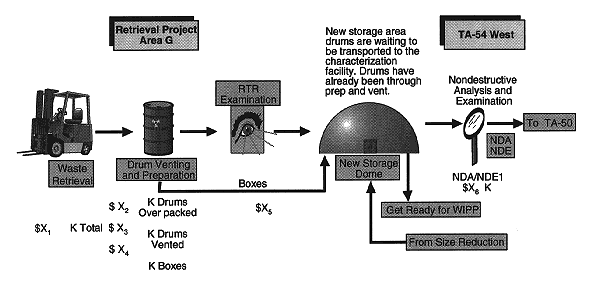
Fig. 1. Segment of TRU
waste model.
The model determines the maximum though put of the overall system for preparing TRU waste for shipment to WIPP. It assesses the effects of slower scenarios on staffing requirements and on the utilization of facilities, especially single purpose facility operations. The model is used to balance activity throughputs for the LANL accelerated TRU waste workoff strategies.
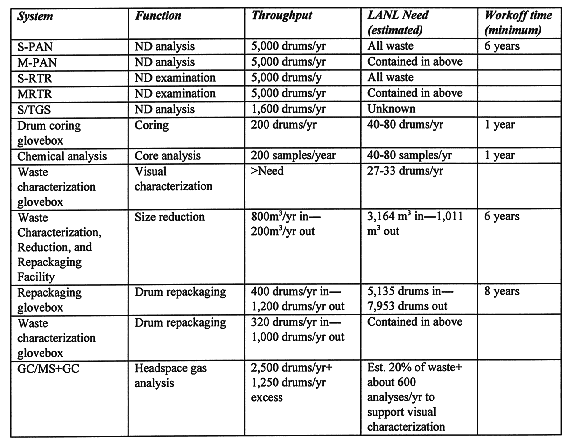
Table II shows the optimized throughputs for TRU waste workoff for LANL TRU waste operations, assuming funding for the "TOPS" accelerated workoff strategy. In this table, systems used by LANL TRU waste operations that are mobile include mobile RTR, PAN, S/TGS, drum venting system, and headspace gas sampling. A mobile TRU waste analytical laboratory is under development. Two other systems are portable; they are the waste characterization glove box and the drum coring glove box. The use of these mobile and portable systems, combined with existing facilities, provides LANL the capabilities required to prepare TRU waste for shipment to WIPP. No new facilities need to be constructed. In fact, a planned TRU waste characterization facility was found to be unnecessary. No undeveloped technologies are needed to prepare LANLs waste for shipment to WIPP. Consequently, assuming adequate budget for operations is available, LANL is well positioned to control its destiny on TRU waste workoff.
Table II Throughput estimates for optimal TRU workoff.
LANLs model is fully integrated with the National TRU Program Office strategic model for preparing WIPP wastes because both use the same systems analysis software. The model is flexible enough that multiple treatment technologies for different waste streams can be added and their subsequent effects on the overall plan evaluated. This flexibility is valuable because of the potential for changes in the WIPP WAC that may result from ongoing performance assessment studies.
In summary, the TRU waste workoff model provides flexibility and responsiveness to changes in the TRU waste operating environment because it
As is seen in Fig. 1, cost estimates are included for each station in the TRU waste workoff operation. These can be changed as required by different scenarios. Summing up all the costs for TRU waste retrieval, required repackaging, interim storage, characterization, certification, and loading provides the total cost for workoff of the accelerated strategies. These are illustrated in Fig. 2 as straight-line funding profiles and waste workoff. In actual practice, there would be some ramp up and trailing off at the beginning and end of different activities. In addition, some activities must be done early on to meet regulatory milestones, which would require more funding in the early years of the projects. However, the figure is very useful because it conceptualizes the savings to be achieved through accelerated waste workoff.
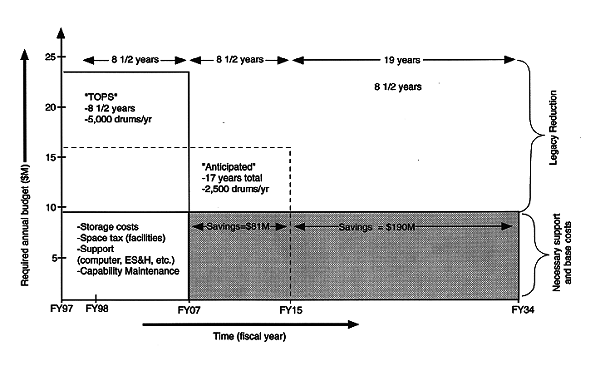
Fig. 2 Illustration of funding
profiles to achieve $270M savings. Elimination of a facility saves $70M more.
Prior to this planning exercise, LANL estimated it would take until FY34 to work off the legacy TRU waste inventory. With level funding, the current estimate is that it would require about 17 years to work off the waste at a total cost of about $277M for shipping 2,500 drums per year to WIPP. This cost estimate includes retrieval, storage, on-site transportation, characterization, repackaging, treatment as required, certification, TRUPACT II loading, etc. Fig. 2 shows that this scenario works the waste off 19 years faster to finish in FY15.This rapid work off produces a savings of about $190M because the required waste workoff infrastructure, and associated costs to maintain it, are eliminated sooner. As noted in Fig. 2, elements of this infrastructure are storage costs, facility space tax, computer support, environmental, safety, and health (ES&H) support, and capability maintenance. Capability maintenance includes analytical, transportation, characterization, and other programs that are required for preparing the waste for shipment to WIPP.
If annual funding is increased during workoff to provide for the "TOPS," the inventory of legacy wastes can be shipped in about eight and one-half years. The total cost is estimated to be $196M while shipping about 5,000 drums per year. Annual budget required to support "TOPS" is estimated to be about $23M. This scenario provides an estimated additional savings of $81M when compared to the level funding scenario. The source of these savings is the same as that for the previous scenario. Fig. 3 illustrates that the largest distribution of these savings are from decreased storage and capability maintenance requirements.
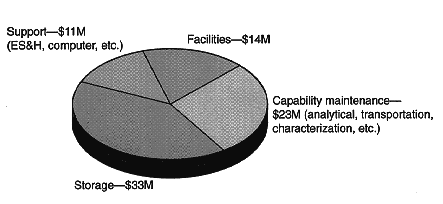
Fig. 3. Breakdown of $81M savings
from the accelerated workoff (8 Þ years total).
A sufficient inventory of stored debris TRU waste exists to prepare, characterize, and certify 500 - 1,000 drums for shipment by 11/97, and ~2,500 drums by 4/98. The actual number of drums that will be certified is dependent upon the available budget. This number includes some drums repackaged to reduce the thermal power output below current limits.
LANL has developed strategies for: 1) certifying a significant quantity of TRU waste for WIPPs opening, and 2) accelerating workoff of the LANL legacy TRU waste inventory. Three key components for creating these strategies were
LANL could have an estimated 500 - 1,000 drums of TRU waste certified for shipment to WIPP by November 1997, and 2,500 drums by April 1998. In addition, two accelerated TRU workoff strategies were developed with estimated savings of $270340M.
Finally, the LANL plan proposes conducting experiments to support raising the thermal power limits, both to simplify the preparation of TRU waste drums for the startup of WIPP and to reduce the degree of repackaging required for the remaininghigher thermal power output wastes.