Fig. 1. Micrograph showing
environmental bacteria on bridge concrete surface sample.
LaMar Johnson, R. Rogers, M. Hamilton, L. Nelson
Lockheed Martin Idaho Technologies, Idaho National Engineering Laboratory (INEL)
J. Benson and M. Green
British Nuclear Fuels plc (BNFL)
Preston, England
ABSTRACT
Managers and engineers around the globe are presently challenged by high estimated costs for the decontamination and decommissioning of nuclear facilities which are no longer needed or are abandoned. It has been estimated that more than 73 Km2 of contaminated concrete currently exists in the USDOE complex and is increased many fold when similar facilities are accounted for in other countries. Needs for the decontamination of concrete have been identified as: more cost effective decontamination methods, reduction of secondary wastes, minimized worker radiation exposures and, contaminant containment.
Recently environmental microbes have been harnessed to remove the surface of concrete as a technique for decontamination and decommissioning (D&D). This BIODECONTAMINATION technology has been tested by INEL and BNFL scientists and engineers in both United States and United Kingdom nuclear facilities. Biodecontamination field tests at a shutdown nuclear reactor facility (EBR-I) have shown radioactively contaminated surface removed at rates of 4-8 mm/yr, thus validating the feasibility of this technology. Engineering economic analyses indicate two attractive benefits embedded in this approach to concrete D&D: 1) due to the passive nature of the technique, a cost savings of more than an order of magnitude is projected compared to the current labor intensive physical decontamination techniques; and 2) the exposure to humans and the natural environment is greatly reduced due to the unattended, highly contained biodecontamination process.
INTRODUCTION
Concrete has been used for radiation shielding and operating structure purposes in nuclear facilities. Typical nuclear system components include canals, sumps, containment walls and floors, support laboratories, etc., all constructed with concrete as the most common material used. It has been estimated (Dickerson) that 73 Km2 or 1.9 x 10⁵ m3 of radioactively contaminated concrete exists in the U.S. Decommissioning of such facilities is made complex and costly by the presence of residual radioactive materials on the concrete surfaces. Removal of the surface radioactive materials minimizes the volume of radioactive waste for special disposal and allows routine disposal or re-use of the uncontaminated concrete.
Currently several mechanical methods for concrete decontamination such as scabbling, pellet blasting, and laser ablation are being employed. These technologies usually require human presence during the decontamination process. This entails occupational exposure (external and internal) to ionizing radiation. One of the challenges of deploying decontamination and decommissioning technologies is to minimize human and environmental exposure to ionizing radiation in keeping with current 'as low as reasonably achievable' (ALARA) radiation protection philosophy/requirements.
A biological decontamination of concrete technology has been applied and development tests are in progress. This passive "biodecon" process minimizes human and environmental exposure because it proceeds with minimal direct worker contact utilizing a humid process that contains the radioactive materials as they are freed from their concrete entrapment sites.
BIODECONTAMINATION PROCESS
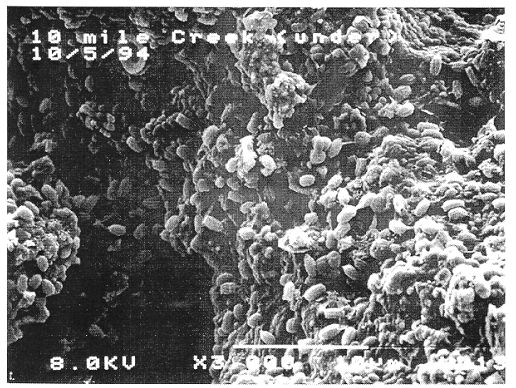
A concrete degradation phenomenon occurs in nature and is illustrated in degraded concrete pipelines, bridges, and other structures where microbial activity is stimulated by optimum moisture and nutrient conditions. Concrete sewer pipes have been the most frequently attacked structures (1). A reduced form of sulphur is the usual environmental nutrient. The basis of the effect stems from production of sulfuric acid by the microbes which in turn dissolves the cement matrix of the concrete. Hamilton, et. al.(2) observed this phenomenon around massive concrete structures such as concrete bridges and cooling towers at geothermal energy plants where 4 to 6 mm/year of concrete surface has been removed. Figure 1 is a micrograph of a concrete chip taken from the surface of a Western U.S. bridge. The presence of numerous environmental microbes on the bridge concrete sample surface is readily observed in this micrograph.
Fig. 1. Micrograph showing
environmental bacteria on bridge concrete surface sample.
Nature provides a huge environmental microbiological resource that has numerous potentially useful bioprocessing applications. The sulfur and nitrogen oxidizing microbes are of potential interest for concrete surface removal applications. The biodecon process is based on the use of naturally occurring microbes. Several types of bacteria are know to promote degradation of concrete. Sulfur oxidizing bacterial strains of Thiobacillus thiooxidans have been selected for the biodecontamination process. T. thiooxidons are the most aggressive concrete degraders (Fig. 1). Concrete surface materials are loosened as a result of their metabolic processes. These naturally occurring, nonpathogenic, ubiquitous bacteria oxidize reduced forms of sulfur (examples are H2S, S, S2O3-2, S4O6-2) to sulfuric acid. They stick to the surface by producing, at the microscopic scale, a biofilm or adhesive. Once on the surface and given moisture and reduced sulfur nutrients, these bacteria produce sulfuric acid at numerous "microsites" thus loosening the surface. While the decontamination mechanism is an acid facilitated mechanism, the result is not the same as that of directly applying industrial sulfuric acid. Several applications of acid would be required to achieve the desired effect and would produce, via solution runoff, a mixed (hazardous and radioactive) waste. The bioprocess is about 20 time more efficient than simply dumping sulfuric acid on a surface, e.g., 1 part inorganic H2SO4 degrades 2.5 parts concrete compared to 1 part H2SO4 produced by T. thiooxidans which degrades 50 parts concrete (Fig. 2). The bioprocess produces no effluents because the microbes produce the acid at numerous microsite locations on the concrete surface. This microbially produced acid is neutralized during the concrete surface loosening process. The dissolution of cement at these microsites results in loosened concrete surface which can be collected for special disposal.
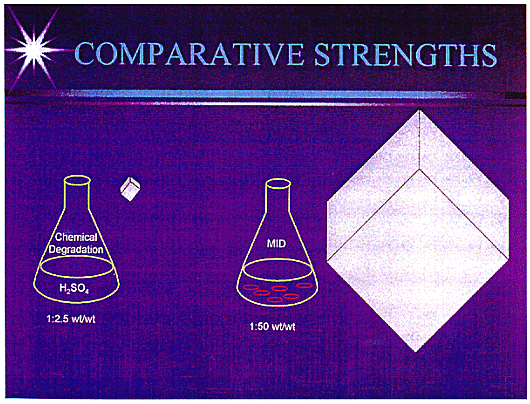
Fig. 2. Comparison of applying
sulfuric acid versus biologically generating sulfuric acid to remove concrete
surface.
The effect of environmental microbes on concrete waste forms for radioactive wastes has been researched by Rogers, et. al (3,4). Significant microbial attack of the concrete waste form surface was observed under disposal conditions where contact with soil/sediment materials is allowed. This observation stimulated interest in employing this natural process in decontaminating radioactively contaminated concrete surfaces.
Steps to promote concrete surface degradation using naturally occurring microbes were developed in the laboratory and are the basis for field scale tests underway at a closed nuclear reactor facility (EBR-1) at the Idaho National Engineering Laboratory in the United States and in a glovebox facility at Capenhurst in the United Kingdom (5). Radioactively contaminated walls and support structures at both locations are undergoing biodecontamination tests. Figure 3 shows a biodecon test cell with a surface sample removed. Full scale biodecontamination technology applications are being initiated at various locations. The depth of concrete surface removal has been observed to be 2 mm/year under uncontrolled conditions at a geothermal power station and 4-8 mm/year under controlled tests in nuclear facilities (5,6). These data are encouraging in that they cover the range of radionuclide contaminant deposition/penetration indicated by nuclear facility operators. The T. thiooxidans bacteria show no ionizing radiation effects in the tests conducted thus far and are not expected to show any effects in most biodecontamination cases being contemplated.
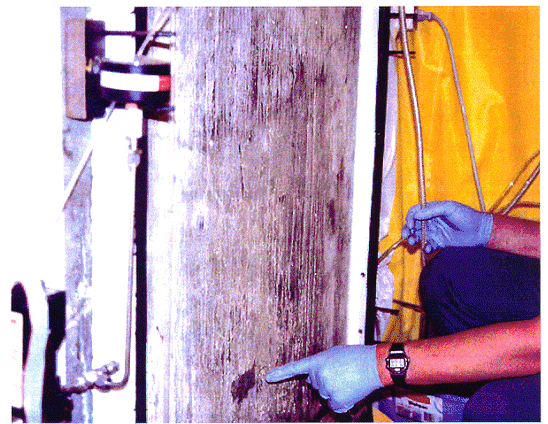
Fig. 3. Test cell displaying
biologically treated nuclear reactor building concrete surface with a sampled
area removed to an average depth of 2 mm after 6 months treatment.
Practical considerations in deployment of a biodecontamination technology include acceptability of processing time periods that are on the order of one year to remove enough surface to eliminate the embedded radionuclides. Also, maintenance of D&D facility temperatures above 50 degrees Farenheight is a need for optimum continuous microbial activity. The loosened materials may be collected by wet vacuuming or similar techniques. Stopping the concrete degradation process merely requires removal of either or both the moisture and nutrients which causes the microorganisms to die or to go into an inactive state.
ENVIRONMENTAL ANALYSES
The biodecontamination technology can be described in three simple steps: 1) application of microbes to the contaminated concrete surface, 2) maintenance of the environment (humidity and nutrients) to sustain microbial activity, and 3) termination of the bacterial support environment and removal/disposal of the loosened radioactively contaminated concrete materials. Reduced potential for human exposure to ionizing radiation is realized in all three steps compared to current alternate technologies. Application of microbes to initiate the biodecontamination process and removal of debris at the conclusion of the process may be conducted manually, but with significantly reduced stay times compared to physical removal methods. Maintenance of the biodecon process requires no man entry to the radiation zones.
Technology needs and comparisons for decontaminating and decommissioning facilities in with radioactively contaminated surfaces have been described by Dickerson (6). Cost estimates for various technologies and scenarios cover a wide range, i.e., $10s/sq ft to a few cents/sq ft. The cost range is determined by the type of D&D technology used, occupational protection prescribed, and environmental containment engineering required. External radiation fields can limit worker stay time although worker heat stress limitations may be more constraining when worker protective gear is used. Potential for internal exposure to radioactivity requires the use of protective equipment which in turn slows worker progress and adds other work efficiency challenges such as heat stress. Some of these issues are overcome by use of robotics. Robotics may also be employed to enhance the biodecontamination process such as in the initial application of the microbial culture to the surfaces to be decontaminated and in collecting the decontamination debris at the conclusion of the biodecontamination process.
Occupational radiation exposure experience in D&D activities is not well documented in the open literature. A PNL report (6) provides some of the very meager radiation protection information documented. Using these data a cost and occupational exposure comparison estimate was completed. The results of this comparison is summarized in Fig. 4. Implicit in this comparison was the assumption that the costs are directly proportional to the "stay time" since labor charges dominate decontamination costs. The cost per unit area ranges over nearly two orders of magnitude. Biodecontamination technology shows both the lowest cost and the lowest relative occupational radiation exposure. This outcome is not surprising since the biodecontamination technology is passive. No penalty is taken into account for the likely 6-18 month decontamination period since most facilities that are slated for D&D typically have long periods of inactivity prior to the cleanup action.
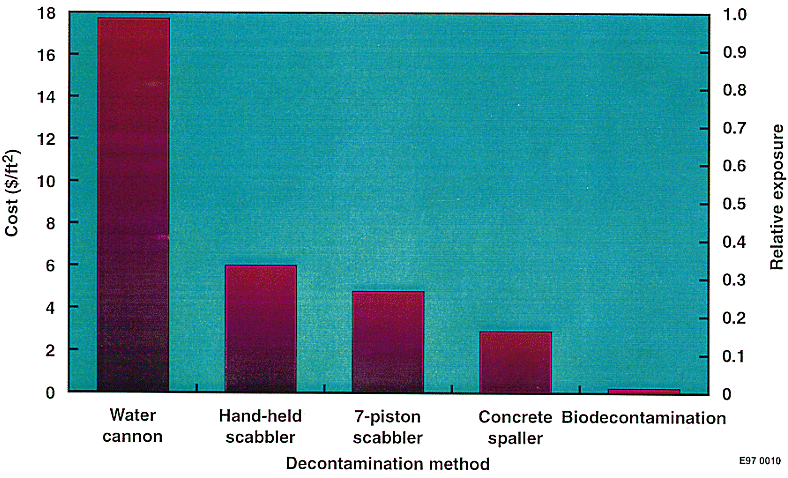
Fig. 4. Relative cost and worker
radiation exposure estimates for alternative concrete decontamination methods.
Radioactive materials containment efficiency is even more difficult to compare between D&D technologies. Decontamination scenarios range from water cannons to scabbler operations to biodecontamination or combinations thereof. Containment engineering experience with the various technologies is limited. High pressure liquid decontamination processes such as water cannon cleaning and chemical methods result in liquid effluent streams which require collection and processing. With each added processing/handling step required the potential for environmental release increases. Physical removal methods such as scabbling are most often conducted under dry conditions. In the latter case suspended particulate matter must be contained or removed via filtration to prevent environmental release. By contrast biodecontamination is conducted in a humid environment which aids in particle containment, but produces no liquid effluent streams. Removal of the moist, loosened concrete surface materials significantly reduces the potential for airborne particulate. While containment engineering analyses of the various decontamination technologies is limited, biodecontamination technology compares favorably where it fits the case requirements.
COMPARISON CONCLUSIONS
In summary the benefits of biodecontamination technology are in both reduced processing costs and in reduced health and safety costs. Occupational health and safety benefits are significant where biodecontamination technology time requirements can be accommodated. Similarly environmental containment benefits flow from D&D operational conditions which promote contaminant containment. Further economies stem from waste volume minimization and elimination of side streams requiring parallel treatment. These positive technology features will favor application of this D&D technology.
ACKNOWLEDGMENTS
This research has been supported by Lockheed Martin Idaho Technologies Company, Idaho National Engineering Laboratory, and is currently sponsored by the U. S. Department of Energy, DOE/EM, Office of Science and Technology, Contract DE-AC07-94ID13223
REFERENCES