Manfred Schrauben, Ingrid Verstraeten, Marnix Braeckeveldt
ONDRAF/NIRAS
ABSTRACT
Since 1988, major nuclear facilities are being decommissioned on three sites in the Mol and Dessel area. Some other facilities were decommissioned and the remaining buildings were demolished or are being re-used e.g. for conventional research by a new owner.
Niras/ondraf is directly involved in these operations. Indeed, the Agency is legally bound to collect and assess information about the decommissioning of nuclear facilities in Belgium, to approve the decommissioning plans and, in some cases, to execute the decommissioning programs.
As costs for radioactive waste management are rather high and the recycling of materials was decided to be a major objective to preserve precious raw materials, efforts have been made since 1992 to minimize final amounts of radwaste arising from decommissioning. In this manner, encouraging results have been gained in building surface decontamination, where the removal of a 1.5-3 mm layer allows in most cases the remaining structure to be released. In the same way, the development and the implementation of an industrial decontamination unit for ferrous components by a dry abrasive technique allows free release of up to 90% of the arising steel components in the near future.
NIRAS/ONDRAF ACTIVITIES CONCERNING DECOMMISSIONING
The Belgian decommissioning legislation provides for the intervention of niras/ondraf in the following two fields: preparation of the future decommissioning of nuclear facilities and possible execution of the decommissioning programs.
Preparation of Decommissioning Plans
In accordance with the royal decree of October 16, 1991, niras/ondraf concludes conventions with all operators of nuclear facilities in Belgium, which determine which information regarding decommissioning must be provided to the Agency and how the decommissioning operations will be financed. However, financing of the decommissioning of commercial power plants is not subject to this general rule. Indeed, in 1985 the Belgian Government and the utilities concluded a specific convention regulating this matter.
With a view to standardizing the transfer of data regarding the nuclear facilities to be decommissioned, niras/ondraf issued recommendations for drawing up the legally required decommissioning plans in accordance with the Safety Standard of the International Atomic Energy Agency (IAEA) for the decommissioning of nuclear facilities.
A decommissioning plan is a tool that evolves in three phases. When starting up a facility, the operator prepares an initial decommissioning plan in which the decommissioning costs and the provisions necessary to ensure its financing are assessed. These assessments provide the basis for the decommissioning funds to be set up by the operator.
During operation, the operator revises the decommissioning plan every five years to allow for the evolution of the facility itself and of the decommissioning and waste processing techniques, methods and costs. When the facility is definitively shut down, this plan becomes a final decommissioning plan. It contains a definitive decommissioning strategy, after it has been established that the available financial means are sufficient to execute the whole program.
In order to be able to collect and assess the information about nuclear facilities properly, niras/ondraf has developed a software to file the inventories of the facilities and their contents and, at the same time, analyze the relevant data. This analysis allows, on the basis of the programs under way in Belgium, to verify the nature and quantities of the materials and radioactive waste produced by the decommissioning of the facility. It also allows to assess the human and financial resources required to decommission the facility.
The methodology and software developed by niras/ondraf have been applied repeatedly in the past few years. The Institute for Radioelements (IRE) in Fleurus for instance called upon niras/ondraf to inventory its facilities and their contents and to assess the financial means necessary to cover the technical liabilities of the institute. The same methodology was used to re-assess the liabilities of the Belgian Nuclear Research Center SCK•CEN, and the two sites of Belgoprocess where decommissioning operations are currently taking place.
At the request of the Walloon Government, the Agency is currently drawing up the inventory and assessing the financial means needed for another nuclear site in Fleurus operated by a private company but of which the Walloon Government took over the financial responsibility for decommissioning.
Furthermore, the Belgian Federal Government charged niras/ondraf to identify, inventory and assess all radio-contaminated sites in the country.
Execution of Decommissioning Programs
niras/ondraf is in charge of the overall management of the three technical liabilities in Belgium, for which there already exists a financing mechanism, i.e. the liabilities of the Belgian Nuclear Research Center SCK•CEN and of the two Belgoprocess sites. Financing of the technical liabilities of SCK•CEN, created by research performed before 31 December 1988, is thus ensured by the Belgian Federal Government until 2020 and covers the whole decommissioning and clean-up program. To this end, a convention was concluded in 1991 by the Belgian Federal Government and niras/ondraf. Financing of the liabilities of both Belgoprocess sites is ensured partially, until 2000, by the Belgian Federal Government, the utilities and Synatom. For that purpose, two conventions were concluded with niras/ondraf in 1991. The technical and financial management structures of the SCK•CEN and Belgoprocess liabilities are identical.
The decommissioning and clean-up operations performed by SCK•CEN and Belgoprocess within the scope of subcontracting must of course be approved. In actual practice the annual work programs and budgets are presented by SCK•CEN and Belgoprocess to niras/ondraf. If the latter agrees with the proposals, they are submitted for advice to a technical committee and for approval to an orientation and supervisory commission.
Both the committee and the commission are composed of representatives of the Federal Ministry of Economic Affairs, the utilities, Synatom and niras/ondraf. They meet at least four times per year for each of the liabilities. The approved programs are then implemented respectively by SCK•CEN and Belgoprocess under the supervision of niras/ondraf.
So far, the three current decommissioning programs have progressed satisfactorily.
DECOMMISSIONING MATERIAL AND WASTE STREAMS
Basis of Evaluation
A representative view of the amounts and streams of materials and waste arising from decommissioning programs can be provided through the re-assessment of the major liability programs which was performed by the Agency at the beginning of 1996 at the request of the Federal Government. These liability programs concern the following sites and facilities:
- br1, a graphite-gas reactor in operation for research purposes since 1956;
- br2, an MTR reactor in operation for research purposes and isotope production since 1961;
- br3, the first PWR reactor in Europe, from Westinghouse type, operated successfully between 1962 and 1987, and currently under decommissioning;
- research laboratories and hot cells in operation since 1955.
These programs thus cover a large range of nuclear facilities and deal with most aspects encountered during decommissioning.
Main Decommissioning Material and Waste Streams
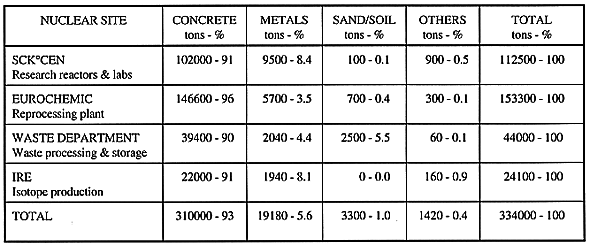
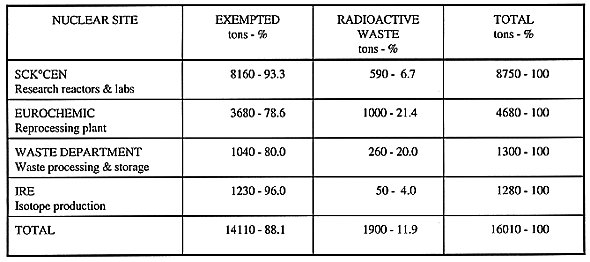
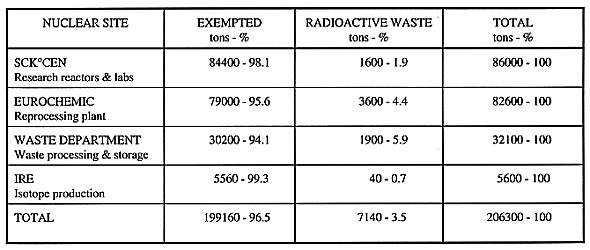
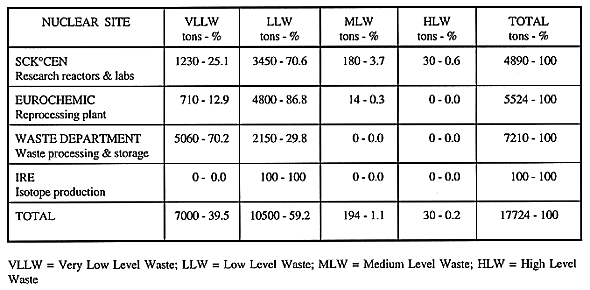
A summary of the amounts of materials and waste is given in the following tables showing global quantities of structures, equipment and soils (Table I), their classification as non-nuclear, contaminated and activated materials (Tables II and IV), the results after decontamination of building structures and metals according to current regulations and practice (Tables III and V), as well as the categorization of the radioactive waste (Table VI). These amounts concern the remaining structures and equipment after January 1, 1996; the components dismantled before this date are not included in these figures.
TABLE I Global Decommissioning Masses
Contaminated and activated material and waste arising from decommissioning are mostly concrete and similar construction materials, steel and other metals. Thus, efforts have been made to reduce the final amount of radioactive waste and, consequently, the costs of the whole decommissioning programs.
TABLE II Concrete
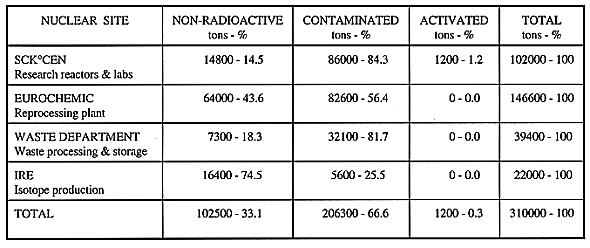
TABLE III Metals
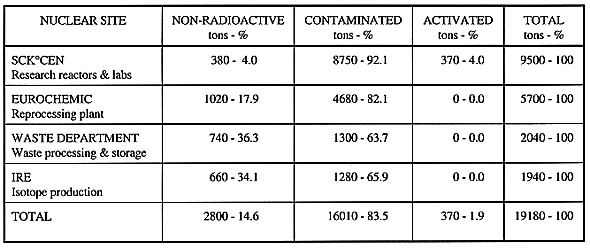
One of the most successful activity of the Agency's subsidiary Belgoprocess was the development of a technique and the implementation of an industrial facility for the decontamination of metal below the free-release limits. Whereas till 1994, most of the dismantled metallic components were treated as radioactive waste, this part of metals is currently below 20% of the global masses, and the intention is to perform decontamination and free release of more than 90% in the near future.
TABLE IV Contaminated Metals
This decontamination is performed at relatively low costs by a dry abrasive
technique with full recycling of the grit. The production of secondary waste is
thus rather low. Furthermore, the effectiveness of the technique is very high :
stainless steel parts contaminated at levels up to 30000Bq/cm2 were
decontaminated below the free release limits (0,4 Bq/cm2 for
 ,
,
 ;
0,04Bq/cm2 for
;
0,04Bq/cm2 for
 ).
Nevertheless, the economic limit of such decontamination in comparison with
processing as radioactive waste can be estimated to be in the range of 10000
Bq/cm2 initial contamination, which makes it possible to release
large amounts of metallic parts arising from decommissioning.
).
Nevertheless, the economic limit of such decontamination in comparison with
processing as radioactive waste can be estimated to be in the range of 10000
Bq/cm2 initial contamination, which makes it possible to release
large amounts of metallic parts arising from decommissioning.
Another major effort was made by Belgoprocess in the development of decontamination techniques for building structures with the aim to increase the effectiveness of decontamination and to reduce the production of waste. As the initially used scabbling technique produces strains on tools as well as on operators due to high vibrations, a technique based on diamond discs was developed and is now being used with success. It allows the removal of a first layer of about 1.5-3 mm thickness which contains most of the activity and is treated as radioactive waste. In most cases, the remaining structure can be exempted from regulatory control. The initial estimated amount of radioactive concrete has thus been reduced largely.
TABLE V Contaminated Concrete
With regard to (highly) activated metallic parts from reactor components, techniques for dismantling under water (SCK•CEN) and for conditioning of the cut parts in concrete matrices (Belgoprocess) were developed and are being used since 1993. They are still available for the dismantling of reactor vessels and its activated components.
After preliminary mechanical decontamination, contaminated aluminum heat exchangers are sent to Sweden for melting. After melting, the ingots remain in Sweden where they are free released from nuclear control, while the secondary waste is returned to Belgium for processing and disposal.
Decommissioning is responsible for the production of a special kind of waste which is not encountered during plant operation : Very Low-Level Waste. This category of waste comprises mostly large amounts of activated concrete and other shielding materials, deeply contaminated building structures and contaminated soil. Activity levels are mostly below 100 Bq/g and the classification of this kind of waste as low-level radioactive waste would saturate disposal sites to an unjustifiable extent and be too expensive with regard to the quantities involved. That is why the Agency is considering alternatives for economical management of this waste.
Finally, the remaining radioactive waste arising from decommissioning is categorized following the classifications and specifications applicable in Belgium. This waste is taken over by niras/ondraf in the same way as operational waste, and is processed and stored on the central waste management site in Mol/Dessel. However, some special waste such as activated graphite, beryllium and other exotic material needs special attention and solutions.
TABLE VI Radioactive Waste
It can be concluded that, from global masses within a nuclear area, decommissioning can provide a large material and component release from nuclear control. Major efforts have been made during the last five years to increase extensively this part of decommissioning materials. In the near future, the decommissioning operators will continue to improve techniques and methodologies in order to withdraw more and more material from the nuclear circuit.
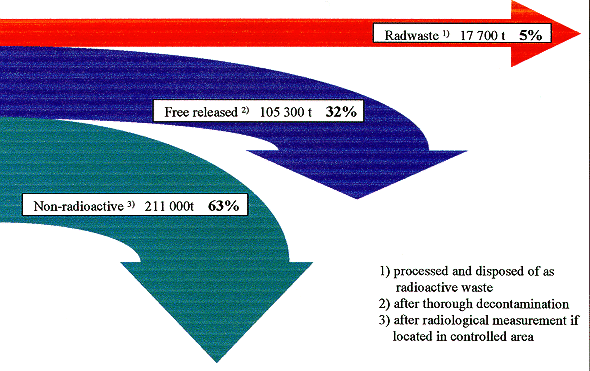
Fig. 1. Material
streams from a nuclear site.
DECOMMISSIONING COST BREAKDOWNS
Basis of Evaluation
The basis for the evaluation of the facilities is the same as for the decommissioning materials, i.e. the re-assessment of the major liability programs which was performed by the Agency at the beginning of 1996. The variety of the nature of these sites shows the differences in cost breakdowns for different kinds of facilities.
Main Decommissioning Cost Breakdowns
The cost breakdowns for the remaining decommissioning programs after January 1, 1996 are provided in Table VII. This table shows the global cost percentages for the major elements of the decommissioning programs.
TABLE VII Decommissioning Cost Breakdown (%)
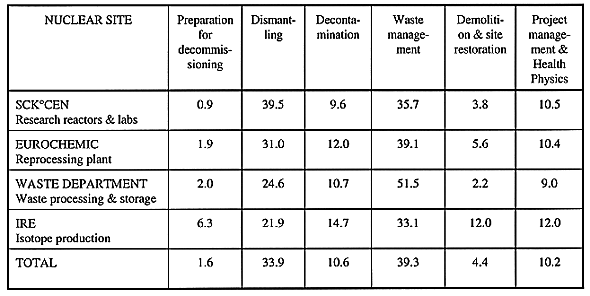
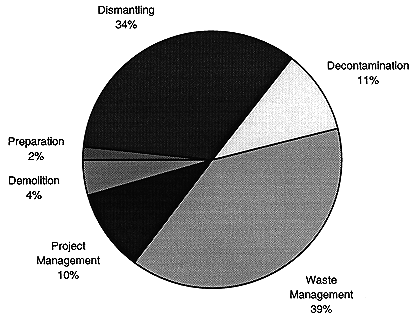
Fig. 2.
Decommissioning cost breakdown.
In any case, waste processing, storage and disposal entail the major part of the costs involved. That is the reason why minimizing waste production and optimizing waste management are the main objectives of the decommissioning programs in Belgium. Furthermore, continuous efforts to improve dismantling techniques and their performances will provide another major contribution to decommissioning costs minimization.