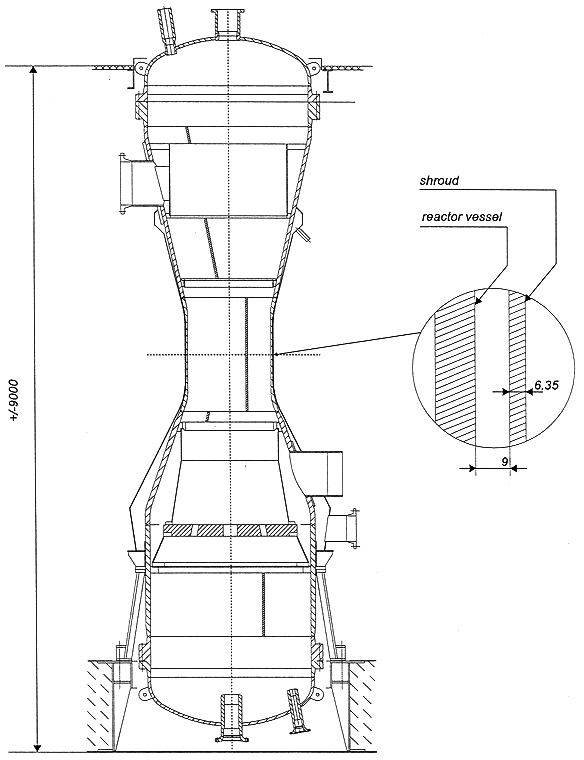
Fig. 1. General view of the BR2-reactor.
L. Noynaert, V. Van Alsenoy, R. Cornelissen
SCK•CEN
Boeretang 200, B-2400 Mol, Belgium
ABSTRACT
During the last decade it became obvious that the management of nuclear installations does not stop at the end of its operational lifetime, but only when its decommissioning is completed. To optimize the decommissioning, measures have to be taken as early as the design phase of those installations. These measures include:
The detailed description of all these measures must be collected in a decommissioning plan which has to be submitted for approval to the authorities.
In the case of a nuclear research center, the management of a decommissioning program is complex due to the diversity of the nuclear installations and the radioactive material generated by the research programs. In the case of SCK•CEN, the Belgian Nuclear Research Center, the nuclear installations include the air/graphite reactor BR1, the material testing reactor BR2, the first European PWR BR3, nuclear laboratory buildings, and a farm with pastures. The radioactive materials present on the site vary from ordinary materials like steel, aluminum and concrete to less common ones like beryllium, sodium and a large variety of fissile materials and spent fuel.
To develop its decommissioning plan, SCK•CEN set up a nuclear information system which is principally a database. This database records the physical and radiological inventory of the site infrastructure and its installations. It also contains waste and dismantling information necessary for the cost evaluation of decommissioning strategies. This system resulted in a tool which can be used by various facilities such as power reactor plants, reprocessing plants...
The decommissioning techniques and associated costs used in the decommissioning plan were based on experience accumulated by SCK•CEN since 1988. Since then, SCK•CEN has already carried out the complete decommissioning of 3 nuclear laboratories and is the dismantling operator of the BR3 plant. The draw up of the nuclear information system and the execution of the different cost evaluations finally resulted in SCK•CEN's decommissioning plan. This plan is in conformity with the IAEA recommendations and was approved by the Belgian authorities.
INTRODUCTION
Detailed decommissioning plans should be prepared before a nuclear installation is retired from service (1). The principal features of a decommissioning plan are:
The decommissioning plan must describe all the measures that have to be taken to reach the final goal, which is, the complete dismantling of the installation or the site and its withdrawal from regulatory control.
By Royal decree, each Belgian owner of a nuclear installation has to submit the final decommissioning plan at least 3 years before the final shutdown of the installation to the National Institute for Radioactive Waste and Enriched Fissile Material, ONDRAF/NIRAS. It is also required that for every new nuclear installation, an initial decommissioning plan has to be set up. This plan has also to be submitted for approval to ONDRAF/NIRAS and will be revised at least every 5 years. For the following nuclear installations of SCK•CEN, a decommissioning plan is thus required:
This paper describes two principal aspects of setting up of a decommissioning plan, namely the draw up of the inventory and the decommissioning cost evaluation. Results obtained for the BR2 plant are presented.
DECOMMISSIONING PLAN
Physical and Radiological Inventory of the Components of the nuclear facility
The set up of the physical and radiological inventory is the first and principle step in establishing the decommissioning plan. Such an inventory allows the determination of the total amount of material to be dismantled, the estimation of the dose intake and the waste volume, waste characterization, and finally a detailed cost evaluation.
Setting up such an inventory can be a difficult task, especially for old installations, as the documentation can be missing, incomplete or not up to date.
To obtain a description as precise and as detailed as possible, different steps were taken. Primarily, all existing documents related to the different parts and equipments of the plants were collected, analyzed, and relevant information was transferred to a database. In a next step, the registered information was checked on site, together with the principal operators, whenever and wherever it was possible and reasonably achievable (ALARA).
The radiological characteristics of the nuclear installations were obtained by dose rate measurements, sampling and radiological analysis and/or modeling. This radiological data was completed using existing reports of incidents (through reports of the Health Physics Department) and radiological characteristics of the waste resulting from exploitation of the installations. For example, samples of the shroud of the BR2, used to estimate the fatigue of the pressure vessel, were also used for the estimation of the radiological characteristics of the pressure vessel (Fig. 1, 2), and the radiological data obtained from the first beryllium moderator, during its first replacement in 1979, is used to characterize the other beryllium moderators.
Fig. 1. General view
of the BR2-reactor.
Since the initial inventory evolves simultaneously with the nuclear installations, its continuous updating is necessary. This demands close collaboration with the operators of the nuclear installations during its entire life time. In addition, regular meetings with the Purchase Service and the Contract Service are required to initiate, at an early stage of new projects, the process of decommissioning costs evaluation and inventory making. Acting accordingly, the design of a new nuclear installation can be optimized with the emphasis on easy decommissioning and waste minimization. At SCK•CEN, the Site Restoration Unit is in charge of the set up and the updating of the inventory, the computation of the decommissioning costs and the waste management.
The radioactive material present on the site (Fig. 2) varies from ordinary materials like steel, aluminium and concrete to less common ones like beryllium, sodium and a large variety of fissile materials and spent fuel. The total amount of material described in the inventory (131 200 tons) includes 40 tons of spent fuel and fissile materials, 10 tons of radioactive material and 131 150 tons which can be free released (3).
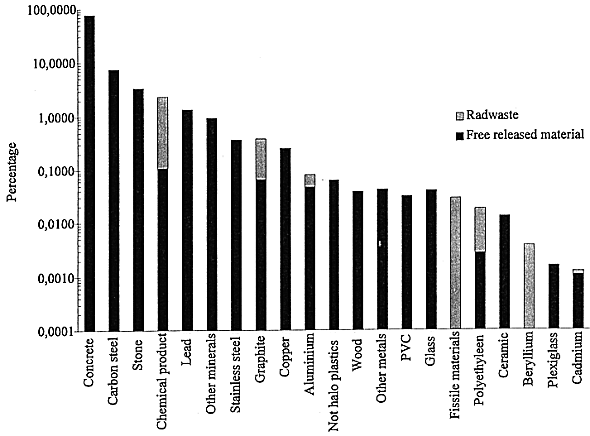
Fig. 2. Overview of inventorized
material quantities (in percentage).
All the information obtained by the above described procedure was fed into the SCK•CEN nuclear information system. This system proved to be a versatile and flexible tool. The nuclear information system also contains waste and dismantling information necessary for cost evaluation of decommissioning strategies.
The description and the Assessment of Decommissioning Alternatives
The decommissioning of a nuclear installation has to be done according to the current regulations, at the minimal (estimated) cost, by assuring the safety of the population and the environment, by generating a minimal amount of waste, and with an admissible dose uptake (ALARA).
The selection of the decommissioning techniques and their associated costs were mainly based on the experience gathered by SCK•CEN. Since 1988, SCK•CEN has already carried out the complete decommissioning of three nuclear laboratories and is the dismantling operator of the BR3 plant.
In the case of dangerous or toxic materials like sodium, beryllium, spent fuel of research reactors, the costs evaluations were based on specific market studies. Whenever the proposed solutions were not acceptable, from a safety or an economic point of view, specific R&D projects were launched to find a solution which fulfils our requirements.
The final shutdown of the BR2 reactor is now planned for the year 2010. The costs related to its decommissioning were evaluated for the following scenario's:
The results obtained are given in Fig. 3. Surprisingly, from a financial point of view, the immediate dismantling strategy turns out to be one of the most favorable options. The data in Fig. 3 were calculated without taking into account the bank rates (large uncertainty over long periods of time). The waste cost evolution as showed in Fig. 4 does not plaid for a deferred dismantling either.
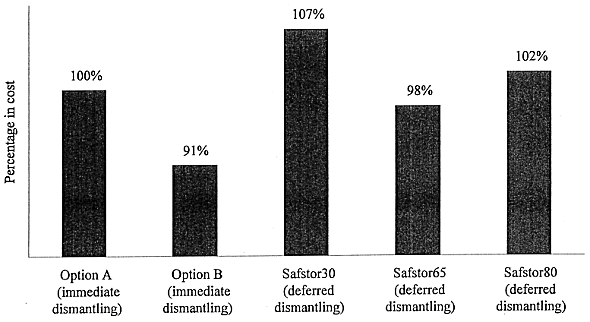
Fig. 3. Evolution (%) of the
dismantling costs of the BR2 facility as a function of the strategy. The
immediate dismantling without decreasing storage for the activiated concrete
(option A) is taken as reference (100%).
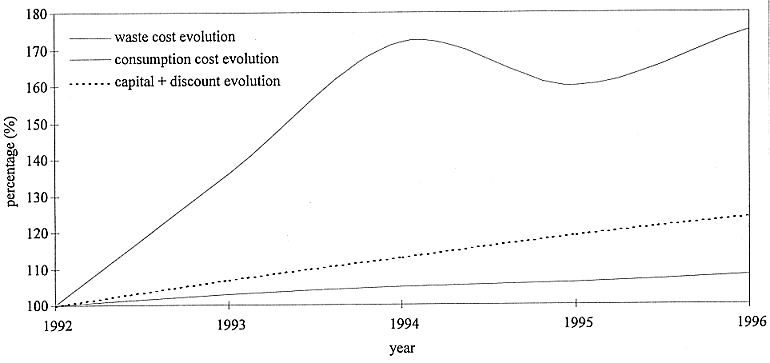
Fig. 4. Comparison of 5 years
evolution of waste cost and consumption product cost with the raising of a
capital.
An independent engineering office carried out the decommissioning costs evaluation for the BR2 plant in case of immediate dismantling (option A) and SAFSTOR30. The results obtained by this office confirm those obtained by SCK•CEN (4). This was also the case for the decommissioning cost evaluation of the BR3 facility (5) (6).
For the BR1 facility and the nuclear research laboratories, the scenario of an immediate dismantling after their definitive shutdown, now planned in 2020, was also retained (3).
The SCK•CEN's initial decommissioning plan, containing a detailed inventory, an analysis of the selection of decommissioning techniques and the decommissioning cost evaluation, was established in 1995. This plan, which is in conformity with the IAEA recommendations, has been approved by ONDRAF/NIRAS, by a commission consisting of a delegation from Belgian electricity producers, and by the Ministry of Economic Affairs (7).
CONCLUSIONS
SCK•CEN established a decommissioning plan in conformity with the IAEA recommendations.
Since the physical and radiological inventory is a fundamental aspect of a decommissioning plan, a lot of time and effort were devoted to obtain all the necessary information for the draw up of a complete inventory.
A database was especially designed to record the entire inventory. It also contains the information about waste management and decommissioning techniques. The selection of the decommissioning techniques and their associated costs were mainly based on the experience gained by SCK•CEN. Cost estimation for various decommissioning strategies were evaluated with the aid of the database.
The decommissioning cost evaluation performed by SCK•CEN for the BR2 and BR3 facilities were confirmed by an independent engineering office.
Setting up the inventory has allowed SCK•CEN to identify the problems which will be encountered during the decommissioning. They mainly concern the management of toxic or dangerous radioactive material like beryllium, sodium and spent fuel. R&D projects were launched to solve the identified problems.
Since the radiological and physical inventory is the most important aspect of a decommissioning plan, the team entrusted in the setting up of the inventory spends part of its time updating and managing the inventory.
The SCK•CEN initial decommissioning plan was approved by the Belgian authorities.
The approval by the authorities and the evaluation by an independent engineering office have confirmed SCK•CEN's know-how, its pragmatic management of decommissioning activities, and its draw up of decommissioning plans.
REFERENCES