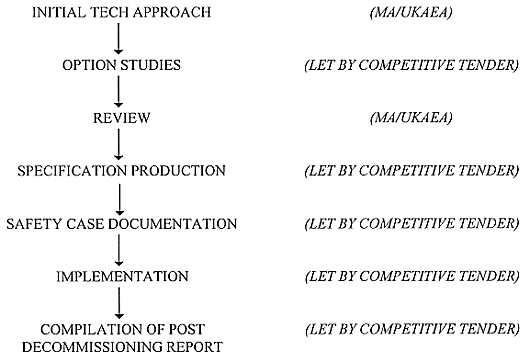
Fig. 1. Procurement strategy contractual relationships.
K F Collett, B Hickey, S J Parkinson
United Kingdom
Atomic Energy Authority
ABSTRACT
The two Windscale Pile Reactors constructed between 1946 and 1950 operated as military and civil research reactors. Both operated until October 1957 when Pile One was shut down following a Core fire. These reactors are now being decommissioned by UKAEA with DTI/MOD (Department of Trade and Industry/Ministry of Defense) funding. The current work plan encompasses the Phase One Decommissioning of both Piles One and Two. This is to enable a program of Phase Two dismantling of the Pile One reactor core and a fifty year care and maintenance regime for the Pile Two reactor to be put in place. This paper addresses Phase One decommissioning.
INTRODUCTION
The requirements of the Phase One decommissioning project are to totally isolate the Pile One reactor core from the water ducts and pile chimneys thus reducing the potential for leakage during core dismantling, to install systems to enable the core to be constantly monitored, to provide a HEPA filtered ventilation system for the core, to provide a fixed water deluge fire fighting system, and upgrade various structures to seismic design standards. Intrusive and non-intrusive survey and sampling work is also being carried out to provide more accurate information on the core inventory and the state of the graphite lattice. This will be used to assist in the Phase Two dismantling.
These tasks have been undertaken as small work packages (£50k - £500k) and awarded through competitive tender to appropriate subcontractors. Skills requirement range from underwater ROV's through civil installation works to remote graphite coring. The technical and project management of these packages is being carried out by a Managing Agency (MA) supplied by a contractor, which includes a technically qualified Managing Agent to act as the ATO (Authority to Operate) holder. The MA is provided with technical and corporate safety support from UKAEA DRAWMOPS who retain the overall safety responsibilities as holders of the nuclear Site Licence. Procurement is carried out by a UKAEA procurement team against technical specifications and assessments being prepared and undertaken by the MA.
RISK MANAGEMENT
Letting of tightly defined work packages has reduced the uncertainties for both UKAEA and the contractors. This has provided an equitable risk sharing approach and flexibility, enabling methods to be changed as the work packages progress. It has also allowed experience data to be fed into defining the latter work packages. All work packages have been let by competitive tender which has produced both competitive prices against budgets and new innovative approaches to the Project particularly from the U.K. offshore oil industry.
One area that has resulted in significant savings is the use of existing equipment stocks on a 'free-issue' basis to contractors. This in particular has been very useful when repeat tasks have been carried out on Pile Two. This has also reduced the amount of plant brought into active areas which could become contaminated and result in costly disposal/decontamination.
The general procurement approach is shown in Fig. 1.
Fig. 1. Procurement
strategy contractual relationships.
CONTRACTUAL RELATIONSHIPS
The Managing Agency (MA) for the project was selected following a competitive tendering process, selection was not just on price but also technical capability, resources, quality and safety -management skills and experience. The MA contract which was eventually let by UKAEA DRAWMOPS to WS Atkins contained an incentivisation clause based on achieving a target project cost.
Contracts let for the individual work packages have generally been fixed price lump sum using either G C Works One or UKAEA CC2 Contract conditions. These contracts have included a pricing schedule against which varied or modified work can be priced. This has aided the commercial risk assessment at tender review stage and helped to monitor costs on ongoing but varied contracts fairly accurately.
The general approach is that the contracts are let by UKAEA DRAWMOPS and then managed by the MA which has its own commercial management advising UKAEA on the payments to the contractors. UKAEA procurement would only normally be involved during the life of a contract if there were a dispute.
INTERFACES
The main interfaces between the three main parties for a particular work package are shown in Fig. 2.
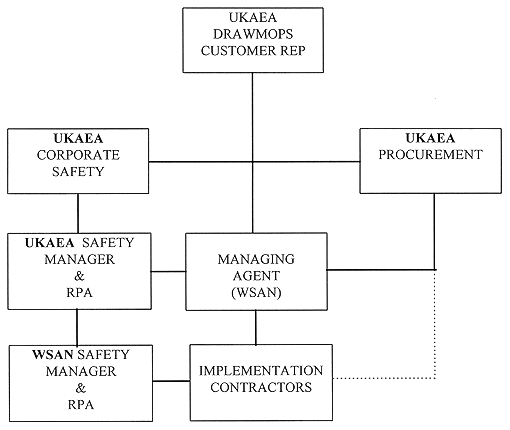
Fig. 2. Project
interfaces.
WASTECHEM LIMITED'S INVOLVEMENT IN THE PILES DECOMMISSIONING PROJECT
The following contracts have been completed by WasteChem on the Piles Decommissioning Project:
The Installation of Seismically Qualified Barriers at the B29 Pond
Objectives:- To isolate the Piles Complex from the B29 fuel storage pond. Water ducts run from the rear of both Pile One and Two into which fuel was discharged into fuel skips which ran on rails through the water ducts to the B29 pond where the fuel was then cooled. In order to contain and control any discharges from the Piles and to provide the isolation required for further decommissioning the need was identified to provide a high integrity barriers at the pond end of the water ducts. There were existing sluice gates at the Pond end of the water ducts but these were neither in very good condition or deemed capable to withstand a seismic event.
Design:- In order to meet the requirements a design was developed which consisted of the construction of permanent steel formwork sections which would be fitted after the sluice gate at the entrance to the ponds. The space in between these steel shutters would be then mass filled with concrete. To provide a key between the new concrete and the existing pond structure all existing concrete surfaces within the pond to be in contact with new concrete were required to be scabbled.
Methodology:- As the task involved under water scabbling, drilling and bolting operations it was determined that a remotely operated tool post would be needed to effect the majority of tasks. A tool post was designed by WasteChem and manufactured by subcontractors. At the same time the scabbling operations were investigated and it was determined that high pressure water jetting (HPWJ) would provide the best solution. In order to trial the operations and to train the operators a full size replica of the corner of the pond was constructed off site. The equipment was then tested off site for a period of 8 weeks, this inactive commissioning trial provided the following:-
The installation of ventilation and air dams to Pile One exhaust air ducts.
Objectives:- To isolate the core of Pile One from its chimney and to provide a High Efficiency Particulate Air (HEPA) filtered controllable extract system for airflows across the core. This will contain any releases during core dismantling and provide control over the airflows across the core. The original exhaust route was up the chimney and then through the filter galleries at the top of the chimney.
Design:- Air dams of hollow steel construction were designed with an engineered opening at the top to which the HEPA ventilation plant is connected. A cross section of this is shown in Fig. 3.
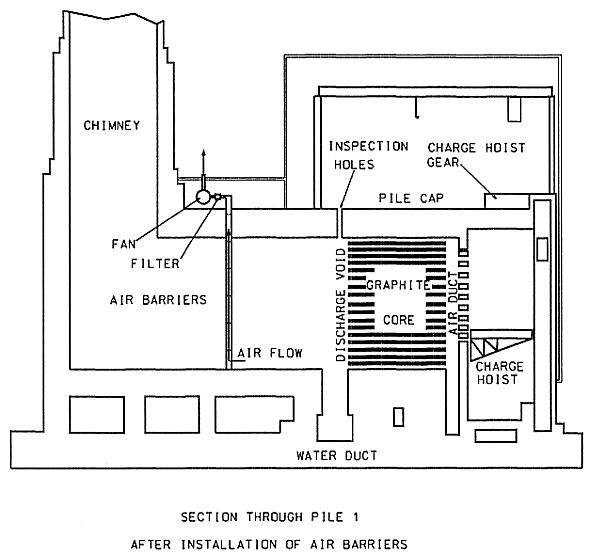
Fig. 3. Section
through pile 1after installation of air barriers.
Methodology:- In order to gain access to the exhaust air ducts the concrete bioshield roof had to be removed. These access holes were planned to be cut using part diamond coring and hydraulic bursting but using standard percussive breaking for the majority of the concrete removal. During operations this method was disrupted by two events. The first was the discovery of contamination within pipework spread throughout the excavation area. This meant that the pipework could not be removed within the mass concrete because of the risk of cross contamination to both the concrete and the surrounding area. The pipes were injected with an expanding foam to fix the contamination and they were then removed by manual means. The second problem was the discovery of weakened concrete on the chimney filter gallery and the subsequent dislodging of pieces of this concrete during the percussive operations to excavate the access holes. Vibration analysis tests were carried out but it could not be discounted that the percussive operations may have induced the dislodging of the concrete. It was therefore necessary to use alternate methods for the excavation of the access holes. Expanding grout was used in additional cored holes which broke up the concrete into large pieces, the reinforcement was then cut. The access hole was completed with the removal of the concrete lintels, insulation boxes, thermal shield plates and structural steelwork.
The dams were fabricated off-site in eight sections. These were lowered through the access hole and then welded and bolted together before being lowered to enable the next section to be attached. Finally the HEPA filtered ventilation system was connected to the engineered air outlet.
Exhaust Air Duct Sealing
Objectives:- To seal the gap between the underside of exhaust air duct shielding plates and the concrete structure of the air duct at the same position as the air dams. This was required in order to reduce air leakage up the chimney which only became apparent once the system detailed above had been commissioned. It was discovered that there were air leakages occurring due the presence of a cooling cavity (75mm - 125mm deep) between the thermal shielding and the concrete base of the duct.
Design:- To meet the requirements a closed cell polyurethane non flammable foam was proposed that would be injected remotely through 300mm diameter 6m long holes diamond cored through the wall of the chimney base. The foam system used was one that had been previously used on piles projects and was adapted for this task. The system utilized a heavy duty gun applicator, as used in industry for high volume application such as lining refrigerated units.
Methodology:- A scaffold platform was constructed against the chimney with the working platform fully encased in heavy duty 'monarflex' sheeting. The inside of the working area was sheeted out in PVC, and a boot barrier and change area constructed. No ventilation system was built into the tent as it was determined that once the concrete containment was breached the airflow would be into the chimney. The drilling location was marked out on the chimney wall and the drilling rig attached. The rig was then checked for the required drilling angle. As the drilling process uses water as a lubrication a catchment tray was fixed onto the wall below the drilling position to collect the lubrication water and funnel it to a settling tank. This water was then pumped back up to the cutting head and recycled. The drilling process took longer than anticipated as a high number of large diameter (40mm) reinforcing bars were encountered. This was problematic for two reasons: firstly the bars were smooth mild steel which whilst being cut would break adhesion with the concrete and jam in the teeth of the bit (with modern 'twisted' high yield reinforcement this does not occur as the sections of bar left in the concrete remain firmly embedded); secondly as we were not cutting at 90E to the bars one side of the bar was being cut first and then jamming up the bit.
Once the hole was through to the underside of the thermal shielding plates a check was carried out to determine that in fact the airflow was into the chimney thus confirming that there was no need for additional ventilation plant to the tent. A miniature CCTV camera and 150w light were then deployed down the hole using modified drain rods. This revealed that there was debris in the void which would prevent the deployment of the foam gun. A 100mm diamond bit was then run in the void to clear the debris. The foam gun was introduced into the hole and using a solenoid operated trigger the gun was inserted and withdrawn at a measured rate(trials had been carried out to determine the amount of foam generated for certain trigger periods and then the rate of withdrawal required to ensure a complete filling of the cavity calculated, ensuring the foam gun did not become engulfed in foam itself). This process was recorded on video tape.
The foam filling equipment proved very cumbersome to use on the first exhaust air duct and required a very rigorous cleaning regime. For the second exhaust air duct a lightweight disposable system that dispensed a similar foam was utilised which was far lighter to use and could be manhandled effectively at a distance of 8m. Apart from this change the second exhaust air duct sealing was carried out in a similar manner.
Installation of a Water Duct Barrier To Pile Two
Objectives:- To provide a seismically qualified barrier within the water duct at the Pile Two core end, to provide an opening in the reactor side of the water duct, and to scabble to a depth of 10mm the whole of the water duct access shaft. The barrier was required to allow the water within the main duct to be drained whilst maintaining the water level within the duct section at the discharge face of the reactor core. The water level at the rear of the core being necessary to maintain the integrity of the Pile ventilation system. The access opening was constructed to allow the deployment of ROV's etc to carry out clean -up tasks within the duct at the discharge face of the pile. The scabbling was required to remove contamination within the concrete forming the access shaft walls so that when the duct is drained the dose uptake will be significantly reduced.
Design: A barrier had previously been installed within Pile One and a slightly modified version of this design was used. This was a steel barrier split into a base shutter and a main barrier which sat on top of the base shutter. The barrier was constructed from sheet steel with channel strengtheners. On completion the base shutter, barrier side channels and the barrier head would be filled with an underwater grout.
Methodology: For the installation of the water duct barrier to Pile One a remotely operated toolpost had been utilized. This unit was hydraulically operated and could carry out all the drilling, bolting and scabbling operations entirely remotely. Positional information was given by magnetic decoders reading back to a digital display panel. There were also two CCTV cameras fitted which could be used to view all operations. This was handed to WasteChem on a 'free issue' basis to carry out the works to Pile Two. On receipt we overhauled the toolpost and carried out a series of in active commissioning trials in order to develop our Method Statements for the works and provide training for our operators. As parts of the tool post were contaminated these trials had to take place within a specially constructed scaffold that was fully encased in 'monarflex' sheeting with a HEPA extract system. The tool post itself required some minor modifications as the access to the water duct was different to that at Pile One.
Once the tool post was lowered into the water duct access shaft the first task carried out was to carry out a dimensional survey of the barrier location to check that the barrier would fit and seal correctly. This identified that modified barrier side restraint angles would be required as the duct was slightly out of plumb.
The tool post was then fitted with a scabbling lance and the shaft walls and base scabbled. A guide wheel was fitted adjacent to the lance which could be observed running along the walls this ensured that the scabbling nozzle maintained the required 'stand off' distance from the wall irrespective of whether the wall was plumb or not. The scabbling system employed was a WOMA high pressure water jetting lance fitted with a six jetted 'turbo' nozzle. This nozzle had the advantage over the 'fan' jet used on Pile One in that it produces fines rather than flakes of concrete. On Pile One the flakes caused problems with the water duct sludge clearance operations.
Once the scabbling was complete the water in the duct was allowed to clear over a weekend. The drilling operations were then started using a 25mm diameter diamond tipped core bit. Once a hole was drilled it was flushed out. On completion of a section of holes the tool head was changed and the shear bolts fitted to the correct torque as indicated on the pressure gauge on the control panel.
The barrier base shutter was then lowered into the duct using the building crane and bolted into position. The main barrier was then lowered onto the base shutter and temporarily secured whilst the remaining bolts were fitted.
The remaining task was to fill the base shutter, barrier side channels and the barrier head with underwater grout. This was placed using a series of 100mm diameter tremie pipes which were filled from the top of the duct by a skip suspended from the building crane. Calculations were carried out to ensure that only the required amount of grout was fed into each area as an overspill would have been very difficult to remove. The whole operation was monitored on CCTV.
The formation of the access hole involved the removal and decontamination of mortuary tubes and the removal of the steel plate roof to the water duct access shaft. This presented no significant problems and the majority of steelwork removed was cleared for free release to the scrap metal market.
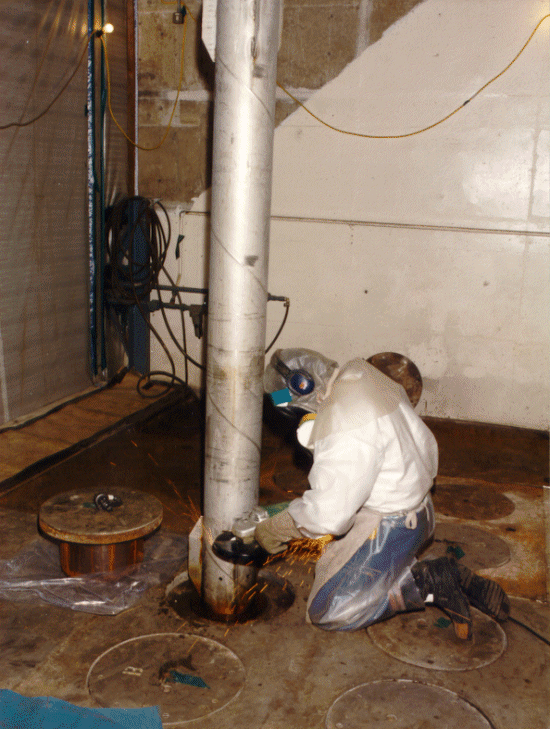
Fig. 4. Size reducing contaminated
components on windscale piles.
The following contracts are currently being undertaken by WasteChem on the Piles Decommissioning Project
The Sealing and Ventilation of Pile Two
Objectives:- To install a HEPA filtered air inlet and extract system to provide controlled airflows across the Pile Two reactor core, and to seal the charge face to stop air leakage. This is required as part of the proposed 50 year care and maintenance regime.
Design:- 15 charge plugs are to be removed from the base of the charge face and a HEPA filtered engineered air inlet will be bolted to the charge face. The rest of the charge face will then be sealed with a heavy duty reinforced sealant paint. This will provide a controlled air inlet path through the reactor core and in the event of failure of the ventilation extract system will prevent the release of contamination through the charge face. A four branched extract ductwork manifold will be fitted to the existing inspection holes in the pile cap bioshield above the discharge face, this will then be connected to the existing HEPA filtered extract system. The supply also incorporates a temperature, pressure and activity monitoring system.
Program: All the ductwork sections have been manufactured and installation is expected to be carried out in Feb 1997.
The Draining, Decontamination and Sealing of the Pile One Water Duct
Objectives: To drain the water duct between the barrier at the B29 pond and the water duct barrier at the reactor core, the removal of any contamination 'hot spots', the laying of a screed floor to the duct and the sealing of the concrete surfaces to the walls and soffit of the water duct. This will allow the duct to worked in without respiratory protection and with a relatively low dose uptake. The duct will then be used to house the pipework and pumps which form the Pile One Emergency Water Supply System.
Design: The water duct will be drained by lowering a submersible pump into the at the B29 end and pumping the water into the B29 pond. Once this has been completed a health physics survey of the duct will then be carried out to determine the location of contamination 'hot spots'. The will then be removed by operators using hand held HPWJ lances. A concrete floor screed will then be laid on the floor of the duct, this will provide a level surface for the further installation works and provide some shielding from the base of the duct which is expected to be the most active area. The final task will be to seal the walls and soffit of the water duct using a water tolerant concrete sealant.
Program: This work is programmed to commence in Jan 1997.
The Installation of an Emergency Water Supply System to Pile One and a Seismic Upgrade of Critical Structures.
Objectives: To provide a permanent water deluge system to Pile One, and to upgrade the control room and main staircase to seismic standards. This will provide protection during the Phase Two core dismantling operations.
Design: 200mm diameter flow and return pipework will be installed from the B29 pond to the water duct access shaft in front of the Pile One water duct barrier. Pumps will be installed at this location which will pump the water through a riser pipe to 9 injection points in the pile cap. The system will be controlled manually and has a back-up diesel generator. The water that flows through the core will be pumped back to the B29 pond via a valve in the water duct barrier and the return pipework. The seismic upgrades involve the fitting of additional steelwork to both the stair tower and the control room.
Program: This work is currently in the detailed design phase and is expected to be installed in late April 1997.
CONCLUSION
Development of a series of smaller well defined work packages has allowed project participation on a commercial sector. Through limiting risk, on both the client and contractors sides, safe and cost effective decommissioning has been achieved assisted by prevailing market forces.
The approach to the Phase One decommissioning has provided a solid platform for the basis and implementation of the Phase Two work.