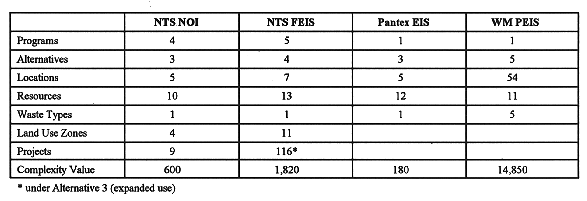
Table I Complexity Value
Angela Colarusso
DOE/NV EM
WMD EIS Coordinator
MaryEllen Giampaoli
DOE/NV EPD
EIS Document Manager
Jim Henderson, BN
EIS Contractor Project Manager
Joe Johnston, BN
EIS Contractor Deputy Project Manager
Carrie Stewart, PAI
EIS Contractor Project Manager
ABSTRACT
The Department of Energy (DOE) Nevada Operations Office recently completed a site- wide Environmental Impact Statement (EIS) for the Nevada Test Site (NTS) and off-site locations within the state of Nevada. This EIS was two years in the development and cost about 10 million dollars to produce.
The NTS EIS is a program level EIS, rather than a project-specific EIS. The NTS EIS identifies the potential environmental impacts to 13 natural resources (biology, hydrology, air quality, etc.) associated with 4 alternatives (No Action plus 3 alternatives) for implementing 5 DOE programs at 7 sites in the state of Nevada (the NTS plus 6 others). Such complexity created a need for author diversity, and ultimately nearly 300 contractor personnel (representing 10 organizations) and 100 federal staff (representing over a dozen DOE program offices, several DOE field organizations, the National Laboratories, as well as other federal agencies including the U.S. Bureau of Land Management, U.S. Fish and Wildlife Service, U.S. Air Force, and Defense Special Weapons Agency.) The lessons learned while developing this 2,000-page EIS are relevant to other complex environmental projects that produce large documents with input from many authors.
Four important lessons learned during the NTS EIS development are highlighted. They are in the areas of management, planning, the expanding scope, and the approval process. Although the development of the NTS EIS was a success, there is always room for improvement and many lessons to learn.
The Department of Energy, Nevada Operations Office (DOE/NV) recently prepared an Environmental Impact Statement (EIS) for the Nevada Test Site (NTS) and off-site locations within the state of Nevada. The EIS took two years to develop and produce at a cost of nearly 10 million dollars. It identifies the potential environmental impacts associated with alternative future uses of the NTS.
The NTS EIS is a program level EIS, rather than a project-specific EIS. As such, it identifies the potential impact to the human environment by analyzing impacts to the natural resources identified in the National Environmental Policy Act (NEPA). In some cases there was also a need for the NTS EIS to evaluate the suitability of several proposed sites to support future siting decisions. In other cases, there was heel as well as requirements, to evaluate no action at a particular site along With a suite of proposed actions. The result: an impact statement that identifies the potential environmental impacts to 13 natural resources (biology, hydrology, air quality, etc.) associated with 4 alternatives (No action pins 3 action alternatives) for implementing 5 DOE programs at 7 sites in the state of Nevada (the NTS plus 6 others). Such complexity created a need for author diversity, and ultimately nearly 300 contractor personnel (representing 10 organizations) and 100 federal staff (representing over a dozen DOE program offices, several DOE field organizations, as well as other federal agencies including the U.S. Bureau of Land Management, U.S. Fish and Wildlife Service, U.S. Air Force, and Defense Special Weapons Agency). The lessons learned while developing this 2,000-page EIS are relevant to other complex environmental projects that produce large documents with input from many authors.
This paper presents recommendations regarding ways to approach the successful completion of a large environmental report. In some instances, actual examples of situations encountered during the development of the NTS EIS are used. Our intent is to help others avoid some of the pitfalls that can bring normal NEPA Ninjas as to their knees.
BACKGROUND
Major changes in the attitude of the nation toward the environment began in the 1960s, and on January 1, 1970, President Richard M. Nixon signed the NEPA. This federal law established the policy that all actions of the federal government that had the potential to significantly impact the quality of the human environment would have to be evaluated, and a report would be provided to the government decision makers. The NEPA also created the President' s Council on Environmental Quality (CEQ) that established the NEPA review process. The DOE's NEPA regulations at 10 CFR 1021 augment the CEQ regulations (40 CFR 1500-1508) and implement DOE's NEPA process.
In September 1977, the Final Environmental Impact Statement, Nevada Test Site, Nye County, Nevada, a broadly scooped NTS EIS was published (ERDA, 1977). Pursuant to the DOE's mission responsibilities at that time, the 1977 EIS focused on an evaluation of the environmental impacts of underground nuclear tests with yields of less than one megaton. An analysis of other intermittent nuclear and non-nuclear activities that were conducted--and continue to be conducted--at the NTS was included in this earlier EIS. In recent years, nuclear testing policy changes have occurred. These policy changes have caused significant changes in NTS programs. These changes, together with the favorable environmental and infrastructure characteristics at the NTS, have resulted in additional DOE and non-DOE activities being proposed for siting at the NTS.
The NTS, a unique national resource managed by the DOE/NV, is about 65 miles northwest of Las Vegas. The 1,350 square mile site features desert and mountainous terrain and is larger than the state of Rhode Island, making it one of the largest secured areas in the United States. The NTS is in a remote and arid region, surrounded by federal installations with strictly controlled access, and public lands that are not open to public entry. The NTS has served the nation as the location for the development and testing of nuclear explosive devices and weapons. More than 900 nuclear tests have been conducted since the 1950s in the atmosphere and underground. A moratorium on nuclear testing has been in place since 1992.
In accordance with NEPA, the EIS presented an analysis of the impacts from historic, on-going, and newly proposed DOE programs at the following sites in Nevada: the NTS, the Tonopah Test Range, portions of the Nellis Air Force Range Complex, the Central Nevada Test Area, and the Project Shoal Area. These programs include activities for the stewardship of the nation' s nuclear weapons stockpile, defense research and development for non-nuclear weapons, management of radioactive waste, and environmental restoration. Also examined were newer programs such as Technology Development, which includes proposals to construct solar power generation facilities at the NTS and three additional sites in southern Nevada. Because of the breadth of the scope and the analysis, the EIS contains a large volume of information and represents a very complex analytical process.
Work began on compiling the baseline for the EIS in 1993. The Notice of Intent (NOI) was issued on August 10, 1994. With the NOI issued, the DOE was committed to scooping hearings and internal guidance that put the EIS on an 18-month schedule. Cost of the EIS was initially estimated to be 4 million dollars.
MANAGING THE DEVELOPMENT OF AN ENVIRONMENTAL IMPACT STATEMENT
As with any large project, planning is the crucial task that will most benefit development of an EIS. There are numerous factors that must be considered up front. The more aware the EIS team is of the different factors that go into creating an impact statement, the better off the entire team will be. Several factors associated with the NTS EIS led to a decision by DOE for hands-on federal involvement in the project. These factions included Secretarial policy, ambitious schedule, limited funding, and the potential volatility of some issues considered in the EIS.
Management of a project that is as complex, political, and large as a site-wide EIS requires the DOE assign federal staff to oversee the vinous program areas. A single DOE Manager should be responsible for giving budget and schedule direction and guidance to the contractors and other federal staff. In addition, well-defined scopes of work assist the team in planning activities, managing resources, and understanding expectations and goals.
The DOE was heavily involved in the development of several sections of the NTS EIS including Purpose and Need, Description of Proposed Action and Alternatives (DOPAA), Regions of Influence, and Affected Environment(s). Developing the sections of an EIS in the order presented and with DOE direct management promotes consistency and ensures that the federal perspective is included. Such involvement is not without perceived drawbacks--as the project (and the product) proceeds, changes in facility and program plans require changes to the DOPAA, as well as resulting changes to the product.
One of the most important keys to success in managing any project of this type is rapid, clear, and concise communication. The development of an EIS of this magnitude requires a lot of tearnwork. The level and extent of communication amongst team members can either strengthen the team or destroy it. Therefore, it is imperative that effective communication at, and between, all levels of DOE and contractor management and staff be initiated, maintained, and encouraged.
PLAN TO PLAN
Planning is critical to the development of an EIS. The initial schedule for EISs can be affected by HQ's guidance which recommends development of an EIS in 18 months.. Schedules are also particularly difficult during the development of projects that are as complex, political, and large as an EIS. Because of the expanding scope and the aggressive schedule, some schedule changes should be expected. The end of the schedule must remain fixed, which can result in interim activities being given extensions at the expense of later activities. Flexibility in scheduling can be achieved by taking detailed baseline schedules and modifying them week to week, and at times day-to-day to account for project progress and approaches. Printed calendars, lists of dates, and even white boards can be used to develop and quickly update schedules, as well as track progress. Up-to-date schedules also serve to keep the entire EIS team focused and informed on the progress and goals.
A major lesson learned during the NTS EIS development was that plans need to remain as flexible as possible to allow the EIS to evolve in response to external factors (public comments, agency needs, etc.), but well enough defined to be used as a planning tool. This helps determine whether the same endpoint can be accomplished by adding resources or whether modification to the schedule is required.
THE INCREDIBLE EXPANDING SCOPE
A simple way to put things related to the NTS EIS in perspective is provided by the task of receiving the printed Final EIS. We printed about 2,000 copies. A lot of copies but no big deal. Right? Wrong! That' s about 16 pallets, 16 tons, 32,000 pounds of EISs. That is not something you want delivered to the Document Manager's office.
It is important that EIS managers comprehend issues related to the distribution of such a large volume of material. By focusing on the 16-ten nature of the document, we were able to identify adequate areas for off-loading, storage, and distribution. Tracks and forklifts were made available for receipt and distribution of the EIS, and warehouse space at the NTS was obtained. In order to minimize the number of times the document was moved, and minimize the handling costs, the addressing was completed. on the back dock of the Mercury Post Office located on the NTS. Postal workers placed the appropriate postage on the EISs then loaded the documents directly into mail trucks.
As scope expands, another factor that is hard to visualize is the resulting complexity of the NTS EIS. To represent this, a complexity factor was calculated. The calculated value is an attempt to illustrate the complexity of different EISs. Because every resource needs to be evaluated under each alternative at each location, etc., the complexity growth is exponential. The more alternatives and locations you have, the more complex (and thick) the EIS becomes. The complexity value is sirnply the product of the number of programs, alternatives, locations, etc. As can be seen in Table I, the complexity of the NTS EIS is high.
Table I Complexity Value
Also, Table I shows how the NTS EIS scope expanded. The expansion in this case was a result of adding new alternatives, projects, locations, etc. to the scope of the document. Some scope expansion should be expected during EIS development. This can be dealt with as long as the project remains flexible enough to adjust to the changes and the changes are documented along the way. Consistency checklists, master project lists, and graphic representations of the activities, programs and alternatives can all be used extensively during the development of an EIS to adapt to and maintain control of an ever expanding scope. It was suggested that the NTS EIS include issues related to the high-level waste repository at Yucca Mountain. Although suggested, this is one area in which the NTS EIS did not expand its scope. Table II contains an excerpt from the Final NTS EIS discussing this topic.
Table II - Excerpt from the NTS EIS Regarding Yucca Mountain
(DOE/NV)
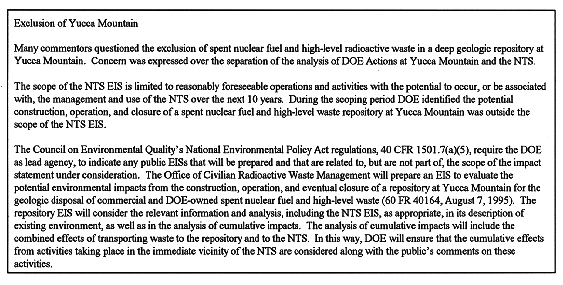
EXCLUSION OF YUCCA MOUNTAIN
Many commentors questioned the exclusion of spent nuclear fuel and high-level radioactive waste in a deep geologic repository at Yucca Mountain. Concern was expressed over the separation of the analysts of DOE Actions at Yucca Mountain and the NTS.
The scope of the NTS EIS is limited to reasonably foreseeable operations and activities with the potential to occur, or be associated with, the management and use of the NTS over the next 10 years. During the scooping period DOE identified the potential construction, operation, and closure of a spent nuclear fuel and high-level waste repository at Yucca Mountain was outside the scope of the NTS EIS.
The Council on Environmental Quality' s National Environmental Policy Act regulations, 40 CFR 1501.7(a)(5), require the DOE as lead agency, to indicate any public EISs that will be prepared and that are related to, but are not part of, the scope of the impact statement under consideration. The Office of Civilian Radioactive Waste Management will prepare an EIS to evaluate the potential environmental impacts from the construction, operation, and eventual closure of a repository at Yucca Mountain for the geologic disposal of commercial and DOE-owned spent nuclear fuel and high-level waste (60 FR 40164, August 7, 1995). The repository EIS will consider the relevant information and analysis, including the NTS EIS, as appropriate, in its description of existing environment, as well as in the analysis of cumulative impacts. The analysis of cumulative impacts will include the combined effects of transporting waste to the repository and to the hITS. In this way, DOE will ensure that the cumulative effects from activities taking place in the immediate vicinity of the NTS are considered along with the public's comments on these activities
THE ELUSIVE WASTE QUANTITY
Virtually every program at a site produces a variety of data that must be included in a site-wide EIS. Almost all programs use electrical power, water, fuel, and human resources and generate waste, air emissions, and water effluent that must be considered. Obtaining facts for each resource and from each information source can be a difficult data acquisition exercise. The following example is provided in an effort to detail the potential difficulty in gathering information on a single data source (volume input) for a single program (waste management), and might into why the task was successful during the development of the NTS EIS. This discussion only reflects one topic in one of five programs addressed in the NTS EIS. Virtually every program at a site generates waste and therefore contributes to waste quantity estimations.
Even at sites with less diversity, nailing down data to develop waste management volumes can be difficult. The very nature of this business (waste management) seems to promote avoidance (don't get any of it on you!). The information can be scarce for this specific topic because the resource requirements needed to manage this task at most sites tend to be limited. In addition, there has been a historical lack of interest in the subject. Acquiring information on this task, which is part of all site-wide EISs, is one that should not be underestimated. Waste management volume data was a particularly challenging subject for the NTS because the NTS receives waste for disposal from many other sites. Development of estimates requires integration between NTS personnel and personnel from other sites. The largest part of the NTS waste volume analyzed in the EIS was developed directly from, and was dependant on, input from other sites. Concurrence was obtained on the waste volumes in time to allow for the development of the Description of Proposed Action and Alternatives.
Success was achieved due to a comprehensive search and gathering of available information on the topic of waste volumes. Use of national, local, and site specific sources of information, as well as current NTS waste disposal information led to defendable and justifiable estimates for waste volumes. The adjusted national and local volumes reported were credible and understandable because the relevant information was available for immediate comparison. When situations arose where there were apparent discrepancies between waste volumes, the players involved in providing the data were assembled to resolve the issues. The logic used to determine the waste volume numbers was explained and decisions were agreed upon in order to set standard estimates prior to continuing on with the analyzes. An excerpt from the Final NTS EIS, which includes a specific example related to the complications regarding waste quantities, is presented in Table III.
There are other issues that must be addressed prior to finalizing acceptable numbers. One issue inherent to the waste volume data is what to do with the data once it is compiled. Sites with complex waste management topics should anticipate variability in the units used to report volumes. This is due in part to the different units used in describing volumes of waste. For instance, at the NTS, low-level waste is reported in cubic feet or cubic meters, whereas, hazardous waste is reported in gallons, liters, or kilograms. The use of different units of measure will likely confuse the general public who may not have a good understanding of the reasons for measuring waste types differently. Of utmost importance is to select the units of measure that will be used and stick with them. If during development, the determination is made to change the units, the change should be made at the very end of the process during technical editing. Waiting until near completion will help maintain consistency and reduce the amount of errors that could arise from rounding numbers during conversions and switching back and forth between units.
Table III - Excerpt from the Final NTS EIS regarding Waste
Quantifies (DOE/NV)
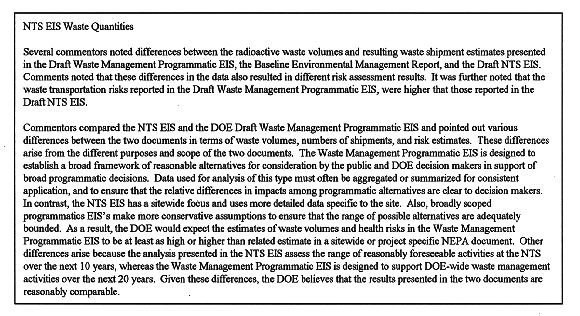
NTS EIS WASTE QUANTIFIES
Several commentors noted differences between the radioactive waste volumes and resulting waste shipment estimates presented in the Draft Waste Management Programmatic EIS, the Baseline Environmental Management Report, and the Draft NTS EIS. Comments noted that these differences in the data also resulted in different risk assessment results. It was further noted that the waste transportation risks reported in the Draft Waste Management Programmatic EIS, were higher that those reported in the Draft NTS EIS.
Commentors compared the NTS EIS and the DOE Draft Waste Management Programmatic EIS and pointed out various differences between the two documents in terms of waste volumes, numbers of shipments, and risk estimates. These differences arise from the different purposes and scope of the two documents. The Waste Management Programmatic EIS is designed to establish a broad framework of reasonable alternatives for consideration by the public and DOE decision makers in support of broad programmatic decisions. Data used for analysis of this type must often be aggregated or summarized for consistent application, and to ensure that the relative differences in impacts among programmatic alternatives are clear to decision makers. In contrast, the NTS EIS has a sitewide focus and uses more detailed data specific to the site. Also, broadly scooped programmatics EIS' s make more conservative assumptions to ensure that the range of possible alternatives are adequately bounded. As a result, the DOE would expect the estimates of waste volumes and health risks in the Waste Management Programmatic EIS to be at least as high or higher than related estimate in a sitewide or project specific NEPA document. Other differences arise because the analysis presented in the NTS EIS assess the range of reasonably foreseeable activities at the NTS over the next 10 years, whereas the Waste Management Programmatic EIS is designed to support DOE-wide waste management activities over the next 20 years. Given these differences, the DOE believes that the results presented in the two documents are reasonably comparable.
E!S APPROVAL PROCESS
The formation of a DOE HQ Integration Team can assist the site through the HQ review, concurrence, and approval process required for EISs. Four major documents (Draft Implementation Plan, Implementation Plan, Draft EIS, and Final EIS) went through the approval process for the NTS EIS with the Integration Team's assistance.
The Final Implementation Plan. was submitted in late April 1996, for approval by HQs and was allowed to flow through the approval process on its own. This took about ten weeks.
The approval process for an EIS depends on the technical nature of the material and its relationship to other DOE reports such as the Baseline Environmental Management Report and the Waste Management Programmatic Environmental Impact Statement. If a variety of programs are included in the EIS, each program office will have input. Site EIS representatives should be sent to HQ to resolve comments and to expedite the review process. With NTS personnel in Washington, D.C. for a week, the Draft NTS EIS was approved in about a month.
The Final NTS EIS faced many challenges, including HQ personnel changes and requests for rewrites. In addition, the approval level was elevated (U.S. Secretary of Energy concurrence), and national issues relating to the Comprehensive Test Ban Treaty were raised. The same team that worked in HQ on the Draft NTS EIS was sent to Washington D.C. to resolve issues on the Final. Even with changes to text and the elevated nature of the approval process, most major issues were quickly resolved, and several rewrites were accomplished. The Final EIS went to HQ in June for signature, revisions to the document were completed by July, and the EIS was released October 8, 1996.
The review and approval cycle at DOE HQ is formidable and should not be underestimated or scheduled as a one-week activity. It should be noted that the "approval" process is also often viewed as a last chance to comment. Rewrite and production time must be included in the approval cycle. The NTS HQ Integration Teem and the Defense Programs NEPA Office were both critical in identification and tracking of this ever changing approval process. Having a core of site EIS personnel available in Washington D.C. during the HQ approval process promotes a relatively quick review and document approval.
LESSONS LEARNED/CONCLUSION
Four important lessons learned during the development of the NTS EIS are highlighted below. They are in the areas of management, planning, the expanding scope, and the approval process. Although the development of the NTS EIS was a success, there is always room for improvement, and many more lessons to learn.
First, as with any project, skillful management is a necessary component for success. The development of a large, complex document will benefit from the appointment of a single lead for the project. A single manager providing clear, specific, and well defined guidance avoids duplication of effort and ensures effective communications. Good communication and teamwork are also critical factors necessary for success of this management approach.
The need for planning is the second critical lesson learned. Maintaining a schedule and budget for the project is critical because the schedule and budget should be used as planning tools. Although up-front, comprehensive planning is critical, flexibility is equally as important.
Third, to handle the expanding scope when developing an EIS, flexibility is once again crucial. The document' s scope and schedule tend to expand as it is influenced by stakeholders, state and local governments, local and HQ DOE, sovereign nations, private industry, and politics. It is beneficial to the development of the document to use both experienced NEPA professionals and people with little or no NEPA experience. The experienced people will provide historical knowledge and assist in determining baseline scopes for the alternatives. The relatively inexperienced people will provide innovative thinking and approaches to developing an EIS.
The final lesson learned from the development of the NTS EIS involves the DOE approval process. Areas for improvement include the site taking an active role in the tracking and monitoring of the DOE HQ approval process. This can be accomplished by sending a site EIS representative, the higher the level the better, to HQ for a week or two just prior to each approval cycle. By contacting each person in the review cycle, changes or updates can be identified, and actual meetings held to obtain approval can be scheduled. Having site personnel at HQ during the concurrence process helps expedite the answering of questions and resolution of
The development of the NTS EIS was exciting, complex, and at times, extremely stressful. Many requirements to successfully manage and develop the EIS were common sense elements that apply to almost all large project documents. Hopefully the examples and suggestions presented in this paper will assist future NEPA Ninjas in the successful completion of a large, complex EIS.
Work supported by the U.S. Department of Energy Nevada Operations Office under Contract No. DE-AC08-96NV 11718.
By acceptance of this article, the publisher and/or recipient acknowledges the U.S. Government's right to retain a nonexclusive, royalty-free license in and to any copyright covering the article.
BIBLIOGRAPHY
U.S. DEPARTMENT OF ENERGY (DOE), "Energy: Compliance with the National Environmental Policy Act," Code of Federal Regulations, Office of the Federal Register, National Archives and Records Administration, U.S. Government Printing Office, Washington, DC, 1992.
COUNCIL ON ENVIRONMENTAL QUALITY (CEQ), "Protection of the Environment: Regulations for Implementing the Procedural Provisions of the National Environmental Policy Act," Code of Federal Regulations, Office of the Federal Register, National Archives and Records Administration, U.S. Government Printing Office, Washington, DC, 1993.
U.S. DEPARTMENT OF ENERGY, NEVADA OPERATIONS OFFICE (DOE/NV), Final Environmental Impact Statement for the Nevada Test Site and Off-Site Locations in the State of Nevada, Volume 3, Report No. DOE/EIS 0243, Las Vegas, NV, 1996:
U.S. ENERGY RESEARCH AND DEVELOPMENT ADMINISTRATION (ERDA), Nevada Test Site, Nye County, Nevada Final Environmental Impact Statement, Report No. ERDA-1551, Washington, DC, 1977.