Edward J. Bentz, Jr., C.B. Bentz, and T.D. O'Hora
E. J.
Bentz & Associates, Inc.
Alexandria, Virginia
ABSTRACT
This paper reviews the increasing role of state-established, contaminant-specific remediation standards in environmental cleanup of nuclear waste sites, and discusses how the development of such standards has varied from U.S. Environmental Protection Agency (EPA) standards and guidelines. The paper describes the overall regulatory processes applicable to environmental cleanup at U.S. Department of Energy (DOE) Weapons Complex sites; describes the regulatory criteria which provide the framework for the development of preliminary remediation goals and final remediation levels under the Comprehensive Environmental Response, Compensation, and Liability Act, and for the development of action levels and media cleanup standards under the Resource Conservation and Recovery Act; and describes the role of states and state-derived standards in these processes. States which have, to date, established their own numeric standards and/or guidance regarding contaminant-specific exposures by media and their human use are identified, and a description is provided regarding how the various state-developed standards and/or guidance differ from and/or supplement EPA standards. The paper then provides examples of methodological approaches that have been used by states to develop general and DOE site-specific cleanup standards, and describes how such approaches are similar to and/or different from established methodologies recommended by EPA.
NATURE AND SCOPE OF THE REQUIRED REMEDIATION
For more than 50 years, the mission of the DOE and its predecessor agencies has included responsibility for atomic energy and nuclear weapons research, development, production, and field testing in the United States. During this period, a vast network of industrial facilities, which became known as the "Nuclear Weapons Complex," was established. It consisted of 16 major facilities, including large reservations in Nevada (the Nevada Test Site), Idaho (the Idaho National Engineering Laboratory), Washington (the Hanford Site), and South Carolina (the Savannah River Site), and in excess of 100 smaller facilities. These facilities include over 2.3 million acres of land and thousands of large industrial buildings, such as nuclear reactors; chemical processing buildings; metal machining plants; and maintenance, waste treatment, and support facilities.
Because of the national priority historically placed on weapons production, the treatment, storage, and disposal of radioactive and chemical wastes within the Weapons Complex was previously handled in a manner that led to large backlog stores of wastes and hazardous materials, and to contamination of soil, surface water, and groundwater at a large number of the sites. Approximately 10,500 potential contaminant release sites have been identified to date by DOE within 115 current or former Weapons Complex facilities, located in more than 30 States and Territories.
The contaminants released at these Weapons Complex sites range from chemicals used commonly in various industrial processes to long-lived radioisotopes generated as part of the nuclear weapons development and testing program. Sites and contaminants can vary widely, even within a specific facility.
FEDERAL REGULATORY FRAMEWORK
Currently, contaminated sites are regulated by a patchwork of Federal statutes and implementing regulations. The primary Federal statutes applicable to site remediation are:
Resource Conservation and Recovery Act, 42 U.S.C. §6901 et seq. (RCRA). The RCRA establishes a comprehensive national regulatory framework governing the environmental management of hazardous wastes (including the hazardous components of radioactive mixed wastes) "from cradle to grave." RCRA establishes a framework for investigating and addressing past, present, and in some cases, future environmental contamination at hazardous waste treatment, storage, and disposal facilities currently in operation. RCRA uses a permit process for administration and control of hazardous substances and to oversee and enforce compliance. Jurisdiction is primarily over chemical contaminants, not radionuclides or the radionuclide portion of mixed wastes.
Federal Facility Compliance Act, 42 U.S.C. §6961 et seq. (FFCA). The FFCA waives the sovereign immunity of the Federal Government and permits states and the EPA to impose fines and penalties for RCRA violations (see para. above) at Federal facilities. It also requires DOE to develop plans for the management and treatment of the hazardous components of radioactive mixed wastes subject to RCRA requirements. The FFCA provides states with a valuable tool in regulating the management (handling, storage, treatment, and disposal) and cleanup of hazardous wastes (and importantly, of mixed hazardous/radioactive wastes) within the boundaries of Federal facilities.
Comprehensive Environmental Response, Compensation, and Liability Act, 42 U.S.C. §9601 et seq. (CERCLA). Also known as the "Superfund," the CERCLA is directed at protecting human health and the environment by establishing a comprehensive regulatory framework for investigating and remediating uncontrolled releases of hazardous substances, most often from facilities no longer in operation. The hazardous substances include both chemicals and radionuclides. The Act and its implementing regulations prescribe a process for compliance. The oversight of the process is undertaken by the EPA and authorized states.
Atomic Energy Act, 42 U.S.C. §2011 et. seq. (AEA). The AEA authorizes DOE to develop its own rules, procedures, and standards to ensure the safe management (including production, possession, storage, transportation, and use) of radioactive materials at its own facilities. These rules, procedures, and standards are generally specified in the form of DOE Orders.
RCRA, CERCLA and the FFCA, along with their associated regulations, are the primary regulatory drivers governing environmental remediation activities at DOE Weapons Complex facilities. Note, as discussed below, that many of the standards applied by RCRA and CERCLA are developed under other relevant statutes, such as the maximum contaminant levels developed under the Safe Drinking Water Act. Each of these statutes, and its associated regulations, applies to different types of sites and, in some cases, to different types of materials (e.g. radionuclides generally are exempt from regulation under RCRA, and petroleum/natural gas products are generally exempt from regulation under CERCLA); however, at least one of the two remedial statutes applies to nearly all substances present at DOE sites. The primary difference between the CERCLA and RCRA regulatory scope is that CERCLA addresses "uncontrolled releases of hazardous substances," often from facilities no longer in operation; by contrast, RCRA focuses on prevention and remediation of releases from currently operating facilities (including waste management facilities).
Both RCRA and CERCLA remedial responses are generally triggered if EPA, an authorized state, or the facility itself determines that hazardous wastes, substances, or constituents have been, or are likely to be, released into the environment. A site only becomes subject to the provisions of CERCLA if, after a preliminary assessment and site investigation process, the site scores at least 28.5 using EPA's Hazard Ranking System and is therefore included on the National Priorities List (NPL) of hazardous waste sites.(1) The following Weapons Complex sites are currently included on the NPL, and are therefore subject to the requirements of CERCLA: Brookhaven National Laboratory, Fernald, Hanford (Areas 100, 200, 300, and 1100), Idaho National Engineering Laboratory, Laboratory for Energy Related Health Research, Lawrence Livermore National Laboratory (Main and 300 Areas), Maywood Chemical Works Site, Monticello (Mill Tailings and Vicinity Properties), Mound Plant, Oak Ridge Reservation, Paducah Gaseous Diffusion Plant, Pantex Plant, Rocky Flats, Savannah River, the St. Louis Airport Site, and Weldon Springs. Note that current and/or near-term risk to the public health are important bases for inclusion on the NPL. The Nevada Test Site, among the most contaminated of DOE sites, is not presently listed on the NPL, because of its isolation from human populations.
Investigations initiated under one authority (CERCLA or RCRA) may trigger response under the other authority: a RCRA investigation may uncover conditions requiring that the facility be placed on CERCLA's NPL; or, conversely, a CERCLA investigation may reveal conditions which do not meet the NPL threshold, but do require remedial action under RCRA.
DEVELOPMENT OF CLEANUP STANDARDS UNDER FEDERAL REGULATIONS
Development of Remediation Standards Under CERCLA. The CERCLA process utilizes Preliminary Remediation Goals (PRGs) as long-term targets during the analysis and selection of remedial alternatives. Contaminant-specific PRGs are remedial action concentration goals for specific medium and land use combinations at CERCLA sites. PRGs are developed during scooping of, or concurrently with, initial CERCLA Remedial Investigation/Feasibility Study (RI/FS) activities. Development of PRGs requires site- specific data regarding: 1) media of potential concern; 2) contaminants of potential concern; and 3) probable future land use. The two general sources of contaminant-specific PRGs are concentrations based on ARARs and concentrations based on risk assessment:
ARARs: Contaminant-specific or other Federal or State numeric standards (e.g. Clean Water Act maximum contaminant levels (MCLs), or alternative treatment standards) which are considered applicable or relevant and appropriate (ARAR) by the EPA or the State on the basis of the contamination present and the site conditions. ARARs may include potentially more stringent (than Federal) State numeric standards or State "antidegradation" policies (such as for groundwater); such policies may be more stringent than cleanup standards based on human health risk. However, many identi fied ARARs may not have been derived from risk levels that would meet the CERCLA objectives of "protectiveness of human health." In other words, PRGs based on ARARs could also be less stringent than criteria based on that 10-4 to 10-6 risk level (e.g. as noted below, the cancer risk of the Federal MCL for beryllium in groundwater is 1.97 x 10⁻⁴). Nonetheless, ARARs are considered to be acceptable as action levels under CERCLA.
Risk-Based PRGs: ARARs do not exist for all contaminants in various environmental media. If no Federal or State standard exists for a particular contaminant, a site-specific risk-assessment may be performed to establish a preliminary cleanup standard for the specific contaminant. These risk-based standards must satisfy the requirements and criteria of The National Oil and Hazardous Substances Pollution Contingency Plan (CERCLA's implementing regulation, 40 CFR Part 300).(2)
The initial PRGs are refined into final remediation goals during the process leading up to remedy selection using additional data gathered during the RI/FS and guidance(3) and data provided by the EPA.
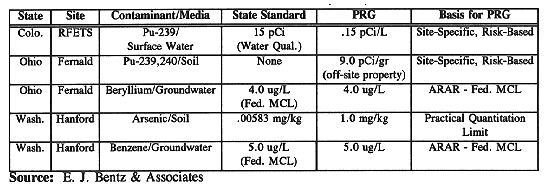
Table I provides illustrative examples comparing State standards with PRGs for different contaminant/media combinations. The State standards listed in the table were all established under RCRA-delegated authority. Note there are differences between some of the State Standards and the PRGs listed in the table. The PRGs were all established under site-specific agreements integrating State and Federal site remediation activities under both RCRA and CERCLA (i.e., the Fernald Environmental Management Project Amended Consent Decree; the Rocky Flats Cleanup Agreement; and the Hanford "Tri-Party Agreement"). The more stringent site-specific PRG for Pu-239 in surface waters at Rocky Flats was negotiated and agreed upon between the DOE, EPA, and the State of Colorado. The State of Ohio has not established a standard for Pu-239/240 levels in soils; hence, the PRG was used as the preliminary standard. The proposed PRG for Arsenic in soils at Hanford is the practical quantitation limit (levels at which measurements can be "trusted").
TABLE I Illustrative Examples Comparing State
Cleanup Standards with Proposed Preliminary Remediation Goals (PRGs) under
CERCLA
Development of Media Cleanup Standards Under RCRA. The primary mechanism triggering a Corrective Measures Study (CMS) under RCRA is the discovery that the concentration of a contaminant released from a Solid Waste Management Unit (SWMU) exceeds the "action level" set for that contaminant. Action levels are media- specific contaminant concentrations considered protective of the public health and the environment. Action levels are generally based on standards issued under State and Federal ARARs, such as the Safe Drinking Water Act (SDWA). For example, groundwater action levels for contaminants at Rocky Flats were established at SDWA MCLs and, if no MCL was available for a specific contaminant, then action levels were set at the preliminary PRGs established for the site under CERCLA. In turn, these preliminary PRGs were established by a site-specific risk assessment.
The action levels described above are not cleanup goals. In contrast, target Media Cleanup Standards (MCSs) are established as preliminary cleanup goals during a RCRA CMS, to provide a benchmark for evaluating the effectiveness of alternatives for the corrective measure. Action levels and target MCSs can differ significantly from final MCSs established for the corrective measure. They may be substantially modified into the MCSs in a final Record of Decision by the process and factors set forth in 40 CFR 264.525. These factors include: 1) the effects of exposure to multiple contaminants; 2) the impacts to environmental receptors; 3) the cumulative risk arising from other exposures not directly related to the release; and 4) the effectiveness, practicality, reliability, and other factors related to alternatives and the ability to achieve the MCL for a contaminant. Under certain circumstances, cleanup to MCSs may not be required (See 40 CFR §264.525(d)(2), for example, in broadly contaminated areas if the risk posed by a release from the single SWMU is slight when compared to the risk posed by the entire area.
Relationship Between CERCLA PRGs and RCRA MCSs. Both the CERCLA and RCRA preliminary cleanup standards stress protection of both human health and the environment. CERCLA is more explicit in requiring consideration of standards and criteria established under other Federal and State statutes. Although preliminary cleanup standards under both statutes may be identical, it is also possible for different preliminary cleanup standards to be developed under the two programs for the same contaminant/media. In general, where CERCLA is applicable, sites proceed under CERCLA as the lead regulatory program with RCRA MCSs as an ARAR. However, the final site-wide remediation standards would be those established under CERCLA.
STATE ROLE WITHIN THE FEDERAL REGULATORY FRAMEWORK
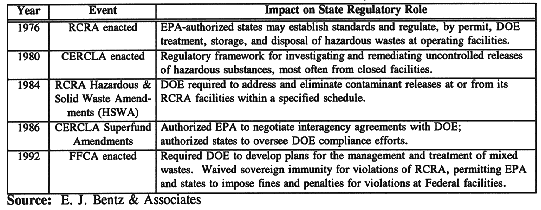
Overall, the role of states in regulating the management and cleanup of hazardous wastes at DOE facilities is dependent on the authority provided by Federal regulations and the degree of delegation by Federal authorities, such as EPA. A succession of Federal statutory enactments have provided an ever-increasing role for states. Table II provides a chronology of these enactments and describes their impacts on state regulatory roles:
TABLE II Chronological Summary of Federal Statutory
Enactments and their Impacts on State Regulatory Roles
Between 1985 and May of 1995, following the enactment of the RCRA HSWA, more than 117 agreements (Federal Facility Compliance Agreements, Settlement Agreements, and Consent Orders)(4) have been entered into between DOE and EPA, and/or various states. These agreements have involved more than 30 facilities in 16 states. The number of agreements has grown at a steady pace, as indicated by Table III:
TABLE III Chronological Summary of the Number of
Cleanup Agreements Entered Into by Federal and State Authorities

In addition, an increasing number of states (more than 20 to date) have established their own risk-based standards for media-specific cleanup for some contaminants under the above authorities (see Table IV, below).
State Role Under RCRA. Under RCRA, permitting is the instrument of regulatory control. The EPA has lead administrative authority/responsibility for a RCRA corrective action. The EPA has enforcement authority through site permitting. However, states are authorized to apply for approval by EPA to administer and enforce the state's own hazardous waste program in lieu of the Federal RCRA program, and to regulate radioactive mixed wastes (the hazardous portion) based on the FFCA. The degree of state regulatory authority at a site under RCRA depends on the amount of authority requested by the state from, and delegated to the state by, EPA. For example, since November 2, 1984, the State of Colorado has been authorized by EPA to administer and enforce the State's hazardous waste program (the Colorado Hazardous Waste Act) in lieu of the Federal program. In November, 1986, Colorado was authorized to regulate radioactive mixed waste; and on July 14, 1989 was further authorized to enforce certain portions of the Solid Waste Disposal Act Amendments. The State of Nevada has had EPA-delegated authority for the RCRA hazardous waste program since November 1, 1985; and on July 29, 1992 was further delegated Federal HSWA authority for mixed wastes and corrective action activities.
State Role Under CERCLA. For a CERCLA remedial process, DOE, under authority of the AEA, has lead administrative responsibility for its sites, with oversight and concurrence authority in EPA and an authorized State. An example is the Hanford Site in the State of Washington.
Operating DOE facilities which have been designated CERCLA National Priorities List sites typically contain one or more sites that are subject to concurrent RCRA regulation. Furthermore, many DOE sites are also subject to regulation of mixed waste treatment activities by EPA or an authorized State under the FFCA. In such cases, the overlap ping authorities of CERCLA, RCRA, and the FFCA; and applicable State statutes (e.g. the Washington Model Toxics Control Act; the Colorado Hazardous Waste Act) are usually integrated through a negotiated, site-specific Consent Order and/or Federal Facility Agreement (e.g. the Rocky Flats Cleanup Agreement; the Hanford Site Tri- Party Agreement; and the Nevada Test Site Federal Facility Agreement and Consent Order for corrective actions and FFCA Consent Order for mixed waste management). These agreements are designed to ensure compliance with all applicable regulatory requirements.
In general, the state role, under delegated Federal authority, has been practiced in two areas: 1) in the development of processes to comprehensively integrate multiple regulatory compliance requirements (e.g. the Federal Facility Agreements and Consent Orders identified above); and 2) in the development of state standards (and methods to develop standards) for cleanup levels, as discussed below.
STATE INITIATIVES IN ESTABLISHING CLEANUP STANDARDS
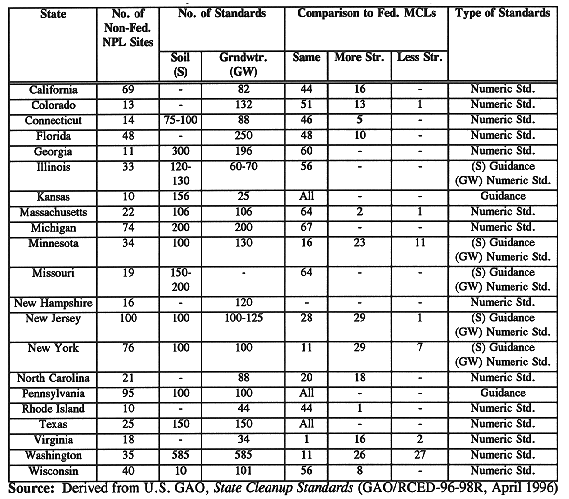
There are currently only a few established Federal standards for contaminants in soil (e.g. PCBs and lead). For groundwater, there are currently enforceable Federal standards for 68 organic and inorganic chemicals under the Safe Drinking Water Act. These standards establish maximum contaminant levels (MCLs) that restrict the concentration level of a contaminant that may be present in drinking water. Often an MCL is adopted as the applicable or relevant and appropriate (ARAR) standard for a specific contaminant and site. EPA also establishes generally more stringent, maximum contaminant level goals (MCLGs) for each contaminant. MCLGs are contamination levels at which no known adverse human health effects have been identified, and which will allow for an adequate margin of safety. MCLs (enforceable Federal stan dards) are generally set as close to the MCLGs as "feasible," considering the availabil ity of technology and considering cost (e.g. the MCLG for alachlor is 0.0 ug/L; the corresponding MCL is 2.0 ug/L).As of March, 1996, at least 21 states had established their own numeric standards for contaminant exposures by media and their human use. For each of these states, Table IV below provides a summary of: 1) the number of non- Federal National Priorities List (NPL) facilities located in the state; 2) the number of numeric standards established by medium; 3) a comparison of groundwater standards to Federal MCLs; and 4) the type of standards (numeric standards vs. guidance).
Of these 21 states, 20 have based contaminant-specific standards, in part, on estimates of human health risk posed by exposure (the basis in one state -- Virginia -- is unclear). In general, the states have provided more flexibility in allowing for adjustment of cleanup levels derived from soil contamination standards than from groundwater contamination standards in order to take into account site-specific conditions. Note that the state standards summarized in Table IV generally refer to contaminant standards developed under RCRA authority (usually hazardous chemical contaminants, not radionuclides). A further discussion is provided below regarding the joint (EPA/DOE/State of Colorado) development of standards for radionuclide contaminated soils.
About one-third of the states with no numeric soil standards use risk assessments to develop cleanup levels for soil on a site-specific basis. Approximately one-half of the states with no numeric standards use Federal drinking water standards to set cleanup levels for groundwater. Most states have established standards based on the Federal MCLs and on risk assessment processes which generally follow the EPA Superfund Guidance, but which are either more generic or based on the state's own methodology and/or supplemental guidance.
TABLE IV Summary of State-Established, Numeric
Cleanup Standards
EXAMPLES OF STATE INITIATIVES IN ESTABLISHING CLEANUP STANDARDS
The following discussion provides a brief description of two examples of state initiatives involving the development of contaminant-specific standards: 1) an example of the development of a standards development methodology by the State of Washington; and 2) an example of the cooperative development of contaminant-specific standards at a DOE site by the State of Colorado, in cooperation with DOE and EPA.
State of Washington Standards Development Methodology. Under the Washington Model Toxics Control Act (MTCA), the State of Washington bases its cleanup standards on the health-based assessment of risks posed by individual contaminants. The MTCA risk assessment process follows the EPA Superfund Guidance, but provides a three-tiered methodology for establishing cleanup levels.
The three tiers, represented by increasingly complex Methods labeled A, B, and C are applied in increasingly complex contamination environments. Each Method provides risk assessment criteria. The more complex (B and C) are to be utilized where no sufficient health-based standards have been established. Cleanup levels must be as stringent as existing ARARs and meet Method-specific lifetime risk ceilings (for carcinogens).
The following is an example applying the MCTA Method B in establishing a groundwater cleanup level for a single contaminant (beryllium). Cleanup levels for groundwater under Method B must be as stringent as existing ARARs. For known or suspected carcinogens (including beryllium), risk-based cleanup levels are determined using the following equation and standard exposure assumptions (as a matter of policy, the regulation defines the exposure parameters which are to be used: groundwater cleanup levels must be based on estimates of the highest beneficial use -- generally drinking water and other domestic uses -- and on estimates of reasonable maximum exposure):
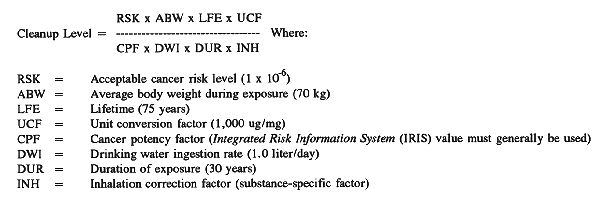
Using the EPA-provided IRIS Oral CPF value (4.3), the MCTA Method B groundwater cleanup value for beryllium is calculated to be .00203 ug/L, which is more stringent than the Federal MCL (4.0 ug/L). However, since the Federal MCL value exceeds a cancer risk of 1 x 10⁻⁵ (the MCL cancer risk is 1.97 x 10⁻⁴), the MCTA cleanup value of .00203 ug/L must be used.
State of Colorado Cooperative Development of Contaminant-Specific Standards. Under the Rocky Flats Cleanup Agreement (RFCA), a Working Group consisting of representatives of DOE; EPA; the State of Colorado; and Kaiser-Hill, L.L.C. was established to develop soil action levels and cleanup standards for radionuclides at the site. The Working Group chose radiation dose as the primary criterion for assessing radionuclide action levels for soils; specifically, it was recommended that EPA's draft 10 CFR 196(5) standard be used, i.e., for a period of 1,000 years after remediation, an annual effective dose equivalent to a reasonably maximally-exposed individual through all pathways of no more than 15 mrem/yr., and 85 mrem/yr. should institutional controls fail in the future. Upon this basis, the Working Group developed site- and radionuclide-specific action levels for site remediation.(6)
Future land uses for developing action levels (as prescribed by the RFCA) for the Rocky Flats Environmental Technology Site (RFETS) are based on open space and industrial uses of the site. The inner and outer buffer zones of the site are to be remediated to accommodate open space uses in the near and intermediate terms. Industrial uses are applicable to the plant-site area.
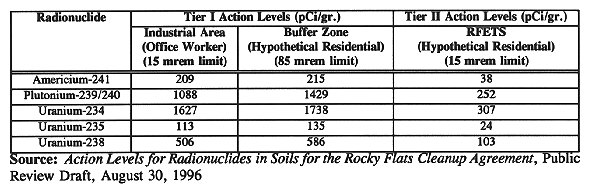
Two action levels were calculated for radioactive materials in surface soils at RFETS: Tier I action levels (levels that, when exceeded, trigger an evaluation, remedial action, and/or management action, given the presence of institutional controls); and Tier II action levels (levels that, when met, do not require remedial action and/or institutional controls.
The RESRAD computer code (Version 5.0)(7) was selected for use in calculating the action levels for multiple scenarios over the 1,000-year modeling period. Although all isotopes of RFETS plutonium were initially assessed, successive investigations of decay rates and toxicity resulted in focusing on Pu239, Pu240, Am241, and Am242. In addition, the more conservative Tier I exposure scenarios (for the Industrial Area and Buffer Zone) were utilized in the development of the RFETS action levels. The resulting action levels are summarized in Table V:
TABLE V Rocky Flats Environmental Technology Site
(RFETS) Action Levels for Radionuclides in Soils
SUMMARY
There are significant amounts of contamination at DOE Weapons Complex Sites. The contaminants include radionuclides, hazardous chemicals, and mixed wastes.
Within the Federal regulatory framework, states have a delegated role in the regulation and enforcement of media- and contaminant-specific cleanup levels at DOE Sites. State initiatives within the Federal regulatory framework have included the establishment of Federal-State regulatory integration processes to ensure complete and comprehensive regulation of contaminant storage, transportation, disposal, and cleanup; and to ensure the development of appropriate remediation standards.
The number of Federal-State Compliance Agreements has grown to over 114 since 1985, involving more than 30 facilities in 16 states.
To date, at least 21 states have developed numeric standards for remediation of hazardous substances in groundwater, surface water, and soils. Most of these standards have been for groundwater. Numeric cleanup standards do not exist for many substances. In developing these standards, states have relied on both the adoption of Federal standards and on their own methods of standard-setting, especially for substances with no applicable Federal standard.
Methods used to develop these state standards have included site-specific risk assessments and more generic risk analyzes, including cooperative development of contaminant-specific standards by DOE, EPA, and states.
We expect the pace of such state and Federal-state cooperative standard-setting to increase, and to play a greater role at DOE Weapons Complex Sites in the future.
REFERENCES