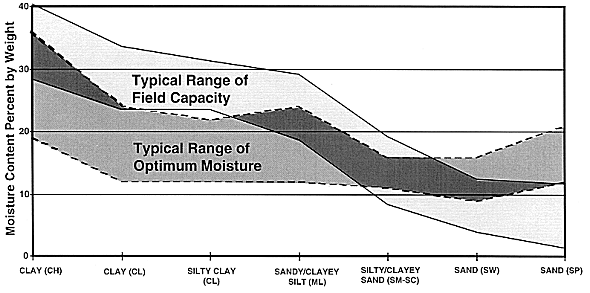
Fig. 1. Field capacity and optimum
moisture content ranges for various soil types.
Ben RogersCHMM
Bechtel National, Inc.
Preston
McDaniel and Eric Strassburger
Bechtel National, Inc.
ABSTRACT
The Department of Energy's Formerly Utilized Sites Remedial Action Program has developed a moisture control plan to prevent free-standing liquid from collecting in waste shipments. Site waste conditions are assessed, waste moisture content is measured before loading, waste containers are examined for integrity, and moisture reduction methods are applied as required. To determine the potential for excessive moisture in waste shipments, several laboratory tests were evaluated to find a suitable method of identifying the moisture-holding capability of soil at the anticipated shipping density. As a result of this evaluation, the vibratory free liquid test was devised and validated through field testing.
INTRODUCTION
The Formerly Utilized Sites Remedial Action Program (FUSRAP) was established in 1974 to identify, investigate, and clean up or control sites where residual radioactivity exceeding current guidelines remains from the early years of the nation's atomic energy program and other sites assigned to the Department of Energy (DOE) by Congress. The residual radioactivity at these sites resulted from the storage, sampling, assaying, and processing of uranium ore and metal during the 1940s, 1950s, and 1960s. FUSRAP includes 46 sites in 14 states.
WASTE MOISTURE PROBLEM
In the past, radioactive waste disposal facilities limited the amount of free-standing liquid in a waste shipment to 1 percent of the volume of the container or 1 gallon (4L), whichever is less. More recently, waste acceptance criteria have been tightened to exclude waste shipments containing any free-standing liquids.
More than 1,600 individual shipments of waste material for disposal have been successfully completed by FUSRAP. These shipments consisted of 220 trucks, 755 rail gondolas, and 719 intermodal containers. However, seven shipments were received at the disposal facility with free-standing liquid; all of these were soil shipments made in winter months in enclosed steel containers. Although each of them was inspected at the loading site and determined to be dry, the containers arrived at the disposal facility with amounts of 90 to 650L of free-standing liquid.
An engineering evaluation of the free-standing liquid problem determined that free-standing liquids in FUSRAP shipments were probably the result of
Based on this evaluation, a four-phase moisture control plan was developed and implemented at FUSRAP sites.
MOISTURE CONTROL PLAN
The engineering evaluation identified four main areas of concern to be addressed in the moisture control plan:
The moisture control plan should also determine the maximum allowable moisture content in waste shipments, establish methods for controlling moisture content in the field, set a quantitative limit for moisture content, and provide easy-to-use tools for field personnel to monitor and adjust the moisture content to meet the prescribed limit.
As the plan was being developed, it became clear that a test method was needed to simulate a shipment of soil that had released water during transport. This method would determine a moisture content by weight (i.e., not volumetric) under which a soil will drain by gravity. In the agricultural world, this parameter is termed the "field capacity" and is dependent on soil density, gradation, plasticity, and other parameters.
LABORATORY EVALUATION OF SOILS
Shown in Fig.1 are typical ranges of field capacities for various Unified Soil Classification System (USCS) soil categories at densities of about 90 percent relative compaction (1, 2).
Fig. 1. Field capacity and optimum
moisture content ranges for various soil types.
To determine the field capacity of a given soil, the density of the soil as a result of compression or settling during transport must be considered. The ideal field capacity test would determine the moisture-holding capability of the soil at the density it will have when received at the disposal facility. The following standard laboratory tests were evaluated to determine whether they provide a basis for predicting soil field capacity.
The key criteria for the ideal field capacity test are simplicity, rapidity, and repeatability. The test must simulate conditions during shipment, including the vertical flow of water and soil densification by vibratory loading under appropriate overburden stresses. It is also desirable to use standard laboratory equipment, like the vibratory table and soil mold from the maximum density test (ASTM D-4253).
To meet these criteria, the vibratory free liquid test was developed:
Sample test results are presented below. The dry density and Proctor test results are shown for comparison.
Table I Typical Vibratory Free Liquid Test Results
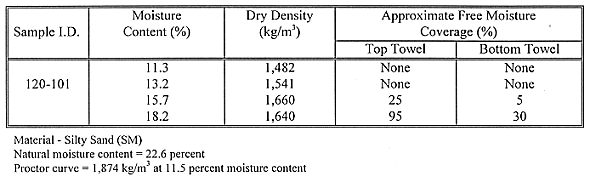
The moisture content at which water is released is assigned as the vibratory free liquid test result. The allowable shipping moisture content is determined by adding an appropriate adjustment to reflect the sensitivity of the soil (+2 percent for clays, +0 for all other soils).
The results of the soil tests are compared with the published field capacity values in Fig.2.
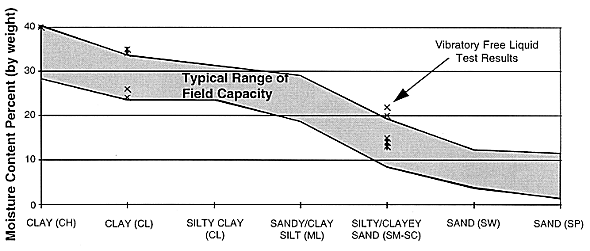
Fig. 2. Field capacity and vibratory
free liquid results for various soil types.
FIELD TESTING
A field test to validate results of the vibratory free liquid test was conducted during shipping of soils from one FUSRAP site to another. About 65 m3 of material was shipped in sealed metal boxes.
For the test, eight 19-L plastic buckets were prepared by drilling small holes in the bottom, setting each bucket inside another solid-bottom bucket, and then sealing the two together with duct tape. Samples of the soil material were then mixed at approximately 2 percent moisture content increments ranging from the stockpile moisture to a moisture about 14 percent wetter. Each soil sample was placed in one of the test bucket setups, and tightly fitting lids were used to seal the buckets tops. The buckets were then nested in the corners of the already filled metal shipping containers. In this way, the samples in the buckets would undergo the same vibratory loads and temperature changes as the shipped soils, although the average confining pressure would be lower. The containers were shipped by truck from New Jersey to Tennessee and allowed to sit for about a month before they were opened. During and after transit, the soil samples could drain into the void space between the two buckets. When the buckets were opened, the top of the soil sample was inspected and the water in the outer bucket was measured. The measured water was then normalized to the amount of dry soil in the bucket. Figure 3 shows the normalized quantity of free water released relative to the moisture content of each sample.
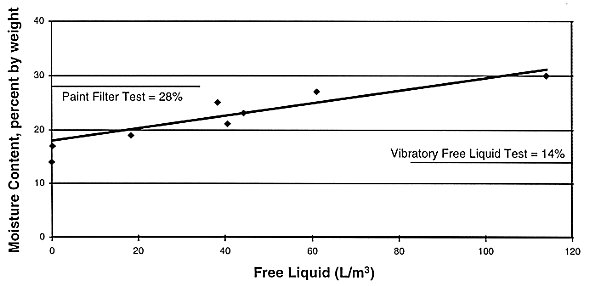
Fig. 3. Moisture characteristics,
dark brown sandy silt.
At the allowable shipping moisture content determined by the vibratory free liquid test, no free water was observed, but at 4 to 6 percent above that limit, significant free water was measured. The wettest samples also had measurable free water on top of the soil in the buckets. This water appeared to be from sweating or from vibration. Samples in the vibratory test also often show significant moisture at the top of the sample as well as the bottom. Initial testing with the soils indicated that a successful paint filter test would allow about 28 percent moisture, a moisture content measured to produce about 115L/m3. However, while the theoretical water release is predicted to exceed the vibratory free liquid test result (plus 4 percent), only one-third to one-half of that amount was ever observed.
After the accuracy of the vibratory free liquid test was established, the test was incorporated into the moisture control plan implemented at FUSRAP sites.
IMPLEMENTING THE MOISTURE CONTROL PLAN
Figure 4 shows the logic for the moisture control plan.
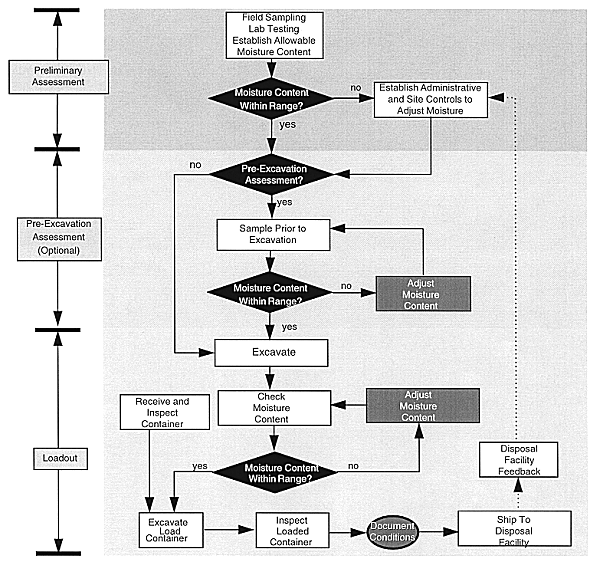
Fig. 4. Moisture content logic
diagram.
Preliminary Assessment
The first phase of the moisture control plan is a preliminary assessment of site waste conditions. The plan requires the gathering of technical and descriptive information that is used to classify each type of waste. For example, soils are classified by color, soil type, USCS type, consistency, and geologic origin. Based on waste characteristics, including water holding properties, an allowable moisture content is established for each waste material. This specifies an upper boundary of moisture content to ensure that no free liquids are present in the shipment upon receipt at the disposal facility. As part of the subsurface investigations of the site, the following actions are taken:
- visual classification (per ASTM D-2488),
- standard Proctor (per ASTM D-698) with one four-point curve for each material,
- moisture content (per ASTM D-2216),
- paint filter liquid test (EPA Method 9095), and
- soil pH (per ASTM D-4972).
As part of the preliminary assessment, recommendations for moisture adjustment methods may be made that could include improving site drainage characteristics, air drying, using effective soil additives, and other applicable means to adjust or control moisture content.
Pre-Excavation Assessment
Before excavation, a pre-excavation assessment is used to verify moisture conditions and make adjustments as necessary to comply with the soil moisture criteria. The assessments are performed within two days of packaging the waste and are repeated as dictated by climatic or site characteristic changes. As part of this assessment, field moisture content is measured for each type of material. The results of this testing should allow for timely implementation of moisture control alternatives.
Waste Loading
Before the containers are loaded, the moisture content of the waste is measured. This evaluation establishes the requirement for moisture control measures and indicates whether additional mitigation efforts are needed. During loading of the waste, final moisture content measurements are made to verify that the waste moisture content is under the allowable limit. Materials that exceed moisture acceptance criteria are identified, and moisture conditioning actions are taken before the waste leaves the site. Soils with moisture greater than 2 percent above the allowable limit are not loaded until they are properly moisture conditioned and retested to verify that they are acceptable. Wastes with moisture contents of up to 2 percent above the limit are allowed if absorbent is added. After field moisture contents have been determined and loading has been approved, no additional water may be added, either from natural causes (such as rain) or for dust control. If water is added, intentionally or not, new moisture content measurements must be made.
Absorbents used to condition the waste need to be approved by the disposal facility for such considerations as organic and inorganic content, hazardous material content, long-term stability, and ability to retain liquid under freeze-thaw or external load application as measured by SW-845 Method 9096 (liquid release test). When absorbent is mixed with waste before determination of the moisture content, the moist absorbent must be included in the moisture content determination.
Because frozen materials can release free liquids during thawing, and field detection of ice and frozen saturated materials is nearly impossible under normal work conditions, frozen soils and ice are not loaded regardless of moisture content measurements.
Container Inspection
Guidance is provided on inspecting shipping containers to verify that they are suitable for the waste material being transported, are structurally sound, and have no holes or cracks that would allow waste to leak out or water to leak in. Before loading, an additional inspection is performed to verify that no water or liquids have been introduced to the container and the container has not been damaged. After loading, the container is inspected again for proper placement of materials, and the waste is tested for acceptable moisture content.
OTHER CONSIDERATIONS
No problems have been reported since the implementation of the moisture control plan. However, not explicitly addressed in the moisture content testing are the effects of freeze thaw and sweating. It is recognized that freezing may cause the development of ice lenses in fine-grained soils and that upon thawing, the soils are often found to be over consolidated, and thus less water can be reabsorbed than was released. Another concern is that sweating inside the container can release water. Absorbent material may be placed in areas of the container where water could accumulate as a result of sweating.
Several shortcuts have also been recognized. For example, soil stored in covered stockpiles that have been allowed sufficient time to drain has consistently been found to have a moisture content at or below the vibratory free liquid moisture content, as is implied by the term "field capacity."
CONCLUSIONS
The moisture control plan has proven to be effective for FUSRAP waste shipments. No shipments containing free water have been reported by the disposal facility since the plan was implemented.
The plan is based on conservative assumptions because shipments cannot be inspected or remediated at the disposal facility.
A 2-percent contingency in the plan is required to account for variability in soil properties and moisture content and for accuracy limitations in the laboratory and field moisture content measurements. Because of the uncertainty in shipping duration for many waste shipments, contingencies in moisture content must also be provided for sweating and freeze-thaw.
Shortcuts and other cost-saving methods are being considered. These methods include less frequent moisture content testing, particularly where soils are relatively consistent in material type and moisture content and where soils have been stockpiled and allowed to drain for a significant period before shipment.
Any project shipping materials that have produced free water in transit should consider using the vibratory free liquid test as an indicator of the allowable moisture content. The frequency of testing and use of moisture control methods should be based on the variability and sensitivity of the materials being shipped.
REFERENCES