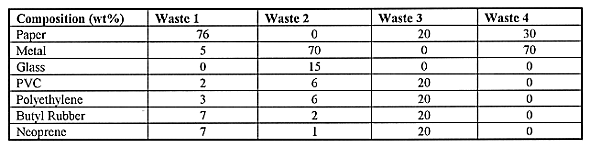
Table I LLW Waste Compositions
Stephen Barlow, Gordon Turner and John Palmer
United
Kingdom Nirex Ltd
Richard Bush
AEA Technology Plc
ABSTRACT
High-force, whole drum compaction (supercompaction) is being adopted in the UK as a means of treating Low Level Waste (LLW) to reduce its volume prior to disposal. Fire tests on active and inactive supercompacted simulant wastes have provided data on thermal properties and behavior under fire conditions and have permitted measurement of release fractions. Computer modeling techniques have been used to predict release fractions for packaged LLW in potential fire accident scenarios for the operational safety assessment for the UK deep repository.
INTRODUCTION
United Kingdom Nirex Limited (Nirex) is responsible for providing and managing facilities for the safe disposal of intermediate and certain low-level radioactive wastes (ILW and LLW respectively). The Company is pursuing the development, design and construction of an underground repository for these wastes. Nirex is concentrating its investigations on a site adjacent to the Sellafield reprocessing plant operated by British Nuclear Fuels plc in the north-west of England.
A substantial body of information exists regarding the safety of LLW which has been routinely transported and disposed of in the UK for some 30 or so years. Whilst the radiological hazard from LLW is very low, Nirex needs to understand the performance of LLW under fire conditions particularly for operations underground where operators may be in close proximity to packages on a routine basis. In addition an underground fire may have greater consequences due to limited access and the restricted area over which releases can be dispersed. High-force, whole drum compaction (supercompaction) is a new waste management approach being implemented in the UK and elsewhere for LLW and for which no directly applicable fire performance data are available. Most operational LLW will be placed in 200 litre drums or similar containers. These will be 'volume reduced to about one-fifth of their size using high-force compac tion, typically with a compaction force in the region of 2000 tonnes. This will reduce storage and transport costs and conserve space in the repository. The resulting supercompacts, or 'pucks, will be packaged in a special disposable freight container, similar to the ISO containers in routine use for conventional transport purposes.
This recent advance in the treatment of LLW for disposal means that existing fire performance data may give pessimistic results when used for operational safety assessments. The purpose of this paper is to present the results of a substantial program of work aimed at providing the necessary inputs to safety assessment of supercompacted LLW under fire conditions. The behavior of supercompacted LLW has been established and predictions made for releases under various fire conditions.
SCOPE
This work was carried out by AEA Technology on behalf of Nirex, with the experimental work receiving joint funding from the European Commission. The scope of work can be divided into the following five areas of work.
EXPERIMENTAL PROGRAM
Selection of Wastes
Within the UK, LLW is categorized as material with radioactivity not exceeding 4 GBq/tonne alpha activity or 12 GBq/tonne beta-gamma activity. For transport and disposal of LLW to the deep repository, two boxes have been selected as standard containers; the 4m box and the half-size 2m box. As well as for pucks, these boxes can also be used for larger items of operational and decommissioning LLW that are unsuitable for packaging in 200 litre drums.
Waste streams classified as LLW may contain a wide range of materials such as cellulose, plastics, rubber, metal and glass, contaminated with a wide range of radionuclides. Many of these components may be combustible or susceptible to thermal decomposition. For the purposes of the experimental program, four generic waste compositions (Waste 1 - Waste 4) were devised. These were based on a survey of the physical and chemical characteristics of LLW detailed in the UK Radioactive Waste Inventory.
Table I shows the composition of the LLW simulants that were used in the program. Wastes 1 and 2 span the composition range of most LLW, representing arisings from nuclear plants and laboratory wastes. Waste 3 contained major combustible and thermally sensitive components of LLW and provided data relevant to a wide range of release mechanisms and thermal phenomena. Waste 4 was selected to illustrate the effects of high metal loading (i.e. high thermal conductivity) within cellulose wastes.
Fabrication of Large-Scale and Small-Scale Pucks
Each waste mixture was produced by introducing its component parts as homoge neously as possible into a 200 litre drum (for the large-scale tests) or a can of approximately half-litre capacity (for the small-scale tests). The drums or cans were then supercompacted in a high-force compactor to provide 'pucks or 'mini-pucks for the thermal experiments. For the small-scale active tests, suitable radionuclides were introduced at the mixing stage in the form of nitrate solutions using a tumbling process.
Table I LLW Waste Compositions
Fire Tests on Large-Scale Pucks
To obtain information about the general behavior of a supercompacted 200 litre drum puck when subjected to high thermal flux, initial experiments were carried out in which supercompacts containing Wastes 1 and 2 were exposed to a radiant panel providing a heat flux at the puck face of 150kWm-2 (which is comparable to the heat flux seen by a puck in a hydrocarbon fire). The pucks were fitted with internal thermocouples enabling measurement of the temperature profiles in the waste. The test configuration is shown in Fig. 1.
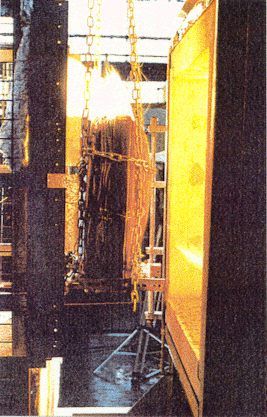
Fig. 1. Heated panel test.
Large-Scale Inactive Tests
The large-scale tests were conducted in an electrically heated oven, with the puck enclosed in an 'overcan provided with a vent pipe and analysis system. The tests were divided into two phases and conducted at a range of temperatures from 300°C to 1000°C. Phase 1 provided basic data for the formulation of mathematical models of the thermal behavior of LLW and as a guide to planning the active experiments. The Phase 2 tests were designed to validate the mathematical models and to provide the basis for applying the results of the active tests to real situations.
Small-Scale Active Tests
Samples of Waste 3 contaminated with an active solution of radionuclides were used to prepare 'mini-pucks for use in small-scale active experiments.
In successive tests, samples were heated in the furnace to 1000°C, 700°C, 450°C and 150°C. The released material was collected and analyzed to determine the fractions of the initial inventory of radionuclides released.
The purpose of these experiments was to determine radionuclide specific release fractions for supercompacted LLW under anaerobic conditions and at temperatures representative of those that might occur in fire accidents. The choice of Waste 3 (which contains equal mass fractions of cellulose, plastic, chlorinated plastic, rubber and chlorinated rubber) ensured that all the important release mechanisms for LLW were represented in the tests.
RESULTS
Fire Tests on Large-Scale Pucks
Examination of the pucks following 3-hours exposure to the radiant heat flux confirmed that puck degradation was controlled and benign. The integrity of the steel puck walls was maintained with no failure or 'spring-back observed. Within the pucks, thermal decomposition occurred in the outer regions of the waste only, with the central area unaffected. The mass loss in each case was less than 10% of the initial mass. The thermocouple results showed steady temperature rises indicating that the waste contents decomposed and pyrolysed, although there was some combustion of liberated gases on the outside of the pucks. A section through the Waste 1 puck following the radiant panel test is shown in Fig. 2 and clearly indicates regions of pyrolysed and unaffected material.
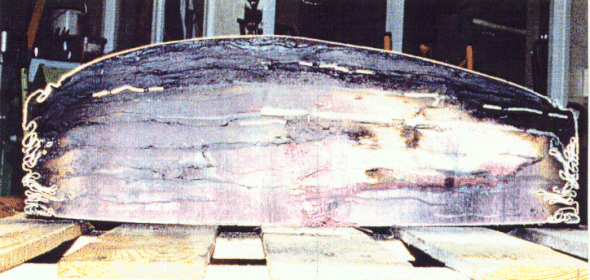
Fig. 2. Post-test section through
Waste 1 puck.
These results suggested that any release of radioactivity from heated pucks would be a function of decomposition and volatilisation processes in the waste and not combustion. Releases were concluded to be determined primarily by the temperatures reached in the waste. Further tests in the program (both large- and small-scale) were therefore conducted anaerobically at temperatures at which specific types of chemical and physical changes were expected to occur.
Large-Scale Inactive Tests
The amounts and chemical composition of the volatile materials collected from the oven tests were typically C8-C12 branched hydrocarbons with ketones, alcohols and aromatics at higher temperatures. This finding was consistent with the expected thermal and chemical behavior of the waste components present. Temperature- time plots for various positions in each puck show that heat penetrates into the pucks quite slowly and at a rate dependent on the overall thermal conductivity of the waste. No significant temperature excursions were noted confirming pyrolysis rather than combustion was the degradation mechanism. The presence of water associated with cellulose in the waste retards the temperature rise, so that the temperature remains at or around 100°C until all the water has evaporated. Figure 3 shows a typical temperature plot.
Examination of the pucks after the tests showed they remained retrievable and handleable. Sectioning of the pucks revealed pyrolysis in the waste consistent with the temperature profile that had been established. Details of all the large-scale tests are presented in Table II.
Table II Summary of Large-Scale Inactive Tests
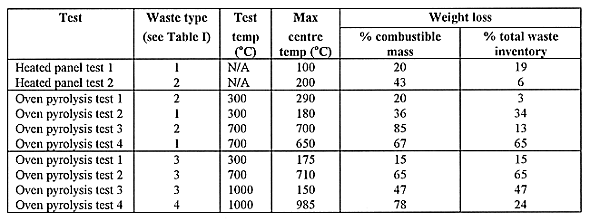
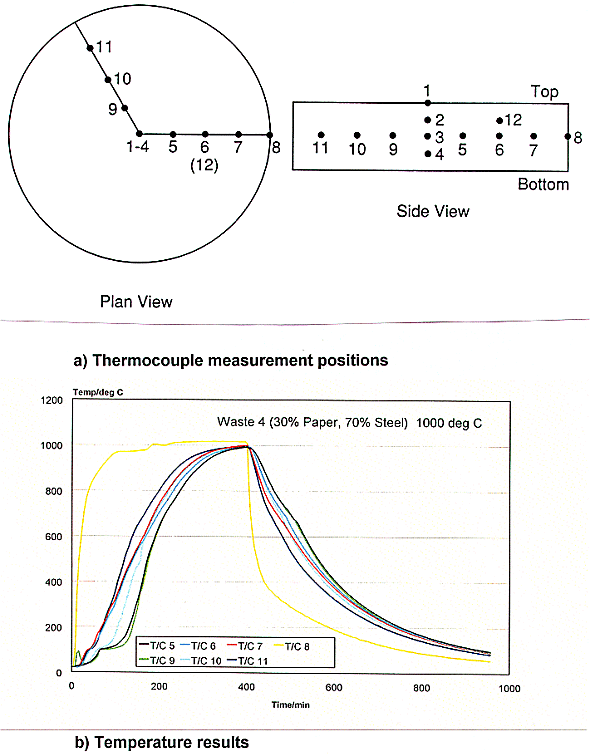
Fig. 3. Typical thermocouple
temperature results for the 30% paper, 70%steel waste at 1000°C
Small-Scale Active Tests
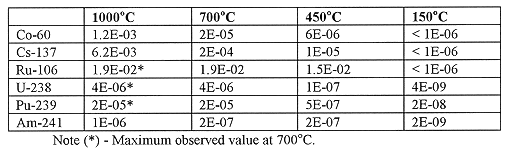
Data for the measured amounts of radionuclides collected in the condensed off-gas material are given in Table III, as fractions of the initial mini-puck inventory. The releases of cobalt-60 and caesium-137 increase steadily with temperature, reaching 0.1% and 0.6% respectively at 1000°C. Much lower release fractions were observed for the actinide elements. Ruthenium behaved differently with releases of 1.5, 1.9 and 1.8% at 450°C, 700°C and 1000°C respectively. The release of ruthenium may be associated with the formation of the volatile tetroxide. In general, the results provide confirmation that the temperature attained is the main determinant of radioactivity release from heated wastes.
Table III Release Fractions of Active Material
LLW FIRE PERFORMANCE MODELING
Theoretical Model of LLW Behavior
The disposal container assessed in these analyses is the Nirex 4m LLW box which is assumed to be loaded with supercompacted 200 litre drums. The puck contents selected were Waste 4, the 30%wt paper and 70%wt metal composition. This composi tion was chosen for the analysis as the high metal content was shown to give greater heat penetration and hence, expected to give a greater release of radioactivity. Input data on the thermal properties of the supercompacted waste was taken from the literature and supplemented by the post-test analysis data which provided measurements of the pyrolysed material and of the anisotropic properties resulting from the layering effect of compaction. The measured release fractions from the active experiments were used in the calculation of radionuclide releases. It was assumed that the box provides no barrier to the release of radioactivity from the pucks to the external environment.
Within the 4m box convection will be an important mechanism for heat transfer to the pucks. Computational fluid dynamics methods are suitable for the calculation of buoyancy-driven flows in complex geometries, and 3D calculations have been carried out using the computational fluid dynamics code CFX-4 (3). Conduction through the box walls and floor was also included. The pucks were assumed to have a 20% contact with the base of the box; and a 50% contact between pucks within a stack. Figure 4 shows a 4m LLW box and the modeled stacking pattern.
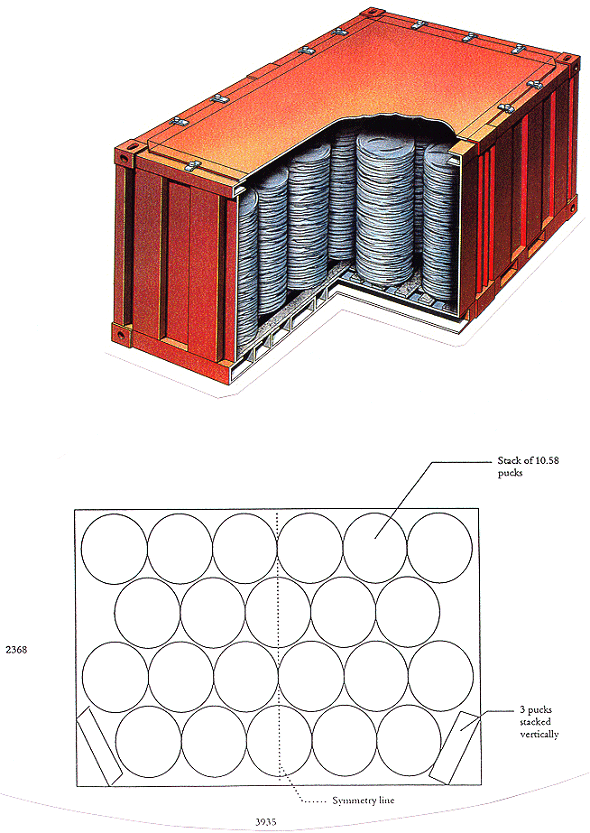
Fig. 4. The 4m LLW box and the
modeled stacking pattern.
Accident Conditions
Two fire scenarios are considered in this paper:
Thermal Results from the Fire Model
For the 20 minute localized fire, one quarter of the box floor was heated. It was found that only a small volume fraction of the box contents would exceed 100°C. The temper ature in the gas space above the pucks is heated faster than the gas between the pucks due to the free flow of gas above the stacks. Heat was slow to spread from the 'hot corner of the box and is largely confined to the box wall suggesting little horizontal heat transfer compared with vertical thermal transport which would be assisted by the hot gas flowpath. The outer regions of the pucks were heated very slowly by convection and the major part of the contents was unaffected.
For the 1000°C engulfing fire case, it was assumed that all six sides of the box were heated to 1000°C by the external fire. At the end of 15 minutes heating, the tempera ture of the gas space above the pucks reached the temperature of the fire. By 30 minutes the gas temperature in the region between the box sides and the pucks had also attained the temperature of the flame. The box contents act in two ways to reduce average waste temperatures: pucks are shielded from the radiation emanating from the box walls by close packing in stacks; and airflow is restricted to natural convection within the central region of the box. The calculated temperature contours at the end of the 2-hour fire are shown in Fig. 5.
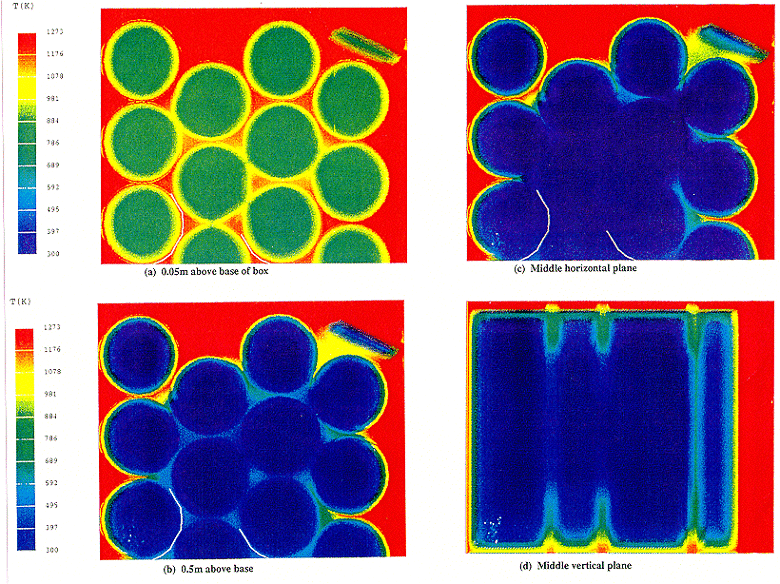
Fig. 5. Temperature in Nirex 4m LLW
box after a 2-hour all-engulfing fire.
Calculation of Activity Release
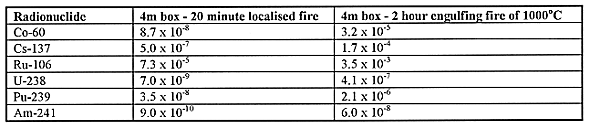
For a given waste under defined fire accident conditions, the temperatures generated in the waste can be derived from the thermal models. These temperatures can be used in conjunction with the release fractions from the active experiments to predict the releases of radionuclides from wastes exposed to fire accident conditions. A key assumption has been that radionuclide release fractions are linear with temperature between known measured values
Estimated release fractions for the above scenarios are shown in Table IV.
Table IV Predicted Radionuclide Release Fractions from a Nirex 4m
Box for Two Fire Scenarios
Application to Repository Safety Cases
It is not certain at this time what fire scenarios will be relevant to operations at the planned UK repository. This will in the event be determined by the features of repository design and operations which contribute to fire initiation and propagation. These features will be identified by Nirex once designs become finalized and at that time the models may be re-run as necessary to cater for any detailed changes. Whatever the outcome of detailed safety assessment, the data provided by this program encompasses fire scenarios which could occur in a deep repository and can be used to predict release fractions from supercompacted wastes. This work has given confidence that the releases from supercompacted LLW will be low and well within the design assumptions for the UK deep waste repository. The data generated is also sufficiently generic to allow estimates of releases from supercompacted ILW of similar composition subject to appropriate development of the model.
CONCLUSIONS
The following main conclusions may be made:
REFERENCES