Fig. 1. Comparison of treatment
options.
Stephen B. Schreiber
Actinide Process Chemistry
Nuclear Materials Technology
Los Alamos National Laboratory
Los
Alamos, NM 87545
ABSTRACT
Radioactive legacy wastes or residues are currently being stored on numerous Sites around the former Department of Energy's (DOE) Nuclear Weapons Complex. Since most of the operating facilities were shut down and have not operated since before the declared end to the Cold War in 1993, the historical method for treating these residues no longer exists. The risk associated with continued storage of these residues will dramatically increase with time. Thus, the DOE was directed by the Defense Nuclear Facility Safety Board in its Recommendation 94-1 to address and stabilize these residues and established an eight year time frame for doing so. There are only two options available to respond to this requirement: 1) restart existing facilities to treat and package the residues for disposal or 2) transport the residues to another operating facility within the Complex where they can be treated and packaged for disposal.
This paper focuses on one such residue type, pyrochemical salts, produced at one Complex site, the Rocky Flats Plant located northwest of Denver, Colorado. One option for treating the salts is their shipment to Los Alamos, New Mexico, for handling at the Plutonium Facility. The safe transportation of these salts can be accomplished at present with several shipping containers including a DOT 6M, a DOE 9968, Type A or Type B quantity 55-gallon drum overpacks, or even the TRUPACT II. The tradeoffs between each container is examined with the conclusion that none of the available shipping containers is fully satisfactory. Thus, the advantageous aspects of each container must be utilized in an integrated and efficient way to effectively manage the risk involved.
INTRODUCTION
Over the past half century, the United States built and operated a large Complex for the production of nuclear weapons. It consists of industrial facilities located in several states across the country each designed to handle a different step in the process. Uranium was mined, enriched and formed into fuel. Nuclear reactors burned the uranium fuel and produced plutonium. The plutonium was separated from the spent fuel, purified and converted into metal. The metal was made into nuclear weapons components. The finished product from each site was packaged and transported to the next site in the cycle. At each site and in each processing step, the byproduct or waste streams generated were either recycled or treated and disposed of. With the conclusion of the Cold War in the early 1990's, the Complex was essentially shut down mid-course with no serious thought given to its ultimate disposition.
Radioactive materials, which for years had been safely moved around the nation from site to site, are now essentially frozen where they currently reside. While shipping pure plutonium oxide or metal is still possible, the transportation of impure and potentially unstable residues has been all but precluded. There is a growing need to safely transport such radioactive residues as part of the final dismantling of the Nuclear Weapons Complex. This paper focuses on one such residue type, pyrochemical salts, produced at one Complex site, the Rocky Flats Plant located northwest of Denver, Colorado. One option for treating the salts is the shipment to Los Alamos, New Mexico, for handling at the Plutonium Facility. The key to this option is addressing the transportation and shipping issues.
BACKGROUND
Residues at Rocky Flats
The Rocky Flats Environmental Technology Site (RFETS or Rocky Flats) historically manufactured nuclear weapons components from plutonium, a radioactive fissile material. In 1989, production of the plutonium components was stopped by the Secretary of Energy for safety reasons. A large inventory of various forms of plutonium was placed into indeterminate storage. There were noformal plans for a safe and orderly shutdown of operations and storage was not expected to be long-term. The end of the Cold War eliminated the need for resumption of plutonium operations, consequently plutonium materials continue to be stored without appropriate packaging in facilities not suited for extended storage. In 1993, the Site's manufacturing mission was formally terminated by the Department of Energy (DOE) and replaced with the current mission of remediating or "cleaning-up" the Site of legacy waste and contamination. There now resides on the Site some metric tons of plutonium in various forms, mostly as low-grade residues generated as byproducts of the main manufacturing operations. These residues must be treated for long-term storage or disposal as part of the Site remediation effort. The most direct method involves extracting or separating the plutonium from the bulk residue matrix and then properly packaging both the recovered plutonium and the depleted bulk matrix.
In the intervening years since 1989, very little of the residues have been treated or stabilized. This is because none of the facilities or process buildings on the Site have been returned to an operational status. The primary reasons for this are their age which yields an unreliable infrastructure and their inability to operate within the strict regulatory environment of today. Many of these buildings were constructed in the 1950's and have never been adequately upgraded to meet the more stringent environmental requirements of the 1990's. This presents a dilemma in that to completely shut the Site down by performing final decontamination and decommissioning, the existing residues must be prepared for long-term storage or disposal. Thus, only two options exist. Either the facilities must be restarted and operated in some mode to stabilize the residues or the residues must be transported to another facility in the country at which they can be properly treated. The key to the former approach is the extensive and expensive upgrade of the Site facilities for a short-term, limited campaign while the key to the latter is the ability to safely package and transport residues to another operating facility. Until recently, there was no real driver to make either option happen and thus the existing residues continued to be stored without further treatment in their current locations at Rocky Flats.
Risk Management
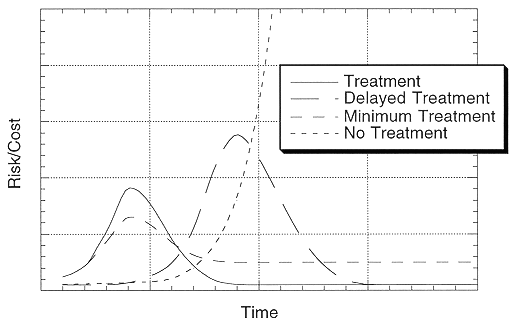
In qualitative terms, all the residues stored at Rocky Flats (as with other sites around the Complex) pose some finite risk to the facility worker, the public and the environment. Until the residues are processed, stabilized and packaged for long-term storage, this risk will continue to increase as the existing containers will eventually fail with time. Treating the residues, by whatever method is ultimately selected, will reduce this risk. However, during the actual period of processing, this risk will be increased to some extent as workers handle and package the residues. Figure 1 presents this generic risk assessment for several scenarios. These include a "do nothing" or no treatment option, a minimal treatment option, a full treatment option and a delayed treatment option. If the cost of treating residues is roughly correlated with the risk involved, then the higher the total risk the more costly the remediation or residue treatment approach.
Fig. 1. Comparison of treatment
options.
Clearly, the optimal course of action is the one which minimizes the risk or cost over time. Thus, by integrating or comparing the areas under each curve the advantages of each option can be evaluated. The minimum overall risk or cost is the Full Treatment option. While it involves some additional short-term risk over the Delayed Treatment or No Treatment options, overall the risk is minimized. If the Minimum Treatment option is pursued, the final risk condition is not minimized and additional overall risk is incurred. If the Delayed Treatment option is followed, additional processing or short-term risk is incurred when compared to Full Treatment. Finally, if the No Treatment option is pursued, the short-term risk is minimized but in the long-term the risk or cost becomes unacceptably high. The conclusion from this qualitative evaluation is that the residues currently stored at Rocky Flats should be treated as quickly and efficiently as possible.
In 1994, the Defense Nuclear Facilities Safety Board (DNFSB), an organization established by Congress to oversee the DOE's many nuclear facilities around the nation, issued Recommendation 94-1. It directs the DOE to stabilize "unstable" plutonium residues within three years and the remainder within eight years. The DNFSB thus established a clear timetable for dealing with plutonium residues such as those stored at Rocky Flats. Pyrochemical salts were identified as a priority residue requiring early treatment. The Rocky Flats 94-1 commitment is to process or treat 10 metric tons of pyrochemical salts by December 1997.
Plutonium Pyrochemistry at Los Alamos
There are a number of chemical unit operations used to prepare plutonium metal from scrap or oxide by the reduction to an impure metal form. Pyrochemical operations are then used to change the impure metal into high-purity metal. Without going into specific details, the separations chemistry is performed in a molten bath of chloride salts, either calcium chloride (CaCl2) or a eutectic mixture of sodium and potassium chloride (NaCl-KCl). While these processes are very effective at purifying the plutonium stream, a significant amount of radioactive materials, mostly americium and plutonium, wind up in the salt. During normal operations, these salts were used to exhaustion and then set aside for future recovery and retrieval. A limited amount of plutonium, magnesium and calcium in a metal form, which is potentially pyrophoric, still resides in the salt. Also, because of their chloride content, the salts are potentially corrosive to the metallic containers in which they are stored. For these reasons, the pyrochemical salts were classified as having a priority for rapid treatment.
The Los Alamos National Laboratory (LANL) in Los Alamos, New Mexico, has the last fully functional and operational plutonium handling facility in the nation. The Plutonium Facility at Technical Area 55 (TA-55) was designed and constructed in the 1970's to perform a broad spectrum of research and development activities on radioactive materials. During the 1980's, the TA-55 Plutonium Facility acted much as a testing arena or pilot plant to the full-scale manufacturing of plutonium parts at Rocky Flats. In more recent years, a major area of research has been in developing improved techniques for the treatment of existing residues. Several of these techniques are applicable to the treatment of pyrochemical salts. Salt oxidation involves the addition of an oxidizing agent, such as sodium carbonate (Na2CO3), to the salt and heating the mixture which converts any residual reactive metals into a stable oxide form. Salt distillation utilizes the large difference in volatility between the chloride salt and the plutonium and americium oxides to effect a separation between the bulk salt matrix and the radioactive materials. The salt is distilled away from the radioactive materials yielding a concentrated stable oxide and salt classified as either transuranic waste (TRU) or low-level radioactive waste (LLRW), depending on the residual radioactive content. The plutonium oxide can then be packaged safely and efficiently for long-term storage. The bulk salt can also be appropriately packaged for storage and disposal.
With these new treatment techniques, the TA-55 Plutonium Facility currently has the excess capacity to treat pyrochemical salts from Rocky Flats. It has been estimated that Los Alamos has the physical capacity to treat 3 metric tons of salt per year (assuming critical resources such as personnel and equipment are reprioritized and redirected). Thus, if the transportation issues can be resolved, the capability exits to treat a significant portion of the pyrochemical salts now at Rocky Flats using the Los Alamos Plutonium Facility in order to help meet the Rocky Flats 94-1 commitment.
RADIOACTIVE MATERIAL FOR TRANSPORTATION
Rocky Flats has many of the most significant plutonium vulnerabilities in the Complex according to a DOE report issued in November 1994 titled "Environmental, Safety and Health Vulnerabilities Associated with the Department's Plutonium Storage." This report summarizes the Site's plutonium holdings as 12.8 metric tons in 27,679 packages stored in 7 different facilities. Of these, scrap and residues account for 20,528 items and the pyrochemical salts (a subset) account for 6,454 items containing nearly 1 metric ton of plutonium in about 16 metric tons of bulk matrix. The concentration of radioactive material in the salts varies greatly from item to item. Individual lots are not well characterized but identified by a processing "item description" not necessarily suited for sorting or prioritizing residues for treatment.
The salts are stored in a variety of different configurations including 8801 and 8802 Vollrath cans, poly bottles, aluminum paint cans, and other sundry containers. The 8801 and 8802 are slip top metal cans sealed with several wraps of cloth, paper or vinyl tape. The 8801 is 4-3/8 in. diameter by 5-1/2 in. high while the 8802 is 4-7/8 in. diameter by 7 in. high. The poly bottles are of the large mouth variety with varying diameters and threaded lids. The paint cans are of 6-in. diameter or greater with a pressed fit lid. The physical dimensions of these containers are crucial because if they cannot be directly placed into an approved shipping container, the salts will have to be removed and repackaged. In addition, none of these containers meets the criteria as a "leak tight" vessel. The integrity of the primary containers is also questionable as many have not been directly inspected since the 1989 shutdown. They are currently being stored either in glove boxes formerly used to handle and process plutonium or stacked into steel drums. Thus, any selected shipping container must provide appropriate containment or again the salts will have to be removed and repackaged.
The technologies developed for treating salts at Los Alamos cannot currently be applied to all of the salts stored at Rocky Flats. Perhaps only 7 metric tons of the total could be readily treated. However, this is still a large fraction of the total salt inventory requiring treatment and would make significant progress towards addressing this aspect of vulnerability at the Site. Thus, given all these factors, the amount and type of pyrochemical salts that can be treated at Los Alamos is almost entirely dependent on what can be safely and legally shipped.
REGULATORY ISSUES
The shipment of radioactive materials is defined in two major sections of the Code of Federal Regulations (CFR). The first is the Energy portion, specifically 10 CFR 71 "Packaging and Transportation of Radioactive Material." The second is the Transportation section, specifically 49 CFR 173 Subpart I "Radioactive Materials." Although numerous DOE Orders also give guidance on the packaging and transportation of radioactive materials, they are consistent with the Department of Transportation (DOT) and Nuclear Regulatory Commission (NRC) regulations cited above.
In 10 CFR 71, the approach used to determine the type of packaging and the limits on the amount of radioactive material is presented. For the pyrochemical salts, the plutonium and americium present are dispersed but not contained in the salt matrix, thus it is not a special form. The analysis may be simplified by assuming that while both plutonium and americium are present in the salts (Am-241 "grows in" as a daughter product of the radioactive decay of Pu-241 present in all plutonium lots), the plutonium is the most prevalent radionuclide and thus the only one considered. The normal form activity limit (A2 value) for a Type A quantity is 0.002 Ci. With a specific activity of 0.062 Ci Pu-239 per g, the upper limit for the Type A quantity is 0.032 g Pu-239. Thus, for practical purposes the shipments of pyrochemical salts will be of Type B quantities.
An additional constraint is the special requirements for plutonium shipments in
10 CFR 71.63. It specifies that plutonium in excess of 20 Ci per package must be shipped as a solid and it must be packaged in a separate inner container placed within outer packaging that meets the appropriate package requirements.
Type B package requirements are specified in Subpart E "Package Approval Standards" and include the package dimensions, seals, closure devices, materials of construction, temperature limits, protected penetrations, and requirements for no continuous venting. External radiation standards are such that the radiation level does not exceed 200 mRem/hr at any point on the external surface of the package and less than 10 mRem/hr at 1 m from the external surface of the package. Under normal conditions of transport, there would be no loss or dispersal of radioactive contents (defined as less than 10-6 the activity value per hour), no substantial reduction in the effectiveness of the packaging, and no significant increase in external radiation levels. Under hypothetical accident conditions, the separate inner container must restrict the loss of radioactive contents to no more than an activity quantity in a week. Additional requirements for packages containing fissile material are that they must be so designed and constructed and its contents so limited that it would remain subcritical if water (or other neutron moderator/reflector) were to leak into the containment system.
DOE Order 5480.3 "Safety Requirements for the Packaging and Transportation of Hazardous Materials, Hazardous Substances, and Hazardous Wastes" reiterates the DOT regulations presented above. It does, however, provide an exemption to these guidelines for solid plutonium in excess of 20 Ci per package if it is in reactor fuel elements, as a metal or metal alloy, as special form materials, or other forms of plutonium-bearing materials (e.g. wastes or contaminated equipment) as approved by the DOE Office of Operational Safety. The Order specifies the structural standards for Type B packaging by referring again to the DOT regulations with the option for setting different standards. Such standards must be reviewed and approved by the Head of the Field Organization who would issue a Certificate of Compliance for approved designs. This approach entails the development of a safety analysis report for packaging (SARP) by a DOE contractor for the packaging design.
Finally, in 10 CFR 173.7 "U.S. Government Material," there is one further exemption to the DOT shipping guidelines. Shipments of hazardous materials, made by or under the direction of the DOE or the Department of Defense (DOD), for the purpose of national security, and which are escorted by personnel specifically designated by or under the authority of those agencies, are not subject to DOT regulations.
SHIPPING CONTAINERS
There are two shipping containers that meet all the above identified regulatory requirements and have been approved by the DOE for the transportation of materials similar to the pyrochemical salts. These are the DOT 6M and the DOE 9968. Three other shipping containers could potentially be used to ship the salts including an existing hazardous material/Type A container overpack, a Type B container overpack, and the existing TRUPACT II. Each of these will be examined in some detail and their advantages and disadvantages identified.
DOT 6M with 2R Internal Containment Vessel
The specifications for a DOT 6M shipping container are identified in 49 CFR 178.354 and the specifications for the 2R internal containment vessel are in section 178.360. Basically, the shipping package consists of an outer steel drum with a removable lid and bolt-type locking ring. The inner containment vessel is essentially a steel pipe with a screwed cap having a maximum usable inside diameter of 5.25 in. and a minimum height of 6 in. The inner vessel is fixed, centered, and protected within the outer shell using machined discs and rings of solid insulation media providing a separation of at least 3.75 in.
The authorized contents in the DOT 6M/2R packaging for DOE fissile radioactive materials, plutonium in excess of 20 Ci, are more restrictive than what is authorized under 49 CFR 173.417. These restrictions arise due to the concern that the 6M/2R is not a leak testable containment boundary, nor is the packaging capable of providing double leak testable containment boundaries required of NRC/DOE certified packaging for transport of plutonium in amounts greater than 20 Ci per 10 CFR 71.63. To address the concern for an enhanced safety margin, modifications internal to the 2R inner containment vessel were made with approval by the DOE headquarters. These modifications include: the material is doubly encapsulated in stainless steel welded vessels, both vessels are leak tested to "leak tight" standards per ANSI N14.5, gauge thickness of the vessels is the same or greater as the crimp seal food pack cans which have been demonstrated to survive accident condition drop testing, and all other criteria for shipment per DOT regulations are met (i.e. thermal loading, gas generation, etc.).
The DOE has authorized shipments in configurations which include compounds that are not pyrophoric and have a loss on ignition (LOI) less than 1% yet contain greater than 20 Ci plutonium. This allows for the shipment of various residue forms including slag and crucible, ash, hydroxide cake as well as pyrochemical salts. The form of the radioactive material must be a metal or oxide but the quantity can be greater than 20 Ci plutonium with less than 4.5 kg Pu per 2R and less than 2.3 kg per any inner vessel (with two allowed). Configuration requirements internal to the 6M/2R must include double leak tight welded stainless steel containment boundaries. The 6M/2R packaging restrictions limit the overall container to a gross weight of 200 lb. and thus only the 30-gallon sized 6M container may be used.
In summary, the DOT 6M/2R is approved by the DOE to ship metal and oxides, but perhaps not a salt matrix, up to a criticality limit of 4.5 kg plutonium. The inner container must be a sealed food pack cans, or the equivalent, which will require repackaging all the salts stored at Rocky Flats prior to shipment. Thus, to use the DOT 6M/2R container may require additional DOE approval to use it for salts and a major repackaging effort within some facility at Rocky Flats.
DOE 9968
The specifications for the 9968 container are found in the Safety Analysis Report - Packages (SARP) "USA/9968/B(U)F Packaging of Fissile and Other Radioactive Materials" issued June 1984 and revised June 1988. The 9968 shipping package is one of a series designed at the Savannah River Plant in Aiken, South Carolina, for the surface shipment of fissile and other radioactive materials where a double containment is required. The package has been assessed for transport of up to 4.4 kg of plutonium metal, oxides or scrap having a maximum radioactive decay energy of 30 watts. This quantity and configuration of plutonium metal cannot be made critical by any combination of hydrogeneous reflection and moderation regardless of the condition of the package.
The 9968 package includes the external drum, primary and secondary containment vessels, insulation, bearing plates, and aluminum honeycomb spacers. The drum is 35 in. high with a 35-gallon capacity. An aluminum honeycomb spacer is inserted into the concave cavity of the secondary containment vessel (SCV) to provide horizontal flat surface for the primary containment vessel (PCV).
The PCV consists of a stainless steel pressure vessel that is designed in accordance with Section VIII of the American Society of Mechanical Engineers (ASME) Boiler and Pressure Vessel Code to design conditions of 1,000 psig at 500oF. It is fabricated from 5-in. schedule 40 seamless type 304 SS pipe with a standard weight pipe cap at the blind end. The primary containment vessel has a volume of 313.4 cubic in. (5.1 L), weighs 33.6 lb. and is 18-5/8 in. high. The SCV consists of a stainless steel pressure vessel that is designed in accordance with Section VIII of the ASME Boiler and Pressure Vessel Code to design conditions of 1,000 psig at 500oF. It is fabricated from 6-in. schedule 40 seamless type 304 SS pipe with a standard weight pipe cap at the blind end. A 5-in. schedule 40 pipe of the same material is welded to the convex side of the cap to form a skirt to support the SCV vertically. Both the PVC and the SCV closures consist of a male-female cone joint that mate with zero clearance and seal with two seated fluoroelastomeric O-rings. A leakage test port is provided between the O-ring grooves which allows for simple leakage tests using a pressure drop method.
In summary, the 9968 is approved by the DOE to ship scrap and powders up to a criticality limit of 4.4 kg plutonium. Since it is designed with two nested, sealed inner containers, no repackaging would be required to transport the salts. However, some repackaging will be necessary to physically fit the salt containers into 4-3/4 in. diameter cavity of the PDV. The 9968 is an expensive shipping container to construct and certify. There are few available (only 40 at Los Alamos) and these are due for recertification within the next few months. Thus, to use the 9968 contained would require recertification to use it for salts and a significant repackaging effort within some facility at Rocky Flats.
Type A Overpack
This existing shipping container or drum has been proposed to overpack a 55-gallon drum Type A package. It is an available container designed to handle highly toxic or hazardous wastes but, while very robust, it is not certified for significant quantities of radioactive materials. The criticality safety limit and the materials it could contain have not been determined. Since few of the pyrochemical salt items at Rocky Flats meet the Type A quantity limit, to make this container useful in the short term would require a DOE exemption to allow for shipping Type B quantities of salts per container. The advantages of this approach are that no repackaging of items containing Type B quantities of radioactive material would be required and the containers already exist and are being used in other fields.
Type B Overpack
This shipping container is still in the conceptual design phase but would be designed to overpack a 55-gallon drum Type B package. The criticality safety limit and the materials it could contain have not been determined. A significant advantage to such a container would be that no repackaging of Type B quantities of radioactive material would be required. Unfortunately, to complete the design, to test, to issue a SARP, and to certify such a container is estimated to take more than two years to complete. Thus, while it could be very useful in the long term, it is not a viable solution to the problem of treating Rocky Flats salts within the constraints of the 94-1 response schedule.
TRUPACT II
This existing shipping container was designed overpack fourteen 55-gallon drums of Waste Isolation Pilot Plant (WIPP) certified waste and transport them from locations around the Complex to the test facility near Carlsbad, New Mexico. Fifteen of the TRUPACT II containers (non-vented double-walled overpacks) have been fabricated and certified for their intended use. They are constrained to a 200 g Pu per drum limit with an overall container limit of 325 g Pu. They are designed to ride, three at a time, on specially designed trucks which would require a special receiving facility at the Los Alamos TA-55 Plutonium Facility. The advantage of using the TRUPACT II is that minimal repackaging of items in 55-gallon drums would be required. However, a higher criticality safety limit would need to be established to make them practicable. A revised limit of 2.8 kg Pu per container (the total limit of 200 g Pu in each of the 14 drums) has been proposed but would have to be approved by the DOE. In addition, there may be a security issue if the material being transported is not waste by definition or if the total amount of plutonium in a shipment exceeds the safeguards termination limit. Thus, the criticality safety limit, the safeguards issue, and developing a suitable receiving facility at Los Alamos would all have to be addressed, which would entail a significant delay, prior to use of this container for shipping salts.
SHIPPING OPTIONS
Five containers were evaluated and compared for shipping pyrochemical salts from Rocky Flats to Los Alamos for treatment. While each had some advantages, their disadvantages precludes any single container from being immediately available to transport all the salts.
The DOT 6M/2R and the DOE 9968 are approved and certified containers, but most of the salt items will have to be repackaged before they can be shipped in them. With the DOT 6M/2R, it is because the inner container must be leak tight. With the DOE 9968, it is because most of the existing salt items will not physically fit into the PCV. Since repackaging will entail restarting at least a portion of a facility at the RFETS, a lengthy delay will be incurred.
The overpacking option using the Type A and Type B drums solves this problem, but neither container is currently available for use. The Type A container is not certified to handle significant quantities of radioactive material. A lengthy delay could be involved in obtaining an exemption from DOE to allow their use for this effort. The Type B container, while being specifically designed for this activity, is still in the conceptual design phase and will not be available for at least another two years.
The TRUPACT II also addresses the repackaging problem by overpacking existing items, but since it was designed to transport waste to the WIPP site, it is not an optimal shipping container for this effort. For example, compare the number of shipments required to transport the salts. The standard method for shipping plutonium around the Complex uses a Safe Secure Transport (SST), a safeguarded vehicle which can move up to 48 55-gallon drums per shipment. With a criticality safety limit of 4.4 kg Pu per drum (the established limit for the DOE 9968 container), a single shipment could move 211.2 kg Pu. With the proposed, but not approved, limit of 2.8 kg Pu per container, to move the same amount of plutonium using the TRUPACT II would require 26 shipments. If the existing limit of 325 g Pu per container is used, it would require 650 shipments. There are only 15 TRUPACT II containers in existence so a long delay would again be incurred. Since the time, and thus risk and cost, increase dramatically with the number of shipments, the TRUPACT II is not a viable option for shipping the salts.
RECOMMENDATIONS AND CONCLUSIONS
There is clearly no single suitable shipping container of those evaluated that adequately meets all the constraints placed on transporting pyrochemical salts from Rocky Flats to Los Alamos. Thus, the advantageous aspects of each container must be utilized in an integrated and efficient way to effectively manage the risk involved.
The best available approach to transporting the Rocky Flats salts within the timetable established by the 94-1 recommendation is to overpack existing drums to avoid extensive item repackaging. Of the three options presented, the quickest is to move as rapidly as possible through the DOE approval process and obtain the necessary exemption to allow the use of an existing Type A container for transporting the salts. This would be a limited term effort targeted specifically at the Rocky Flats pyrochemical salts. There does not appear to be any technical or physical reason why the salts could not be shipped safely using this method. The number of shipments using available SSTs would be minimal and the shipping duration only a few weeks or months depending on established criticality safety limits.
For the long term, a specifically designed overpack type shipping container must be made available to ship the many forms and types of residues that exist around the Complex. Thus, work should proceed on the development and deployment of a Type B overpack as described herein. It would allow for safe and timely shipment of any future residues around the Complex to any site which could best address their specific hazards.
Once residues have been treated by whatever process at whatever site, two subsequent streams will be generated which will also require a safe form of transportation. A concentrated plutonium stream will be separated and placed in a certified long term storage container in either a metal or oxide form. A DOE standard exists (DOE Standard 3013-94) for packaging plutonium metal and oxides in double-contained, welded, stainless steel cans. These cans were sized to be placed within a DOT 6M or containers of the DOE 9968 series for shipment. These containers were themselves originally designed and certified to handle plutonium metal and oxides.
The second stream which will be generated is a low activity waste, most likely in a TRU certified package destined to be shipped to the WIPP. The existing TRUPACT II container was specifically designed and certified for this very purpose. Thus it is already available for use when the need arises.
By this approach, the DOE can begin to efficiently work off the legacy wastes or residues generated and currently being stored at the numerous sites around the former Nuclear Weapons Complex. Safe and effective transportation of the residues and the resulting product and waste streams is a necessary and integral part of this overall effort.