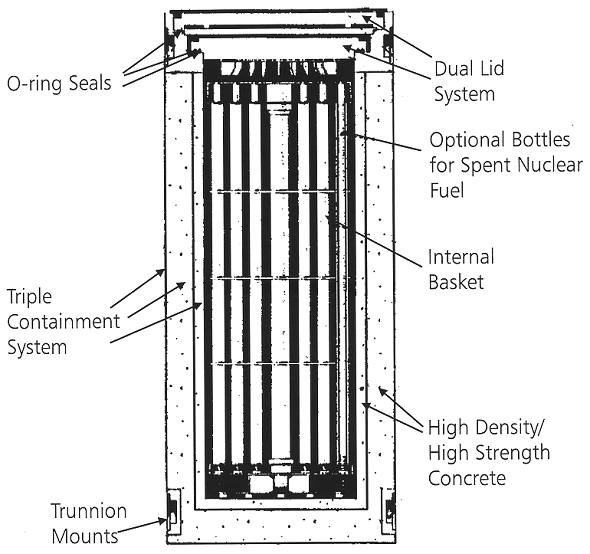
Fig. 1. Metal-Concrete Cask (MBK)
Storage Unit
N. Mote
NAC International
Atlanta, Georgia, USA
V. Guskov
Special Mechanical Engineering Design Office
(KBSM)
St. Petersburg, Russia
R. Dyer
U.S. Environmental Protection Agency
Washington, D.C., USA
P. Moskowitz
Brookhaven National Laboratory
Upton,
New York, USA
V. Akhunov
Ministry for Atomic Energy of the Russian
Federation
N. Yanovskaya
ICC Nuklid, Russia
ABSTRACT
NAC International (NAC), a leading U.S. company in the nuclear spent fuel industry, and the Special Mechanical Engineering Design Office, known as KBSM, of St. Petersburg, Russia, have combined their technical expertise to develop a dual purpose metal-concrete cask system for transport and storage of intact, damaged and undamaged icebreaker and submarine spent nuclear fuel. The project is being supported by the U.S. Environmental Protection Agency (EPA) as part of the new tri-agency Environmental Security Initiative between EPA, the U.S. Department of Defense and the U.S. Department of Energy. The project is also part of an international effort with the governments of Norway and Russia to cooperatively address radioactive waste management problems in northwestern Russia. The basis of the system design is KBSM cask technology developed for RBMK-1000 fuel, which is now in the final stages of testing and review for certification by the Russian regulatory agency, Gosatomnadzor (GAN). The RBMK cask development program provides for a series of drop tests using a 4:10 scale model and a full-scale prototype. NAC is participating in the design of the support equipment and interface equipment that will make the system functional at a plant or storage site. The design features of the system and the schedule for the completion of the project are presented.
PROGRAM BACKGROUND
The United States has been working with the Russian Federation on nuclear waste management problems for the past few years. With the implementation of the START II Agreement, and amendments to prohibit ocean dumping of radioactive waste under the London Dumping Convention, this work has expanded. The U.S. Environmental Protection Agency (EPA) has developed a program to examine and address, and find solutions to, specific environmental problems associated with nuclear submarine decommissioning in northwestern Russia.
One problem identified is the lack of a suitable transportable storage cask for spent and damaged icebreaker and submarine fuel. Some fuel is currently stored in leaking containers out in open areas in the Russian Arctic and presents a heightened environmental security concern for the United States. Two key organizations leading the development of this special cask are the Special Mechanical Engineering Design Office (KBSM) of the Russian Ministry for Defense Industries and NAC International (NAC) in the United States.
NAC has been involved in spent fuel transportation projects, worldwide, starting as early as 20 years ago. After the Gulf War, NAC removed spent nuclear fuel from Iraq and transported it to Russia in NAC-owned legal weight truck casks flown aboard an Antonov 124 aircraft. In 1993, NAC opened an office in Moscow managed by a former senior executive in Minatom, the government agency responsible for managing the Russian nuclear industry. In 1995, NAC signed an agreement of cooperation with the Murmansk Shipping Company (MSCo), operator of nuclear powered icebreaker ships in Murmansk, Russia. That agreement focused on assisting MSCo to obtain funding for its spent fuel management needs. It was anticipated that NAC's technology and experience in packaging and transporting spent fuel, particularly failed fuel, could contribute to an emerging clean-up program for the Murmansk region. The initial application of this technology was identified as interim storage, and later transportation, of spent fuel currently stored aboard the Lepse, a service vessel that has been out of services for several years.
The subject cask system development project has arisen as a direct result of the U.S.-Norwegian-Russian concern to avoid further contamination from spent fuel temporarily stored on land and in vessels anchored in the Murmansk region of the Arctic.
By early 1996, NAC had signed an agreement with KBSM. KBSM was already developing a cask for the Leningrad Nuclear Power Plant (LNPP) to manage its spent fuel and this agreement stated the intent of the two companies to advance the KBSM technology, referred to as a metal-concrete transportable storage cask, for use with other types of spent nuclear fuel. The government program and the private company objectives converged at this point.
KBSM CASK TECHNOLOGY
KBSM developed its cask technology initially for the RBMK-1000 type reactor spent fuel. The Leningrad NPP is the first customer who will use this technology. The technology, as shown in Figs. 1 and 2, consists of first a steel-lined concrete structure with a dual lid system that comprises the storage module of the cask system. The system is unlike U.S. concrete storage systems that employ a thin-walled removable canister for the leak tight containment of the fuel, and use the ventilated concrete merely for shielding. In the KBSM case, the concrete structure and its lids are the containment for storage.
Fig. 1. Metal-Concrete Cask (MBK)
Storage Unit
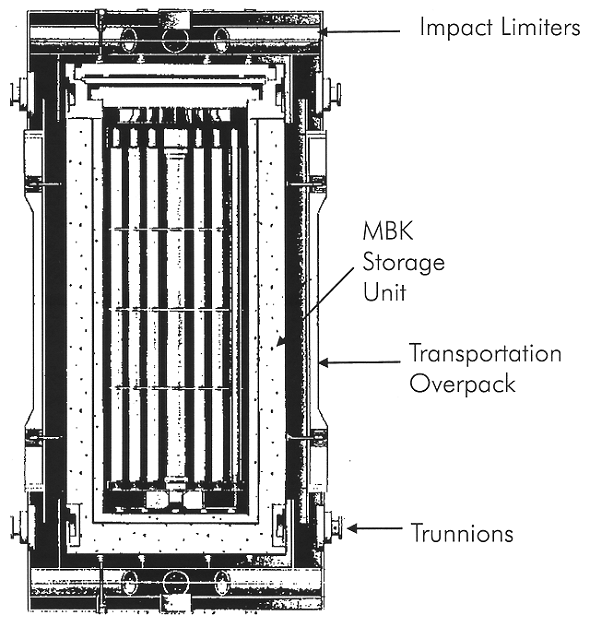
Fig. 2. MBK with Transportation
Overpack
Table I shows some of the details of the cask system. This particular configuration is for the 70 metric ton (empty) cask designed for RBMK fuel after separation of full length assemblies into subassemblies about 3.5 meters long. The cask can accommodate 114 RBMK subassemblies, equivalent to 57 fuel assemblies.
Table I Metal-Concrete Cask for Storage and Transportation of
RBMK-1000 Spent Nuclear Fuel
The main body of the cask uses a corrosion resistant steel and the concrete is a high density, high strength shielding material as indicated in Table I. In order to have the system transport qualified, it is placed in a fully enclosing steel cover designed to be its impact limiter. This cover (or overpack) is shown in Fig. 2. Although not necessary during storage, the overpack provides some additional shielding during transportation. The overpack is intended to be a sacrificial energy absorber in the event of any impact accidents during transportation.
REGULATORY REVIEW OF KBSM TECHNOLOGY
In Russia, the NRC-equivalent agency is known as Gosatomnadzor or "GAN." Somewhat like NRC, there are regional offices of GAN, and one is located in St. Petersburg. KBSM has conducted cask design meetings with the local GAN office to discuss details of the design and any necessary safety features or analyses that are required. Concurrently, GAN personnel regularly visit NRC headquarters in the United States to learn regulatory approaches used here for U.S. systems.
The Safety Analysis Report (SAR) for the RBMK cask design has been submitted to GAN for evaluation. In addition, extensive testing is programmed to demonstrate the performance of the system. A model of the complete system on a scale of 4:10 has been fabricated to conduct drop testing in accordance with IAEA standards. One full-scale prototype is being constructed concurrently which will also be subjected to both thermal and drop tests. This performance qualification program will be monitored by GAN and by NAC personnel and the results will form the basis for the licensing of the system, expected to be completed in 1997.
DEVELOPMENT OF THE CASK SYSTEM
In mid-1996, after extensive discussions had taken place involving NAC International, the Murmansk Shipping Company, EPA, the U.S. Department of Defense (DOD), the U.S. Department of Energy (DOE) and the Norwegian government, in addition to technical and programmatic meetings between NAC and KBSM, a program was developed to extend the KBSM technology so that it could be applied to the management of icebreaker or submarine spent nuclear fuel. EPA entered into an agreement with DOE and Brookhaven National Laboratory was selected as the contracting agency for the program, since it had existing relations with Russian programs that paralleled this program.
In Russia, the ability to handle spent nuclear fuel from icebreaker fleet operations, and from the submarine decommissioning program, is hampered by the lack of a modern multiple purpose cask system. As a result, the various U.S. government programs with Russia found a common need and a common solution by utilizing the KBSM system. Thus, EPA/DOE/DOD established a protocol for endorsing an NAC/KBSM cask development program that also had the support of the Russian government and the Norwegian government.
The project was initiated in January 1997 with targeted completion in 24 months by delivery of the first cask ready for use. The key steps in the program are shown in Table II. The main items are as follows.
Table II Project Plan Outline
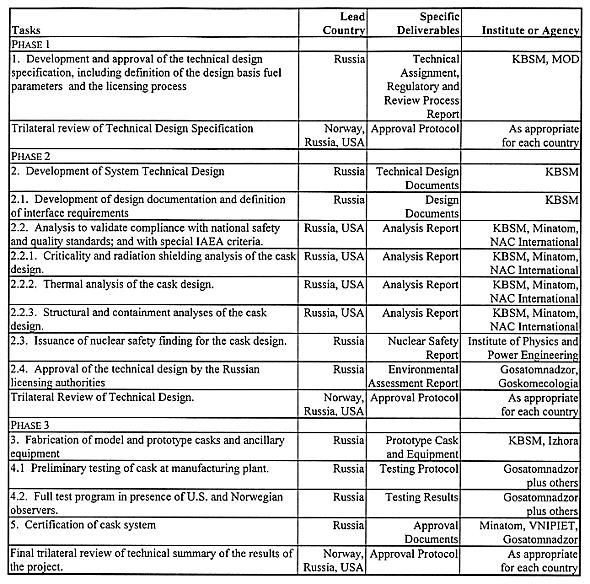
PHASE 1. DEVELOPMENT OF THE TECHNICAL DESIGN SPECIFICATION
This phase of the project is intended to prepare and issue the controlling documents that:
During this phase of the project, the appropriate range of fuel parameters to be used as the basis for the cask design will be defined. All of the fuel types for which the cask system may be used must be bounded by the selected design basis parameters.
It is estimated this phase will take about two months. During this period, discussions will also be held with Russian regulatory groups to ascertain any special requirements that need to be considered.
PHASE 2. SYSTEM TECHNICAL DESIGN
This task comprises the main design scope of the project. It includes:
The work necessary to complete this task will involve either input from or verification by some of the technical institutes of the Russian Ministry for Atomic Energy (Minatom) including VNIPIET and ARZAMAS-16. The design work will be completed by specifically qualified nuclear engineering staff in these Russian organizations.
The working design drawings and documents provide the detailed specifications required for fabrication of equipment. In this task, all the documentation will be produced which is needed for an order to be placed for fabrication of the prototype and model casks and supporting hardware.
In order to use the KBSM cask at an operational facility, site systems and support services will need to be provided. These interface requirements (e.g. heavy haul equipment and utility services) must be identified and provision made for any site specific adaptation. Also, the use of equipment and services must be planned in advance of operations to ensure that they are available and that no conflict with other site operations arises. This phase also provides the planning and coordination required to ensure the KBSM cask fuel loading and handling operations are effectively integrated with other operations on the site.
Following the completion of the cask design and preparation of the operational and interface documents, the SAR will be submitted for certification by the appropriate Russian regulatory authorities including GAN and Goskomecologia, the Ministry of Ecology. The necessity to submit the documentation to any other regulatory agency will be determined as part of this phase of the project. It is planned that this phase of the project will be complete in six months.
PHASE 3. MODEL AND PROTOTYPE FABRICATION AND TESTING
To support the certification application, a test program will be performed in accordance with requirements of the regulatory authority, and if required, a scale model and a full-size prototype will be manufactured. If the full-size prototype is not required for the test program, it will be used as the demonstration cask for transportable interim fuel storage.
The test program will be performed in accordance with the requirements of the Russian regulatory authority and in accordance with IAEA recommendations. Following completion of the test program, the results will be submitted to GAN and any other necessary Russian regulatory authority as the final step in the certification process. This last phase of the project is scheduled to take about 15 months to complete.
U.S. PARTICIPATION AND CONTRIBUTION
As was noted earlier, this project has developed from an agreement between NAC and KBSM as peers in the industry. The technology at the center of the project is KBSM's RBMK cask technology and the main purpose of this project is to safely accommodate the spent fuel from the Lepse. However, a very important additional benefit is the development of new applications by Russian industry for its technology with the associated economic benefit. In line with this objective, the majority of the design and fabrication will be done by or under the direction of KBSM within Russia.
NAC engineering participation in the project is focused in two areas. One is the design of ancillary and interface equipment for cask loading operations (e.g. the cask yoke and other lifting equipment), in line with NAC's extensive experience in handling fuel and casks at numerous sites worldwide. This is complemented by NAC's experience with shipping operations, including transport of cask systems to storage locations at a number of nuclear facility sites.
The second area of focus for NAC is provision of an independent evaluation of the design, and of the analyses that support the design. NAC engineers and analysts will perform selected design basis calculations such as worst case criticality conditions or structural evaluations using NRC-accepted techniques to allow comparisons of the Russian design basis calculations with U.S. and IAEA criteria.
CONCLUSIONS
The project described here is a unique partnership between two companies, three U.S. government agencies and two other countries engaged in the spent fuel arena. Many U.S. government programs are focused on Russian economic development, but few are as broadly supported by different U.S. agencies as well as other European governments. The benefits of this program will be:
KBSM believes its technology will be more cost effective than other technologies available in Russia today. Perhaps this program will eventually result in technology transfer to the United States from Russia.