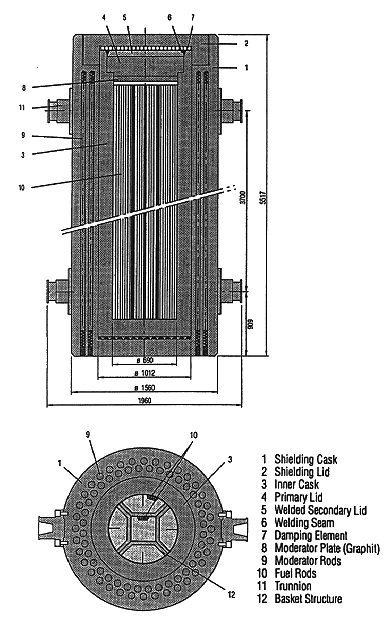
Fig. 1. Final
disposal cask POLLUX its components.
U. Knopp and H. Spilker
Gesellschaft fr Nuklearbehalter
mbH
Hollestr. 7a
45127 Essen
Germany
ABSTRACT
In Germany some progress has been made to develop a system for final disposal of spent fuel. Apart from the exploration of a suitable storage site, transport and storage cask systems for consolidated and non-consolidated spent fuel assemblies have been designed. These packages meet the requirements for a safe handling during transport and final disposal as well as the requirements resulting from the site characteristics of a final repository.
BASIS FOR ORIGINALITY AND AUDIENCE INTEREST
Since 1985, the German industry is working on the development of a cask system for final disposal. During the same time a pilot conditioning plant (PKA) has been planned which is now under construction at the Gorleben site.
As a result of this work the following packages for consolidated and non-consolidated spent fuel have been developed:
The design requirements for the final disposal of spent fuel as well as the packages and the status of their development are described more detailed in the paper.
DESIGN REQUIREMENTS FOR THE FINAL DISPOSAL PACKAGES
The following requirements have to be met by the final disposal packages:
These requirements as well as the properties of the spent fuel and the specific data of the regarded final repository in a salt dome led to the following planning requirements:
THE FINAL DISPOSAL CASK POLLUX
Figure. 1 shows the basic design of the final disposal cask POLLUX which consists of an inner cask with screw-fitted primary lid and welded secondary lid to maintain the leaktightness of the package and an outer cask with screwed lid which meets the requirements for shielding, heat removal and the mechanical protection of the inner cask. The consolidated spent fuel is deposited in packed canisters into the inner cask.
Fig. 1. Final
disposal cask POLLUX its components.
In addition to the suitable corrosion resistance of the used steel the inner cask can be covered with a corrosion protective coating to satisfy the final disposal requirements.
THE FINAL DISPOSAL CANISTER POLLUX
The fmal disposal canister POLLUX is designed for the pins of consolidated PWR spent fuel assemblies. The design and the principal components of the canister are shown in Fig. 2.
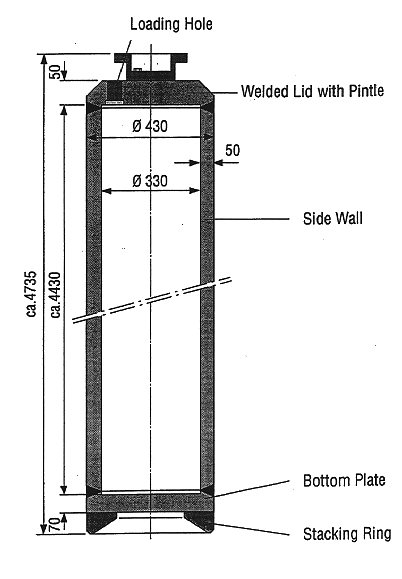
Fig. 2. Final
disposal canister POLLUX.
The welding closure of the final disposal canister after loading ensures the leak-tight containment of the radioactive material during transport, intermediate storage and final disposal.
THE UNIVERSAL CANISTER CONCEPT
The universal canister concept based on a final disposal canister which can be placed into suitable overpacks for transport and intermediate storage prior to the final disposal.
The canister is sealed by a narrow gap welding which has been development for this purpose. Due to the welding closure the leak-tightness of the hole package for transport or intermediate storage is maintained by the final disposal canister itself.
Therefore the design of the overpacks for transport and intermediate storage can be performed much more simple than for a common transport and storage cask. The overpacks only have to meet the requirements for shielding, heat removal and mechanical protection of the fmal disposal canister during transport and intermediate storage and fulfills the international transport requirements or the licensing demands for an interim storage site (see Fig. 3 to Fig. 6).
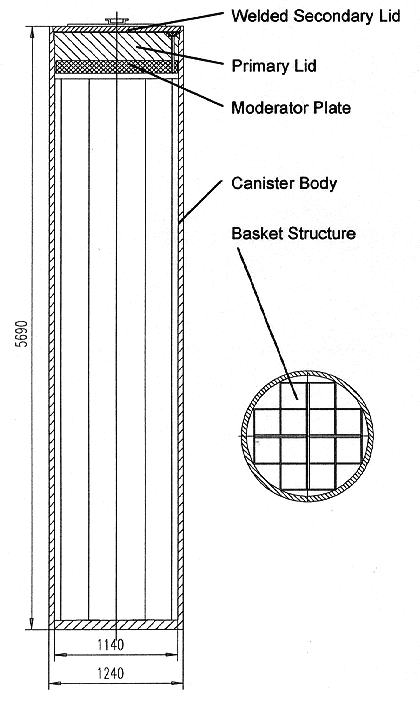
Fig. 3. Final
disposal canister.
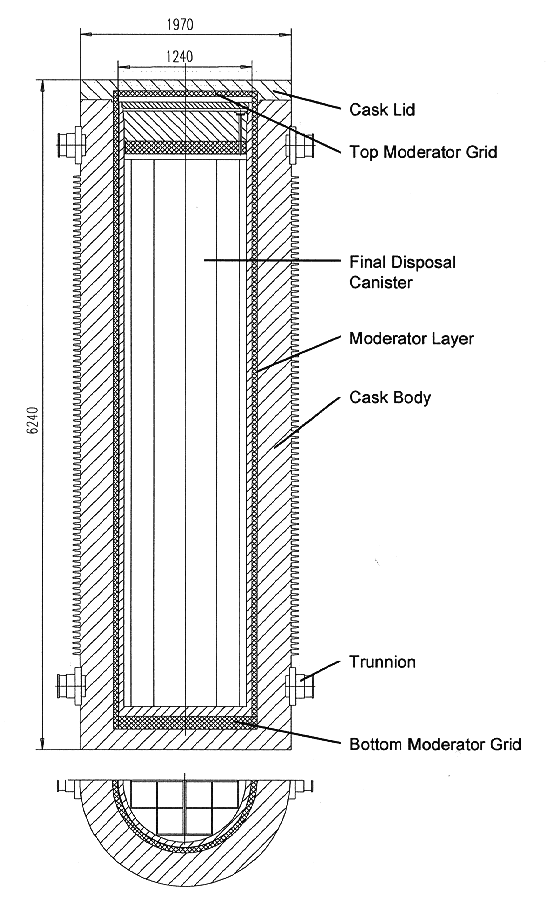
Fig. 4. Closure
system of the final disposal canister.
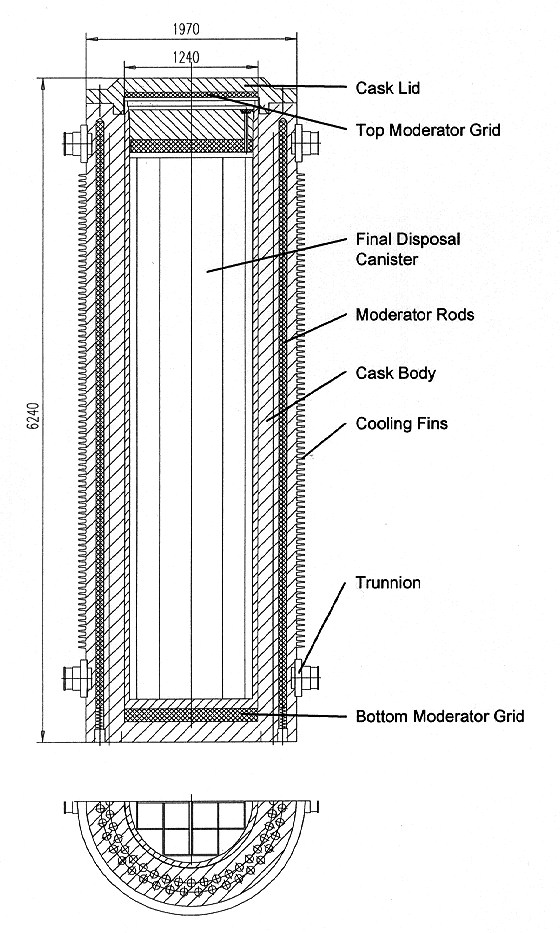
Fig. 5.Overpack for
transport.
Fig. 6. Overpack for
intermediate storage.
TECHNOLOGY OF PROCESSING AND PACKAGING OF SPENT FUEL
The technology of processing and packaging spent fuel assemblies will be tested in the Gorleben Pilot Conditioning Plant (PKA). Due to a possible large-scale utilization in the future, the technology and safety standards have to be optimized by this plant. So the experience gained in operating the PKA will be the base upon which to decide wether direct final disposal is feasible, both technically and from the point of view of regulatory aspects.
CONCLUSION
These systems for managing spent fuel, the POLLUX cask, the POLLUX canister and the universal canister provide new possibilities for transport, intermediate storage and final disposal of spent fuel.
Non-consolidated spent fuel can be treated as well as consolidated one and due to the leaktight welded canisters the safety against hazardous activity release is much better than for the common systems used today.
Even the handling ratios of the spent fuel assemblies on their way to final disposal can be reduced significantly. And because of that the radiation dose for the handling personnel can be minimized.
Up to now some efforts have to be made in developing the narrow gap welding to a approved process. Even the testing procedure of the weld by ultrasonic testing has been approved.
Furthermore some drop tests of the POLLUX cask has been performed to get more data about the behavior of cask material under accident conditions and even for benchmarking the mechanical calculations of the double-walled cask and its components.