Table I Steel Fiber and Cementitious Slurry Utilization for
Prototype Construction

Joey F. McCarter
Senior Engineer
Scientific Ecology
Group, Inc.
Oak Ridge, Tennessee
ABSTRACT
This paper presents the techniques, methods and design technology which led to the successful incorporation of volumetrically contaminated, recycled scrap steel and concrete into the design and manufacturing of performance oriented packaging for radioactive materials. The Scientific Ecology Group, Inc., SEG has successfully completed the design, fabrication and testing of concrete packaging. This packaging is designed to utilize over 41 percent recycled materials. This achievement was realized during work performed as part of a Program Research and Development Announcement (PRDA) Between the US DOE and SEG. This unique concrete packaging met all design criteria and performance testing requirements for Type A packaging as stipulated by the US Department of Transportation (DOT) for performance oriented packaging.
Vast amounts of scrap steel and concrete are and will continue to become available for beneficial reuse as a result of efforts initiated by The US Department of Energy (DOE) through its Environmental Management Program. This program will result in the decommission and industrialization of DOE sites. In addition, materials suitable for recycling are available in the commercial sector. If not recycled, these materials will require costly processing and disposal and will require the unnecessary use of vital disposal site resources that could otherwise be utilized for materials not suitable for recycling. On the other hand, recycling of these materials utilizing the design accomplishments in the generation of resource conscious packaging can provide an effective solution for the conservation of disposal resources while at the same time as provide performance oriented packaging which will be vital in the disposal and remediation of other non-recyclable waste streams that will be generated.
Although, this project consisted of the development of metal packaging in addition to the unique concrete packaging, the focus of this paper is to present specific aspects of the work which resulted in the research and development, engineering, design, manufacturing and testing of US DOT 7A, Type A packaging comprised of high compressive strength, high impact resistant concrete. The uniqueness of this type of packaging with regard to the application of recycled constituents, necessitates aconcentration on the efforts specifically supporting its development. These development activities targeted a material that was formulated specifically for the utilization of scrap steel as structural reinforcement and recycled concrete as a portion of the aggregate for the cement matrix. Design data, manufacturing specifications, testing criteria and test results are considered and discussed. In addition, the applicability of the data and the results achieved are presented with respect to both short term and long term goals for scrap materials currently slated for remediation disposal.
DISCUSSION
As a major contributor to the efforts of radioactive waste remediation worldwide, SEG is dedicated to developing innovative technologies and processes to assist the DOE in accomplishing its primary objective of Environmental Remediation and Waste Management (ERWM). As a result of this objective and the goals established by the DOE, huge volumes of contaminated scrap steel and concrete will be generated. With no existing recycling program established, there remains two major options available for the remediation of this material:
Neither method is cost effective and does not serve to support a wise use of available resources. Considering the negative results that are created utilizing these scenarios, it is imperative that other, more resource conservative methods be established to supports the DOEs efforts.
Project Objectives
In an effort to demonstrate the feasibility of beneficial reuse of potential waste streams, the PRDA was initiated to conduct a demonstration of proposed recycling and reuse vehicles. Actions were initiated to acquire material that is representative of the waste streams that will be generated as a result of the facilities decommissioning process and utilizing these materials, construct beneficial products. Items to be produced included performance oriented metal packaging, performance oriented concrete packaging, concrete reinforcing bar and metal fiber for use as concrete reinforcement.
SEG was tasked to design packaging - both metal and concrete, that would fill an existing need within the DOE system. Upon completion of the packaging design and review by the DOE, prototypes of the packaging were to be constructed and a testing program was to be implemented utilizing the criteria established by the DOT for Low Specific Activity (LSA), performance oriented packaging that could be utilized in the transportation and disposal of other existing, non-recyclable waste streams. Upon completion of the testing and certification process, a limited quantity of the packaging types were to be fabricated and supplied to the DOE for a demonstration phase which would consist of an actual utilization and disposal scenario. The packaging design and performance characteristics required for the demonstration was not to be altered to consider the specialty of the packaging with regards to the utilization of recycled raw materials.
During the implementation of this project, it was necessary to address certain goals by indirect methods. Tasks such as the integration of recycled concrete constituents into the production of performance oriented packaging was achieved through the use of bench scale testing activities and engineering analysis. These testing and analysis activities serve to establish that recyclables integration can be achieved with successful results and, additionally serve to provide methods for the incorporation of the recycled waste streams. The bench scale testing activities and engineering analysis performed was necessary to offset time constraints and the availability of commercial resources established at the time to directly address the handling of volumetrically contaminated material.
Acquisition of Raw Materials
SEG acquired approximately 70 tons of scrap carbon and stainless steel from Oak Ridge DOE facilities. These metals were volumetrically contaminated above the limits established for free release criteria consisting primarily of surface contamination. The acquisition of the scrap metals required an on-site mobilization of SEG personnel at the DOE K-25 facility located in Oak Ridge to perform the processing and collection activities. The location of the scrap metal was defined as a Radiological Control Area (RCA) and size reduction, sorting, staging and transportation activities were performed to transport the raw scrap metal to the SEG facility for decontamination and further processing.
In addition to the steel acquired from the K-25 site, approximately 24 tons of concrete was acquired from the Lawrence Berkley Laboratory (LBL) in Berkley California. The concrete, in the form of steel reinforced shield blocks utilized in the Beavatron Accelerator Project was chosen because the material exhibited no radiological contamination and as such, was capable of being free released for immediate processing by commercial resources available to meet project schedules.
Carbon Steel and Stainless Steel Scrap Raw Materials Processing
Both the carbon and stainless steel scrap metal exhibited volumetric radiological contamination on the order of 0.01% by weight. Major consideration was given to the methods to be used to reduce the contamination levels thus enabling controlled free release of the metals for commercial processing utilizing the most cost effective means.
Studies conducted by SEG demonstrate that decontamination of volumetrically contaminated scrap metals can be achieved successfully by a process of melt-decon. This process, whereby the contamination can be removed during the initial melting/casting operation by "skimming" contamination constituents from the surface of the heat, has been successfully utilized in achieving free release of metals contaminated with various isotopic concentrations. This process, however, could not be utilized since, at that time, no regulatory acceptance criteria existed for the free release of volumetrically contaminated metals which have undergone this type of decontamination process. Therefore manual methods such as sponge blasting, Co2 blasting and chemical decontamination techniques were employed.
Following decontamination of the raw metals at the SEG facility, further processing was conducted as the metal was melted into 10 ton ingots for transportation to commercial steel rolling mills and process subcontractors, utilizing SEGs 20 ton induction furnace. During the melting/casting process, the raw metal was chemically modified to meet the requirements of American Society for Testing and Materials (ASTM) specifications for A-36 and A-569 carbon steel and A-240 stainless steel. Processing conducted by commercial rolling mills consisted of rolling carbon steel sheet for the fabrication of the metal packaging and, in addition the fabrication of reinforcement bars for concrete.
The stainless steel component of the scrap was processed into metal fiber to be utilized in the fabrication of the high compressive strength concrete packaging. Typically, this material is utilized in the reinforcement of refractory products to increase thermal cycling and shock resistance.
The production of the fiber is achieved through a melt-extraction process involving a melting of the stainless steel in a small capacity furnace and skimming the surface of the heat with a special rotary-type mold that captures the molten stainless into a small groove, forming the fiber shape. The molten fiber is immediately passed through a water spray to quench the metal into its final shape. The fiber utilized for the construction of the concrete packaging measures approximately 1 3/8" in length and approximately .020" in diameter. The fiber exhibits course surface characteristics and is therefore ideal for the reinforcement of cementitious products since it readily anchors itself to the product in which it is embedded.
Concrete Raw Materials Processing
Concrete shield blocks supplied by LBL exhibited a configuration which required size reduction in order to facilitate an end product suitable as a replacement for the aggregate constituent of the concrete. To achieve this goal, the shield blocks were transported to SEGs subcontractor where the concrete blocks were manually reduced in configuration so as to accommodate processing in a crusher that reduced large "chunks" of the concrete to 2" to 3" rocks. During this process, the embedded reinforcing bar was removed and discarded.
Following this Phase I size reduction of the LBL blocks, a small amount of the crushed concrete was further processed to create a suitable configuration for introduction as an aggregate substitute
Concrete Packaging Design
The application chosen by the DOE to which the development of the concrete packaging was to focus was the disposal of vitrified K-65 Silo material located at the Fernald Environmental Management Company (FERMCO) facility in Fernald, Ohio. The material stored was to undergo a vitrification process, be packaged and disposed of at the Nevada
Test Site (NTS) facility. The radiological characteristics of the material required that the packaging meet the performance requirements for US DOT 7A, Type A packaging. The container design must also provide radiological shielding of the content from its unshielded dose rate of approximately 800mR/hr to a surface contact dose rate of less than 80mR/hr.
The predicted mass of the vitrified product was approximately 180 PSF. Therefore, the design of the packaging was required to accommodate a maximum gross weight of 21,000 pounds per package so that two packages could be shipped per transport. The packaging configuration and basic design criteria was established with concurrence and approval of the FERMCO project team. Following the approval of the design criteria specifications, SEG engineering developed the detailed design for the packaging.
Design considerations necessitated that the performance requirements, shielding characteristics and geometry be satisfied by a concrete formulation that exhibited excellent compressive strength while exhibiting high impact and shear resistance. In addition, the criteria for the integration of recyclables must be considered so as to accommodate the maximum amount of recycled constituents possible without degrading the integrity of the packaging. Considering these criteria, and the previous experience obtained by SEG in the development of similar packaging, the decision was made to utilize a fiber reinforced concrete design. This material Slurry Infiltrated Fiber Reinforced Concrete (SIFCON)(1) provided the required characteristics to satisfy the structural performance requirements, shielding characteristics and the ability to easily integrate recyclable constituents into the material matrix.
Utilizing the SIFCON material, SEG finalized the design of the packaging incorporating design features which would ensure the structural characteristics of the total design would accommodate and maximize the performance characteristics of the concrete formulation. Previous experience gained by SEG in the development of similar packaging served valuable in the development of the subject packaging. Design considerations such as controlling shear forces created by free drop impact and the importance of steel fiber orientation within the concrete matrix were prime considerations during the detail design phase.
All design criteria considered, SEG developed the detailed design of the packaging which incorporates a bolt-on, gasketed lid-to-body interface, passive venting system and configuration that supports handling using standard fork lift vehicles. During the detailed design phase, engineering analysis to predict and verify the packaging behavior during drop testing was implemented. This analysis considered both known data for the behavior of the material under static conditions and data regarding dynamic behavior acquired from previous similar development and testing activities.
A standard analytical software product was utilized to establish the shielding characteristics of the packaging design. Once the final design was complete, a fabrication specification and drawing package as well as a performance testing specification reflecting the requirements for DOT Type A packaging was forwarded to FERMCO for concurrence and approval.
Research and Development of Concrete Formulation
Although SIFCON was not developed as a result of its application to this program, the basic formulation of the material required some additional development in order to provide consistent results in its strength characteristics. As a result of this need, SEG initiated a teaming arrangement with Lankard Material Laboratory to develop a formulation that would provide consistent and predictable structural characteristics. As part of this development scope, the basic material design was altered, creating several distinct mix designs and creating samples of each mix design that were tested for compression strength, flexural strength and impact resistance.
SIFCON is a cementious material incorporating Portland cement, silicates, such as sand and fume as aggregates contained within a low water to cement ratio mixture. The primary reinforcing medium is steel fiber. As a result of the characteristics of the material design, the development program initiated to maximize the materials strength also considered the integration of recyclable constituents for future implementation. The criteria for modification of the mix design to incorporate recyclables was established and the research and development results were incorporated into the fabrication specifications for the packaging.
Fabrication of Prototype Concrete Packagings
The fabrication of three prototype packages was initiated as a result of a detailed investigation and selection activities considering commercial concrete fabricators that exhibited the needed experience with like materials. The fabricator chosen was Lindsay Concrete Products of Akron, Ohio.
Following the design, fabrication and the shipment of the specifically designed concrete form sets to the fabricator, a small scale training program was initiated in which the fabricator received instruction on the proper methods to be employed to achieve the desired result considering the characteristics of the SIFCON material. These characteristics and the design of the packaging necessitate specific methods be utilized for placing the reinforcing fiber into the forms.
Fiber placement is important in that proper orientation will maximize the strength of the product. Considering the desired structural characteristics of the package, it is necessary to orient the fiber reinforcement in the packagings lid such that the fiber matrix is placed in bending when subjected to the qualification testing routine. On the other hand, fiber orientation in the packagings body must be placed so the fiber matrix will resist both shear and bending and provide maximum resistance to impact. In order to ensure that this fiber orientation would be achieved, two distinct methods for placement of the fiber within the molds were developed.
Fabrication activities consisting of form preparation, fiber placement and cement slurry infiltration required very little time to complete considering that all operations were performed using strictly manual methods. A total of approximately 2,900 pounds of fiber and 8,200 pounds of cementitious slurry was utilized per unit, resulting in a total cement matrix weight of approximately 11,200 pounds per unit. Table 1 presents data relative to amounts of fiber and cementitious slurry utilized.
Table I Steel Fiber and Cementitious Slurry Utilization for
Prototype Construction
After all infiltration tasks were complete and test cylinders made, the forms were filled with approximately 12" of water, wrapped in plastic and placed in storage to begin the curing process. After approximately twenty days of undisturbed curing time, the forms were stripped of the containers, the containers were cleaned and a sealer was applied to the exterior of the finished containers.
An examination of the structural properties of the test cylinders made during the fabrication of the prototype units revealed that the compressive strength of the cement matrix averages approximately 7, 610 PSI at 2 days, 9,060 PSI at 3 days, 12,690 PSI at 14 days and 13,670 PSI at 28 days. Comparing this data to data collected during the concrete formulation development phase of the project, it is noticed that the fabrication tests cylinder compressive strengths average somewhat lower than the average of 17,000 PSI exhibited during the development phase. This can be contributed to the fact that the steel fiber content of the comparatively smaller specimens cast during the fabrication of the prototypes averaged 7.3 volume percent, while larger specimens made during the development phase averaged 9.5% to 10%. The inability to achieve a higher fiber loading in the small specimens is due to edge effects which make it impossible to duplicate fiber placement in a large void volume such as the form sets. Therefore, the strength characteristics expected from the prototype packaging should be closer to that resulting from the test specimens made during the development phase.
Test Program for Concrete Packaging Certification
Following the final preparation of the prototype packaging units, all three prototypes were loaded onto a flatbed truck, adequately covered to protect them during transport and shipped to SEGs facility located in Carlsbad, New Mexico.
The first activity to be implemented was to test the packaging for compliance to DOT requirements for packaging ability to withstand the dynamic effects of transportation. Prior to being loaded onto the transport truck, one prototype was loaded with a content configuration simulating that of the intended content of vitrified "gems" of K-65 silo material. The mock content, consisting of standard gravel and a mixture of embedded concrete panels was introduced into the packaging so as to create a package gross weight of 21,000 pounds. The gasket seal was installed, the lid placed onto the container and all lid bolts installed or in accordance with the testing specification. Following this procedure all prototypes were shipped to SEG Carlsbad Facility for testing.
Upon the receipt of the prototypes at SEG-Carlsbad, a thorough examination of the prototype containing the mock content was initiated. The inspection criteria consisted of examining the packaging for any effects that could be caused by transportation such as cracking, signs of fatigue or loss of content. No effects were found and all prototypes were off loaded from the transport truck and prepared for the remaining testing activities.
Following preparations of the prototypes for the compliance testing activities such as removing the mock content used for the transportation test so that the unit could be used to conduct a compression test, introducing a mock content into the remaining two specimens to prepare them for free drop test activities and marking the specimens for tracking purposes, the certification testing activities commenced. The testing routine was conducted in accordance with the testing specification compiled by SEG which reflected the requirements imposed by 49 CFR 173.465. The test routine consisted of the following testing activities in addition to the transportation test performed during the shipment:
The performance of all required testing activities, inclusive of multiple drop test orientations, resulted in no failures of the packaging, no release of the content and only minimal damage incurred from the drop testing activities. Following the testing activities, a test report was compiled and forwarded to FERMCO for examination and approval.
Recycled Materials Integration Research
The successful completion of the aforementioned design, fabrication and testing activities serves to provide the evidence that the program is successful in that the methods utilized in the design are sound and support certification of the design to the criteria established by the DOE. However, integration of recycled constituents requires attention in order to fulfill the core goal of the PRDA.
The integration of recyclable material can be applied to two of the packagings material of construction the steel fiber and the micro aggregate constituent of the cement slurry. In consideration of the steel fiber, readily accessible data serves to substantiate that fiber manufactured from recycled steel constituents compares favorably with that manufactured from virgin steel resulting in almost identical structural properties of both materials. As a result, it can be concluded that the packagings performance would not be altered by the use of steel fiber made from a recycled steel product.
However, the integration of recycled concrete constituents into the SIFCON matrix required considerable testing to ascertain the effects of the integration and to establish controls on the amounts of recycled concrete that can be used. To achieve the data needed to integrate recycled concrete constituents, bench scale testing activities were implemented to determine the effects of recyclables integration at various levels of introduction. The testing consisted of utilizing the LBL shield block material as a replacement for the micro silica sand aggregate component of the SIFCON material. The LBL concrete was milled to mimic the sieve characteristics of the sand and test batches of the SIFCON slurry were produced utilizing graduated replacement ratios. Table II presents the results derived from SIFCON slurry test cubes cured at 28 days for compression strengths and 8 day flexural strength of various levels of integration compared to virgin material.
Table II Effects of Recycled Concrete Aggregate Integration On
SIFCON
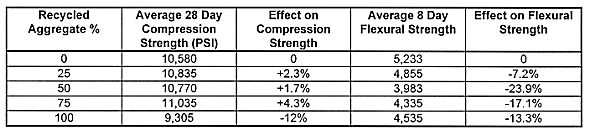
The performance of this testing utilized only non-reinforced SIFCON slurry and no credit is taken for the structural characteristics provided by the inclusion of metal fiber reinforcement which greatly enhances the structural characteristics of the total matrix.
An examination of the data resulting from the tests show that different levels of recyclables integration do have an effect on the physical properties of the material. It can be noted that up to and including a 75% replacement of the micro silica sand resulted in an increase in the compressive strength while any integration level resulted in a decrease in flexural strength. Comparing this data to properties of virgin SIFCON it can be noted that the increase in compressive strength is more beneficial than the decrease in flexural strength is detrimental. Since the majority of the flexural strength characteristics of a complete SIFCON matrix can be attributed to the steel fiber reinforcement resistance to bending, it can be concluded that an integration level of 75% replacement of the micro silica sand would not degrade the structural properties of the SIFCON and considering that the prototype packaging design incorporates a large wall thickness to strength ratio to accommodate shielding requirements, an integration level of 100% replacement of the micro silica sand would not be unreasonable.
An examination of the total matrix with regard to all dry constituents results in a total integration of recyclables equaling in excess of 48% of the total mass. This includes a complete replacement of the steel fiber with that derived from recycled steel scrap and a 75% replacement of the micro silica aggregate replacement with recycled and milled concrete. Therefore these tests establish that the successful performance of the packaging would not be detrimentally effected by the integration of the recyclables as discussed.
In addition, Considering the levels of integration of the recycled concrete constituents, residual contamination levels in the waste concrete can be easily dispersed throughout the total concrete matrix. Due to the shielding characteristics of the concrete, a self shielding effect can be realized and dependent on these residual contamination levels, no decontamination efforts may be necessary.
CONCLUSION
Through the development activities associated with this project, it has been demonstrated that performance oriented packaging has been, designed, manufactured and tested that utilize en excess of 48% recycled scrap steel and concrete materials that would otherwise remain a liability for disposal.
The accomplishments realized as a result of these activities have provided valuable tools with regard to the methods for the conversion and utilization of essentially non-beneficial waste streams into useful and beneficial products. The resulting products are essential in the transportation and disposal of other non-recyclable waste streams. In addition, these methods provide for the conservation of ever decreasing disposal resources and avoid the unwise use of these resources. The old ways of typical disposal must be reexamined in an effort to provide new, more conservative means to wisely utilize the resources that we possess while at the same time maintaining the public trust and confidence.
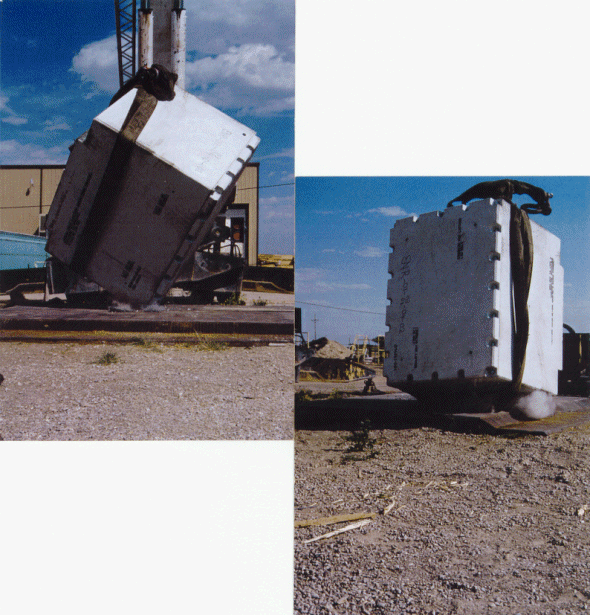
Fig. 1. Free drop testing of
performance oriented concrete packaging to the requirements of 49 CFR 173.465