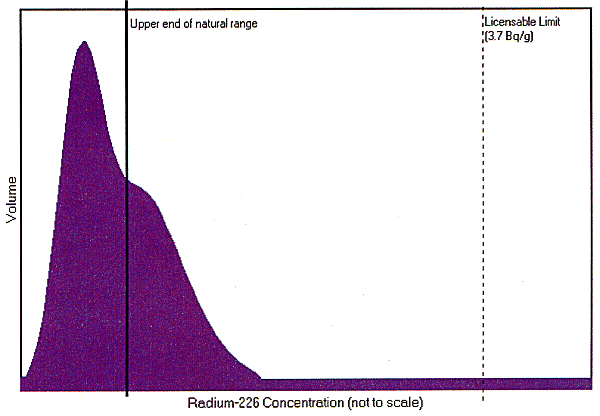
Fig. 1. Distribution of radium-226
concentrations in unsorted excavated soil.
R.W. Pollock and C.H. Clement
Low-Level Radioactive
Waste Management Office
Atomic Energy of Canada Limited
1595 Telesat
Court, Suite 700
Gloucester, Ontario K1B 5R3 CANADA
ABSTRACT
This paper discusses the application of waste segregation approaches at historic waste sites in Canada. At many sites, the original waste volume has been substantially increased due to contamination of soil by natural transport processes or by physical mixing from activities such as property development. This results in a heterogenous distribution of the contaminants between the original wastes and the native soils contaminated by the wastes. Segregation of a large fraction of the contaminant inventory, but in a small fraction of the volume, may thus lead to significantly reduced interim storage and final disposal costs since each fraction of the waste can be treated in a manner appropriate to its potential hazard. More expensive treatments can be reserved for a relatively small volume of material with the highest contaminant concentrations, while less expensive methods can be applied to the remainder.
Policy and regulatory considerations are discussed, and the cost-effectiveness of this approach is examined using five case histories. These demonstrate reduced costs at the two sites where remedial action plans based on waste segregation have been implemented, and the potential for cost reductions for future work at the other sites.
INTRODUCTION
The Low-Level Radioactive Waste Management Office (LLRWMO) was established in 1982 to carry out the responsibilities of the federal government for low-level radioactive waste (LLRW) management in Canada. The LLRWMO is operated by Atomic Energy of Canada Limited (AECL) through a cost recovery agreement with Natural Resources Canada (NRCan), the federal department which provides the funding and establishes national policy for LLRW management. Part of the mandate of the LLRWMO is to resolve historic radioactive waste problems that are a federal responsibility. Historic wastes are LLRW for which the original owner can no longer be held responsible and which are managed in a manner no longer considered acceptable. If they are wastes for which the federal government accepts responsibility, their management comes within the mandate of the LLRWMO.
This paper discusses the application of waste segregation approaches at historic waste sites in Canada. These sites date back to the radium industry, and to the early years of the uranium industry. At many sites, the original waste volume has been substantially increased due to contamination of soil by natural transport processes or by physical mixing from activities such as property development. This results in a heterogenous distribution of the contaminants between the original wastes and the native soils contaminated by the wastes. In addition, contaminant distributions are often heterogenous within the wastes themselves. The expectation is that segregation of a large fraction of the contaminant inventory, but in a small fraction of the volume, may lead to significantly reduced interim storage and final disposal costs since each fraction of the waste can be treated in a manner appropriate to its potential hazard. More expensive treatments can be reserved for a small volume of more active material, while less expensive methods can be applied to the remainder. This paper briefly describes the technical basis for the segregation approach. A second paper in a different session examines the details of the relationships between contaminant inventories and waste volumes(1). Policy and regulatory considerations are then discussed, and the cost-effectiveness of this approach is examined using five case histories.
TECHNICAL BASIS FOR SEGREGATION APPROACH
The segregation approach developed by the LLRWMO is based on categorization of contaminated materials as clean soil, mildly contaminated soil, or licensable LLRW materials. Clean soil has a radium-226 concentration that falls within the normal range of background. All materials that exceed the licensable concentration of the radioactive contaminant must be classified as LLRW. Mildly contaminated soil falls in the region between clean soil and LLRW.
Figures 1 and 2 illustrate this segregation approach. Figure 1 shows the distribution of Ra-226 concentrations in an inventory of excavated contaminated soil. In this example, a substantial amount of clean soil is interspersed with the contaminated soils and only a small fraction of the total volume represents licensable material. However, if the inventory is left unsegregated, it is this small fraction which determines the classification, and subsequent requirements for management, of the entire volume.
Fig. 1. Distribution of radium-226
concentrations in unsorted excavated soil.
Figure 2 shows the distributions of Ra-226 concentrations after sorting into three inventories. In this figure, the upper decision point (the solid line to the right) separates mildly contaminated soil from LLRW material. It can be set below the licensable limit (the lightly dotted line further to the right) to allow for some uncertainty in the decision while still ensuring that all LLRW is properly classified. This is operationally practical because the volume of LLRW is generally quite small, and a decrease in the decision point that allows the use of less precise (and expensive) classification methods will not have a large impact on the volumes in each category. Segregation at the upper decision point is often determined by taking measurements insitu or on trucks loaded with soil using simple, hand-held instrumentation.
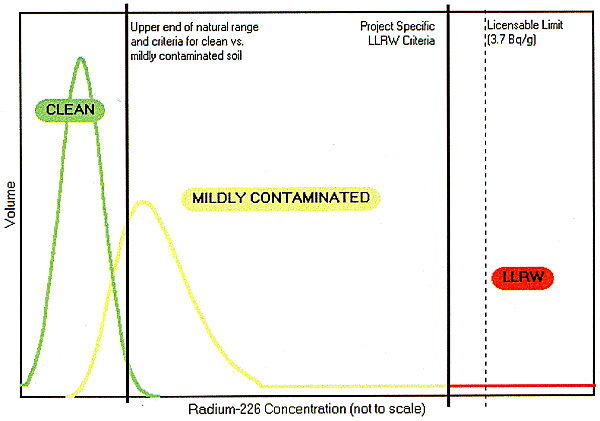
Fig. 2. Distribution of radium-226
concentrations after sorting into three inventories.
The lower decision point (the solid line to the left) separates clean from mildly contaminated material. The precise determination of this decision point is critical. If it is set too high, any mildly contaminated material misclassified as clean will contaminate the clean material. If it is set too low, the volume of material classified as mildly contaminated increases, thus increasing future management costs.
Two technical solutions for identifying and using these two decision points have been developed by the LLRWMO. The Large Area Gamma Survey (LAGS) system was developed to produce detailed surface gamma radiation surveys which can distinguish these points in the field(2). The system has been extensively used at projects in Fort McMurray, Alberta and in Scarborough, Ontario to determine cleanup boundaries prior to excavation and to verify whether criteria had been met following cleanups.
The Soil Sorting Conveyor System (SSCS), which was initially developed in 1990, was redesigned and rebuilt on a larger scale, and with enhanced detection capabilities, in 1994(3). The task included a major quality assurance component to ensure the successful operation of the system. The system operates by passing a stream of soil on a conveyor past sensitive radiation detectors, the output of which is monitored by a computer. The computer triggers a gate to segregate the material based on its gamma radiation. Soil samples are automatically collected for analysis to confirm soil classification. The SSCS processed more than fourteen thousand cubic meters of soil during the Malvern Remedial Project (MRP) in Scarborough in 1995.
POLICY AND REGULATORY CONSIDERATIONS
Natural Resources Canada is the department of the federal government responsible for energy policy, including nuclear energy and extending to radioactive waste management. The general policy is that waste producers and owners are responsible, in accordance with the principle of "polluter pays" for the funding, organization, management and operation of disposal and other facilities required for these wastes. This policy cannot be applied at historic waste sites, and the LLRWMO is designated to resolve these problem sites. A standard basis has been developed whereby current owners, with the exception of private residential owners, pay a portion of the remedial action costs. There is thus a strong incentive to develop cost-effective solutions, not only from the viewpoint of the government, but also from the viewpoint of the current owners.
Since the LLRWMO is federally funded, LLRWMO projects are assessed in accordance with federal requirements. LLRWMO projects to date have been assessed in accordance with the Environmental Assessment and Review Process (EARP) Guidelines Order. In future, the new Canadian Environmental Assessment Act (CEAA), and regulations promulgated pursuant to it, will apply. In either case, a key requirement is public consultation prior to important project decisions being made. The waste segregation approach has been effective in obtaining community support, at those sites where it has been used, since each inventory can be seen to be managed in a safe and environmentally sound manner tailored to that material.
Radioactive waste management is regulated by the Atomic Energy Control Board (AECB), the nuclear regulatory agency in Canada. The objectives of radioactive waste disposal, as stated in AECB regulatory guideline R-104(4) are to:
taking into account social and economic factors.
A general requirement of R-104 is that the predicted radiological risk to individuals from a waste disposal facility shall not exceed 10-6 fatal cancers and serious genetic effects in a year, calculated without taking advantage of long-term institutional controls as a safety feature. It is recognized that for some waste types, such as the large-volume wastes at some uranium mining and milling sites, there may be a need for continued institutional controls. In such cases, an optimization study is to be performed to determine the preferred option.
Wastes may be exempted from further regulatory control for disposal, by application of regulatory guideline R-85(5). The basic requirements are that an individual incremental dose limit of 0.05mSv/a be met, and that collective doses be small. The intent is to allow exemptions for wastes with very low amounts of radioactivity, not to permit dilution as a substitute for disposal of wastes in regulated facilities.
A licence is required for materials containing more than specified amounts of radionuclides. In the case of Ra-226, this licensing threshold is 3.7Bq/g (100pCi/g); in the case of uranium it is 500ppm. This does not mean that materials with radioactivity concentrations below these thresholds are uncontrolled. AECB regulations require approval for the disposition of any prescribed substance, regardless of whether or not a license is required for its possession, that is, licensing is a subset of regulation.
The regulatory classification of inventories resulting from the LLRWMO approach to segregation is then as follows:
- disposal as industrial waste, if they also meet all relevant provincial guidelines.
- in situ management, with institutional controls, under AECB regulation. This requires an optimization study.
- interim storage under AECB regulation. This option is attractive at sites where there is a need for interim action prior to the availability of a permanent disposal facility.
Five sites have been selected for use in this paper, using a case history approach. Two of these sites, the Welcome Waste Management Facility and the Port Granby Waste Management Facility, were used as repositories for low-level radioactive process wastes by the former Eldorado Nuclear Limited. They represent a significant fraction of the historic low-level radioactive waste in Canada. The Port Hope Harbour contains contaminated sediments as a result of effluent from the Eldorado radium refinery during the 1930s and 1940s. This site was selected because it represents a significant portion of the historic low-level radioactive waste in the Town of Port Hope, Ontario, and is an example of contaminated sediments rather than soil. The last two sites were chosen primarily because they contain a significant fraction of their inventory in the form of discrete contaminated artifacts. The Fort McMurray site was contaminated primarily by spillage of uranium ore and concentrates at the barge to railcar transfer point that existed there in the 1930s and 1940s. The contaminated material found in the Malvern community in Scarborough, Ontario resulted from a radium recovery operation located in a rural area in the 1940s, and consisted of discrete radium impregnated artifacts and radium contaminated soil.
RELATIONSHIP BETWEEN CONTAMINANT INVENTORIES AND VOLUMES
With respect to inventory and volume determinations, the selected sites fall into two categories: those where cleanups have already occurred, and those where cleanup is yet to be done.
The contaminated material from the Fort McMurray site and from the Malvern site has already been excavated. The data collected during these remedial projects are sufficient to characterize the contaminated material in some detail. Records of specific activity estimates for each truckload of material taken from the Fort McMurray site, and estimated activities for discrete artifacts recovered, are available. Most of the bulk material from Malvern was well characterized in approximately seven cubic meter batches, and records on individual contaminated artifacts also exist. In both cases there are sufficient data to produce very detailed estimates of the volumetric inventory distributions.
Inventory and volume determinations for sites which have not been cleaned up are based on the integrated analysis of subsurface sampling results and gross gamma radiation borehole logs. Although the data are less complete than for the sites already cleaned up, reasonable estimates of the volumetric inventory distributions are possible.
Details of the relationships between contaminant inventories and waste volumes are provided in another paper(1) being presented in a different session of this conference, and only selected highlights are reproduced in this paper. Table I summarizes the criteria selected for waste characterization for this study, as well as the sources from which these criteria were taken. The waste characteristics are such that both radiological and chemical contaminants need to be considered. Although there are a number of chemical contaminants, other analyzes not discussed in this paper have shown arsenic to be the most important due to the amount present, and its toxicity and mobility in the environment.
TABLE I Criteria Selected for Categorization of
Material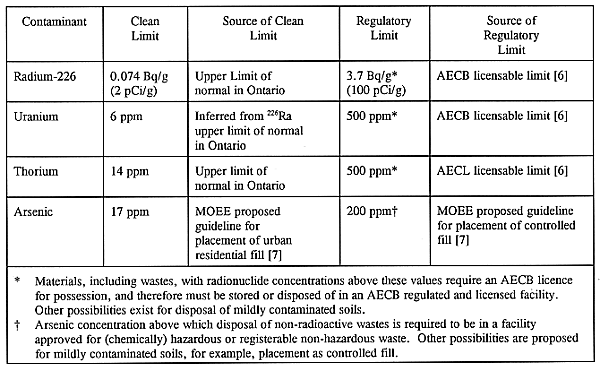
Results of the analyzes are shown in Fig. 3. At the Fort McMurray and Malvern sites, where much of the contaminated material was in the form of discrete artifacts, the licensable fraction makes up less than one percent of the total volume. Substantial amounts of clean soil were randomly interspersed with contaminated soils, because of the nature of the development activities which have occurred subsequent to the deposition of the original wastes. The same general characteristics exist at the other sites where contaminant transport has been mostly due to natural processes, with less physical mixing. The licensable fractions are significantly higher, although still in the range of only 15 to 25%. There is also much less clean soil, typically less than 20%.
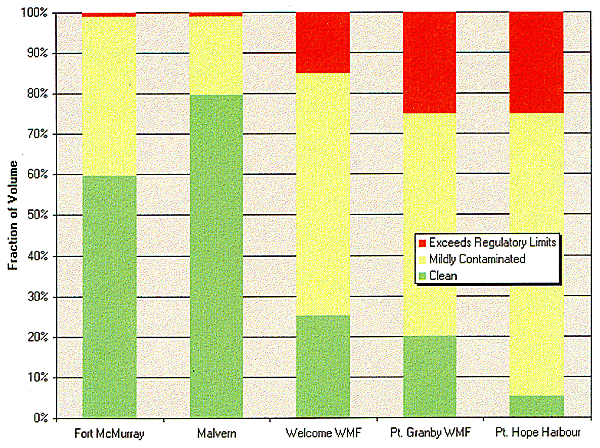
Fig. 3. Volume
fractions by category.
CASE HISTORIES
Former Northern Transportation Network Sites at Fort McMurray, Alberta Fort McMurray, Alberta was the final transfer point in the Northern Transportation Company Limited (NTCL) network used by Eldorado Gold Mines from the 1930s to the 1960s to transport uranium ore and concentrate from their Port Radium mine in the Northwest Territories. A 1,400 mile water transportation network linked the mine site on Great Bear Lake to the barge-to-rail transfer point at the NTCL property in Fort McMurray, Alberta. From Fort McMurray, the ore was transported by railcar to its final destination in Port Hope, Ontario for refining.
Investigations subsequent to the initial discovery in Fort McMurray in 1992 found contaminated soil at adjacent properties that were once part of the original site and at two additional barge-to-rail transfer points, with the total volume estimated at 40,000m3. Cleanup began in the spring of 1993, using the cleanup criteria and waste management plan developed by the Fort McMurray Working Group in consultation with the community(8). The Working Group consists of representatives from the LLRWMO and their engineering consultant, the Regional Municipality of Wood Buffalo (which includes Fort McMurray), and the Northern Lights Regional Health Center, and continues to oversee implementation of the project.
Cleanup operations were conducted such that the inventory of material exceeding the licensable uranium concentration of 500ppm was separated at the source from mildly contaminated soils. Thiswas accomplished by excavating the contaminated soil in lifts of approximately 15cm, after a radiation survey was conducted to identify and remove pieces of ore and pockets of soil with a uranium concentration greater than 500ppm. Licensable material was placed in 210 litre drums for transfer to the LLRWMO interim storage facility at AECL Chalk River Laboratories. The remaining mildly contaminated soil meets all provincial requirements for classification as industrial waste, and was transferred to a disposal cell constructed by the LLRWMO at the municipal landfill. The LLRWMO maintains long-term responsibility for monitoring and maintenance of the disposal cell, through a legal agreement with the municipality. Confirmatory measurements were made on both the drums and the trucks before the material was sent for disposal.
The concept of segregating the licensable inventory has resulted, so far, in about 84m3 of licensable material, with an average uranium concentration exceeding 1,000ppm, being removed from approximately 26,500m3 of contaminated soil with an average uranium concentration of about 12ppm. Licensable inventories are much more difficult and costly to manage than mildly contaminated soils classified as, and treated as, industrial waste. The volume ratio of the mildly contaminated soil to the licensable inventory (about 300 to 1) and the factor of approximately 100 between the contaminant concentrations of the two inventories demonstrates the effectiveness of the approach chosen. Based on costs to date, the overall project costs for site characterization, planning and approvals, cleanup, and waste management are estimated to be about $125/m3 of excavated soil. The low costs have made it practical to use stringent cleanup criteria so that there are no restrictions on future site use, and redevelopment is underway. This approach has resulted in excavation of a substantial amount of clean soil interspersed with contaminated soil. It was not cost effective, however, to segregate these two inventories, given the low disposal cost. By comparison, the unit costs for packaging, transportation, interim storage and final disposal of the licensable material will be $1,500 to 2,000/m3, or perhaps more depending on the eventual disposal costs. It was thus essential to segregate this small component of the waste, to allow the much lower cost approach for the remainder.
Malvern Community, Scarborough, Ontario
Radium-contaminated soil was discovered at a residential subdivision in the Scarborough community of Malvern in 1980. The area had been developed in the 1970s, with the developers unaware of the radium recovery operations carried out at the site in the 1940s. Several initiatives to remove the contaminated soil failed when residents who lived close to proposed interim storagesites objected vigorously. The Malvern Remedial Project (MRP), a joint Canada/Ontario project to complete the cleanup in the Malvern area, was announced in 1992 March. The main elements of the project were to complete the cleanup of soils at the original location and at a second location subsequently discovered, to sort the soil to remove all licensable material and to store the remaining mildly contaminated soil at the sorting site until a permanent disposal site is available in Ontario. An extended survey of the Malvern community was conducted to confirm that no further areas of similar contamination exist.
The planning and approval process for the MRP involved extensive public consultation, lead by the Public Liaison Committee, and an environmental assessment process extending over almost three years(9). In order to minimize the waste volume, soil-sorting equipment was acquired, assembled and tested. The approach of using an automated soil sorting conveyor system to remove material with licensable amounts of radium, and then to characterize and segregate the soil into clean and mildly contaminated inventories, was customized for application to the MRP. The original version of the system was developed for a partial cleanup when the second location was discovered in 1990.
The contaminated soil (about 16,000m3) was excavated in 1995 and segregated into three categories: Low-Level Radioactive Waste (LLRW), Mildly Contaminated, and Clean. The small volume of LLRW, roughly 30m3, may eventually be disposed in a packaged LLRW disposal facility for nuclear fuel cycle wastes, a fairly expensive option. The Mildly Contaminated material (approximately 7,700 m3) may be disposed of in a bulk waste disposal facility, potentially at considerably less cost per unit volume than packaged LLRW disposal. The Clean material (about 7,500m3), which was unavoidably excavated in the process of removing the contaminated materials, may be released for use as clean fill or landfill cover. Segregation of the Clean and Mildly Contaminated inventories proved to be cost effective. As can be seen from Fig.1, about 80% of the originally excavated volume could theoretically have been segregated as Clean. However, the level of confidence (95%) required to classify soil as Clean was such that some was conservatively classified as Mildly Contaminated. Consequently, about 50% of the originally excavated volume was classified as Clean, at a sorting cost of about $2.9M. Had all of this soil been classified as Mildly Contaminated, the additional future management costs are estimated to be about $1M for interim storage and $2.7M to $8.9M for future disposal. The segregation approach was also crucial to obtaining public acceptance. This was particularly important to this project given the history of failures of previous proposals.
Welcome and Port Granby Waste Management Facilities, Ontario
The Welcome Waste Management Facility (WWMF) and Port Granby Waste Management Facility (PGWMF) were used as repositories for low-level radioactive process wastes by the former Eldorado Nuclear Limited between 1948 and 1955, amd 1956 and 1988, respectively.
The material at the WWMF represents the largest volume (approximately 492,000 m3) of historic low-level radioactive waste at a single site in Canada. The main contaminant inventory at the WWMF is found in 7,700 m3 of primary waste in the form of chemical residues and sludges produced at the radium refinery. The remainder of the volume is mostly made up of soils subsequently contaminated by physical mixing with wastes, and a large volume of underlying native soils contaminated by leaching of the primary wastes. The current conceptual plan(10) is to segregate the wastes and contaminated soils into one inventory consisting of the primary wastes and mixed soils, and a second inventory of the underlying native soils contaminated by leachate movement. This would result in one inventory representing about one third of the volume and containing (on average) approximately 40 Bq/g radium-226, 4,000ppm arsenic, and 500 ppm uranium. This inventory would be transferred to a new LLRW disposal facility, yet to be established. The second inventory would represent about two thirds of the total volume and would contain approximately 0.1 to 0.4Bq/g radium-226, 50 to 100ppm arsenic, and 10 to 20ppm uranium. It would be managed insitu or consolidated into a simple on-site disposal cell. This approach could be optimized by sorting mixed soils with low contaminant concentrations from primary wastes. It can be seen from Fig.1 that the inventory requiring transfer to a new LLRW disposal facility may be as low as about 15%, which is about half that in the current conceptual plan.
The PGWMF is second only to the WWMF in terms of volume of historic low-level radioactive waste found at a single site in Canada (approximately 380,000 m3). The main contaminant inventory is found in approximately 94,000 m3 of primary waste in the form of neutralized raffinate and calcium fluoride, and smaller amounts of radium refinery waste and magnesium fluoride slag. The remainder is made up mostly of contaminated industrial wastes and soils contaminated by physical mixing with wastes, and a smaller volume (about 20%) contaminated by leaching of the primary wastes. The current conceptual plan(10) is to segregate the wastes into one inventory consisting of the primary wastes and mixed soils, and a second inventory of the underlying native soils contaminated by leachate movement. This would result in the first inventory containing about 80% of the volume and containing (on average) approximately 50Bq/g radium-226, 4,000ppm arsenic, and 1,000ppm uranium. This inventory would be transferred to a new LLRW disposal facility, yet to be established. The second inventory would represent about 20% of the volume, and contain approximately 0.1 to 0.2 Bq/g radium-226, 20 to 30ppm arsenic, and 20 to 50 ppm uranium. It would be managed insitu or consolidated into a simple on-site disposal cell. This approach could be optimized by sorting mixed soils with low contaminant concentrations from primary wastes. It can be seen from Fig.1 that the inventory requiring transfer to a new LLRW disposal facility may be as low as about 25%, which is about one third of that in the current conceptual plan.
The present conceptual cleanup plans for these sites, which include managing some mildly contaminated soils insitu, are estimated to result in cost reductions of about $60M compared to disposal of all of the wastes in a new LLRW disposal facility. Further optimization of this approach may be possible at the detailed design stage, based on physically segregating additional mildly contaminated soils using the equipment developed for Malvern and Fort McMurray.
Port Hope Harbour, Port Hope, Ontario
The Port Hope Harbour contains contaminated sediments as a result of effluent from the Eldorado radium refinery during the 1930s and 1940s. The contaminants in the Harbour sediments include radium, uranium, arsenic and heavy metals. In the turning basin the contamination extends from the upper sediment surface to bedrock in some areas. The Harbour has been silting at an average rate of about 30 mm per year and the most heavily contaminated layers correspond to sediments deposited between the early 1930s and early 1950s. In the approach channel to the turning basin, lightly contaminated sediments are covered by a layer of relatively clean sediment deposited in recent years.
Although there are no current plans for waste segregation, cleanup of the Harbour would result in about 85,000 m3 of waste requiring disposal in a new LLRW disposal facility(10). Segregation of these wastes into different inventories is clearly technically practical, providing cost-effective disposal alternatives for some of the resulting inventories can be identified.
SUMMARY AND CONCLUSIONS
At the Fort McMurray sites, less than 1% of the original waste volume had to be managed as LLRW, the balance was disposed as industrial waste in a dedicated cell at the municipal landfill. This represented more than an order of magnitude reduction in disposal costs, relative to what they would have been withoutsegregation.
At the Malvern Remedial Project, the recovery of half the original volume as clean soil has reduced future waste management costs by more than the amount needed to offset the sorting costs.
In both cases there were additional benefits. The segregation approach assisted in obtaining community support for the work. Cost-effective disposal options also allow stringent cleanup criteria to be used without a large economic penalty.
The ability to segregate excavated soils into different inventories has been demonstrated to be cost-effective. These methods offer future potential at other historical waste sites, since they create opportunities where public acceptance and cost-effectiveness are not mutually exclusive.
REFERENCES