Michael J.Hickey
Fluor Daniel Fernald, Inc.*
Fernald Environmental Management Project
P.O. Box
538704
Cincinnati, Ohio 45253-8704
ABSTRACT
Impacted Material Placement Plans (IMPP) are documents identifying the essential elements in placing remediation wastes into disposal facilities. Remediation wastes or impacted material(s) are those components used in the construction of the disposal facility exclusively the liners and caps. The components might include soils, concrete, rubble, debris, and other regulatory approved materials. The IMPP provides the details necessary for interested parties to understand the management and construction practices at the disposal facility. The IMPP should identify the regulatory requirements from applicable DOE Orders, the ROD(s) (where a part of a CERCLA remedy), closure plans, or any other relevant agreements or regulations. Also, how the impacted material will be tracked should be described. Finally, detailed descriptions of what will be placed and how it will be placed should be included.
As the U. S. Department of Energy (DOE) moves through the remediation process, safe economical means to contain remediation waste must be developed. Several options exist for the safe disposal of this material. These options include off-site shipment to an approved DOE facility, a permitted commercial facility, or on-site disposal. Currently, there is only one DOE facility authorized to accept remediation waste. Furthermore, limited options exist at commercial sites. With so few options available, the use of engineered on-site disposal facilities should be evaluated. An integral part of the off-site option is strict adherence to established waste acceptance criteria (WAC). If on-site disposal is an option, WAC are equally important. The criteria were developed to ensure that the remedy are protective of human health and the environment. As such, any on-site disposal facility should also establish site specific WACs. The records of decision (ROD) should identify the site specific WACs.
The placement of impacted material (material that complies with the WAC) into approved on-site disposal facilities (OSDF) is an integral part of gaining regulatory approval. To obtain this approval, a detailed plan (Impacted Material Placement Plan [IMPP]) was developed for the Fernald OSDF. The IMPP provides detailed information for the DOE, site generators, the stakeholders, regulatory community, and the construction subcontractor placing various types of impacted material within the disposal facility.
DOE AND REGULATORY REQUIREMENTS
DOE and regulatory requirements are in the applicable or relevant and appropriate requirements (ARAR) section of the IMPP. The ARARs for the Fernald OSDF were developed during the RI/FS stage and included in the ROD. These ARARs encompass all operable units that may place impacted material into the disposal facility. Besides the ARARs, various other "to be considered" (TBC) requirements should be addressed in this plan. TBCs can be DOE Orders or functional requirements.
The ARARs and TBCs result in impacted material activities that are:
ARARS AND TBCS
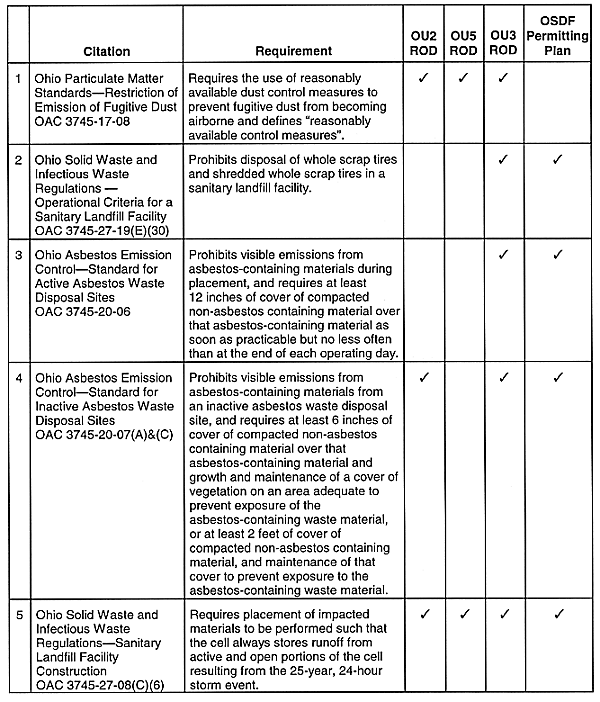
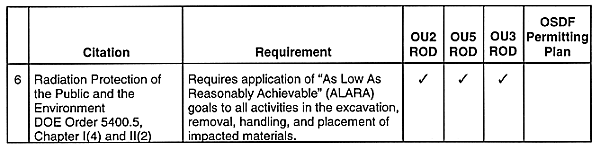
ARARs and TBCs addressed by the IMPP provided here, as obtained from the Final Record of Decision for Remedial Actions at Operable Unit 2 (OU2 ROD) [DOE, 1995a], the Final Record of Decision for Remedial Actions at Operable Unit5 (OU5 ROD) [DOE, 1996a], the Operable Unit 3 Record of Decision for Final Remedial Action (OU3 ROD) [DOE, 1996b], or the Permitting Plan and Substantive Requirements for the On-site Disposal Facility (OSDF Permitting Plan) [DOE, 1996c], as identified in Table I.
TABLE I Applicable or Relevant and Appropriate
Requirements
With the regulatory basis (ARARs, WAC, and TBCs) established, a WAC for the site can be developed. The WAC should contain all pertinent information for the placement of impacted material into the OSDF. The WAC has two major areas of focus. The first area has a protection focus. The radiological and chemical parameters are determined during the comprehensive risk assessment stage of the Remedial Investigation/Feasibility Study (RI/FS) process. The amount and concentration of the contaminants of concern are identified and evaluated during this stage. The range of acceptable disposal WACS are developed on a case by case basis to ensure the remedy is protective of human health and the environment. The second major focus area of the WAC is the physical criteria. The physical criteria should list the type of material, sizes, special handling procedures, and moisture requirements. These physical criteria are needed to produce a stable material mass.
At Fernald, the impacted material was classified into five different categories. These categories were developed to assist all parties in understanding how the OSDF would be constructed. Material placement, physical characteristics, and compatibility are important considerations for stability of the OSDF. The five categories of material are:
Category 1 - Impacted materials that are soils and soil-like and that do not contain hard agglomerations greater than 12 inches (1.0 feet) in a greatest dimension. If the material is other than till or ash from the FEMP site, the material in this category must also have the vast majority of its particles finer than a 1 inch (25 millimeters) particle size. If these later criteria are not met, the material should be classified as a Category 2 material. These impacted materials are expected to be readily compactible using standard construction equipment.
Category 2 - Impacted materials that can be transported, placed, spread, and compacted anytime. These impacted materials can be spread in loose lifts of 18 to 21 inches (1.5 to 1.8 feet) thick and are expected to be moderately compactible under the action of equipment similar to the Caterpillar D-8 dozer or 815C compactor. Examples of these materials include broken-up concrete foundations or impacted soil mixed with broken-up concrete.
Category 3 - Impacted materials that must be individually handled and placed in the OSDF, and which are suitable for having Category 1 material placed around and against them. These impacted materials have a nominal height of no more than 4 feet, are regularly (e.g., rectangularly) shaped allowing impacted Category 1 materials to be compacted around and against them, and are essentially incompactible using standard compaction equipment.
Category 4 - Impacted materials that are high in organic content and very compressible. Examples of these materials are municipal-type solid wastes from the Solid Waste Landfill, and "green" waste from clearing, stripping and grubbing operations around the FEMP.
Category 5 - Impacted materials that require special handling due to their special nature. Examples of these materials include double-bagged asbestos and sludges.
Besides the radiological, chemical, and physical WACs, a section of the IMPP should identify items to be excluded from placement in the OSDF. Several states have statutory prohibitions. Incorporating these prohibitions early in the development of the IMPP is necessary. By developing this exclusive section, a clear understanding by all parties is achieved.
SITE WIDE INTEGRATION
At the Fernald site, several operable units may use the OSDF as the final repository for their impacted material. Each operable-unit's ROD identifies the conditions necessary to place material into the OSDF. As can be expected, the wording of each individual ROD is different. This wording difference often creates confusion among the various site generators. In order to provide consistent interpretation of the various WACs, a single point of contact was established as a clearinghouse for all disposal questions.
This single point of contact is responsible for providing guidance and interpretation for each operable unit, in conformance with the RODs. Interpretations have been necessary for the established chemical, radiological and physical WACs. The RODs established what type of material and at what concentration these materials may be disposed; however, there was not any guidance on how to achieve the WAC. By placing an individual in charge of these interpretations, the generators can receive timely responses and clarifications to their questions.
Once there is a common understanding of the WACs, the site needs to establish how the WAC will be verified. Two competing methodologies are common practice at disposal facilities. One method requires operators of the OSDF to be responsible for verifying that the impacted material meet the WAC. This method provides a certain level of independent checks and balances. However, it also implies that the OSDF operators are able to provide testing facilities and analytical methods to verify compliance with the specified WACs. The other method is that the generators verify that the impacted materials meet the WAC. With this method, the people most familiar with the waste forms negotiate the verification protocols. At Fernald, we have adopted the second method for verification. This method was chosen for two main reasons. First, each operable unit has already established a level of understanding with the public and regulators. They understand the underlying issues and concerns for their operable unit. As such, they are best able to develop a verification plan acceptable to all parties. Second, the resources necessary to write the necessary implementation plans are already assigned to the respective operable units. This method of verification establishes an independent check of the impacted material placed in the disposal facility. To close the loop, each generator will develop an implementation plan to meet its WAC. With an approved implementation plan, the OSDF project Total Quality Management team will periodically audit each generator for compliance with its approved plan.
CONCLUSION
As discussed above, the DOE needs safe economical methods to remediate its sites. One option is the construction of an on-site disposal facility. In addition to the necessary construction documents, e.g., design drawings, technical specifications, and subcontract documents, several support plans should be considered to ease regulatory review and approval. Careful consideration should be given to an impacted material placement plan. This plan should contain pertinent information on the material types, regulatory requirements, waste acceptance criteria and an explicit verification strategy. This plan should be developed for presentation to all stakeholders before the decisions are made. By developing this common vision, the on-site disposal facility will be successfully developed.
*Fluor Daniel Fernald, Inc. with the U. S. Department of Energy under Contract No. DE-AC24-92OR21972
Copyright Statement: By acceptance of this report, the publisher and/or recipient acknowledges the U. S. Government right to retain a nonexclusive, royalty-fee license to any copyright covering this technical information.
Legal Disclaimer: This technical information was prepared as an account of work sponsored by an agency of the United States Government. Reference herein to any specific commercial product, process, or service by trade name, trademark, manufacturer, or otherwise, does not constitute or imply its endorsement, recommendation, or favoring by the United States Government or any agency thereof. The views and opinions of authors expressed herein do not necessarily state or reflect those of the United States Government or any agency thereof, or Fluor Daniel Fernald, its affiliates, or its parent companies