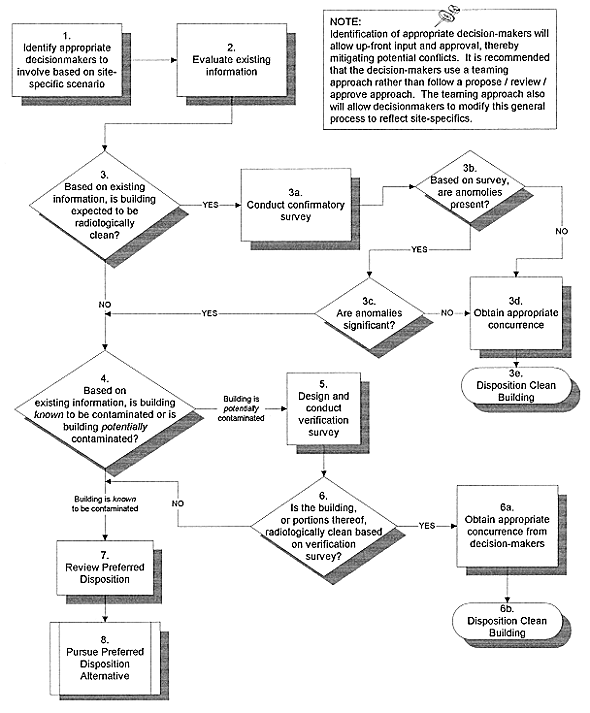
Fig. 1. Summary process for the
disposition of buildings that have potential or actual radiological
contamination.
Alan Spesard
USDOE
Geneva Jensen and Laura Crane
Project Performance
Corporation
ABSTRACT
The Cleanup Standards Committee, which consists of participants from the Department of Energy (DOE-Mound and DOE-Fernald), Wright Patterson Air Force Base, the Ohio Environmental Protection Agency (OEPA), the United States Environmental Protection Agency (USEPA), and the Ohio Department of Healths Bureau of Radiological Protection, has been working to develop a process for the disposition of buildings which have actual or potential radiological contamination. The purpose of developing this process is to provide a consistent approach in Ohio, that meets all Federal and State requirements, for the unconditional release of buildings for public occupancy, as well as to facilitate all end-disposition decisions for buildings that may or do contain radiological contamination. The Federal Facility Forum committee decided to develop the process for two reasons: 1) an increasing number of buildings on federal properties require disposition, due to changing missions, and 2) current federal initiatives encourage the transfer of buildings and land for reuse and economic redevelopment.
The objective of the Federal Facility Forum committee was to develop a process that establishes when a building is radiologically clean, determines disposition alternatives when a buildings is known to have radiological contamination, and addresses determination of disposition for potentially contaminated buildings. This paper describes four key elements of the disposition process: 1) the approach for development of the process, 2) a summary of how the process works, 3) a description of how the process can facilitate all end-use disposition decisions, and 4) the flexibility of the process that allows for modification to address site-specific issues.
The process provides numerous benefits to federal facilities that are dispositioning buildings which have actual or potential radiological contamination. The process draws off of the broad range of experience and expertise of committee members and offers an approach to address identified regulatory concerns. In addition to allowing radiologically clean buildings to be transferred to the public for reuse, unconditional release may decrease disposal costs and conserve low-level waste disposal capacity by potentially allowing radiologically clean material to be disposed of in a landfill.
APPROACH FOR DEVELOPMENT OF THE PROCESS
In 1995, the Ohio Federal Facilities Forum was formed to provide an arena for understanding and addressing environmental clean-up and waste management issues and challenges that face Federal Facilities in State of Ohio. Participants include representatives from the Department of Energy (DOE), the Department of Defense (DoD), Ohio Environmental Protection Agency (OEPA), Ohio Department of Health (ODH), United States Environmental Protection Agency (USEPA), and the National Aeronautics and Space Administration (NASA). Within this forum, a number of committees were formed to focus on specific issues identified by members of the Federal Facilities Forum. One of the committees to result from the Federal Facilities Forum is the Cleanup Standards Committee, which has focused on addressing issues related to cleanup standards, cleanup objectives, and procedures.
Many Federal Facilities in Ohio are changing their mission from a role of production to one of cleanup for reuse or transition. Due to this change in responsibility, the issue of how to disposition buildings that are actually or potentially contaminated is increasing in importance. In an attempt to address this issue, the Cleanup Standards Committee decided to develop a process to: 1) determine when a building is radiologically or chemically clean, and 2) establish disposition alternatives for those buildings which have been established as clean and or not clean. The committee developed this process using a teaming effort, in order to draw from a diverse range of experience. The process is based on the experience, expertise, and opinions of the members of the Cleanup Standards Committee; and those individuals who participated in reviewing and commenting on the process. The first phase of this effort has been to address those buildings which may have radiological contamination. The committee intends to address buildings that may have chemical contamination separately, in the second phase of this effort.
Purpose and Intent of Process
The "Process for Disposition of Buildings That May Have Radiological Contamination" is intended to be used by Federal Facilities responsible for the cleanup of facilities or sites that have significant radiological process history and extensive known radiological contamination. The purpose of the process is to provide a framework for evaluating buildings that have actual or potential radiological contamination, and lay out a logical process for making decisions regarding building disposition. The process is intended to be generic; it is anticipated that modifications will be necessary to address or incorporate site specifics (1).
Intended Audience
The intended audience of this process is the group of decision-makers at a Federal Facility (usually individuals representing specific agencies) that must reach consensus that building conditions are appropriate for a given end use. Specifically, these decision-makers must achieve consensus on the criteria and data necessary to support a range of disposition alternatives for buildings at their site. The process may also be useful to the technical personnel collecting the data for the decision-makers because it conveys the logic underlying how decisions are made and what data is needed to support those decisions. The technical personnel may be able to more effectively support the needs of the decision-makers by understanding the criteria and thought process of the decision-makers, and therefore designing the data collection effort in accordance with the appropriate scope of the project.
Benefits of the Process
To assist the decision-makers, this process:
SUMMARY OF THE PROCESS FOR THE DISPOSITION OF BUILDINGS WITH ACTUAL OR POTENTIAL RADIOLOGICAL CONTAMINATION
This process is based on using existing information to form expectations about the extent of radiological contamination in a building. Depending on the initial expectations for building contamination, this process supports five disposition alternatives: 1) Unconditional release of an intact building (i.e., defined as radiologically clean) for public use in which the federal facility will transfer control and relinquish landlord / ownership or the federal facility will unconditionally reuse the building; 2) Decontamination (where necessary) and demolition of a building for disposal (i.e., as non-radioactive waste) or recycling of building material; 3) Demolition, without decontamination, for disposal in a permitted radioactive waste disposal facility; 4) Conditional release (e.g., the includes the lease to the public or reuse of a building by the federal facility in which the federal facility maintains control, or recycling of building material, following demolition, to a permitted recycler); and 5) Long-term surveillance and maintenance.
A summary level process flow diagram is included as Fig. 1.
Fig. 1. Summary process for the
disposition of buildings that have potential or actual radiological
contamination.
Identify Appropriate Decision-makers
The initial step in this process is to identify the appropriate decision-makers at a site. Appropriate agencies to involve include those who must reach consensus on release criteria for buildings and who must determine if the building meets those release criteria. These decision-makers may vary depending on the regulatory framework of the site (e.g., NPL site, NRC regulated site).
This process also advocates use of a teaming approach to make all decisions regarding unconditional and conditional release. A teaming approach allows the decision-makers at a site to approve each step of the process. This approach also ensures regulatory agency input, provides a forum for addressing issues and mitigates potential "show-stopper" conflicts. This type of approach has been proven to facilitate communication and better address potential issues that a traditional review / comment / approve approach. In addition, through a teaming approach, the decision-makers may choose to modify this process as appropriate to address specifics at a particular site.
Evaluation of Existing Information
Once all appropriate decision-makers are involved, this process allows decision-makers at a site to make assumptions about a building by utilizing existing information to the greatest degree possible. One of the benefits is that the team of decision-makers can form expectations about the degree of contamination in a building which will provide a foundation for determining the approach forward and for managing uncertainties associated with any preferred disposition (i.e., unconditional release).
An evaluation of existing information (e.g., inspection records, material acquisition and disposal records, site maps and facility drawings), including process history knowledge and any available sampling data, allows decision-makers to categorize a building in one of the following categories:
Based on how the building is categorized, the process then identifies the level of survey required for further evaluation. In addition to using existing information to make an assumption of the conditions of the building, this process also recommends the team of decision-makers identify the preferred disposition of the building, if one exists. If a preferred disposition does not exist, the decision-makers can still use existing information to define the boundaries of what alternatives are plausible. This initial consideration of potential or preferred disposition alternatives is key to focusing future data collection efforts. By making this determination early in the process, future data collection efforts can be focused to address only those questions associated with the potential or preferred disposition alternative(s).
Appropriate Level of Survey and Data Requirements
Based on the initial assumption of the building conditions (i.e., known or potentially contaminated, radiologically clean), the process outlines the appropriate level of survey to be performed for each category of building for unconditional release, and the rationale for each survey. This process also provides recommendations for implementation, types of equipment and survey technique guidance. These recommendations are intended to provide input based on the committees experience and professional expertise, and are not intended as requirements or to limit the flexibility of tailoring the process to meet site specific needs.
Before conducting each survey, the decision-makers of the site should reach consensus on what data is needed to support disposition of the building and communicate those data needs and expectations to the technical personnel collecting the data. This process also recommends that each survey should be performed, taking into consideration, to the extent possible, the likely or preferred disposition of the building and data needed to implement the preferred disposition. Described below is the appropriate survey needed based on the initial categorization of a building (i.e., known or potentially contaminated, radiologically clean). These surveys are based on the assumption that the preferred disposition for a building that is expected to be radiologically clean, or potentially clean, will be unconditional release.
For Buildings That Are Expected To Be Radiologically Clean
Prior to unconditional release of buildings that are expected to be radiologically clean, a confirmatory survey is required. A confirmatory survey is necessary prior to release for two reasons: 1) it is preferred by state regulators to have this level of data to support that the building is clean in addition to information that no radiological process activities occurred in the building, and 2) it is possible that contaminant tracking at facilities / sites with extensive radiological process history may have caused unexpected contamination in buildings.
A confirmatory survey is a non-destructive survey which serves as a final check that a building does not have unexpected radiological contamination prior to disposition. To serve that purpose, the survey should be very focused on only those areas which are most likely to contain unexpected contamination, based on the activities and potential pathways for contamination at a site. Generally, the most common unexpected radiological contamination is transported via an air or fugitive dust pathway. Consequently, this process recommends conducting a confirmatory survey on the floor of the buildings, and in the floor drains and air vents. This process recommends that a confirmatory survey consist of floor and wall scans/ wipes and general area dose rates.
If a confirmatory survey identifies anomalies (i.e., elevated readings), this may indicate unexpected contamination. This process allows the decision-makers to evaluate and determine if the anomalies are significant. Anomalies are significant if readings exceed established radiological criteria (e.g., established in Regulatory Guide 1.86 or DOE Order 5400.5) or the team of decision-makers determine that the anomalies constitute a problem because they pose an unacceptable risk to human health and the environment. If the building is not radiologically clean, the data from the confirmatory survey will be used to fill existing data gaps (e.g., health and safety requirements, extent of contamination) and to focus any subsequent surveys, if needed. When the decision-makers determine that anomalies are significant, the building is re-classified as potentially contaminated and continues through the process for further evaluation.
If no anomalies are detected, or anomalies are determined to be insignificant, the building is radiologically clean. Once it is determined that the building is radiologically clean, this process provides a step for obtaining appropriate concurrence for unconditional release of the building (e.g., unconditional public use, unconditional reuse of the building by the federal facility, disposal as non-radioactive waste). If the appropriate agencies have used a teaming approach throughout the release process, this step will require minimal effort. The process also provides an unconditional release matrix which identifies applicable agencies to involve / consider in dispositioning the building.
For Buildings That Are Potentially Contaminated
For buildings that are potentially contaminated (i.e., possibly contains radioactive constituents above background and above existing radiological criteria), a verification survey is required prior to unconditional release. This survey is performed to identify if contamination exists and the location and extent of contamination. A verification survey is more intense than a confirmatory survey in that a more extensive area of the building is surveyed and more time is spent per area surveyed. This process recommends that a verification survey include: 1) floor, overhead, and wall surveys, 2) general area and contact readings, and 3) smears. A verification survey may also include destructive testing.
If a verification survey does not identify radiological contamination (i.e., the building is radiologically clean), the data from a verification survey can support unconditional release of the building, since a verification survey is more intense than the confirmatory survey. Again, the process identifies a step to obtain appropriate concurrence from the decision-makers before unconditional release of the building.
If a verification survey does identify radiological contamination above established surface and dose criteria (e.g., established in Regulatory Guide 1.86 or DOE Order 5400.5), the building is now known to be radiologically contaminated and continues through the process (e.g., may require a characterization survey).
For Buildings That Are Known To Be Contaminated
For buildings that are known to be radiologically contaminated, the preferred disposition should be determined prior to conducting a survey to focus data collection. However, in order to unconditionally release a building that has known radiological contamination, a characterization survey is necessary. This type of survey is the most intensive survey described in this process. It may include destructive testing to determine the specific radionuclides present in the building, the concentration of these radionuclides (e.g., measured in pCi/g), and depth of contamination (e.g., core samples). A characterization survey will address data needs such as identify / characterize anomalies (i.e., location, nature, and extent of decontamination required),health and safety requirements, and compare against surface and dose criteria. The design of the characterization survey will vary depending on the extent of existing information and the preferred disposition alternative. For example, if a verification survey has already been conducted on the building, specific areas of concern have been identified, and the design of the characterization survey should focus on those areas. If a building is known to have radiological contamination, based on process history, the characterization survey will need to determine location and extent of contamination. Considerations in designing the characterization survey include: 1) Determine if the data needs can be answered based on existing information; 2) Determine what data needs can be managed with collecting additional data; 3) Develop a contingency plan to manage the possibility of encountering unexpected conditions; and 4) If existing data are sufficient to satisfy data needs and to design the decontamination plan, proceed forward with design of the preferred disposition.
Review of the Preferred Disposition
Only those buildings with known radiological contamination are evaluated through the rest of the process. At this point in the process, the decision-makers should review the preferred disposition alternative. It is possible that the preferred disposition is very costly (e.g., those dispositions requiring extensive decontamination and verification). Based on known extent and level of contamination (from existing information and any surveys), it may be appropriate to conduct an order of magnitude cost / benefit analysis to determine the economics of (1) decontamination vs. no reduction of contamination; and (2) leaving the building intact vs. demolition.
If an order of magnitude cost analysis is conducted, consider the following costs associated with the appropriate disposition alternatives:
Precedence has shown that it is not economically beneficial to decontaminate buildings with extensive contamination because of high decontamination and verification costs. Buildings with localized contamination are the likely candidates for decontamination and unconditional release because the decontamination and verification costs are less then the costs associated with disposal as low-level waste.
Once the range of preferred dispositions is reviewed, this process provides a decision-point for proceeding forward with the preferred disposition. The appropriate steps for design and implementation for each preferred disposition alternative are detailed out by the process.
Identifying Uncertainties and Developing a Risk Management Approach
Throughout disposition of a building, this process advocates identifying uncertainties and developing a risk management approach. This will allow a project to proceed with uncertainties and defines which uncertainties must be reduced (i.e., identification of a data need to support decision-making). This process describes how to use uncertainty analysis as a working tool for identifying and planning for uncertainties during design and implementation of the preferred disposition alternative. An uncertainty analysis table is included (See Table I. Example Uncertainty Analysis to Define Contingency Plan) to provide a framework for identifying conditions expected to be encountered during design and implementation of a preferred disposition and the associated uncertainties. This framework links these uncertainties to a corresponding contingency plan.
TALBE I Example Uncertainty Analysis to Define Contingency Plan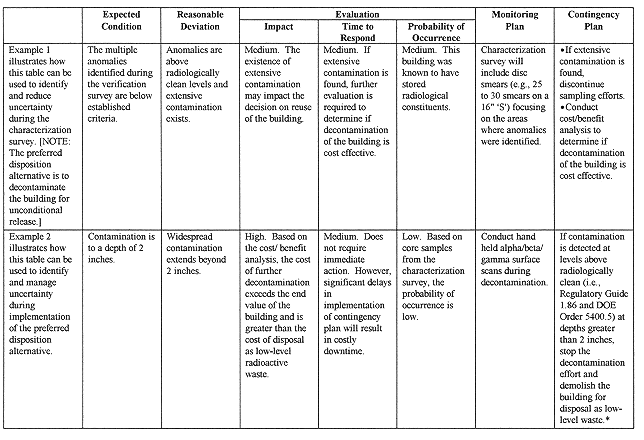
Uncertainty analysis requires four steps as described below:
- Impact: Evaluates how the deviation impacts the cost, schedule, and technical operations of the project. This evaluation can be qualitative (i.e., high, medium, low) and/or quantitative.
- Time to respond: This is an estimate of the likely time (qualitative or quantitative) between discovery of the deviation and the impact to the project.
- Probability of occurrence: This is an evaluation of how likely a deviation will occur.
CONCLUSION
The "Process for the Disposition of Buildings That May Have Radiological Contamination" is a generic process that provides a framework for evaluating buildings that have actual or potential radiological contamination, and lays out a logical process for making decisions regarding building disposition. It based on the experience and expertise of those individuals who developed it, and incorporates their recommendations. One of the great strengths of the process, however, is its flexibility. By implementing this process using a teaming approach, site specific concerns and requirements can be addressed. It is only by using this type of teaming approach that the maximum benefit from this process will be realized.